Service Robots for Residential & Apartment Complexes, Package Delivery, Cleaning, and Security Automation for Multi-Tenant Buildings
At a glance: AOMAN D1 delivers packages to the door with a 40 kg payload on four trays, AOMAN C1 cleans 2,040 m²/h in common areas, and AOMAN G1 screens overnight visitors at 5 m pickup. This guide maps package logistics, cleaning and 24/7 lobby coverage for a 350-unit building.
Illustrative example: the general manager of a 350-unit luxury apartment tower manages a $14.2 million annual operating budget, and three line items consistently overrun their allocations. Package management labor: the result of package volume growing year over year while staffing stayed flat. Common-area cleaning: daily maintenance of 52,000 sq ft across 28 floors of hallways, two lobbies, a gym, a resident lounge, and a rooftop terrace. And overnight lobby staffing: a concierge and security presence between 11 PM and 7 AM, a role with very high annual turnover because sitting in an empty lobby at 3 AM is not a career-advancing position.
These three line items share a structural problem: they are variable labor costs applied to problems that are continuous and predictable. Packages arrive every day, corridors need cleaning every day, and the lobby needs staffing every night. Volume scales with occupancy, but labor costs scale in step-function increments. A building hires one full-time person or it does not. The gap between those two scaling curves is where service robots create operating leverage.
The Package Problem: The Mailroom That Cannot Scale
In 2026, package volume per apartment continues to climb, roughly double its pre-2019 level across the industry, and a 350-unit building processes on the order of 600 packages weekly, or about 90 packages per day. The workflow: carriers deliver to the mailroom or package lockers across a ten-hour window; staff sort packages by recipient, log them into the building's tracking system, and notify residents; residents retrieve packages during office hours; and the remainder require follow-up and mailroom storage. Oversized packages that do not fit lockers require manual handling and dedicated storage.
The labor cost for a 350-unit building runs to tens of thousands annually at loaded labor cost, and locker systems that fit the volume cost a small fortune to install, while not solving the oversized-package problem or the resident-retrieval friction.
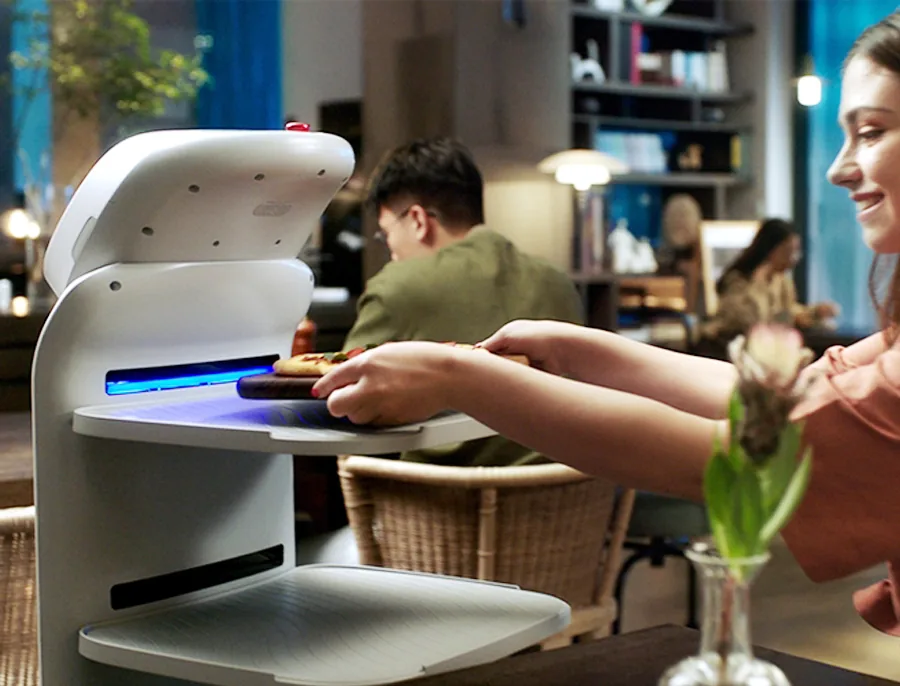
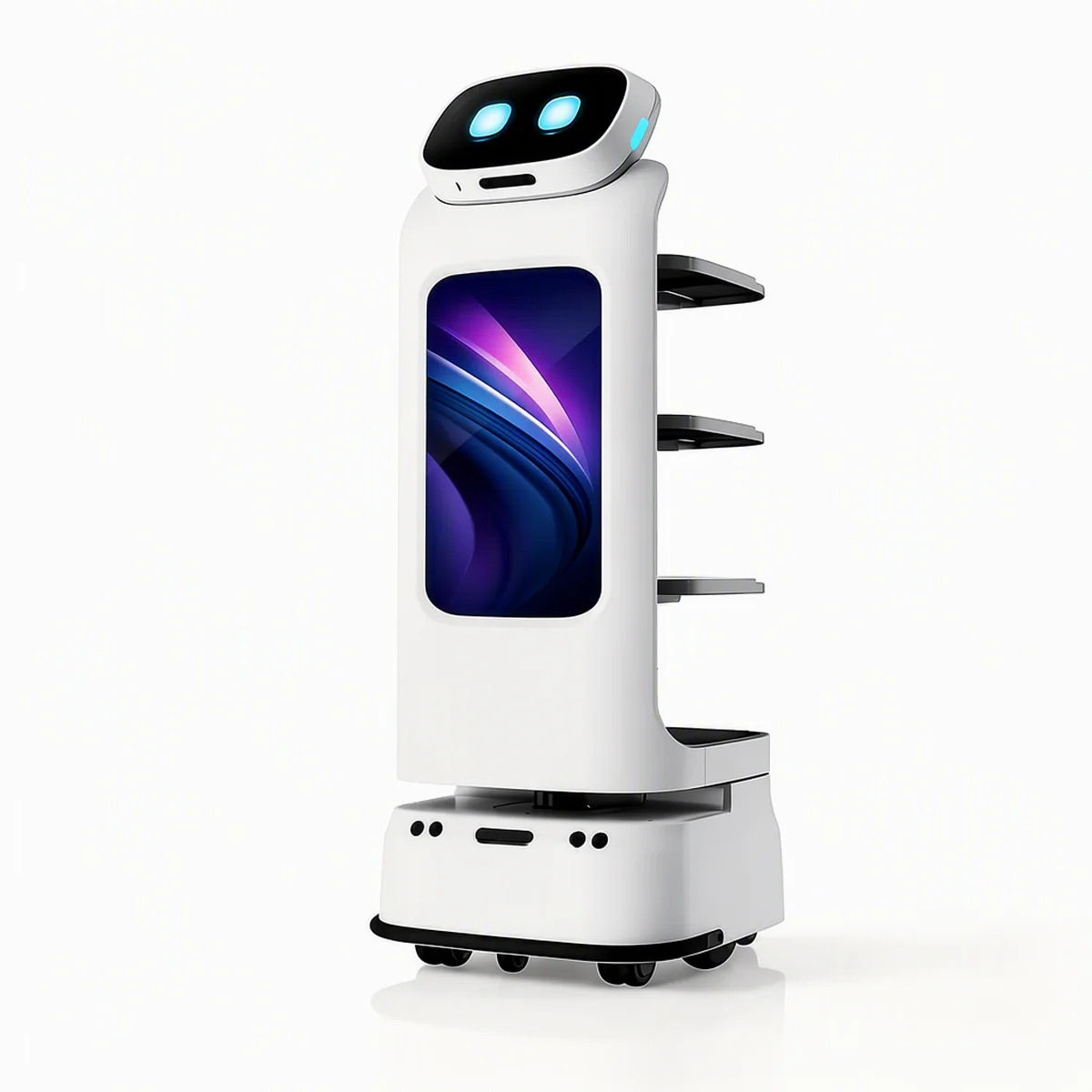
AOMAN D1 in a mailroom-to-door delivery model changes the workflow. Packages are loaded onto the unit in the mailroom, sorted by floor and delivery route; the unit navigates autonomously to each recipient's door, 40 kg payload across four trays, with a 70 cm aisle requirement that clears residential corridors, and the resident is notified via the building app that the delivery is en route. The unit waits briefly at the door before returning undelivered items to the mailroom. In the illustrative configuration, a single unit handles 15–20 packages per hour, so two units clear a day's backlog in about two and a half hours of coordinated operation.
This is not a labor-elimination play; it is a service-quality play. The resident who arrives home at 8 PM and finds the package at the door, rather than waiting until the next office opening, reports higher satisfaction, renews at higher rates, and generates fewer front-desk complaints. The delivery robot selection guide provides the technical evaluation framework; the strategic question for property managers is whether package-delivery friction is costing them renewals.
Common-Area Cleaning: 52,000 Sq Ft That Never Stays Clean
Residential common areas present a cleaning challenge distinct from commercial office or hotel environments: the traffic is continuous and unpredictable. A hotel corridor has predictable peaks. An office corridor is quiet after 6 PM. A residential corridor has traffic at all hours, the night-shift nurse leaving at 5 AM, the early-morning runner returning at 7 AM, the dog owner taking the elevator to the pet-relief area at 2 AM, the student returning from a late-night session at midnight.
This continuous pattern means that once-daily cleaning, the model for hotel and office corridors, is insufficient for residential. A hallway cleaned at 10 AM looks visibly trafficked by 6 PM when residents return from work. The operational response in most buildings is to clean common areas twice daily, which roughly doubles the labor cost without fully solving the perception problem.
AOMAN C1 units on a three-hour continuous cycle during waking hours maintain common-area surfaces at a consistent level throughout the day. At 2,040 m² per hour with a 790 mm squeegee and 70 L plus 50 L water tanks, two units cover the typical common-area footprint of a 350-unit mid-rise. The cleaning staff is not eliminated; their role shifts from routine corridor maintenance to specialized tasks, gym equipment deep-cleaning, upholstery extraction, window washing, that the robots do not perform. This is the same role-redefinition model proven in hotel housekeeping deployments and office building maintenance, where units absorb high-volume, low-complexity surface cleaning and human staff focus on high-value deep-cleaning work.
The financial model in the illustrative profile: cleaning labor of $132,000 annually for common areas reduces against staff plus the annualized cost of two units under RaaS, saving a meaningful amount while improving consistency. And the consistency is what shows up in resident satisfaction surveys, online reviews, and the subtle effect of "the building always looks clean" on lease-renewal decisions. For smaller common-area footprints, AOMAN C2 Pro with its quiet drive and 85 cm passage clearance fits boutique lobbies and amenity rooms.
After-Hours Lobby Coverage: The Midnight-to-Dawn Staffing Problem
Every Class A residential building provides 24/7 lobby coverage, a concierge, security guard, or combined role, because residents expect someone to be present for package acceptance, visitor screening, and emergency response at any hour. The overnight shift is universally the hardest to staff: turnover is high, shift differentials add 15–25% to base pay, and the role's primary function, being present, does not attract career-minded candidates.
AOMAN G1 in the lobby during overnight hours covers the routine layer. G1 greets arriving guests and initiates the visitor-management flow, the guest calls a resident through the building's system from the unit, and the resident grants or denies access from their phone, with G1's six-microphone array carrying the exchange clearly from up to 5 m. After-hours deliveries are logged with timestamp on the chest information screen. Emergency conditions, fire alarm activation, water leak detection, trigger immediate notification to the building's on-call manager via pre-configured protocols. The unit recharges at its dock between interactions, and its near-silent drive keeps it unobtrusive in a sleeping building.
The unit does not replace the overnight concierge entirely; it absorbs the share of overnight interactions that are routine, visitor screening, package logging, amenity-hour questions, and escalates what requires human judgment to the on-call manager. In the illustrative model, the overnight staffing structure shifts from "one full-time concierge on site" to "remote on-call manager supported by the lobby unit," cutting the line item dramatically. The pattern mirrors the corporate lobby reception deployment, where humans handle exceptions while robots manage routine visitor traffic.
Security and Incident Documentation
Residential buildings are liability magnets: slip-and-fall claims in common areas, package theft allegations, noise complaints, unauthorized access incidents. Each incident requires documentation, timestamped footage, access-control logs, witness statements, and the quality of that documentation determines the outcome of insurance claims and disputes.
Units continuously traversing common areas on cleaning or delivery routes generate timestamped location data and camera footage that serve as passive incident documentation. When a resident claims a slip on a wet lobby floor at 11:15 PM, the cleaning unit's log shows the lobby was cleaned at 10:48 PM and the floor state at its next pass. When a resident alleges a package was stolen, the delivery unit's timestamped delivery confirmation provides evidence of the handoff. This passive documentation function mirrors the security surveillance model, where operational robots double as environmental data sources.
Resident Acceptance: The Social Dynamics of Robots in Living Spaces
Resident acceptance follows a consistent pattern across deployments: initial skepticism on announcement, neutral observation during the first weeks, and approval after sustained exposure, with the strongest approval among younger residents and the most cautious view among older ones. The conversion pattern, from skepticism to neutrality to acceptance, tracks the change management dynamics observed in workplace robot introductions.
The key variable is not the robot's appearance or function; it is the building management's communication strategy. Buildings that announce robots as a new amenity with advance notice, a lobby demonstration, and service details in the resident app achieve majority approval at 90 days. Buildings that deploy without resident communication achieve far less. Positive communications, demo days, and clear messaging ("this robot delivers your packages, screens visitors, and cleans the corridors") convert skepticism into default acceptance. The robot is not the variable; the introduction is.
ROI for a 350-Unit Building: The Multi-Robot Model
A four-unit deployment, two D1 for package delivery, one C1 for common-area cleaning, one G1 for overnight lobby coverage, in a 350-unit building produces the following illustrative economics:
| Line Item | Illustrative Pre-Robot Annual Cost | Illustrative Post-Robot Annual Cost | Annual Impact |
|---|---|---|---|
| Package management labor | $71,000 | $36,000 (0.5 FTE oversight) | −$35,000 |
| Common-area cleaning | $132,000 | $104,000 (1.5 FTE + 2 units) | −$28,000 |
| Overnight lobby staffing | $72,000 | $32,000 (on-call + 1 unit) | −$40,000 |
| Total | $275,000 | $172,000 | −$103,000 |
All values are illustrative planning figures. Total annual robotics cost under a multi-year RaaS program is approximately $68,000 for the four units, with the line-item savings absorbing it and the resident-experience effect as the lever that matters for renewal economics. The ROI methodology and the budget planning framework provide the full cost-modeling detail; the vendor evaluation framework covers supplier assessment; and the 60–90 day pilot program guide sets the staging sequence.
Tell us your unit count, common-area footprint, and resident-app stack. We will help you scope the package-delivery pilot and the lobby coverage model. Contact us.