Service Robot ROI: A Procurement Manager's Guide to Automation Investment in 2026
At a glance: A 40 kg single run on an AOMAN D1 replaces a heavy-dash trip per tray for a hotel floor, yet the purchase math is only half the answer: plan for a 36-month cost model or an 18-month one, and the two differ by roughly 40%. This guide builds the ROI model procurement teams use, cost inventory, utilization targets and the hidden value factors.
A service robot is a capital line of roughly $12,000–$30,000; a fully loaded front-line employee costs $28,000–$52,000 per year in developed markets. On paper, the math looks simple: the robot pays for itself in 12–18 months. In practice, the outcome depends on utilization, task mix, and whether you are measuring the right things. Most ROI failures are measurement failures, not robot failures. This guide builds the model procurement managers actually defend: full cost inventory first, then salvage value, then the hidden factors.
The Real Cost of a Service Robot
The sticker price is the starting point, not the total. A complete cost model has an acquisition layer and a recurring layer.
Acquisition (Year 0)
| Cost Item | Range | Notes |
|---|---|---|
| Robot unit | $12,000–$30,000 | Varies by type and payload capacity; an AOMAN D1 carries 40 kg per run |
| Deployment and mapping | $2,000–$5,000 | Site survey, floor mapping, elevator integration |
| Staff training | $800–$2,000 | Typically 1–2 days on-site |
| Total Year 0 | $15,000–$37,000 | One-time |
Recurring (Years 1–5)
| Cost Item | Annual Range | Notes |
|---|---|---|
| Maintenance contract | $1,200–$3,600 | Typically 8–12% of unit cost |
| Battery replacement | $400–$800 | Every 2–3 years depending on cycles; UN38.3-rated packs |
| Software updates | $0–$1,200 | Included by most vendors or billed with the fleet platform |
| Insurance | $200–$500 | Liability coverage |
| Electricity | $100–$300 | Under $1/day for charging |
| Total Annual Recurring | $1,900–$6,400 |
Five-Year TCO Comparison
Illustrative example: a delivery robot with a $22,000 acquisition cost and $3,000/year in recurring expenses has a five-year TCO of approximately $37,000 . Roughly $7,400/year. A full-time delivery staff member at $32,000/year loaded costs $160,000 over the same period. Even under an illustrative assumption that the robot absorbs only 60–70% of the workload, the labor savings dwarf the machine cost. Which is why ROI analysis usually moves on to the harder question: how much of that workload can the robot actually absorb at your site?
Labor Savings: The Primary ROI Driver
Delivery Robots
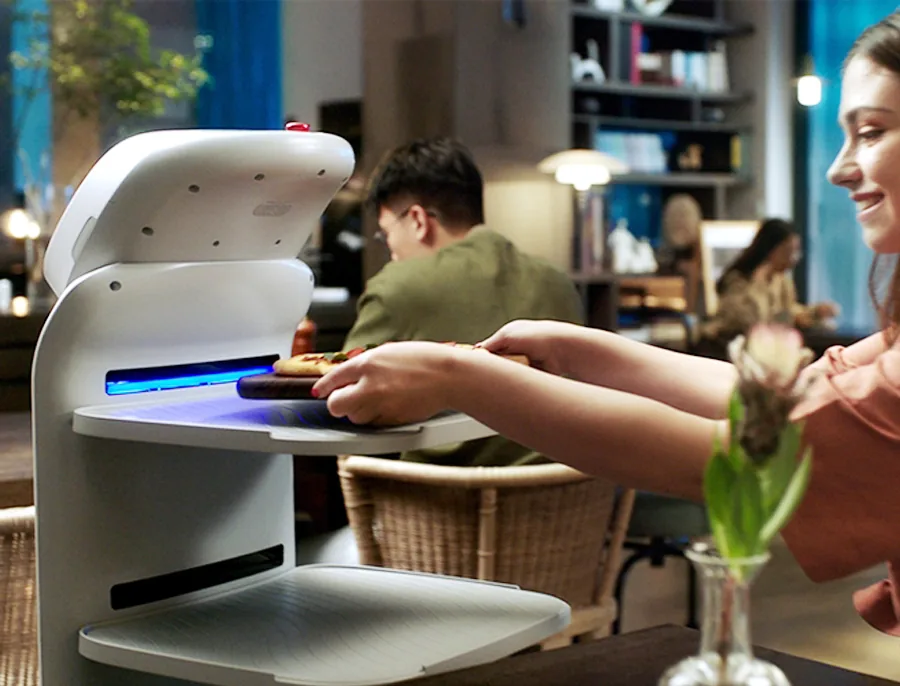
The AOMAN D1 handles room-service delivery, linen and materials transport in hospitality and healthcare settings. Its payload is the practical lever: 40 kg across four trays means one run covers what previously took several trips. For a 20-room-side of a floor, the robot’s effective trip rate is a fraction of manual walks, and it works through evening and overnight shifts without premiums.
- Multi-tray capacity: four trays and 40 kg per run; one run serves several rooms or tables at once
- Off-hours coverage: overnight shifts without overtime staff, the highest-cost hours of the day
- Consistent route discipline: the robot navigates the mapped route every time; the 21.5-inch display carries guest-facing content between runs
Illustrative payback: a single-shift deployment returns its cost in roughly 12–18 months modeled at typical occupancy; a two-shift deployment sharpens that to roughly 6–9 months, because the hardware cost is fixed while the labor offset doubles. In a publicly documented deployment, a ramen chain in Kyushu, Japan runs D1 units through seating corridors to the point that the delivery loop is a background function, the ROI case there is pacing, not replacement.
Cleaning Robots
The AOMAN C1 covers up to 2,040 m²/h of open floor with a 790 mm squeegee and 70 L + 50 L twin tanks; the AOMAN C2 Pro is sized for segmented layouts, 70 cm desk clearance, 85 cm aisles, quiet operation, modular tanks, so it can run during business hours in offices and clinics.
- Staff reallocation: cleaning robots do not eliminate cleaning staff; they shift staff from open-area floor maintenance to high-touch surfaces and detail work, where judgment still matters
- Consistency and evidence: every pass is logged with time and path, so hygiene coverage can be audited rather than estimated
- Overnight operation: night-time cleaning in empty corridors removes the wage premiums attached to overnight janitorial shifts
Illustrative payback: 14–22 months for a day-shift-only configuration, faster in 24/7 facilities where the robot runs two or three cycles a day.
Front-of-House Guidance
The AOMAN G1 handles the repeated directional and welcome questions at entrances, lobbies and exhibition halls, 15 degrees of freedom in the upper body, six microphones with five-meter pickup, a 13 MP camera for visitor recognition, multi-language guidance and check-in assistance, and automatic recharging between shifts.
- Deflection volume: one G1 absorbs the constant stream of “where is X” questions, freeing desk staff for complex requests and problem resolution
- Multi-language service: guidance in multiple languages at no incremental staffing cost, a concrete advantage for international visitors
- No waiting-line pressure: the robot handles front-of-line triage while the podium queue stays short
In a publicly documented deployment, a Belgian retail chain runs an AOMAN G1 to greet and guide shoppers, and an art museum in Osaka, Japan uses one to orient visitors in multilingual sessions. Payback for guidance robots is longer, 18–30 months in the illustrative model, because the return includes brand value and queue relief that pure labor math understates.
The Hidden ROI Factors
Reduced Replacement Costs
Recruiting, onboarding and lost productivity during vacancies are real costs in high-turnover front-line roles. The exact replacement cost depends on your labor market and pay levels. For an illustrative property with 10 staff departures a year, replacement spending lands in the range of $30,000–$50,000 before any productivity loss is counted. Automation does not remove turnover by itself, but it removes the most repetitive tasks, which are the tasks people quit over, a stability argument to model, not a guarantee to assume.
Guest-Facing Effects
Faster room service and shorter queues show up in reviews and order volume, but the causal chain matters more than the claims: a delivery that arrives in minutes instead of twenty-five supports more orders per shift, and a visible robot fleet is a differentiator in a market where properties compete on amenities. Model these conservatively, as upside, not baseline.
Compliance and Audit Trail
Every delivery is timestamped and every cleaning pass is logged with its route. For healthcare, food service and any audited environment, that trail replaces manual evidence assembly. A compliance team that previously spent days preparing inspection evidence finds the work materially reduced, the size of that saving depends on your audit cadence.
The Utilization Trap
The most common reason service robot ROI falls short is under-utilization. A robot that sits idle for 16 hours a day stretches its payback years beyond one that runs across shifts. The denominator is hours worked per day, not the purchase price.
Optimizing Utilization
- Multi-shift scheduling: a C1 that cleans public areas after close can run the kitchen and corridors overnight; a D1 that delivers at lunch can run steady materials transfers in the afternoon
- Task pooling: one delivery robot can serve several departments, room service, housekeeping, engineering, event setup, rather than being siloed to a single function
- Fleet management software: centralized dispatch across three to five robots maximizes utilization and provides redundancy when one unit is charging or in service
A practical target is 16–20 hours of productive work per robot per day at full deployment. The level at which the payback math is comfortable in most facilities. If your site cannot reach it (fewer than two shifts, no task pool), the narrower the difference becomes between a robot and a part-time assistant, and that is the moment to reconsider the configuration rather than the vendor.
Measure utilization the way it will be audited: productive hours on task divided by hours on site, per robot per day. Dashboards quote task counts; the useful number is on-task time minus idle dock time, because idle hours are the cost that never shows up in a completion report. A good fleet layer surfaces that ratio automatically, if the platform only counts completed tasks, ask for the raw event log and compute it yourself.
Questions to Ask Vendors
Before signing a PO, get written answers to:
- Fleet management capability: can I schedule across shifts, re-task robots dynamically, and monitor utilization per robot per day?
- Maintenance SLA: a 48-hour response is a common baseline; ask for faster if you run 24/7, and ask what the SLA costs.
- Battery cycle life: LiFePO4 packs are commonly rated 1,500–2,000 cycles; ask for the rated depth of discharge and the replacement procedure and cost.
- Elevator integration: get a written compatibility assessment against your building’s elevator model and protocol (BACnet, Modbus or vendor-proprietary).
- Pilot before commitment: the standard is a 30–90 day paid pilot with pre-defined success metrics. Avoid vendors who push straight to a full fleet.
The Bottom Line
Service robot ROI is real and measurable when procurement teams model the full picture: acquisition and recurring cost, utilization across shifts, and the value factors nobody puts on a spreadsheet. The fastest-paying deployments are multi-shift, task-pooled, and run in facilities that have the basics, Wi-Fi coverage, mapped routes, elevator integration, already in place. The recommended path for most buyers is the same: pilot one robot for 90 days with pre-defined metrics, measure utilization and labor impact, model fleet ROI, then scale.
For a facility audit and ROI model tailored to your floor plan, occupancy, shifts, staffing costs, contact the AOMAN FUTURE team to request an ROI assessment. Also review the industry pages for how each vertical configures its fleet. The zone-by-zone routing and cycle-time side of the same decision is worked through in the cleaning labour cost model.