Service Robots for Shopping Malls & Retail Complexes, The Complete Guide to Mall Automation in 2026
At a glance: A regional mall concentrates wayfinding, delivery, cleaning and security into one envelope. An AOMAN D1 carries 40 kg per run, an AOMAN G1 answers guest questions from 5 m over a six-microphone array, and an AOMAN C1 scrubs 2,040 m² per hour, this guide maps each role and the rollout order.
A regional mall brings together four service workloads that most commercial buildings keep apart: entrance guidance for visitors who arrive in bursts, delivery across a food court that is often 200 meters from one end to the other, overnight reset of polished common-area flooring, and coverage of parking and back-of-house areas after hours. These workloads share one building, one elevator bank, and one operations team. So they are best planned as one fleet, not as separate pilot programs.
This guide covers the robot roles that fit a shopping mall, the multi-tenant considerations that shape their deployment, and the phased rollout order we recommend. Product figures below are AOMAN FUTURE platform specifications. Financial figures are labelled illustrative examples and should be rebuilt against your own labor and lease rates before budget sign-off.
Why malls are a natural home for a multi-robot fleet
Malls are unusual because they stack several robot job types into one visitor-facing envelope and hand all of them to a single owner. Two structural characteristics drive most of the value.
One operator, one map
The mall operator controls the systems every unit depends on: elevators, back-of-house corridors, charging locations, network coverage, and the cleaning schedule. That makes the environment unusually tractable for a fleet rollout, because a single survey and one SLAM-built map can serve every robot in every role. When a cleaning unit finishes the east wing at 6 AM and a delivery unit starts the morning food-court run at 10 AM, they navigate the same map, dock at the same stations, and report into the same dashboard. Later units reuse that survey, mapping and elevator work rather than paying for it a second time. For the mapping and localization layer behind that, see the SLAM navigation overview.
Demand is elastic, staffing is not
Visitor volume at a regional mall swings hard, holiday weeks, school holidays, weekend afternoons versus a quiet Tuesday. Staffing models are slow to flex in that curve, so peak hours tend to be under-covered and trough hours tend to be over-covered. A robot fleet flexes a different way: the overnight schedule is extended or shortened, delivery routes are enabled or paused per signing, and the capital cost stays fixed while utilization follows demand. The fleet runs hard in December and conservatively in February without a hiring cycle in between.
The four roles a mall fleet can fill
1. Entrance guidance and wayfinding, AOMAN G1
The G1 is the welcome and guidance unit in the AOMAN line. Its six-microphone array picks up speech from 5 meters away, which matters in a stone atrium full of families, and its 15-DoF platform gives the unit a readable, expressive presence rather than a slot-machine feel. A 13 MP camera lets staff observe and take over an interaction remotely when a guest needs help past the basics.
Positioned at a main entrance, the G1 answers the recurring questions, which level the food court is on, where restrooms and family rooms are, what stores are where, what events are running today, in the languages your catchment actually speaks. It can also assist with event check-in (a loyalty club night, a Christmas market entry, a workshop sign-up) and escort first-time visitors to a destination instead of only pointing at a map. Between runs it returns to its charging dock on its own. The guidance role is a good first deployment because it is guest-facing but zero-risk: it serves guests better, and staff stay free for the interactions that need judgment.
2. Food court and retail delivery, AOMAN D1
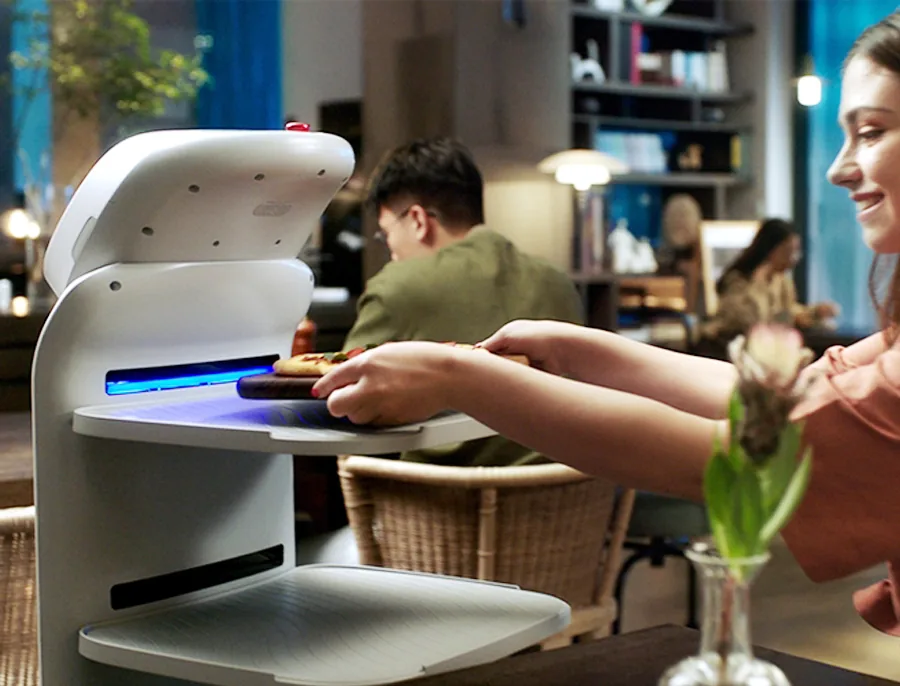
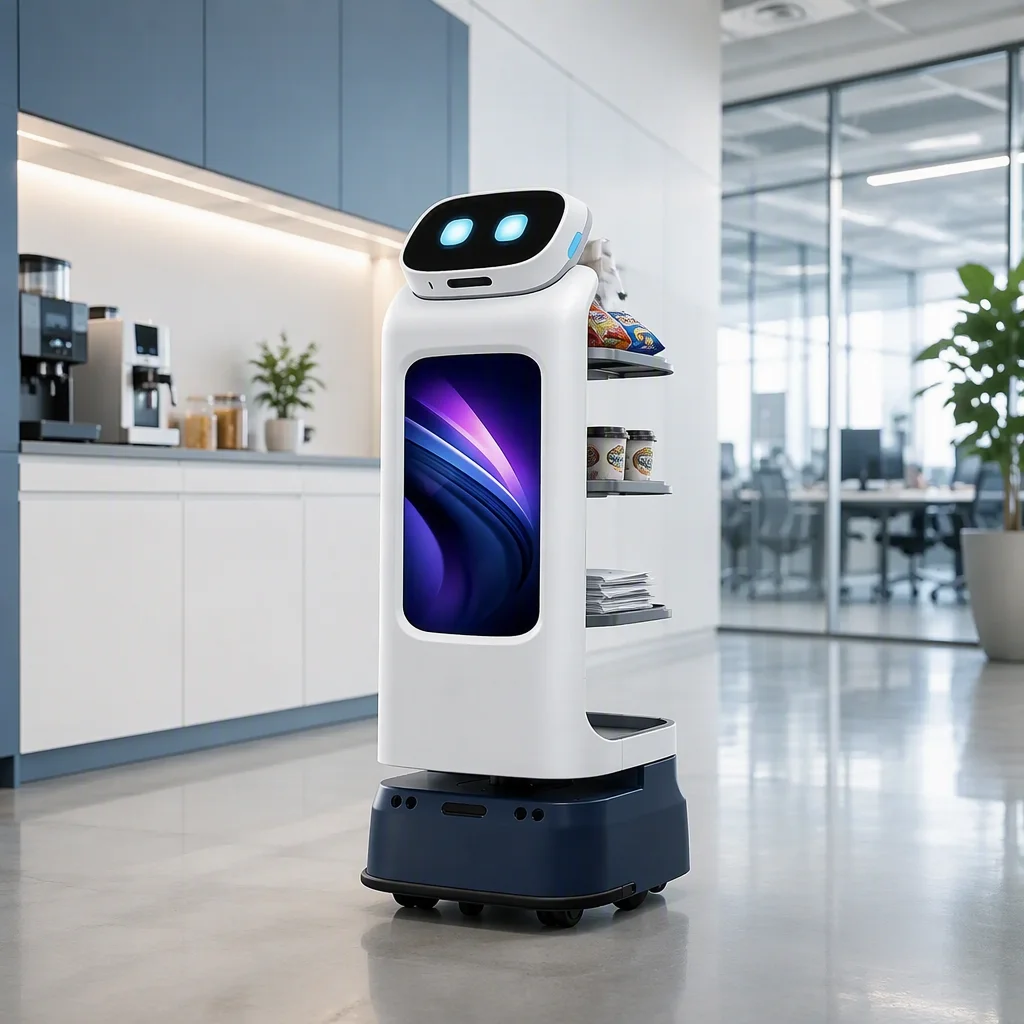
The D1 is the delivery unit. It carries up to 40 kg on a four-tier tray, clears corridors down to 70 cm wide, and carries a 21.5-inch advertising screen that turns every run into media inventory: participating restaurants and retailers can run promos, menus and seasonals while the robot is in motion.
At the food court, the D1's model is a shared infrastructure layer rather than a single restaurant's tool. Tenants stage prepared orders at a pickup station, the robot delivers to the customer's table or to a designated pickup point, and the mall signs a per-delivery, subscription, or revenue-share arrangement with participating tenants. In publicly documented deployments, AOMAN D1 units run exactly this pattern on restaurant routes, delivery to tables along a nine-store ramen chain in Kyushu, Japan, and table service for a Korean BBQ restaurant in the Netherlands.
The same unit serves retailers: a shopper buys a bulky item and requests delivery to a pickup lane instead of carrying it to a parking level. D1's 40 kg payload and four-tier tray handle that load, and it does double duty as a visible tech service for a mall trying to extend dwell time.
3. Common-area cleaning, AOMAN C1
The C1 is the large-format cleaning unit: 2,040 m² per hour on hard surfaces, 70 L fresh water plus 50 L recovery tanks for long runs without a mid-shift refill, a 790 mm squeegee width, and clearance for 85 cm passages. That combination is what allows an overnight crew of one robot to reset a regional mall's common area, atrium, corridors, food-court seating, elevator lobbies, before the doors open.
Its natural window is the closed-mall shift: 10 PM to 10 AM at most centers, which for a typical 12,000 m² common-area floor plan is roughly six hours at the rated coverage. Because the route is programmed per-zone, the mall can push a second pass over the food court after closing, or run an evening version during a holiday season when the space stays open late. For the selection framework across cleaning platforms, see the AOMAN C1 product page.
4. Compact cleaning, AOMAN C2 Pro
Not every mall area warrants a machine the size of the C1. Restroom corridors, management offices, mezzanine dining corners and small back-of-house routes suit the C2 Pro: it fits beneath 70 cm counters and tables, moves through 85 cm aisles, runs quietly, and carries modular tanks that can be swapped at a cleaning station. Where the C1 covers the big floor plan, the C2 Pro covers the tight ones.
| Role | Unit | Platform specs | Typical zone |
|---|---|---|---|
| Entrance guidance & wayfinding | AOMAN G1 | 15 DoF · 6-mic 5 m pickup · 13 MP camera · auto-return charging | Entrances, atria, event floors |
| Food court & pickup-lane delivery | AOMAN D1 | 40 kg payload · four-tier tray · 21.5-in ad screen · 70 cm aisle | Food court, corridors, pickup lanes |
| Large-area cleaning | AOMAN C1 | 2,040 m²/h · 70 L + 50 L tanks · 790 mm squeegee · 85 cm passage | Common areas, atriums, concourses |
| Compact cleaning | AOMAN C2 Pro | Fits 70 cm desks · 85 cm aisles · quiet · modular tanks | Restroom corridors, offices, small dining areas |
The multi-tenant consideration: one approval chain, many stakeholders
Integration is simpler than in other building types
Mall integration is structurally easier than a hospital or a multi-company office tower, because every integration point reports to the same operations director and the same facilities team. The elevator control system, the access control for back-of-house, the BMS for scheduling, and the network that robots ride all belong to the mall operator. That single approval chain compresses the scoping work: in an 8–12 week program, integration engineering is one workstream, not four.
Communication with tenants is what actually takes effort
Tenants cannot veto a common-area robot program, but uncommunicated automation reads badly. A one-page brief emailed to every general manager 30 days ahead of deployment, a short live demonstration in the food court two weeks before go-live, a channel for questions during the first month, and a monthly report of delivery volumes and cleaning coverage to participating tenants keep the program visible and collaborative. This communication layer is a scheduling task, not a technology one. And it should be on the mall operator's calendar before the robots arrive.
Phased deployment over 8–12 weeks
A phased order reduces risk while keeping the fleet conversation whole. Cleaning first is the standard entry because it runs closed-doors with zero guest interaction; guest-facing roles follow once mapping and workflows are proven.
| Weeks | Phase | Work |
|---|---|---|
| 1–2 | Site assessment | SLAM survey of common areas, food court and pick-up lanes; elevator, access-control and network audit; tenant briefing sequence begins |
| 3–4 | Cleaning launch | Deploy C1 (plus C2 Pro in compact zones) overnight; verify maps, docking, refill and coverage metrics |
| 5–6 | Guest-facing launch | Deploy G1 at the main entrance and D1 in the food court with 3–5 participating tenants; start collecting interaction and delivery data |
| 7–8 | Fleet activation | Extend D1 to retail-to-pickup routes; connect the fleet dashboard; publish the first monthly tenant report |
| 9+ | Optimization | Tune routes to actual foot traffic; adjust cleaning zones for season; consider second G1 for multi-entrance layouts |
The economics: an illustrative example
The mall business case is usually built from two lines: the cleaning or delivery department currently paid for, and the service revenue a fleet can create. Here is an illustrative example, rates, coverage and pricing need to be replaced with your procurement numbers.
Illustrative cleaning math: a regional mall common area covering 12,000 m² of hard floor runs about six night-hours of C1 time at the rated 2,040 m²/h. Against a night crew of three staff the run is quicker and repeatable seven nights a week, and a post-event special pass after a fairs weekend can be pushed programmatically instead of staffed. Annualized, the contract-cleaning reduction versus robot leasing is a question your facilities team can answer at the rate card you actually pay.
Illustrative delivery math: if the food court moves 60–80 delivery runs a day at 40 kg of capacity per run, participation fees from 20–30 tenants at a few dollars per delivery produce a service-revenue line the mall operator sees directly. The D1's 21.5-inch screen adds a small media line if tenants want to buy promo slots. Whether that covers the fleet in 18 months or 30 depends on the fee structure. The point of running the examples is to decide that question before ordering hardware. A venue with a different traffic pattern, and how the configuration changes for it, is covered in humanoid robots in retail.
For the products behind each role, browse the full AOMAN product line, or see the retail industry overview for deployment notes in other retail environments.
Tell us your floor plan and common-area square footage. We will recommend the fleet composition and a phased rollout plan, and return indicative pricing within 24 hours. Request pricing.