Human-Robot Collaboration: How to Integrate Service Robots Into Your Workforce Without Resistance, A 2026 Change Management Playbook | AOMAN FUTURE
At a glance: Awareness training takes 45 minutes; super-user training takes 4 hours. That span decides whether a robot runs for years or parks in a closet. This playbook covers the 4-week communication plan, tiered training, and the KPI changes that turn staff resistance into advocacy.
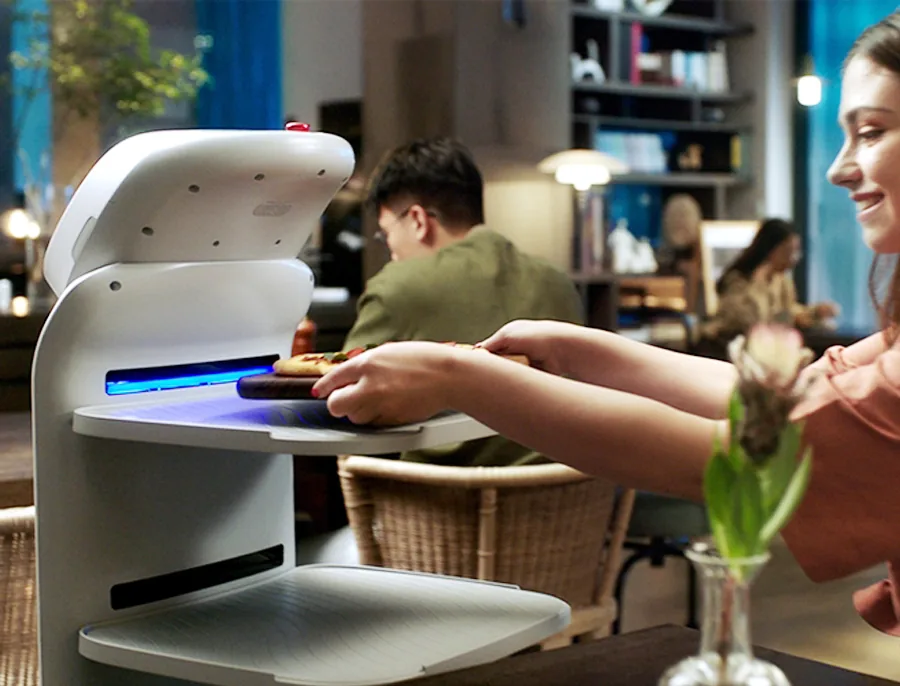
You have signed the purchase order. The robots arrive in four weeks. Then your operations director pulls you aside: "The night-shift team heard about this. Three people asked if they are being replaced."
That conversation happens in every deployment. The pattern is consistent: resistance is not about the technology. It is about fear, communication gaps, and KPIs that punish collaboration. This is the change-management playbook that successful deployments follow, for hospitality, healthcare, retail, and industrial environments alike.

Why Staff Push Back, and Why It Is Rarely About the Robot
When a hotel deploys an AOMAN D1 for room-service delivery, the housekeeping team does not object to the machine. They object to what they think it represents. The three root causes of resistance are predictable:
| Root Cause | What Staff Think | What Is Actually Happening |
|---|---|---|
| Job-loss fear | "This robot is taking my shift" | Robots handle repetitive transit; staff move to higher-value customer interaction |
| Competence threat | "I don't know how to use it and I will look stupid" | Most modern robots need less training than a POS system |
| Autonomy loss | "Management does not trust us to do the work" | Automation addresses labor shortages, not staff performance |
These are emotional responses, not rational objections. Data alone does not fix them, the right communication strategy does.
The 4-Week Pre-Deployment Communication Plan
The biggest mistake deployment teams make is announcing the robots on arrival day. By then, the rumor mill has been running for weeks and the narrative is already set. Front-load the communication, one week at a time.
Weeks 1-2: Frame the Narrative
| Action | Why It Works |
|---|---|
| Name the problem, not the solution | "We are short two people on night shift and everyone is burned out covering overtime", not "we bought a robot" |
| Show the data | Publish current workload metrics from real counters: deliveries per day, average turnaround time, missed windows last month |
| Define collaboration, not replacement | "The robot does the walking. You do what only humans can, check on guests, notice issues, build relationships" |
Week 3: Hands-On Demos
Let staff interact with the robot before it goes live. Three rules:
- No managers in the room. Let the team explore without feeling observed.
- Start with the fun stuff. Voice interaction, the display screen, the obstacle detection, build comfort before discussing workflows.
- One champion per shift. Identify the most curious team member early; they become your internal advocate.
Week 4: Role Redesign
This is the step most deployments skip. After the ROI and total-cost analysis are done, answer the question staff are asking: what does each person's job look like now? A delivery robot taking over transit tasks shifts a server's role from mostly walking and some guest interaction to the inverse. That is a better job. But if you never articulate it, staff see only the portion they are losing, not the portion they are gaining. Write the before-and-after role descriptions and hand them to every affected role.

The Training Framework: 3 Tiers, Not 1 Workshop
A single "robot training day" fails because different roles need different depth. Successful deployments use a tiered approach:
Tier 1: Awareness (All Staff, 45 Minutes)
What the robot does, where it operates, and how to interact with it safely. No technical detail. The goal: eliminate fear of the unknown.
Tier 2: Operator (Direct Users, 2 Hours)
For staff who will dispatch tasks, work alongside the robots, or monitor dashboards. Hands-on with the dispatch interface and real scenarios: "Guest in 312 ordered soup. The robot is at the kitchen. What do you do?"
Tier 3: Super-User (Shift Leads, 4 Hours)
Error recovery, route editing, basic troubleshooting, and fleet dashboard ownership. Super-users become the first line of support, which prevents the "it's broken and I don't know who to call" abandonment pattern.
Training Timing
Schedule training in the second-to-last week before go-live . Close enough that skills don't decay, early enough that super-users can practice without production pressure.
KPI Realignment: Stop Measuring What Automation Breaks
If you deploy robots but keep evaluating staff on deliveries completed per shift, you have set up a conflict. The robot does the deliveries now. Staff metrics must shift with the technology.
| Old KPI | New KPI | Why |
|---|---|---|
| Deliveries per shift | Guest satisfaction score | Staff now have time for quality interactions |
| Rooms cleaned per shift | Hygiene audit score | Cleaning robots handle floors; staff focus on detail disinfection |
| Routine runs completed per hour | Guest return rate / NPS | The AOMAN D1 covers the routine runs; staff solve the complex issues |
This shift is the single most effective way to turn resistance into advocacy. When staff are measured on things robots cannot do, empathy, judgment, relationship-building, the robot stops being a threat and becomes a tool.
The First 90 Days: From Skepticism to Advocacy
Days 1-7: The Honeymoon
Everyone is curious. Usage is high because it is novel. Risk: this fades fast if workflows are not smooth. Make sure every shift lead has Tier 3 training before Day 1.
Days 8-30: The Friction Zone
Reality sets in. Someone leaves a cart in the robot's path and it recalculates for 15 seconds. Suddenly "this thing doesn't even work." A delivery arrives 3 minutes late and someone says "I could have done it faster."
The fix: create a robot feedback channel (team chat, messaging group, or a physical board). Log every complaint and address it within 48 hours. Ignoring the first round of friction is how deployments fail. Staff conclude that management does not care whether it works.
Days 31-90: Normalization
The robot becomes invisible, part of the operation, like the dishwasher or the elevator. That is the goal, but it takes 30-60 days of consistent operation. Two accelerators:
- Share the data. Post weekly impact metrics: "This week the D1 saved 42 hours of walking time, 42 hours the team spent with guests instead of in hallways."
- Celebrate the humans. Publicly recognize staff who found creative uses, the server who set up a custom route, the housekeeper who trained new hires on robot operation.
When Multi-Robot Deployments Add Complexity
Deploying one robot is change management. Deploying a fleet across facility types is organizational transformation. Multi-robot sites introduce coordination challenges:
- Role clarity: which robot does what? An AOMAN C1 cleaning the lobby while an AOMAN D1 runs guest deliveries, staff need to know not to interrupt the cleaning cycle or stop the D1 mid-route.
- Shared infrastructure: elevator scheduling, charging-station allocation, corridor right-of-way become operational bottlenecks if not planned.
- One dashboard: staff should not need three apps to monitor three robot types. A single view across delivery, cleaning, and reception units prevents "too many screens" fatigue, and the AOMAN G1 reception unit adds its guest-facing queries to the same console.
The dependable sequence: deploy delivery robots first, stabilize for 60 days, add cleaning robots (in a publicly documented deployment, an AOMAN C2 Pro runs daytime cleaning through a nursing care facility in Tokyo while staff focus on resident care), stabilize, then add reception. Parallel rollout across robot categories is the most common cause of multi-robot deployment failure.

The Financial Case for Change Management
Change management is not soft spend, it moves the money. Two deployments of identical hardware diverge on one axis: how fast the fleet reaches steady-state utilization. In the illustrative arithmetic commonly used for planning: a robot that reaches 70% utilization in 30 days versus 70% in 120 days means one machine-year of delivered service over the first year versus roughly two-thirds of that, and the delta compounds per unit across a fleet. A C2 Pro or D1 leased on a subscription model lowers upfront risk, but it does not remove the utilization gap, the lease runs the same either way.
The AOMAN Deployment Support Model
AOMAN's deployment team provides a structured onboarding program:
- Pre-deployment site survey . Workflow mapping, floor-plan integration, elevator interface verification
- Tiered training (3 levels) . Delivered on-site by certified deployment engineers, with the tier curriculum above
- 30-day hypercare . Daily check-ins, real-time support, usage analytics review
- 90-day optimization review . Workflow tuning, KPI alignment workshop, expansion planning
The robots do not deploy themselves. The deployment team is as much the product as the hardware.
What Successful Deployments Look Like After 12 Months
- Staff satisfaction scores rise within months. People prefer jobs with less repetitive physical labor once the role is redesigned
- Internal advocates emerge spontaneously . Across deployments, 1-2 staff members typically become unofficial robot champions
- Expansion requests come from operations teams, not management. Once one department sees the impact, others ask when theirs arrives
A service robot is not a headcount-reduction tool. It is a workforce-transformation tool, and the deployments that succeed treat it as such from day one, structured communication, tiered training, realigned KPIs, and the patience to navigate the first 90 days. Tell us your headcount, shift structure, and current staff concerns, and we will design the communication and training plan around your team, not ours. Talk to the deployment team for a site assessment and rollout plan. A comparable deployment with different traffic, dock and shift constraints is documented in fleet management systems.