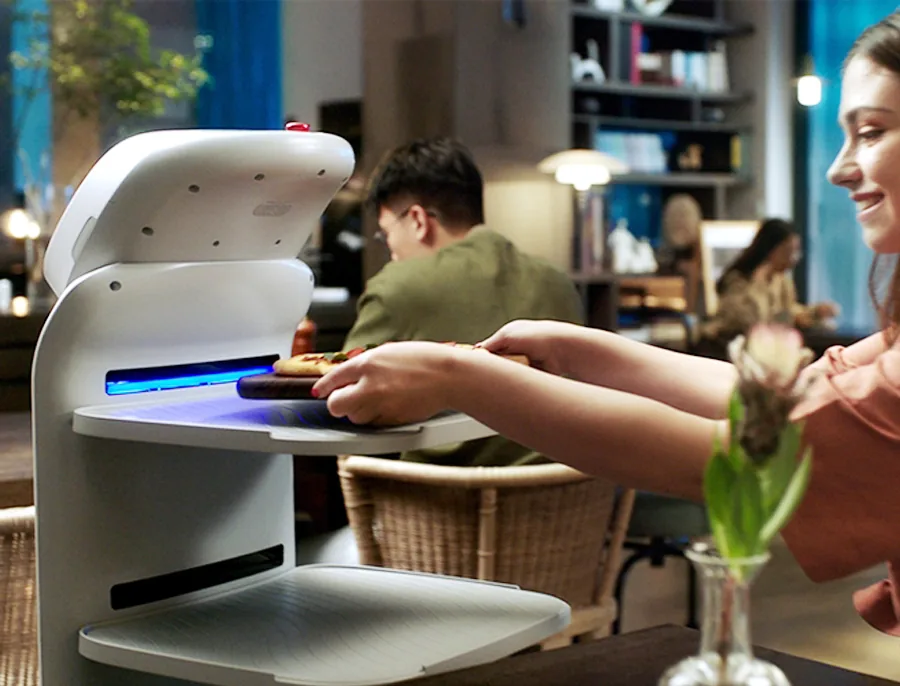
Reception & Concierge Service with AOMAN D1, The 2026 Buyer's Guide
At a glance: An AOMAN G1 greets and guides visitors in multiple languages with 6 microphones and a 5 m pickup range; an AOMAN D1 carries up to 40 kg of badges, kits, and documents per run. This guide covers the division of work, elevator integration, and what a lobby deployment actually needs.
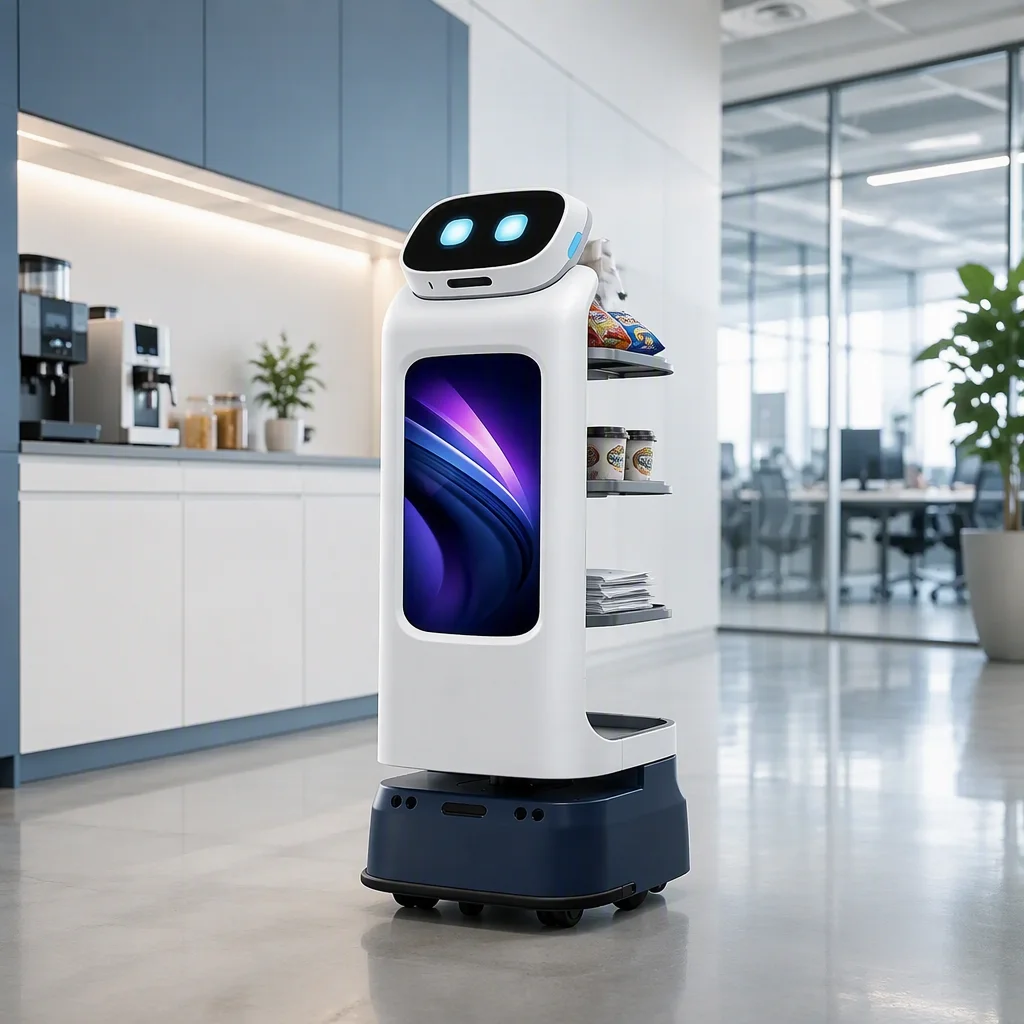
A corporate lobby in a busy Class A office tower handles hundreds to thousands of visitor interactions per day. Every single one follows the same script: greet, verify identity, issue badge, notify host, provide directions. At 9:15 AM on a Tuesday, the queue at reception stretches past the turnstiles; three visitors are late for meetings; a VIP client stands unacknowledged while the receptionist who would carry their badge to the meeting room is already on another run. The range for your building differs, count your own peak-traffic morning, but the script does not.
A tablet kiosk cannot solve this. Neither can a check-in app, because visitors don't download apps for a one-time meeting. The bottleneck is physical presence in a physical space, and the traditional answer was more reception staff. This guide covers how an AOMAN pair covers the lobby: the AOMAN G1 for greeting, wayfinding, and multilingual guidance, and the AOMAN D1 for the physical half, badges, kits, and documents carried between the lobby desk and tenant floors.
What a Lobby Robot Actually Handles
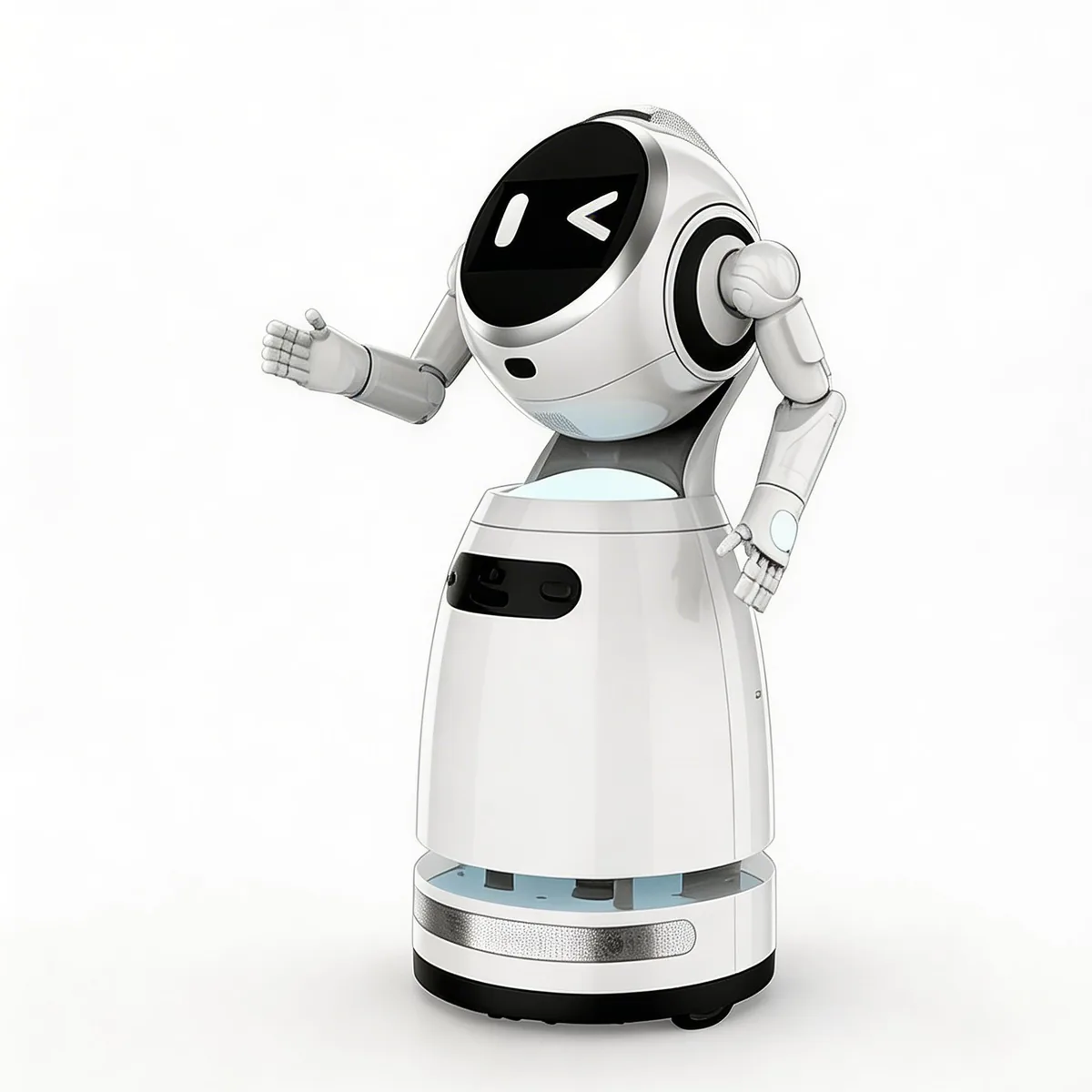
A lobby deployment is a two-robot operation: a guide at the desk and a courier on the elevators.
- Multi-tenant visitor routing (G1): in buildings with 20+ corporate tenants, the G1's on-screen directory shows which company the visitor is here to see, reflects that tenant's visitor policy (pre-registration required? photo ID? NDA signature?), and routes the visitor to the correct floor, with multilingual greeting and guidance across its 6-microphone array and 5 m pickup range.
- Badge and material delivery (D1): the D1 integrates with building access systems to carry pre-encoded temporary badges from the reception desk to the host or meeting room, 40 kg across four tray positions per run, enough for a batch of badge and welcome-kit deliveries.
- Host notification support: when a visitor checks in, the host notification includes the courier's delivery ETA, synced with SMS and enterprise messaging.
- Physical escort and delivery (D1): the robot navigates elevators, automatic doors, and security turnstiles via SLAM navigation . The visitor's route is followed with delivery stops on the correct floor and suite, no paper directions, no wrong turns.
- After-hours coverage: buildings that staff reception from 08:00-18:00 leave most of the day unhandled. The G1 keeps greeting and directing after hours; the D1 keeps covering cleaning-crew check-ins, delivery personnel, and employees who lost access cards.
The Multi-Tenant Challenge: One Lobby, Twenty Companies
Multi-tenant lobbies create a uniquely complex reception problem. Each tenant has different visitor policies, different security levels, and different host-notification preferences. A law firm on floor 12 requires photo ID capture and an NDA signature for every visitor. A tech company on floor 8 waives pre-registered guests through. A financial services tenant on floor 20 requires two-factor host confirmation. A human receptionist manages this by memory and a binder of tenant policies; when that person is busy, on lunch, or absent, the system degrades.
| Tenant Requirement | Manual Process | Robot-Assisted Process |
|---|---|---|
| Photo ID capture | Receptionist finds camera, takes photo, uploads | Desk captures at check-in; the G1 confirms acceptance and routes the visitor |
| NDA signature | Print form, find pen, collect signature, scan, file | Desk captures a digital signature; the D1 delivers the signed return copy to the tenant floor |
| Pre-registration check | Receptionist searches a spreadsheet or email | Desk queries the tenant's visitor database; the D1 dispatches the badge immediately |
| VIP routing | Receptionist calls the executive assistant | Badge and welcome kit delivered by the D1 to the destination floor; the assistant is notified automatically |

The Security Dimension: Why Robots Reduce Risk
Office building security is built on a paradox: the reception desk is both the first line of defense and the weakest link. A distracted receptionist waves through a tailgater. An overwhelmed temp forgets to verify an ID. A visitor badge that should have expired at 15:00 still grants elevator access at 19:30. An autonomous courier removes several failure modes systematically:
- No badge congestion: the D1 removes badge runs from the human critical path, no social pressure on a courier, no waiting for a desk staff member to step away
- Time-bound credentials: badge permissions can be revoked automatically at the scheduled meeting end time, where humans cannot reliably track hundreds of active badges across a workday
- Full audit trail: every delivery, badge issue time, elevator ride, escort route, return scan, is logged with timestamps and retrievable for security review
- Consistent route logging: navigation telemetry records each escort leg with positioning data far more consistently than a route reconstructed from memory
For buildings that host financial services, legal, or government tenants, that audit trail is often a compliance expectation, not a luxury.
When the Receptionist Can't Be There: After-Hours and Overflow
A standard corporate lobby staffing model covers ten hours a day, roughly 42% of a 24-hour day. The other 58% is unstaffed. This is when cleaning crews arrive at 22:00 needing building access, employees return at 21:00 for a forgotten laptop, international clients arrive at 06:30 for a 07:00 video call in another time zone, and delivery drivers show up at 19:00 with urgent documents needing a signature. Each unhandled interaction creates friction that compounds.
As an illustrative example: a building with a $180,000 annual reception staffing budget that wants overnight coverage would pay roughly a third of that again in additional shifts. The robot amortized over a 3-year service life lands in the low five figures per year for the same extended coverage. Directionally, the 24/7-window math works: the marginal run costs a robot nothing, whereas the marginal hour costs a shift.
Elevator Integration: The Hardest Part, Solved
A robot that needs to reach floor 18, suite 1802 must physically enter an elevator and select the correct floor. That is the single hardest integration in lobby automation:
- BACnet/IP integration: direct protocol communication with modern elevator control systems
- IoT relay for legacy elevators: a physical relay module connects the robot to the elevator's call-button circuit for older infrastructure, no controller upgrade required
Once connected, the robot calls the elevator, enters, selects the destination floor, and announces the destination on its screen to the visitor. The return trip works identically: the robot calls the elevator from the tenant floor, escorts the departing visitor back to the lobby, and the visit is logged out. Without elevator integration the robot is a greeter that points; with it, the courier becomes a true lobby-to-destination agent. Budget elevator integration as the longest-lead item: if the building has legacy controllers, it is usually the critical path of the deployment.
What You Actually Need to Deploy
A lobby deployment requires six components, evaluate each before procurement:
- Robot hardware: one AOMAN G1 positioned at the reception zone, plus a D1 stationed at a loading sidecar near the desk, with clear approach areas for badges, kits, and packages
- Building access system integration: API or relay connection to the badge printing and door access control
- Tenant visitor policy database: each tenant's rules, pre-registration, ID capture, NDA, host notification method
- Elevator controller integration: BACnet/IP for modern elevators, IoT relay for legacy systems
- Network infrastructure: a dedicated wireless SSID for robot-to-building-system communication, isolated from the guest network
- Staff training: 2-day onboarding for reception and security staff. The robots are a tool for them, not a replacement
Deployment timeline from contract to operational go-live is typically 4-6 weeks, with elevator integration as the longest-lead item on legacy buildings.
What ROI Looks Like: An Illustrative Model
As an illustrative model with stated assumptions (replace with your own volumes): a 32-floor tower with 18 tenants and roughly a thousand visitors per day, running three reception desks with six staff on rotation, plus two courier runs per hour. If the robots absorb the majority of routine badge and package deliveries, the desk count can drop by one and the remaining staff shift to tenant relations, the visitor's time from check-in to elevator compresses from minutes to about a minute, and the after-hours gap closes with zero added headcount. Directional for your case, not a promise: the model has to be re-run with your traffic, your tenant mix, and your quote.
Wayfinding at scale is the same class of problem museums solved first, in a publicly documented deployment, an AOMAN G1 at an art museum in Osaka greets visitors, answers directional questions in multiple languages, and guides them to galleries. The loop inside a 30-story lobby is the same one, minus the artwork.
Making the Decision: A Pre-Deployment Checklist
- Visitor volume: visitors per day, and the peak-hour surge (typically 08:30-10:00)
- Tenant count and policy variance: how many tenants, and how different are their visitor rules?
- Current pain points: what percentage of visitor complaints cite wait times? What is reception staff turnover?
- Access system: what access control system is installed, and does it support API integration?
- Elevator type: modern (BACnet-capable) or legacy (needs an IoT relay)?
- Delivery load: how many badge, package, and document runs per day, the D1's 40 kg per trip across four trays sizes this
- After-hours gap: unstaffed hours per day, and how many interactions occur in them
Walk the lobby at 09:30 on a Tuesday. Count the queue. Time three visitor interactions from entry to elevator. If the average exceeds three minutes, or if visitors stand unacknowledged for more than half a minute, the case is already made, the rest is procurement. For environments also managing common-area cleaning, an AOMAN C2 Pro handles lobbies, corridors, and restrooms off-hours, and pairing it with the G1 plus D1 creates a continuous lobby operation. Tell us your visitor volume, tenant count, and elevator type. We will size the G1/D1 pair and give you the integration plan for your access control. Request a lobby assessment, or visit our corporate office solutions page for the broader picture. The equivalent requirements in another regulated environment, including its audit expectations, are set out in corporate campus deployments.