Commercial Cleaning Robot Buyer's Guide 2026: Scrubbing vs UV-C vs Multi-Mode, What Your Facility Actually Needs
At a glance: AOMAN C1 cleans at 2,040 m²/h with a 790 mm squeegee and 70 L + 50 L water tanks, enough to cover a mall concourse in one nightly window. This guide compares the large-format C1 with the compact C2 Pro and lays out the cost and vendor checks that matter.
Facility managers evaluating commercial cleaning robots have to answer one sizing question before any brand comparison: does the floor justify the full-size machine, or does the schedule need a compact one? Practically, 2026's robotic scrubbers sort into two classes, large-format machines built for open, sealed floors, and compact, quiet units designed to work alongside people. Getting the class right matters more than any feature list, because a large machine on a small route wastes a night, and a compact unit on a concourse takes all week.
This guide compares the two classes in the AOMAN FUTURE lineup, the large-format AOMAN C1 and the compact AOMAN C2 Pro, then covers the decision criteria, a cost example, and the vendor checks that separate a good fleet from a perpetual training cost.
The Two Classes: Large-Format and Compact
Large-Format: AOMAN C1
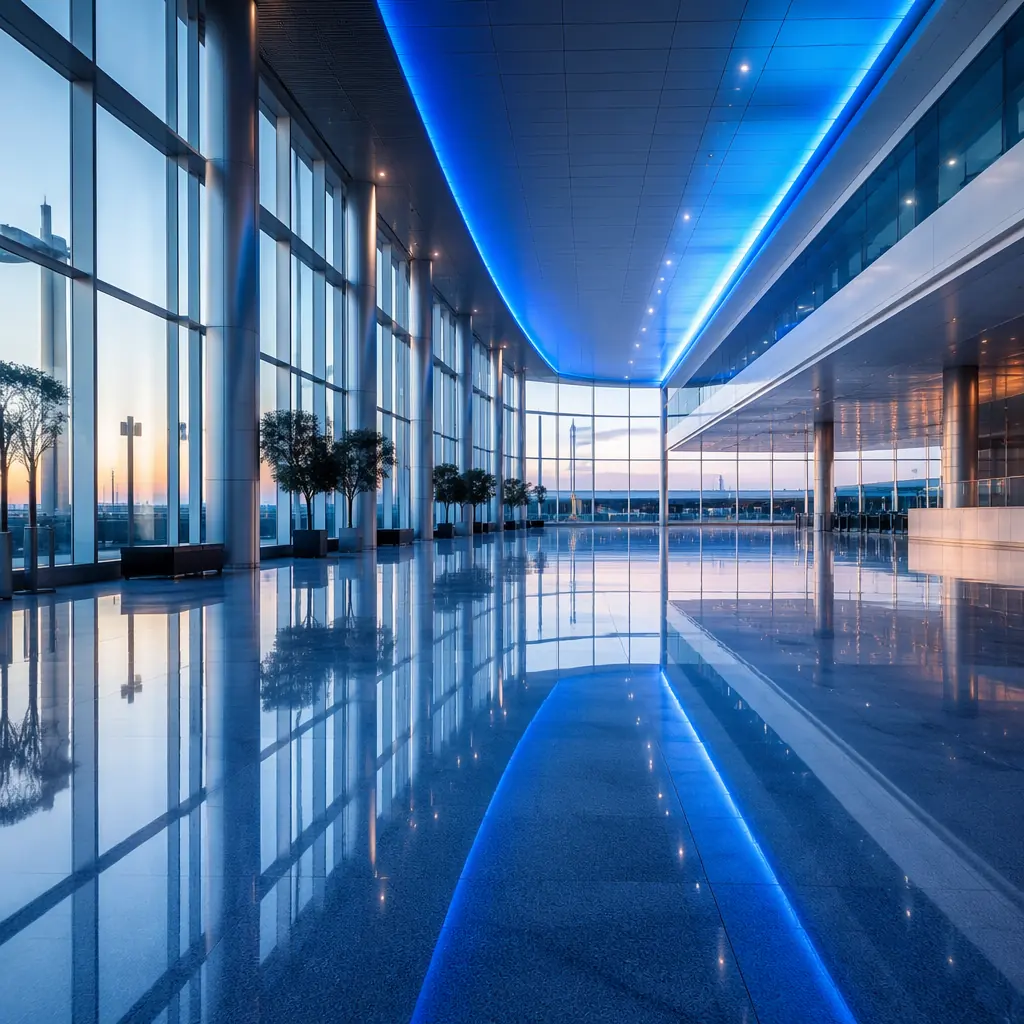
The C1 is built for big, predictable hard floors. It covers 2,040 m²/h, carries 70 L + 50 L of water in dual tanks, and works with a 790 mm squeegee. Its 85 cm working aisle means it handles mall concourses, terminal floors, and hospital corridors, the kind of spaces that used to take a crew of manual scrubbers overnight.
Where it fits: airports and transport terminals, shopping malls, hospitals and similar facilities with wide sealed hard-floor corridors, industrial halls.
Planning math: a 10,000 m² concourse at 2,040 m²/h is roughly five hours of coverage per night, about one shift's worth of machine time, leaving the rest of the shift for the detail points robots cannot reach.
Compact: AOMAN C2 Pro
The C2 Pro is the same cleaning discipline in a smaller body. It is built for busy spaces: quiet enough to run while people are present, compact enough to pass under 70 cm of table height, and sized for 85 cm aisles. Modular water tanks keep changeovers simple between runs.
Where it fits: offices and coworking floors, clinics, hotel corridors, retail floors with shoppers still on them, libraries and schools, any loop where silence and clearance matter more than raw speed.
In a publicly documented deployment at a care facility in Tokyo, a C2 Pro runs corridor cleaning on a schedule that keeps residents and staff uninterrupted. The pattern that makes scattered points with continuous occupancy the compact class's home ground.
| Spec | AOMAN C1 | AOMAN C2 Pro |
|---|---|---|
| Coverage | 2,040 m²/h | Compact class, sized for small loops |
| Water system | 70 L + 50 L dual tanks | Modular tanks, swap-friendly |
| Wet pick-up width | 790 mm squeegee | Compact footprint |
| Clearance | 85 cm working aisle | 85 cm aisle; passes under 70 cm table height |
| Best match | Malls, terminals, hospital corridors, industrial halls | Offices, clinics, hotels, libraries |
One note on limits: both machines are sealed-floor platforms. Carpet, high-pile rugs, and uneven outdoor paving stay manual. Which is exactly why the honest sizing exercise starts with a floor survey, not a spec sheet.
Designing the Cleaning Program
The machine is step one; the program is what makes it pay. A workable design has five parts:
- Zone map: every zone by floor type, cleaning mode, frequency and completion check. A zone map is the difference between a robot that cleans what management thinks it cleans and one that cleans what the floor manager actually schedules.
- Route design: the night window belongs to the wide-format machine, empty floors, no guests, full recovery time. The day loop belongs to the compact unit, interruptions are the design constraint, not the exception.
- Dock placement: sheltered, powered, drained, and at the edge of the largest zone rather than in the middle of it. Water refill and recovery are the real throughput limiters on any program.
- Consumables cadence: pads, brushes and squeegee blades are the items that quietly decide uptime. Put the reorder points in writing before deployment, not during the second month of operation.
- Verification: the fleet console's completion map tells you what was cleaned; the supervisor's walk tells you what to fix. Both belong in the program, and both belong in the shift handover.
And the staffing question underneath all of it: the robot removes the walking and the scrubbing, it does not remove supervision. Someone still owns the checklist, the dock, the exceptions and the complaints. Decide who before the first night run, not after the first complaint.
Decision Framework by Facility
Most facilities mix the two classes. The typical pattern is a large-format machine on the night program and a compact unit on the day loop.
| Facility | Primary need | Recommended |
|---|---|---|
| Airport terminal / concourse | Sealed hard-floor coverage overnight | AOMAN C1 |
| Hospital corridors and wards | Large-area cleaning before morning rounds | C1 (corridors) + C2 Pro (ward loops) |
| Shopping mall / retail complex | Mixed guest-facing floors | C1 at night, C2 Pro during trading hours |
| Corporate office | Quiet, unobtrusive cleaning while staff work | AOMAN C2 Pro |
| Clinic / private practice | Small loops, low noise, patient-contact times | AOMAN C2 Pro |
| Industrial hall / manufacturing floor | Dust and debris control on sealed concrete | AOMAN C1 |
An Illustrative Cost Example
ROI math has to be built on your own labor rates, but the shape of the model is worth showing. Illustrative example: a facility with 8,000 m² of hard concourse currently devotes one night crew of two operators to those floors. Assume $28,000 of annual labor for the night scrub duty including differential, $84,000 over three years. A single AOMAN C1, charging dock, consumables and service plan under a standard three-year agreement comes to roughly $36,000. The machine covers the 8,000 m² in about a four-hour window each night and leaves the operators for restrooms and detail points, illustrative payback around 15 months, after which the saving accumulates annually.
The exact numbers differ by wage rate and site logistics. The point is the labor side must be counted per zone, not per hour. Ask each vendor to redo the arithmetic in writing on your floor plan: if the numbers cannot be reproduced from the spec sheet, the proposal is doing sales work, not engineering work.
What the spreadsheet cannot show is consistency: a robot does not get tired at 03:20, and the second pass over the same floor in the same week is done the same way as the first. Rework is the cost most facility managers under-budget for, because it never appears on an invoice.
Vendor Checklist
Once the class is decided, four checks usually sort the field:
1. Navigation that handles people
Autonomy should mean real-time obstacle handling, shopping carts, guests, trolleys, temporary tables, not tape paths. Look for lidar-and-camera fusion and floor-plan mapping; the same stack is the whole point of adopting an autonomous machine. See our deep dive on SLAM navigation for the underlying technology.
2. One fleet console
Ask how the vendor manages ten machines. Zone-based scheduling (lobby at 02:00, corridors at 03:00), completion maps, battery and maintenance alerts on one screen, and if the fleet platform also runs delivery robots on the same console, training cost drops sharply.
3. Certification that matches the mandate
For general commercial sites: CE marking, FCC and RoHS at minimum, plus ISO 9001/14001/45001 covering the operations behind the units; for lithium-battery transport, UN 38.3 documentation. Healthcare buyers should add the site's own requirements to the RFP and check what the compliance pack actually covers.
4. Spare parts and response terms
Ask for the parts list with lead times. Squeegee pads, brushes, water-system components are the consumables that decide uptime, and a vendor who cannot quote them within days is selling a floor display. Ask how remote diagnostics work: most faults are identified from telemetry before a technician travels.
Pairing Cleaning with the Rest of the Fleet
Facilities with delivery robots, the AOMAN D1 is the fleet's 40 kg four-tray platform, benefit when cleaning and delivery run on the same system. Scheduling becomes coordinated: cleaning pauses when delivery traffic peaks and resumes after; consumables, spare parts and training run through one service relationship; multi-unit coordination, charging windows and reporting consolidate instead of multiplying. See the full product line to see how the platforms relate.
Two practical notes. Keep the spare-parts strategy unified across the fleet: squeegee assemblies, brushes, wheels and water-pump components differ per platform, and the vendor who stocks everything locally is worth more than the one with the lower first quote. And plan charging as one problem, not two. Delivery and cleaning units share the power circuits, and peak-hour charging is the scheduling conflict most sites discover in month two.
The Bottom Line
Robotic scrubbing is reliable enough in 2026 that the question is no longer whether it works, but which class and how many. Large-format machines like the C1 handle broad sealed floors at 2,040 m²/h; compact units like the C2 Pro carry the daytime loops beside people. Mix both, count it per zone, and verify navigation, fleet console, certification and parts before signing. The zone-by-zone routing and cycle-time side of the same decision is worked through in the cleaning labour cost model.
Tell us your floor plan and traffic pattern, request pricing and a zone-by-zone proposal for your facility.