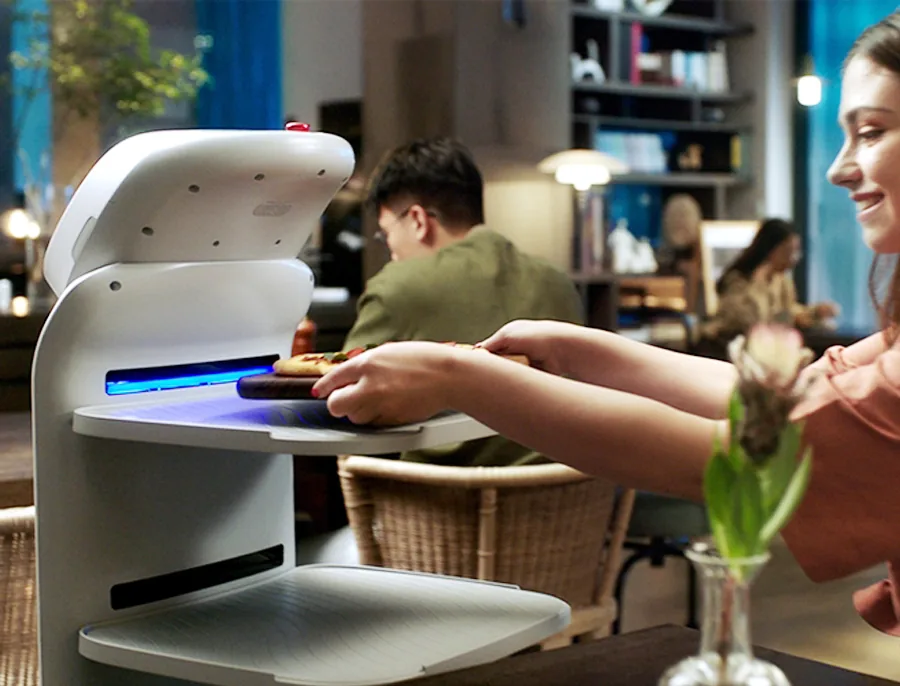
Service Robots for Convenience Stores & Small-Format Retail, 24/7 Operations in 2026
At a glance: A 300 m² convenience store runs 24/7 with a single night crew and no dedicated back-of-house; the floor takes a constant salt, sugar and spill load it can only deep-clean when the shop is quiet. This guide covers AOMAN C2 Pro compact floor care in tight aisles, AOMAN D1 back-of-house restock and delivery, and the night-shift cleaning schedule, with aisle widths, spill-cleanup and ROI data for c-store and small-format operators.
Convenience stores and small-format retail are the hardest sector for service robots to date, and the most obvious fit once you see why. The store is open around the clock, so there is never a long closed window; the footprint is small, so equipment has to be compact; the aisles are tight and shelving overhangs the walkway; and there is barely any back-of-house, so stock lives on the selling floor and restock happens in front of customers.
But the same constraints that make c-stores awkward for a large scrubber are exactly what the compact class of robots is built for. A 300 m² store is not a warehouse. It is a dense, wet-footfall, high-turnover space that needs cleaning at 2 AM and restock at 5 AM, when nobody is watching and nobody is in the way.
Why Small-Format Retail Automates
Three forces push small-format operators toward automation. First, labour is thin and the night shift is the hardest to fill. Second, the selling floor takes a disproportionate spill and dirt load, slushy boots, dropped glucose drinks, snack crumbs, and the constant tracking of dirt from the door mat to the cold case. Third, there is no closed-down cleaning window, so the floor never gets a proper deep clean unless it happens in the dead hours. Each maps directly onto a robot.
- 24/7 footfall . The only clean window is 2–5 AM, exactly when the store is least staffed.
- Tight aisles . A 300 m² store runs 1.2–1.5 m aisles with shelving overhang, so only a compact unit fits.
- High spill frequency . Dairy, drinks and snacks create a constant spot-cleaning load that a floor scrubber handles better than a mop.
- No back-of-house . Restock runs from cart to shelf in the open, so a delivery unit must be quiet and predictable.
Compact Floor Care with the C2 Pro
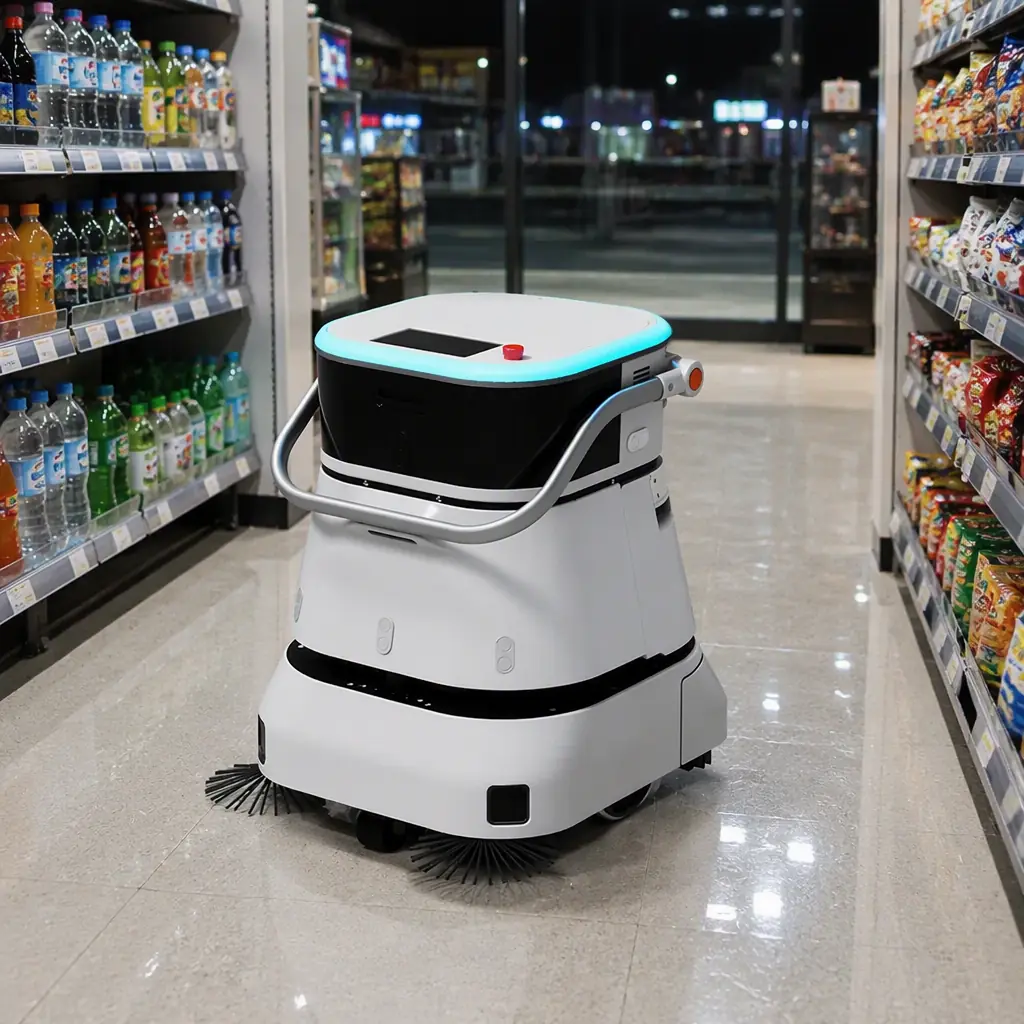
The AOMAN C2 Pro is the small-format workhorse. It fits 85 cm aisles, runs quietly enough to work while the store is empty at night (and unobtrusively enough for a daytime cycle), and its brush deck lifts the tracked-in soil and sticky spills that a mop just smears. For the occasional larger store, a small-format supermarket at 800–1,500 m², the AOMAN C1 covers up to 2,040 m²/h with a 790 mm squeegee and separate 70 L fresh / 50 L recovery tanks.
| Store Zone | Surface | Cleaning Needs | AOMAN Fit |
|---|---|---|---|
| Sales floor aisles | Sealed concrete / vinyl tile | Daily + spot after spills | C2 Pro, 85 cm class |
| Fresh & hot food area | Quarry tile, greasy | Per shift + dish-down | C2 Pro, degreaser compatible |
| Cold case / dairy aisle | Tile, condensation drips | Daily, low-temperature | C2 Pro with water recovery |
| Back-of-house & office | Concrete / commercial vinyl | 2–3× weekly | C1 or C2 Pro |
| Forecourt / entrance | Outdoor tile, tracked dirt | Daily morning | C1, large format |
For a wider comparison of scrubbing modes across retail, see our commercial cleaning robot buyer's guide.
Back-of-House Restock and Delivery with the D1
The AOMAN D1 handles the movement side. It carries up to 40 kg across separate trays, so it can move cartons of drinks, dairy and snacks from the delivery bay or single back room to the shelf gangway, a fixed, short loop repeated through the restock window. Because it runs on a schedule, the restock happens before opening rather than competing with it. In store groups, the same unit moves the trolley from the street-level bay to the store with every delivery.
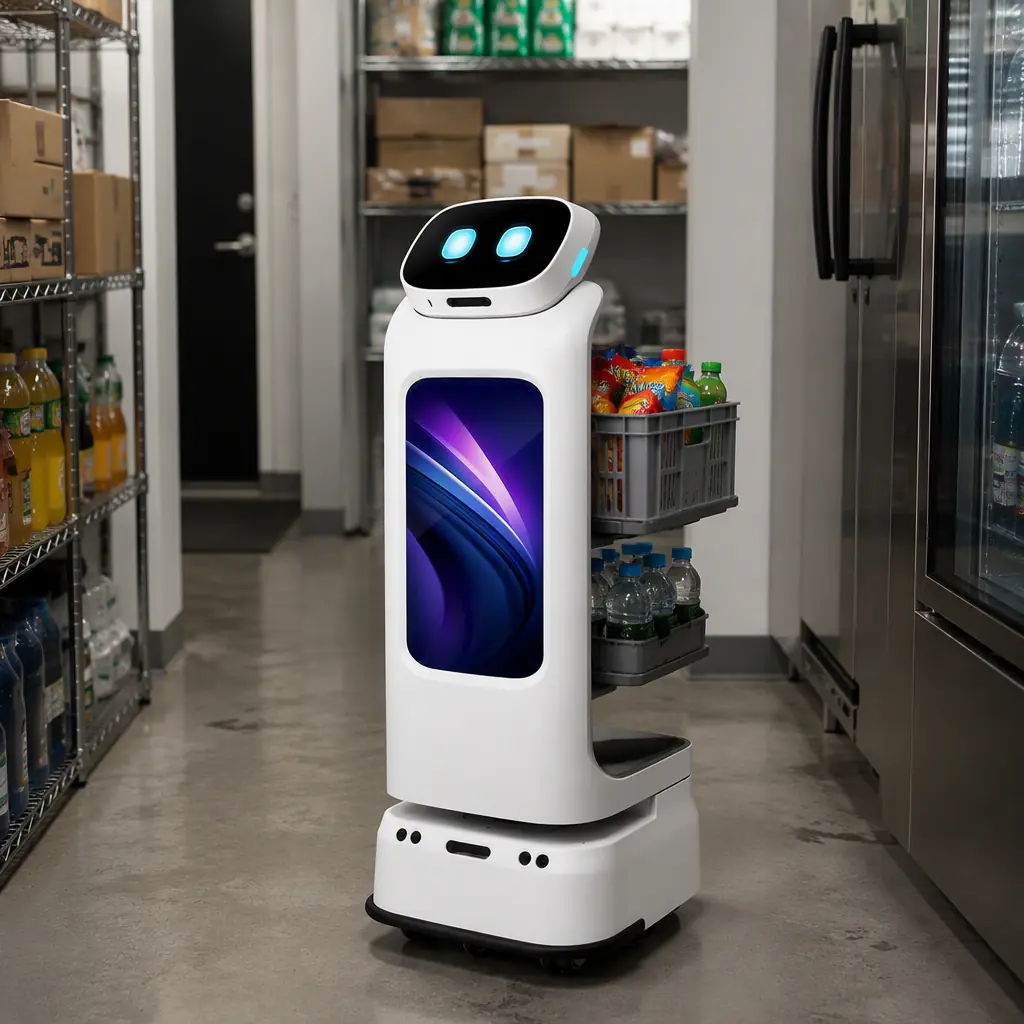
For single-cabin versus multi-tray design on a short run, the delivery robot selection guide is the right reference. The same logic applies whether you are moving snacks or hospital samples.
The Night-Shift Cleaning Window
The single decision that makes or breaks c-store automation is scheduling. Because the store is never closed, the robot works the dead hours: a C2 Pro run of the sales floor and fresh-food area between 2 AM and 5 AM, when the store is empty and the surface is free to be wet. This turns a store that has never had a proper deep clean into one that opens every morning to a scrubbed, dried, ready floor.
- Program the full route . Map the sales floor, fresh area, cold aisle and entrance so the unit covers the whole store in one unattended pass.
- Use the quiet window . Schedule the run for the low-traffic hours, not against the morning setup.
- Deploy overnight charging . Dock the unit when the store is closed so it is ready for the run.
- Keep spill response manual . A grab-and-go mop for an immediate spill during trading hours; the robot handles the deep clean.
For the wider staffing and change-management picture of running robots alongside a lean crew, our change management guide is the reference.
Build-Out by Store Format
- Small c-store (150–400 m²): one C2 Pro for floor care, one D1 on the restock loop. Two units is a defensible first purchase.
- Small-format supermarket (400–1,500 m²): one C1 for the main hall, one C2 Pro for the fresh and cold areas, one D1 for deliveries. Coordination through the fleet management guide.
- Store group / multi-site chain: centralized scheduling and roll-out planning per the multi-site deployment strategy.
What to Verify Before Signing
Aisle and shelf-gap clearance . Measure the pass between shelving overhangs, not the aisle centre; the C2 Pro needs 85 cm. End-cap and display clusters . Temporary floor stacks and seasonal displays complicate navigation; plan clearances. Cold-case drips . A unit that can recover water is essential near the refrigerated cases. Chemical compatibility . Confirm wetted materials against your degreaser and floor cleaner. Store-hours policy . Decide whether the unit runs only at night or also during the quiet daytime; daytime running needs the quiet drive and predictable pathing. For cleaning robotics across retail generally, the supermarket and grocery guide is a useful cross-check.
The ROI Picture
An illustrative single c-store spending about $26,000 a year on night floor cleaning and restock labour, the equivalent of roughly a half-credentialed night position plus contracted cleaners, could trade that against a C2 Pro + D1 fleet and keep headroom, while removing the 2 AM hiring problem. Run it on your own numbers: every store that cannot find a reliable night cleaner is a store that stays dirty and loses repeat customers on first impression. A clean floor is a sales-floor issue, not just a housekeeping one.
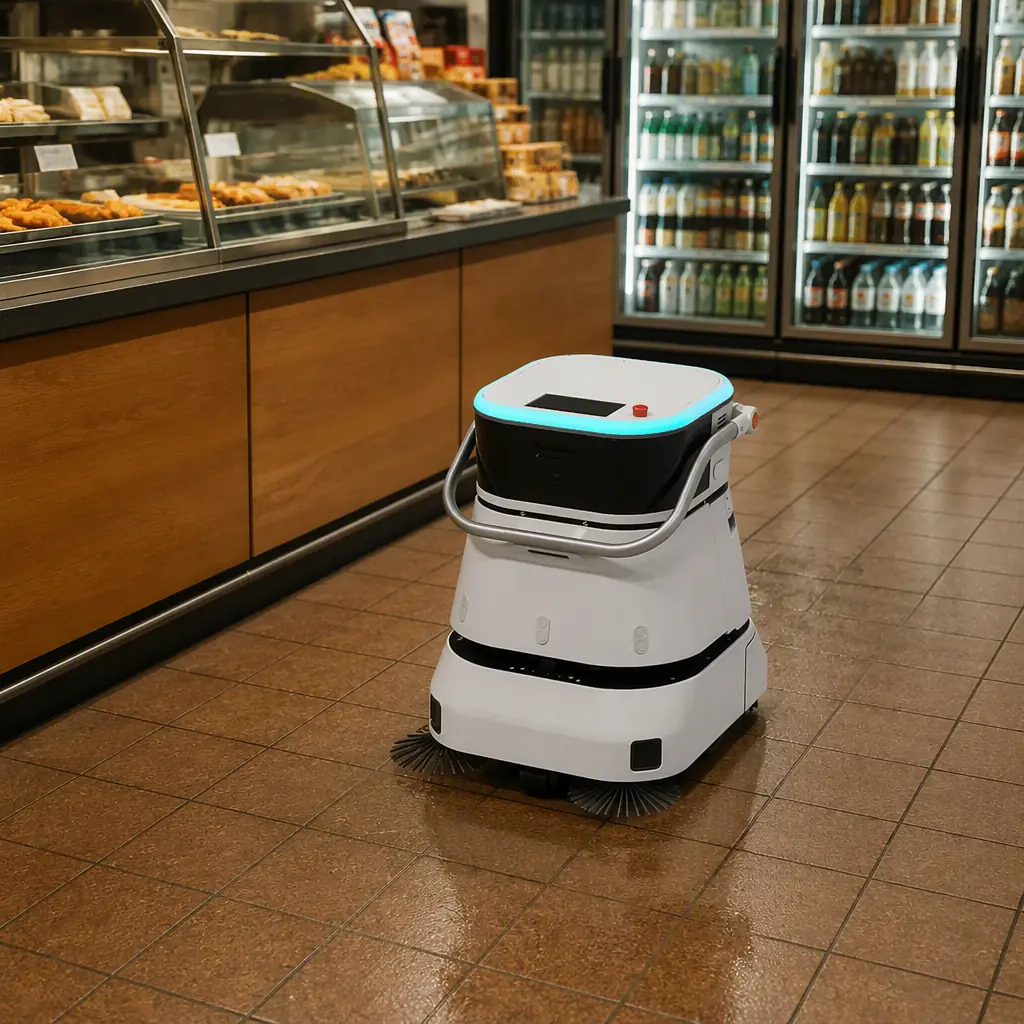
Ordering decides the outcome. Floor care first. Visible within days, needs no workflow change, and directly improves the customer first impression. Restock second. A bigger labour win but it needs a fixed delivery rhythm and a trusted loading habit. Tell us your store footprint, aisle widths and opening hours, request pricing on a small-format fleet and we will match unit types to your store within 24 hours.