Autonomous Service Robots in Retail: How AOMAN D1 Enhances Customer Experience in 2026
At a glance: AOMAN D1 moves 40 kg of stock and click-and-collect goods per trip while its 21.5-inch screen carries promotions to the floor; AOMAN G1 greets and guides at the entrance. This guide covers retail, banking and lobby use, the robot-versus-kiosk-versus-staff matrix, and an illustrative payback model.
Self-checkout handles the transaction. Digital signage broadcasts the promotion. The layer in between, moving goods, answering directions, running the gap between shelf and stockroom, still runs on staff walking.
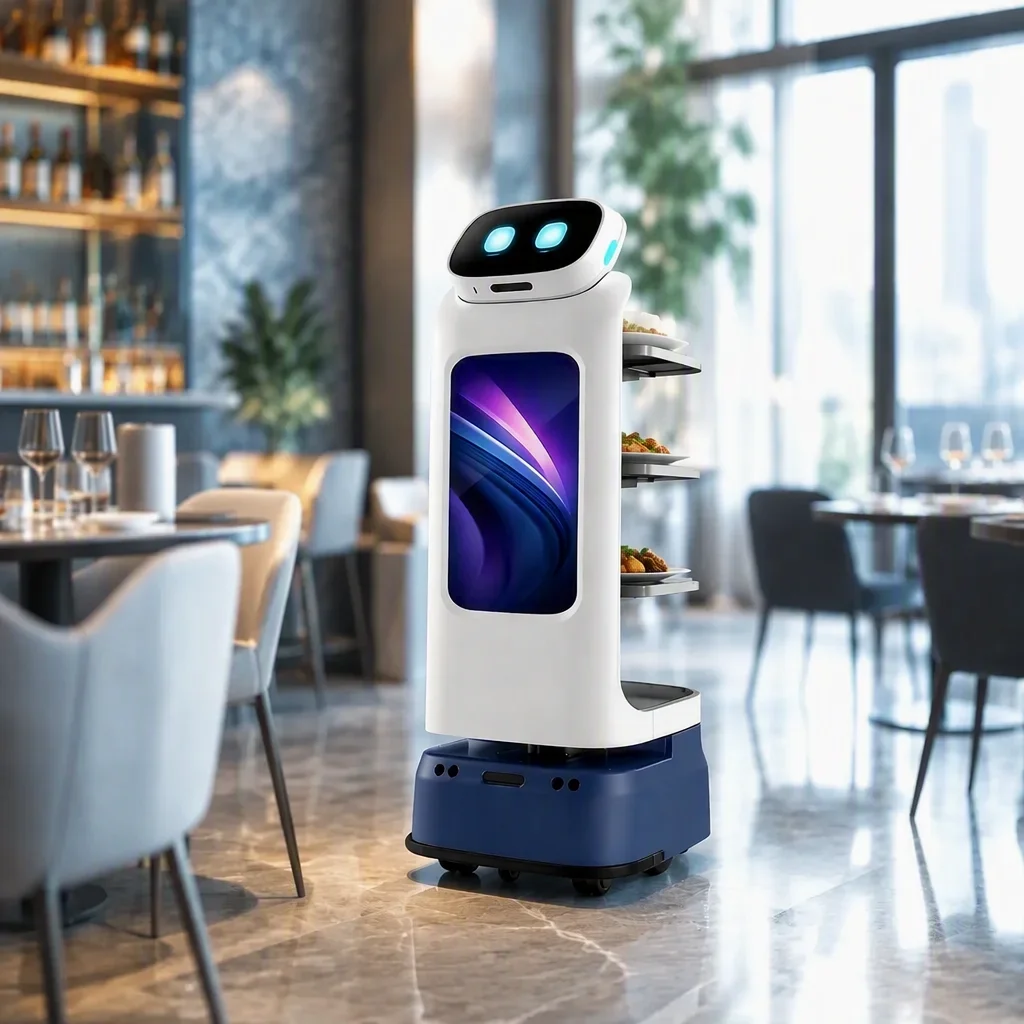
That is the layer autonomous service robots take over in retail. The AOMAN D1 carries up to 40 kg of stock and click-and-collect goods per trip while its 21.5-inch display carries promotions, queue messaging and wayfinding information to the floor; the AOMAN G1 covers greeting and direction in the guest-visible entry zone. This guide walks through what each does, where each earns its keep, and how to decide which interactions go to a robot, which to a kiosk, and which stay with staff.
What the D1 Actually Does
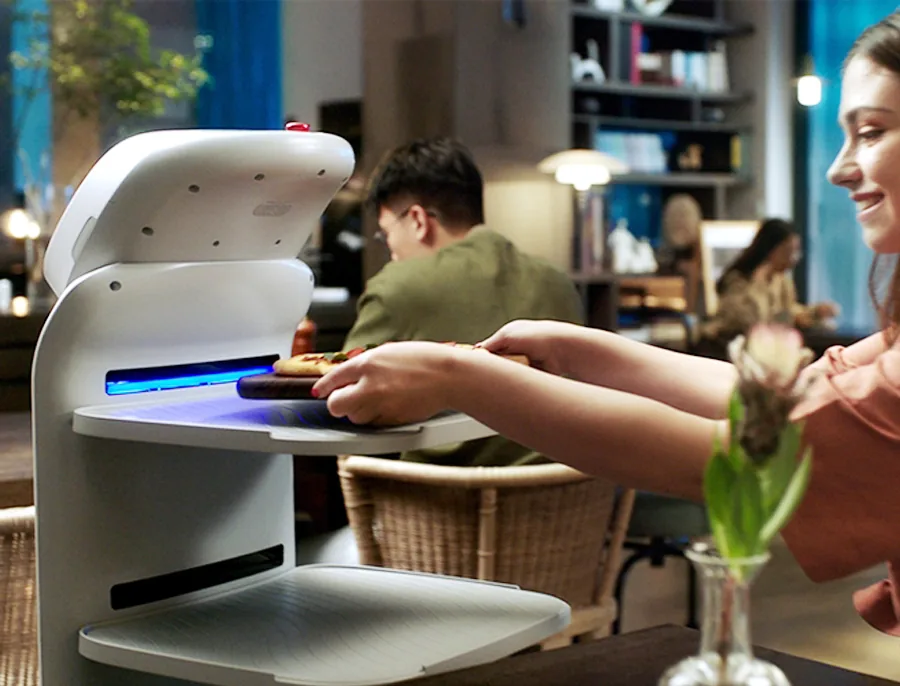
The AOMAN D1 is a tray-based delivery agent with a guest-facing screen: 40 kg of payload across four tray positions, autonomous navigation through corridors, thresholds and 70 cm passageways, and a 21.5-inch display that shows promotions, wayfinding and queue information while it travels. No operator, staff load, the robot runs, staff unload. Multi-floor operation depends on the site's lift integration, so confirm it during the site survey.
The core retail jobs
- Restock runs: stockroom to floor in defined loops. The size run for the back wall arrives without a staff round trip
- Click-and-collect: order to pickup point, per tray
- Fitting-room support: the item and the return bring themselves instead of waiting
- Campaign movement: promotional content reaches high-traffic areas because the screen travels with the delivery frequency
- Wayfinding and queue info: queue numbers, service positions and directions at the point of need
Where Each Platform Earns Its Keep
Retail stores
Stores with high restock frequency see the case most directly: every stockroom-to-floor loop is a candidate, and the trips are short enough that the four-tray design lands one robot per zone instead of one runner per department. The released time lands in fitting rooms and consultations, revenue interaction rather than walking.
A note on the display: the moving screen is only valuable where the campaign calendar is real. Content scheduled on dates, rotated per zone and matched to delivery routes beats any single hero announcement, treat the display as a media unit with a fleet, not as a poster with wheels.
In a publicly documented deployment at a retail group in Belgium, an AOMAN G1 greets visitors at the store entrance and answers direction questions in the language the visitor asks in, greeting and guidance absorbed from the floor team at entry level, while floor staff stay with customers instead of with the door.
Banking and financial services
Branch staff are specialists, and the trips they make, loan packets, signature trays, files between floors, are not billable consultation. The D1 runs the document and item loops while its display shows queue numbers and desk locations. Where visitors arrive expecting a direction, the AOMAN G1 takes entry greeting and check-in assistance with multilingual guidance, 15 degrees of freedom, six-microphone array with 5 m pickup, 13 MP camera, and automatic return to charge. Branches typically start with one unit on the document loop and add the queue display after the first month's data, the rollout pattern is additive, not all-at-once.
Corporate lobbies and exhibition halls
Welcome kits and registration packets to meeting rooms; brochure racks and catering runs between zones; tenant-specific routes in multi-tenant buildings. Forty kilograms per trip, delivery schedules on the fleet console, promotion content per event calendar on the display.
Robot vs. Kiosk vs. Staff
| Factor | AOMAN D1 | Kiosk | Staff |
|---|---|---|---|
| Moves | Yes, routes and delivers | No, fixed | Walks, and that is the cost |
| Carries goods | 40 kg, four trays | No | Yes, at walking cost |
| Display | 21.5-inch, remotely managed content | Pre-configured | Depends on the person |
| Greeting and guidance | Display messaging | Static | Full, and scarce |
| Availability | With charging rotations | Always | Shifts |
| Best for | Transport-heavy, high-footfall floors | Self-service, simple queries | Complex consultation |
Almost every working deployment is hybrid: robots at the transport layer, kiosks at self-service, humans at consultation. The question is not which wins, it is which layer each interaction belongs to.
Deployment Practicalities
Environment
- Wireless: sustained coverage along the route, test it, do not assume it.
- Floor plan: initial mapping during setup; the robot self-navigates afterwards.
- Lifts: multi-floor operations need lift integration confirmed at the site survey.
- Charging: dock placement at the route boundary, one dock will not serve a three-floor loop. Plan it as part of route design: a zone that ends at the dock runs longer than one that ends at a pickup point, and the balance between them is a scheduling decision, not a hardware one.
Staff integration
Deployment success is mostly a people question. The framing that works: the robot is the third team member. It takes the repetitive runs, staff take the conversations. One robot champion per shift handles loading and minor trouble. Share the delivery analytics with the floor: the team that sees its own trips saved stops treating the machine as a rival. The industry guides cover the pattern in more depth.
Content and route setup
Build routes on actual delivery patterns, not guessed paths; promotion calendar with start and end dates; store policy notes for the floor. Setup is handled during deployment; afterwards content is managed on the calendar, shelf-level operations change without changing routes.
Week One and the One-Month Review
The first week is operational: initial mapping, route tuning, tray-assignment practice, and the short training run each shift needs. It is boring on purpose. The one-month review is where the decision is actually made, and it runs on four questions:
- Did the route hold? Exceptions logged and fixed during the month tell you the system is being operated, not just demonstrated.
- Did the walking balance? Measure the walking hours the trip moved from staff to machine, per shift. If the number is small, the route is wrong, not the robot.
- Did the floor adopt it? Loading quality, champion attendance, complaint count. Adoption is a corridor culture fact before it is a technology fact.
- Does the calendar work? Content in, content out, seasonal promotions scheduled. The display earns its place only when the store runs it like signage, not like a novelty.
The review also answers a fifth question the spreadsheet cannot: whether the floor would fight to keep it. Loading happens either because it is watched or because it is wanted. And the wanted one is the deployment that survives the manager who runs the second month.
Illustrative Payback Example
The model is straightforward and needs your numbers, not ours. Illustrative example: a 2,000 m² store runs six restock and collect trips per hour across peak, carried by staff walking, roughly three staff-hours per day, at an illustrative $18 per hour fully loaded, about $14,000 a year. A D1 with dock, service plan and consumables under standard fleet pricing lands under $20,000 in the first year; the illustrative arithmetic puts the payback under 16 months, with the released hours landing in sales time. Raise the rate or the trip frequency and it gets faster. The honest staff note attached to every example: the savings show up as reallocation, not as reductions. The team that was running trips starts spending the time on the floor, which is the point, but it is not a headcount line.
Where This Is Heading
The direction is steady rather than radical: deeper multi-stop routing, more coordinated fleets including floor-to-lift hand-offs, and richer presentation content. Two nearer-term changes matter more for planning than the headline features: fleet software, docks and parts ecosystems mature faster than robot bodies, so the platform decision outweighs the first-year body decision. And display content tooling, meaning how fast a store changes what the screens say, is becoming the real differentiator between fleets that advertise and fleets that merely travel. The sensible procurement outlook: buy the platform that takes today's trips and executes today's calendar, the software updates deliver the next version of the same jobs, not a different machine.
The Bottom Line
Retail automation in 2026 is a layering question, not a replacement question. D1 on the transport layer, G1 at greeting, kiosks for self-service, staff for consultation. Start with the stack, run it on the navigation stack both share, then measure the walking hours the floor gets back. A venue with a different traffic pattern, and how the configuration changes for it, is covered in shopping mall deployments.
Tell us your floor layout and trip patterns, request a demonstration or pricing.