Service Robot Fleet Management Systems, Multi-Robot Orchestration for Warehouses, Hotels & Hospitals in 2026
At a glance: A 30-robot mixed fleet can run delivery, cleaning and guidance units under one coordinator, at 10+ robots, manual dispatching breaks down. This guide covers what a fleet platform must actually do.
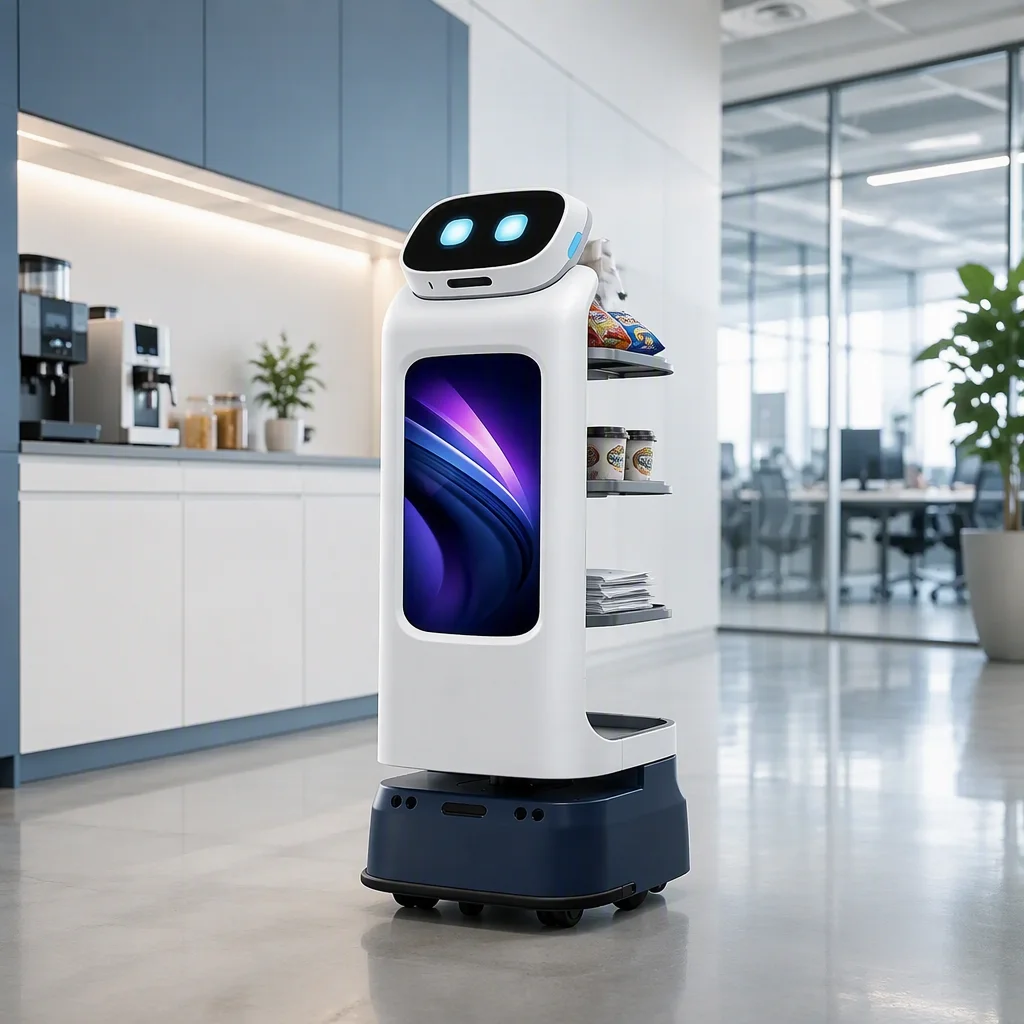
A mixed fleet, AOMAN D1 delivery robots, AOMAN C1 floor scrubbers, AOMAN C2 Pro compact units and AOMAN G1 guidance robots sharing the same corridors, elevators, and charging docks around the clock. Raises the same question at every facility: not "do the robots work?" but "who manages them?"
The answer is a fleet management platform: software that schedules, routes, monitors, and coordinates every robot on the property. Moving from piloting 2–3 robots to deploying 10–30 is where fleet coordination shifts from nice-to-have to the single point of failure in the operation. Here is what operations leaders need to know before that transition.

The Three Problems a Fleet Platform Solves
With a single robot type and one workflow, say, four delivery units in a restaurant, dispatch is simple: which idle robot takes the next order. The complexity arrives with a second robot type, a second workflow, or a second shift, and three problems emerge that no amount of manual dispatching can solve.
1. Intersection deadlock
Two robots approach the same elevator lobby from perpendicular corridors. Neither has a clear line of sight. Both stop and wait. In a facility with 10+ robots, this standoff repeats constantly without a central traffic controller. Fleet platforms prevent it by keeping a real-time occupancy map of corridors, intersections, and elevators: before a robot enters a contested zone, the platform reserves it, like a mutex lock in distributed computing, and re-plans ahead of each trajectory.
2. Charging queue collapse
Robots left to manage their own charging all head for the dock at the same battery threshold, forming a queue that wastes a meaningful share of fleet uptime. A fleet platform staggers charging windows algorithmically: it knows which robot is on a critical task, which has an idle window coming up, and which dock is closest to the robot's next scheduled task. Night-shift units dock through idle hours and rejoin the queue before the morning peak, planned capacity, not bought capacity.
3. Cross-workflow priority conflicts
At 07:30, the hotel's breakfast delivery runs are at peak demand, a unit is crossing the restaurant corridor for its morning shift, and a cleaning robot is finishing its overnight route through the same area. Without a coordinator, this is a three-way standoff every morning. With one, delivery gets right-of-way at the guest-facing window, the crossing unit re-routes through the service corridor, and the cleaning unit pauses its route for a few minutes, then resumes. The priority engine factors guest impact, task deadlines, and battery levels. And it decides in seconds, not after a phone call.

Fleet Architecture: Centralized vs. Distributed vs. Hybrid
| Architecture | How It Works | Best For | Limitation |
|---|---|---|---|
| Centralized | One server schedules all robots, holds the full map, assigns all tasks | Single-vendor fleets, sub-30 robots | Server failure is fleet failure; high latency degrades performance |
| Distributed | Robots run edge compute and negotiate tasks peer-to-peer | Multi-vendor fleets, 30+ robots, multi-building campuses | Higher per-robot compute; emergent behavior harder to debug |
| Hybrid | Central scheduler for task assignment + local navigation per robot | Mixed workloads, sub-100 robots | Requires documented integration paths for non-AOMAN robots |
AOMAN FUTURE's fleet platform uses the hybrid model. The coordination layer handles global decisions, task assignment, charging windows, elevator reservations, zone priorities, while each robot runs its local SLAM stack and obstacle avoidance independently (the technical layer is covered in our SLAM navigation article). If the coordination layer loses connectivity, robots finish their current task from a short local queue instead of freezing in place.
What the Scheduler Optimizes For
Hotels: minimize guest wait time
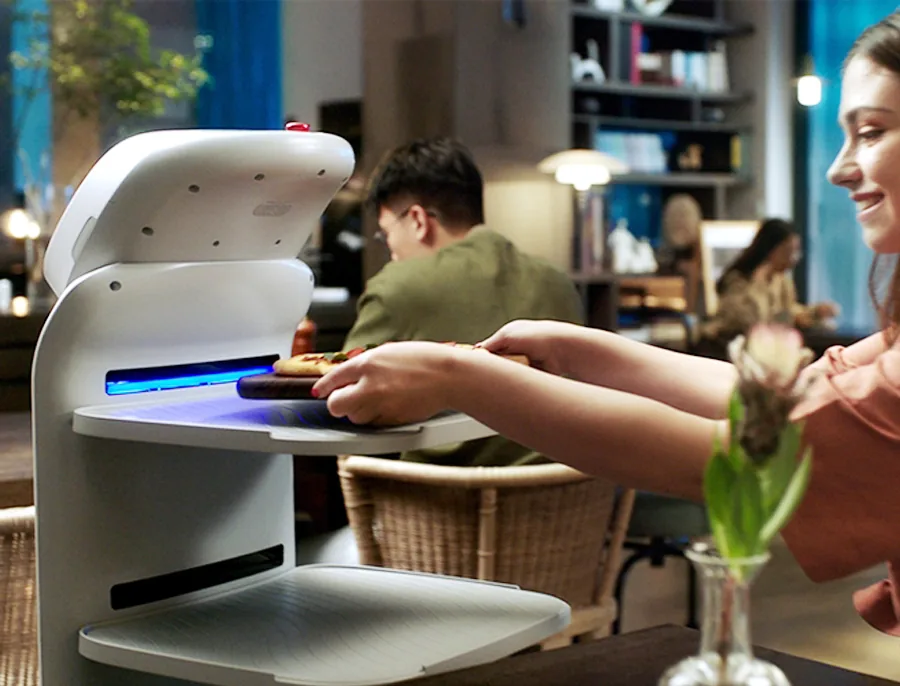
An 11 PM request for a toothbrush is not a fleet-efficiency problem; it is a door-to-door time problem. Hotel scheduling uses shortest-time-to-doorstep as the primary metric, weighted by guest tier. Illustrative example from an 8-unit delivery deployment: with coordinated dispatch, average delivery time drops from the mid-teens to single digits and peak-hour capacity roughly doubles, largely because idle robots stop waiting for a human to notice them. In a publicly documented deployment at a ramen chain in Kyushu, Japan, AOMAN D1 units carry orders from the kitchen window to tables, dispatched from a single on-premises coordinator.
Hospitals: maximize task completion rate
A late lab sample is a clinical risk, not an inconvenience. Hospital fleet scheduling prioritizes on-time completion: reserved lanes for STAT deliveries, planned battery reserves per task class, and elevator slots coordinated with the building management system.
Warehouses: maximize throughput per aisle
In a distribution center the constraint is aisle width and dock access, not robot speed. Scheduling coordinates delivery units with human pickers so neither waits for the other.

Multi-Vendor Integration: The Real-World Challenge
Few facilities buy everything from one vendor. A property might run AOMAN delivery robots, a non-AOMAN vacuum unit from another supplier, and a third vendor's patrol drone. And the platform has to coordinate all of them across different APIs. Three integration approaches exist:
Vendor-native fleet platforms. Full coverage of scheduling, firmware updates, diagnostics, and task assignment with zero integration latency, but only for that vendor's robots. In a mixed fleet, the platform manages its own units and none of the others.
Third-party orchestration platforms. These connect to many robot APIs through a unified dashboard. The tradeoff: every API exposes a different feature subset, one battery level but not task status, another position but not firmware version, so the orchestration layer works at the lowest common denominator, often just "online and where."
Middleware plus human dispatch. A tablet-based dispatch app listing all robots, with operators assigning tasks manually. It is slower and more error-prone, and it works until coordination complexity exceeds one person's span. Around 12–15 robots is where manual dispatch's assignment errors start eroding the business case.
Fleet Metrics That Actually Matter
Operations teams should track four metrics, not twenty:
| Metric | Definition | Healthy | Red Flag |
|---|---|---|---|
| Utilization rate | Share of operating hours actively on task | >85% | <70% |
| Task completion SLA | Share of tasks completed within the deadline window | >98% | <92% |
| Intervention rate | Human interventions per 100 robot-hours | <2 | >8 |
| Fleet uptime | Share of units operational during scheduled hours | >97% | <90% |
Intervention rate is the most diagnostic. Every intervention, a stuck robot, a missed delivery, a false obstacle detection, is a staff member who stopped their primary job to babysit a robot. When the rate climbs, staff start pre-emptively overriding the system or bypassing it entirely, which creates more interventions in a downward spiral. The fix is rarely better robots; it is tighter scheduling, smarter charging windows, and proactive traffic resolution.
Scaling from Pilot to Production Fleet
Phase 1, Pilot (2–4 robots). One robot type, one workflow, one shift. Measure utilization and task completion. Skip the fleet platform, the complexity does not justify it yet.
Phase 2, Validation (4–8 robots). Add a second shift or a second workflow. Intersection conflicts and charging queues appear here. Deploy the platform now. Not because 8 robots need one, but because the learning curve takes weeks and you want it stable before Phase 3.
Phase 3, Scale (8–20 robots). Add robot types (cleaning plus guidance) and extend to all shifts. The platform is now non-negotiable; cross-workflow scheduling becomes the dominant concern. Train 2–3 fleet operators. Dispatch coordinators who understand the scheduling logic and can override when edge cases arise.
Phase 4, Optimize (20+ robots). The fleet largely runs itself. The team moves from "are the robots working?" to "can we improve throughput this quarter?", driven by congestion heat maps, utilization trends by shift, and task-type performance comparisons.

Integration With the Systems You Already Run
A fleet platform does not operate in isolation. It connects to four systems already running in most commercial facilities:
Building management system (BMS). Elevator control and door triggers become robot-requested actions instead of human button presses, turning an 8–12 minute round trip into a scheduled, reservation-backed stop.
Property management system (PMS). Room status, VIP flags, and do-not-disturb markers let the scheduler route deliveries around occupied rooms and match service to guest tier.
Warehouse management system (WMS). Pick lists and inventory locations feed robot tasks the moment a bin runs low, no human work order.
Access control. Robot deliveries and badge logs correlate, so restricted doors stay restricted and delivery runs are auditable. Confirm protocol support with your security vendor before contracting.
How to Choose a Fleet Platform
- Vendor coverage . Does it manage every robot type you own today and plan to acquire within 18 months? If not, budget for a migration path.
- Scheduling sophistication . Cross-workflow priority (delivery vs. cleaning vs. guidance on the same corridor) and predictive charging rather than fixed thresholds. First-come-first-served logic will not scale past a handful of robots.
- Integration surface . Documented APIs for BMS, PMS, WMS, and access control. "We can build a custom integration" means months of engineering; pre-built connectors mean days.
- Edge resilience . What happens when the central server drops? If the answer is "robots stop," so does your operation. Require a local task cache that covers a short outage.
- Analytics depth . Utilization by robot, by shift, by task type, plus raw telemetry export. A green-dot/red-dot monitor is a monitoring tool, not a management platform.
The Fleet Is the Product
Individual robots do individual tasks well. A managed fleet delivers the facility-level outcome, guest satisfaction scores, patient throughput, picks per shift, that no single unit achieves alone. Teams that treat fleet management as core infrastructure spend their first year measuring throughput improvements; teams that treat it as an afterthought spend it fixing deadlocks and charging queues. The zone-by-zone routing and cycle-time side of the same decision is worked through in custodial robot management software.
Every AOMAN FUTURE robot runs under the same coordination layer, with spare parts and support from one team. Tell us your floor plan and shift pattern . We will model the fleet size, charging windows, and dispatch rules for your building.