Service Robots for Supermarkets & Grocery Stores, The Complete Store Automation Guide
At a glance: Grocery stores take more floor abuse than almost any other retail format, and their curbside programs run on walking speed. An AOMAN C1 scrubs 2,040 m² per hour overnight, a quiet AOMAN C2 Pro touches up in daytime, and an AOMAN D1 carries 40 kg of pickups per run, here is where each fits.
Supermarkets operate under constraints that most retail formats avoid: food safety requirements that apply to every surface and every task, perishable inventory where an out-of-stock is lost revenue that cannot be recovered next week, and margins that leave no room for a pilot that does not show up on the P&L. Service robots have to be judged against that standard, including each unit must map to a real line item.
This guide covers the four AOMAN roles that fit a grocery operation, the zone structure that keeps them coordinated, and the rollout order we recommend. Product figures are AOMAN FUTURE platform specifications; financial figures are illustrative examples to be rebuilt with your own cost basis.
What makes grocery automation different from general retail
Food safety is the overlay everything must pass
Grocery robot deployments operate inside a regulated food environment. Cleaning programs need to follow the store's sanitation schedule, water-based scrubbing and squeegee recovery in produce and bakery zones, and separation between raw food zones and ready-to-eat areas per the store's own HACCP-style protocol. Uncommitted machinery in aisles, clutter in service corridors, and spill handling are all already managed by store SOPs; a fleet simply needs to schedule inside them. That is a planning constraint, and a manageable one, but it has to be in scope on day one.
Customers are right there, all day
A warehouse runs automation behind barriers; a supermarket runs it in the same aisles as pushcarts, toddlers and walkers. The practical consequence is that guest-facing fleet members work at pedestrian speed, stay clear of shoppers, and perform best in defined time windows. That is why the groceries article starts with the closed-store shift.
Margins leave no room for a warm-up project
Food retail operates on thin margins, so the deployment order should follow certainty: start with the application whose savings are the most directly measurable, prove it on one store, and scale after the accountancy confirms it. This guide follows that order.
Four roles that fit a grocery store
1. Nightly floor restoration, AOMAN C1
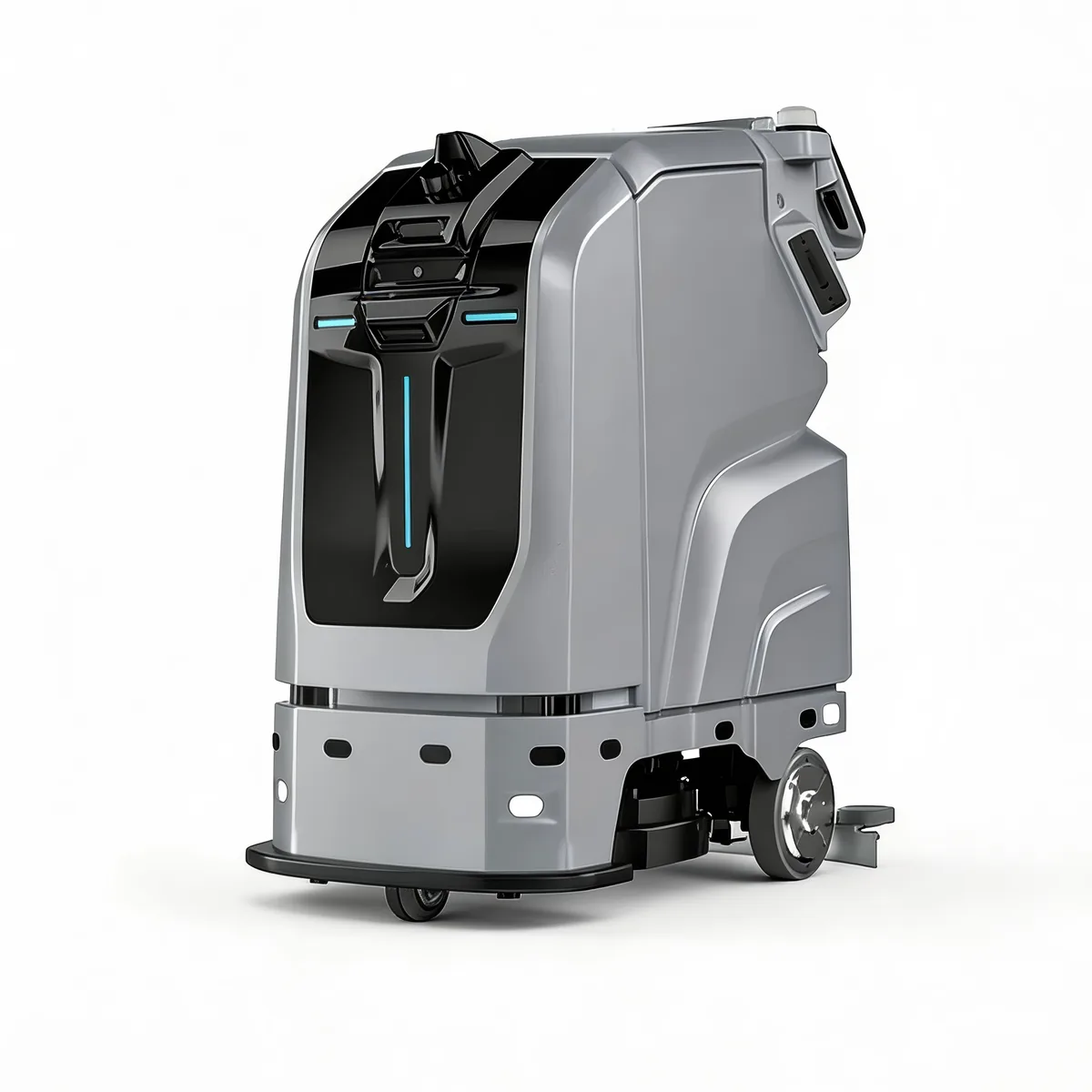
Grocery floors take heavy punishment, water and leaf debris in produce, protein residue near meat counters, flour dust in bakery, tracked-in grit at the entry. The C1 approaches this as an overnight reset: 2,040 m² per hour of scrubbed, squeegeed, recovered hard floor, 70 L fresh water plus 50 L recovery so the full-store cycle runs without a mid-shift refill, and a 790 mm squeegee width that helps finish a 10,000 m² sales floor in about five hours of machine time at the rated rate.
Because the store is empty at that hour, no guest-facing interaction rules apply and the route can cover the whole footprint. The modular-tank AOMAN C2 Pro handles the tighter pocket areas, checkout alcoves, service counters, back-office floors, where a smaller, quieter unit gets in without relocation of displays.
2. Daytime touch-up, AOMAN C2 Pro
Between the 10 PM reset and the next 10 PM reset, produce aisles degrade. A quiet C2 Pro running a short daytime route, after the morning produce delivery, at the mid-afternoon lull, keeps the store presentable without a visible machine program. It fits 85 cm aisles, slides under service counters at 70 cm clearance, and its modular tanks allow a quick swap at a cleaning closet.
3. Curbside and back-of-house transport, AOMAN D1
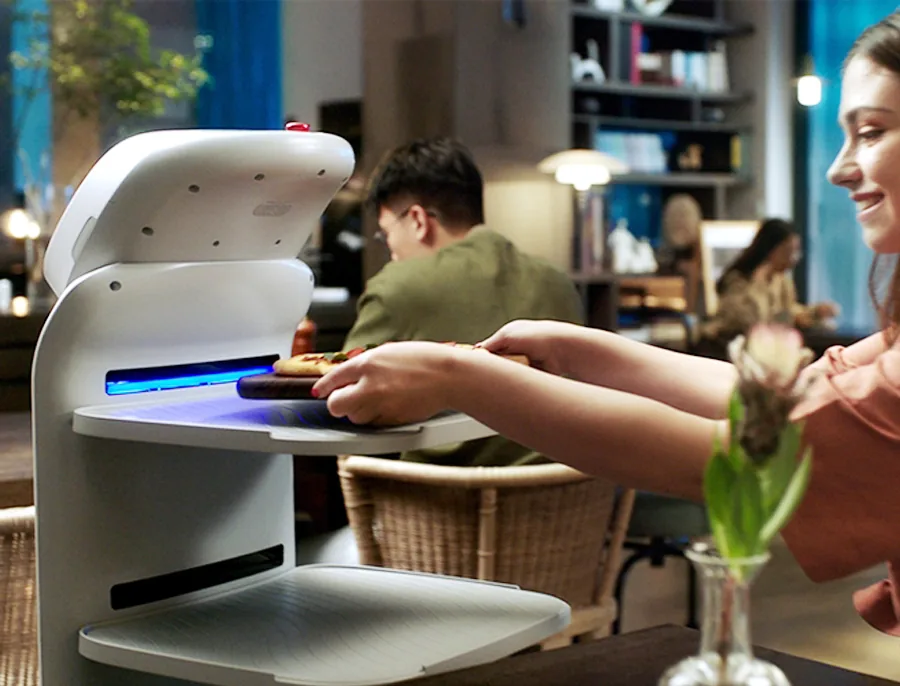
Curbside pickup in grocery turns on a runner carrying orders from staging to the parking lot. The D1 takes that corridor: 40 kg of payload on a four-tier tray, and 70 cm aisle clearance, which covers the back-of-house corridors and the pickup staging layout typical of a mid-size store. One robot at the staging dock keeps the fulfillment runner at the pickup point instead of walking the floor, and in peak windows (the 4–7 PM curbside surge) it keeps pace that staffing cannot flex for.
The same unit moves materials inside the store: catering supplies to the prep area, boxes from receiving to storage, merchandising materials to front-of-house. Payload on a per-run basis is 40 kg. Meaning bulk skid work stays with people or carts, while the recurring run set is automated.
4. Entrance assistance, AOMAN G1
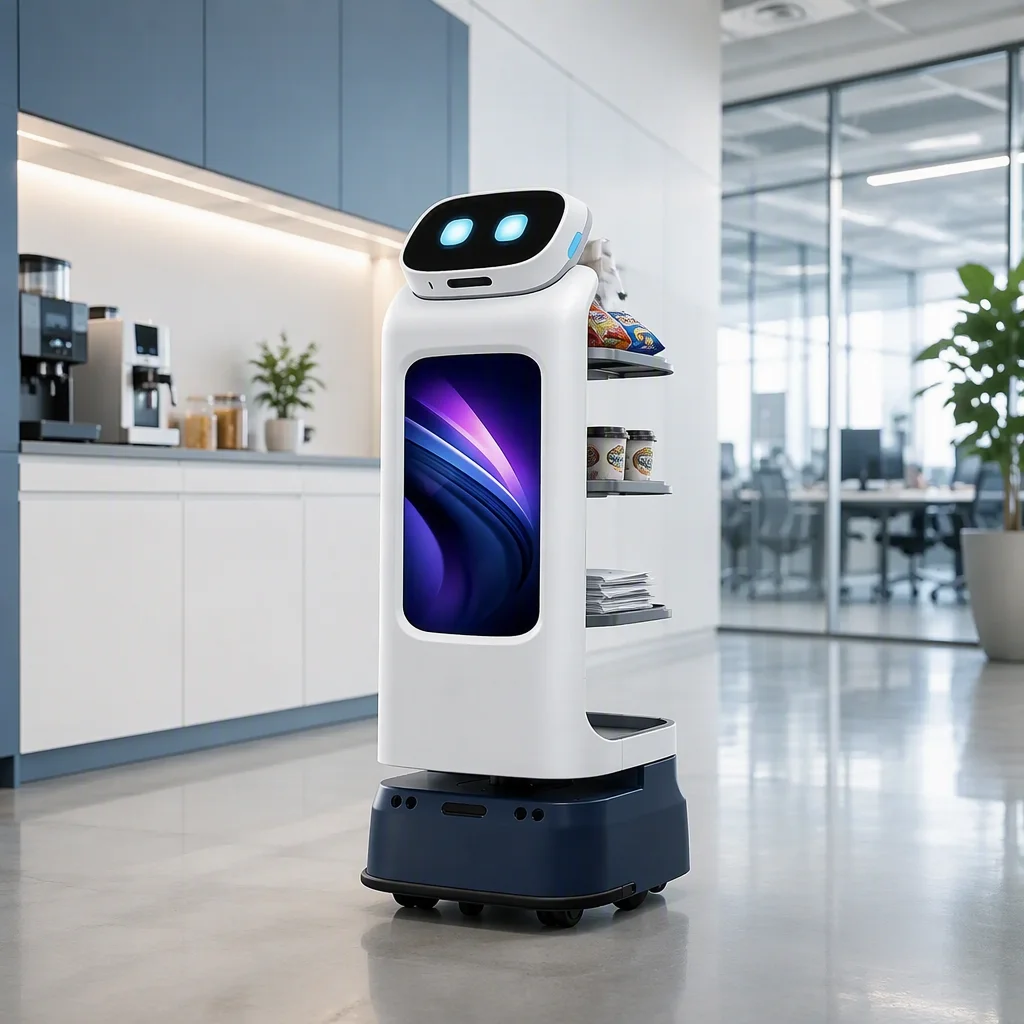
"Where is the olive oil" and "where is the pharmacy counter" are the two questions every grocery associate answers hundreds of times. The G1 handles them at the front door and the center-store junction: six-microphone array at 5 m range so it hears customers over the refrigeration hum, multilingual guidance for internationally staffed or bilingual catchment areas, and a 13 MP camera so associates can see the conversation and jump in when help is needed. It also assists with check-in for in-store events, a tasting weekend, a kids' baking class, a nutrition orientation. Between runs it returns to its dock and charges automatically.

Zone structure for a grocery fleet
Grocery layouts separate cleanly into three zones, which makes fleet coordination simple to describe and simple to enforce.
| Zone | Contents | Fleet plan |
|---|---|---|
| A, Sales floor | Aisles, produce, bakery, deli, checkout | C1 overnight full reset; C2 Pro daytime touch-up; G1 at entrance and center-store |
| B, Curbside & perimeter | Pickup lanes, cart corrals, entrance vestibules | D1 on pickup runs; C2 Pro vestibule cleaning |
| C, Back-of-house | Receiving, cold storage, prep, break rooms | D1 material transport; C1 periodic deep pass |
Zone transitions are scheduling matters, not hardware matters. The fleet dashboard holds separate maps for sales floor and back-of-house, and staff set the crossing rules. Delivery runs from receiving to the sales floor happen on defined routes during defined windows, per the store's food-handling SOPs.
Two scheduling rules keep the zones coherent. Robot runs inside the sales floor are planned around the store's own cycle, the produce night drop, the bakery pull, the checkout staffing curve, so staff never have to explain a machine march to the customers mid-shop. And the fleet schedule is published daily rather than improvised: a one-page run sheet is exactly the artifact a store manager can hold while the machine does its rounds.

The rollout order
Stage 1 (months 1–2): one C1 on the highest-volume store, overnight only. Measure machine hours versus the crew hours it absorbs, and the daily opening condition on a simple visual standard.
Stage 2 (months 3–5): add the C2 Pro daytime pass and the G1 at the door; extend the C1 to the curbside exterior zones where the site allows. This is the point where automation becomes visible to customers, so the G1 and C2 Pro are chosen in part because they signal service, not cost-cutting.
Stage 3 (months 6–9): add the D1 curbside run, then scale the found set to 3–5 more stores. Multi-store scale is where training, choreography and maintenance workflows mature, see the AOMAN product line for the platforms, and the retail industry overview for adjacent retail deployments.

What to ask before you buy
Four numbers decide most of the purchase: the floor plate per zone (so coverage follows from the rated rate), the night crew hours and rate you currently pay, pickup volume by hour of day (to size the D1's run schedule), and the sanitation windows the fleet schedule must respect. Vendor-side, ask how the units handle the store's obstacle set, pallet jacks, display risers, checkout lanes, wet-floor signs, and what the escalation path is when a scheduled run is missed; grocery is a 7 AM–10 PM business and a visibly stuck robot is the worst kind of failure. Ask for the receiving docks, chiller corridors and back-of-house drawers on the same drawing as the sales floor, then check that the fleet reporting shows zone coverage rather than a single happy path.
The economics: an illustrative example
Build the store model on three lines: cleaning labor, curbside labor, and stock conditions that were not being measured before.
- Cleaning . A mid-size store's floor cycle runs about five C1 machine-hours at the rated rate. Against a nightly crew, the comparison on a rate-card basis is usually the line item the store already budgets. Run the model at your rates.
- Curbside . If the store does 100 pickup orders a day, roughly an hour of D1 run time at typical walking speed covers that volume of transfers. The robot does not take breaks at the 5 PM peak, which is the staffing problem curbside always has.
- Stock condition . A clean, staffed-assist floor supports the inspection outcomes the store already cares about. This line is worth tracking, even if the amount is store-specific.
The models above give the shape, not the answer. Run the cleaning line at your contract rate, the curbside line at your labor cost and your measured pickup volume, and hold the stock-condition line as a tracked observation rather than an assumption. That discipline is what lets a chain scale a proven store configuration instead of a paper one.
To keep the first year's payback honest, the recommended sequence is C1 first (measurable immediately), then G1 and C2 Pro when the store is ready for guest-facing automation, then D1 when the pickup volume justifies it. A venue with a different traffic pattern, and how the configuration changes for it, is covered in small-format retail.
Tell us your floor plate, pickup volume and night-crew schedule. We will recommend a store configuration and return indicative pricing within 24 hours. Request pricing.