Service Robots for Restaurants & Food Service, The 2026 Buyer's Guide | AOMAN FUTURE
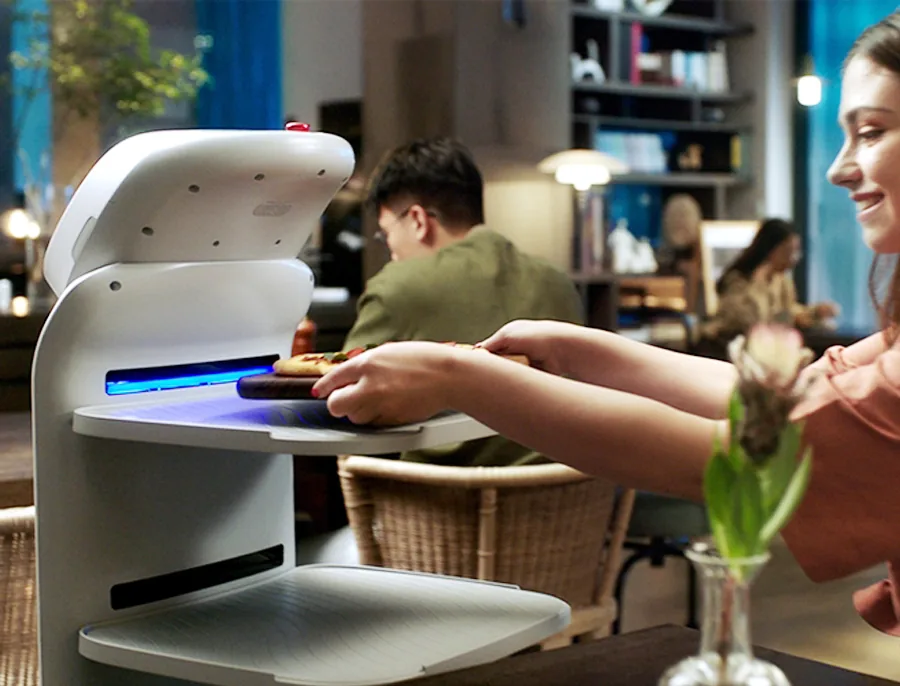
At a glance: AOMAN D1 carries 40 kg across four trays per run -- roughly four courses at once across a dining floor. This guide covers the delivery, host and cleaning roles that fit a restaurant, plus the ROI model to run against your own volumes.
In a dining room, every minute of a plate's journey is a minute of a table's patience. The kitchen-to-table walk -- pickup, traverse, handoff -- is the highest-frequency, lowest-judgment task in a restaurant, which makes it the natural entry point for automation. Whether a robot belongs in a specific operation depends on three things: volume per service, floor layout, and how the kitchen actually hands off its passes.
Two deployment records are worth knowing before the analysis: in a publicly documented deployment in Japan, a ramen chain in Kyushu runs AOMAN D1 units for kitchen-to-table carries; in a second publicly documented case, a Korean BBQ restaurant in the Netherlands uses the same units for grill-course service. Both are modest-footprint operations, and both demonstrate that the mechanics transfer to real service floors.
The roles that fit a dining room
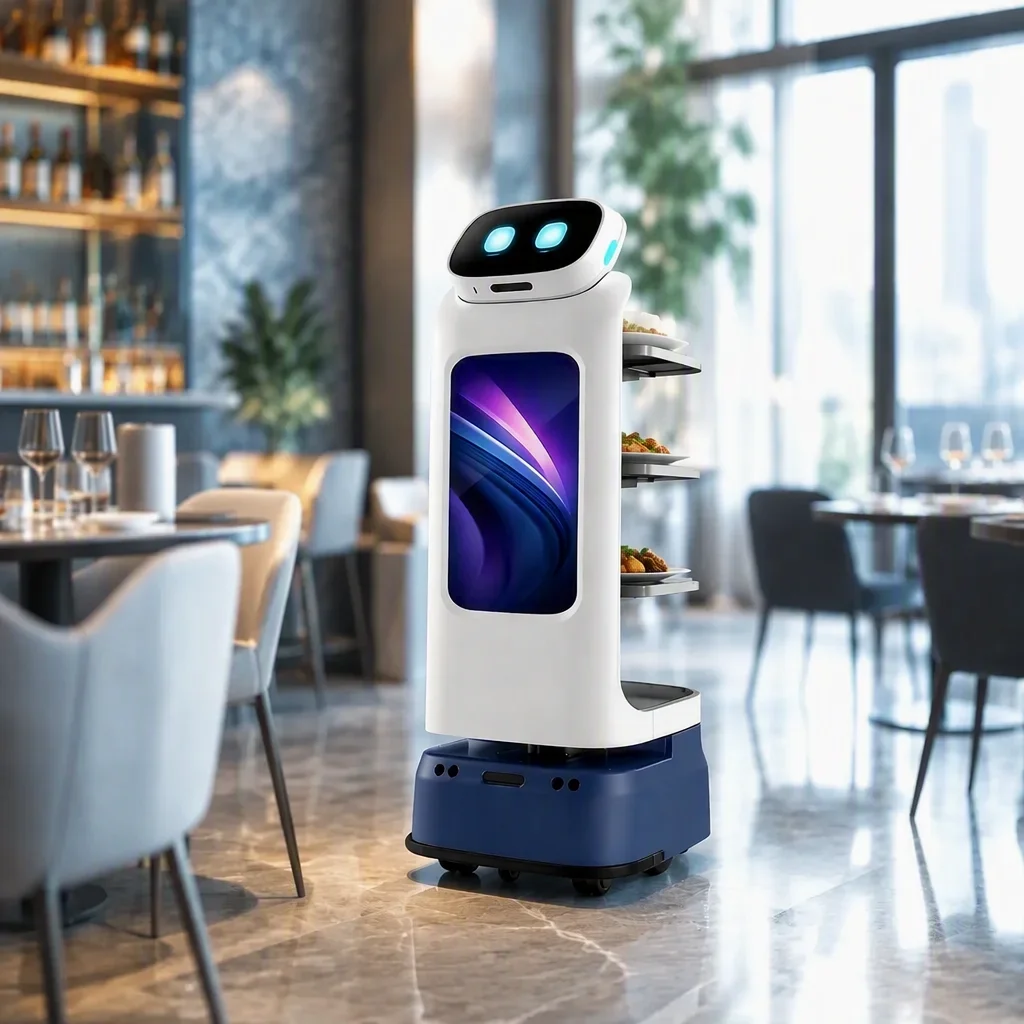
Kitchen-to-table delivery: the AOMAN D1
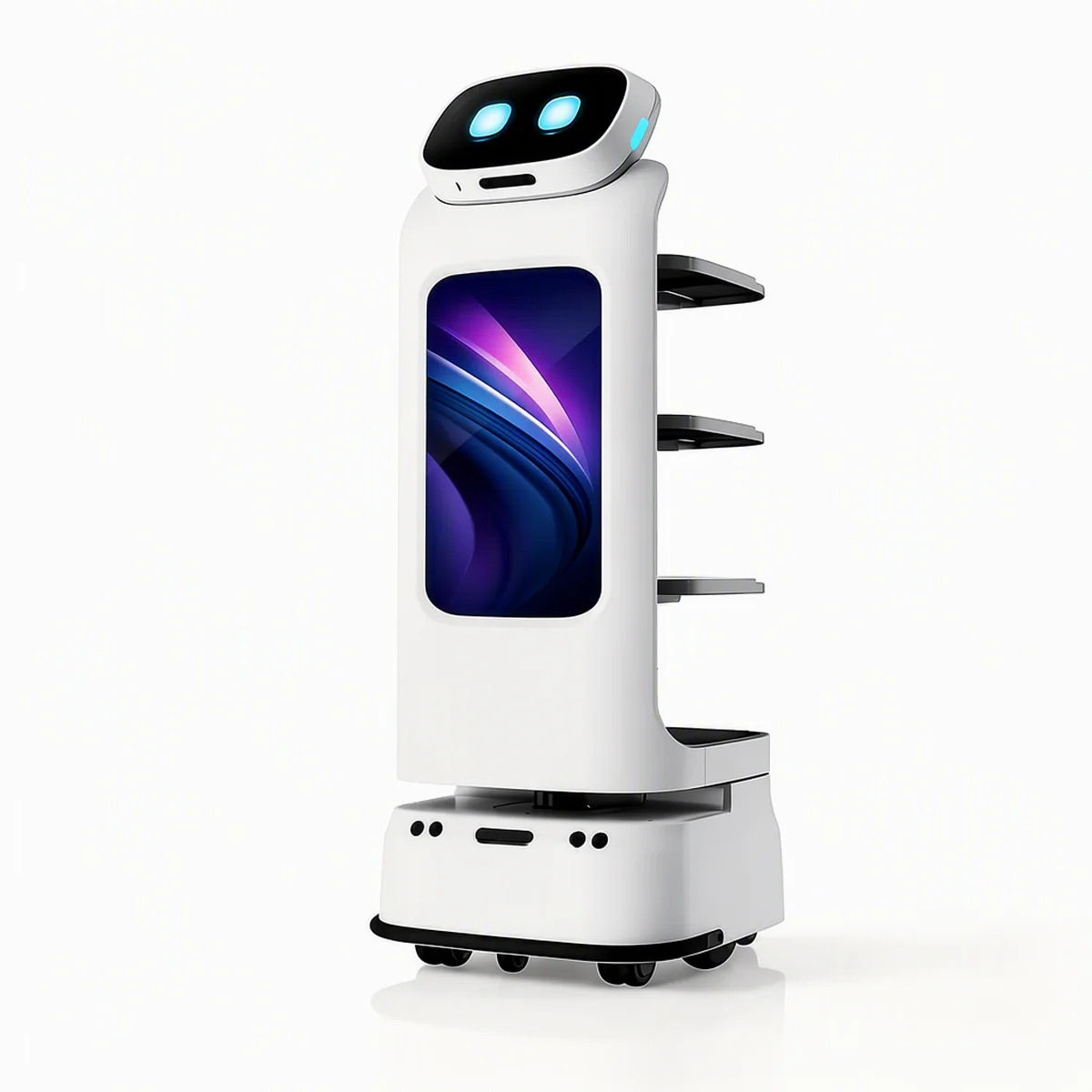
The AOMAN D1 carries up to 40 kg across four trays and clears a 70 cm aisle -- one unit can stage a section's worth of courses in a loop instead of one server carrying one tray. That matters in high-turnover formats: tables turn on the rhythm of food arrival, not on how many plate-runners you have. The 21.5-inch screen on the unit doubles as a table-status and route display for the runners watching the floor.
Host stand and waitlist: the AOMAN G1
Friday 7-9 PM waitlist handling is a bounded, repeatable job, which is what the AOMAN G1 is built for: 15 degrees of freedom for natural movement, a six-microphone array with 5 m pickup for a noisy lobby, a 13 MP camera, and multilingual welcome. Waitlist signup, queue status, and standard menu questions resolve at the unit; anything beyond a standard answer escalates to the host.
Floor and back-of-house cleaning: the C2 Pro and C1
The AOMAN C2 Pro fits the back-office and service-corridor reality of most restaurants: quiet, modular water tanks, 85 cm aisle, and clearance under a 70 cm tabletop. For the dining floor itself -- nightly scratch and degrease of a section -- the AOMAN C1 covers up to 2,040 m²/h with a 790 mm deck and 70 L + 50 L tanks. The pattern most operations land on: C1 after close, C2 Pro for the midday touch-up.

An illustrative ROI model
Illustrative example -- model it against your own volumes before you believe it.
| Assumption | Value |
|---|---|
| Seats | 220, two services per day |
| Kitchen-to-table carries per service | ~ 220 |
| Loop time with a D1 (loading + 4 stops + return) | ~ 12 min |
| Carries per unit per service | ~ 64 (16 loops x 4 stops) |
| Rounding | 2-3 units cover most of a service; the pass remains the limit |
The point of the model is the constraint it surfaces: the kitchen pass, not the robot, sets throughput. If plating speed cannot feed the units, the units wait -- so pair the robot conversation with a staging redesign, or the table above stays hypothetical.

Making it operational
The kitchen pass is the interface
Give the robot a defined staging shelf by the pass, dispatch it from the order system (most POS / KDS stacks expose what is needed, or a middleware bridge does), and close the loop when it returns. The failure mode in most restaurant robot stories is not navigation -- it is that nobody changed the pass. Also specify insulated or heated tray options if your food waits at that shelf; the decision belongs in the RFP, not after installation.
Three rules for crowded floors
Drop to walking speed around tables, use audio cues, and stay to mapped lanes that avoid the servers' tray-carry lines. Staff know the choreography; make the robot the one that adapts.
Table mapping
Assign table numbers to map coordinates once, and route dispatch from the ordering system. SLAM-based navigation makes this a configuration step rather than per-run work, so layouts that change -- moving a table to seat a party of eight -- are a re-map, not a re-engineering.
Dispatch patterns
- Peak dispatch -- during service, the unit takes the next ready order from the staging shelf; keep the shelf hot and the unit never waits.
- Off-peak staging -- between services, the same unit does restock runs: condiment crates, glass racks, menu cards, station supplies.
- Bussing support -- a tray-to-kitchen lane for dish returns clears the restaurant floor so the busser's time goes into reset, not long walks.
Charging and docking in a tight footprint
Kitchen floors are wet and dock space is contested. Plan the charging corner explicitly: a level, dry, dedicated position near the pass (or an adjacent back corridor), with a drip tray under it and a clear rule that nothing gets stacked on the dock. A robot parked in a walkway at 2 PM is a kitchen complaint, not a robot problem -- the dock placement was the failure.
Where robots do not fit
- Small fine dining -- the human presence is the product; a silent machine at a tasting course fights the concept.
- Stair-heavy or split-level layouts -- without a service elevator, the route simply breaks.
- Short-run pop-ups -- mapping and onboarding time exceeds the operating window.
Compliance and food-safety notes
Restaurant floors are wet, greasy, and busy. Specify water-resistant enclosures appropriate to each zone (IPX4 or better for kitchen-adjacent work), food-contact-compatible tray liners, and chemical compatibility with your approved floor-wash products -- a cleaning robot running the wrong chemistry is a liability, not an upgrade. For the EU, confirm the platform carries the relevant CE directives for machinery and EMI; ask the vendor for the declaration of conformity rather than a marketing sentence.
Two more practical notes. First, tray liners and compartment surfaces that touch food lose to regular cleaning -- schedule the wipe-down in the close, and order spare liners with the robot, not three months later. Second, wet-mop chemicals: check compatibility between the cleaning unit's solution system and your approved floor-wash products before the first night shift, not after a residue complaint.

Questions to put in the RFP
- Which tray configurations ship (4-tray, 2-tray, insulated) and what do they carry per service?
- Does the fleet manager talk to your POS / KDS directly, or is middleware required?
- What are the docking and charging requirements in a kitchen-adjacent zone?
- How are software updates delivered -- over-the-air or on-site?
- What is the standard service response time in your region, and what is the warranty term on motors and battery?
- What training is included for front-of-house and kitchen teams?

A realistic six-week path
| Week | Activity | Deliverable |
|---|---|---|
| 1 | Survey + mapping | SLAM map of dining floor, kitchen pass, bussing route |
| 2 | Order-system integration | Live dispatch from the ticket system |
| 3 | Staff training + dry runs | Confident handoff at the pass |
| 4 | Soft launch, off-peak | Route and timing validation |
| 5-6 | Full service hours | Robot on every service |
The one variable that genuinely stretches this timeline is order-system integration; ask the vendor for their list of pre-integrated systems before you sign.
The failure patterns worth watching for are operational, not technical. Week two is usually where the robot stops getting loaded because the kitchen never got its own staging shelf; week three is where the unit gets left on the dock because the champion changeover was skipped; and week four is where a menu change goes in without a map refresh. Each one is a checklist item, not an engineering fault -- and each one is why the six-week path exists instead of a two-day install.
From one outlet to a group
For chains, the leverage is not one unit per store -- it is the standard. A group of shops that standardizes staging shelf, dispatch trigger, and map format can roll out one platform across new outlets with the same training deck. Multi-site sequencing is covered in the multi-site deployment strategy guide: the pilot outlet becomes reference and the rollout follows its playbook. Whatever the number of outlets, keep the map format centralized -- a store that maps one way and a successor that maps another costs a week of retraining.
Bottom line
A restaurant robot decision is a labor-economics decision with an operator-derived payback model. For the configuration questions in depth, see the delivery robot selection guide; for the full model, the service robot ROI guide.
Send us your covers-per-day, the distance from pass to tables, and your layout constraints -- contact the AOMAN FUTURE food-service team and we will come back with a scoped pilot plan for your dining room.