Service Robots for Agricultural & Food Processing Facilities, Autonomous Operations for Hygiene-Critical Production Environments
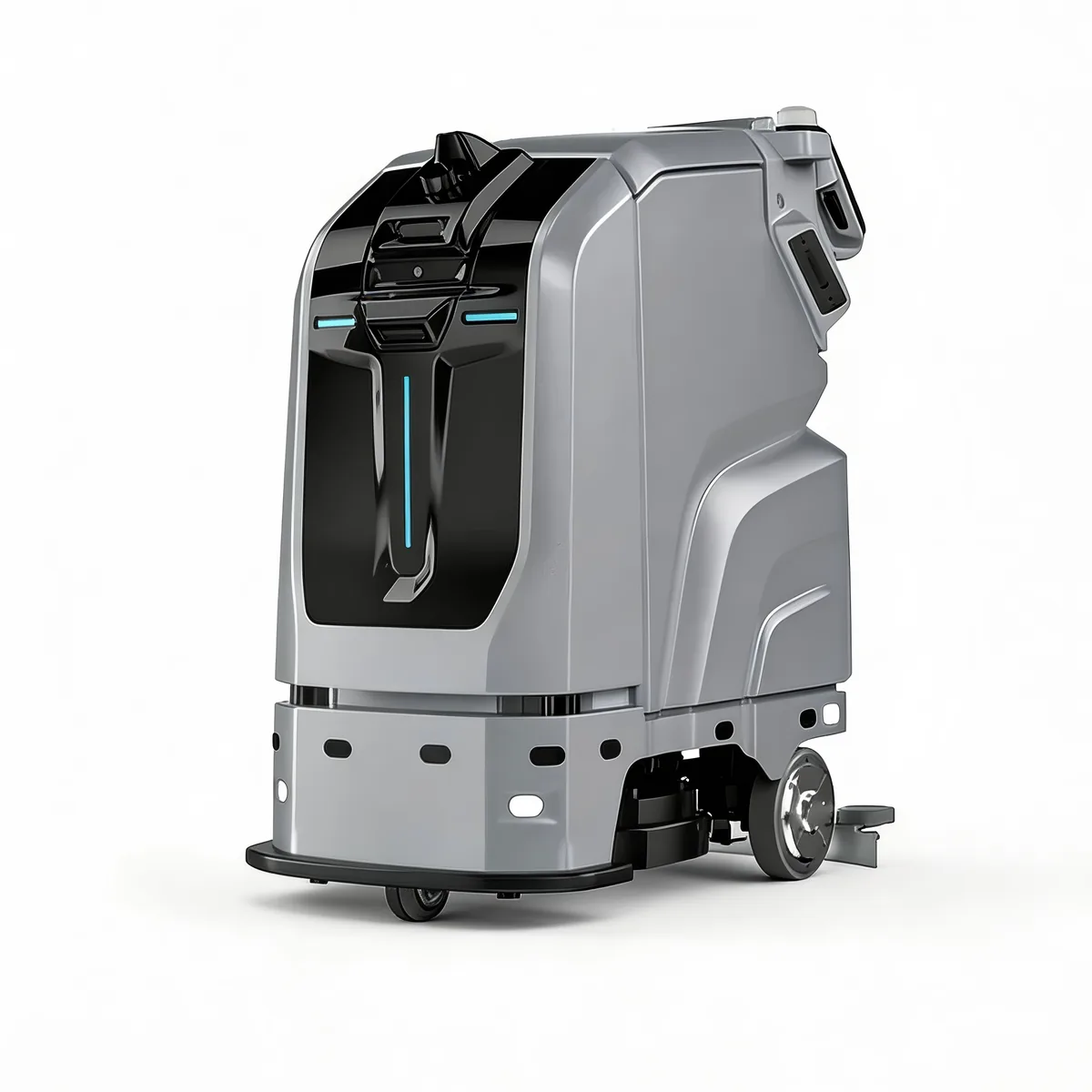
At a glance: The AOMAN C1 scrubs up to 2,040 m²/h with a 790 mm squeegee and leaves an auditable pass log behind; the AOMAN D1 moves 40 kg per trip on geofenced, zone-separated routes. This guide maps both to a facility running FSMA preventive controls and a HACCP plan.
Food processing facilities operate under some of the most stringent hygiene regimes in any industry. In the United States, the FDA Food Safety Modernization Act (FSMA) Preventive Controls rule, 21 CFR Part 117, requires that facilities implement sanitation preventive controls as a documented part of their food safety plan. In practical terms, that means cleaning procedures must be written, validated, executed on schedule, verified, and auditable. On top of that sits the facility's own HACCP plan and, for many processors, third-party certification against SQF or BRCGS frameworks. That is a lot of documentation for work that is done with a mop.
Autonomous cleaning robots enter this environment on their own terms: continuous execution, repeatable paths and machine-generated records. And the discipline of work that is only started when a person is available. This guide covers where cleaning and delivery robots fit inside a food safety plan, and the precautions that keep them from being a contamination vector themselves.
Why Autonomous Cleaning Counts as a Sanitation Control, Not a Housekeeping Cost
Hand hygiene and facility hygiene share the same logic: control the timing, control the procedure, log the execution. A cleaning robot can be held to that standard in three ways a human crew cannot.
Continuous cycles instead of periodic intervention. A traditional mid-shift clean leaves contamination accumulating for the intervening hours. A floor maintained on continuous cycles, the AOMAN C1 covering up to 2,040 m²/h, never builds that long accumulation window. From a HACCP perspective that converts the sanitation control from a periodic intervention into a continuous preventive measure, which is the stronger position during an FDA or third-party audit.
Repeatable, validated paths instead of operator variability. Cleaning thoroughness varies across shifts, workers and hours within a shift. A robot executes the same validated route every cycle, with deviations recorded in the fleet log. The log answers the three questions auditors ask first, what was cleaned, when, and with what parameters, because the traces of the machine are the record.
Fewer people in the processing zone = fewer cross-contamination vectors. Every human entry into a processing zone carries a vector: footwear, clothing, hair, respiratory droplets. Any device that moves non-processing traffic, sample runs, label rolls, tooling, between zones instead of walking people through them reduces the vector count without any process change. The same logic applies at a larger scale in production and logistics environments generally.
There is one qualification that belongs in any proposal upfront: the robot's own materials. A platform used in or adjacent to processing zones should be specified with food-compatible materials and seals suitable for the chemical cleaning regime used on the floor. Food-grade lubricants in drive components, sealed electronics, and a chassis that tolerates the washdown chemistry it will encounter. Confirm the specification during the site survey, not after delivery.
Surface Compatibility: One Facility, Six Floor Types
Food processing floors are not uniform, and the cleaning chemistry differs by zone. A single facility can carry several surface types, each with different friction, porosity and chemical-tolerance requirements.
| Surface type | Typical location | Cleaning challenge |
|---|---|---|
| Urethane cement | Kill floor, evisceration | Non-slip aggregate texture needs more brush pressure; solution chemistry changes by zone |
| Epoxy with antimicrobial additive | Ready-to-eat zones, packaging | Smooth, easiest surface, keep brush aggressiveness low to avoid scratching |
| Acid brick with chemical-resistant grout | Marination, acid-wash areas | Grout lines retain moisture; aggressive chemistry degrades standard seals |
| Stainless steel diamond plate | Freezer tunnels, blast cells | Low temperature and ice; heated fluid systems and low-temperature-rated components required |
| Quarry tile | Older facilities, dry storage | Grout erosion and uneven surfaces trigger suspension and edge-following adjustments |
| Polished concrete | Administrative corridors, break rooms | Lowest cleaning intensity, robots mainly replace scheduled custodial passes |
Zone transitions matter as much as the surface itself. When a robot switches from a production zone to an adjacent corridor, the route boundaries, not the operator's memory, should decide which cleaning parameters apply. Geofenced zone maps do exactly that: the robot refuses routes that cross HACCP separation boundaries and switches profiles automatically at barriers.
Beyond Cleaning: Delivery and Reception in Food Facilities
Intra-facility logistics
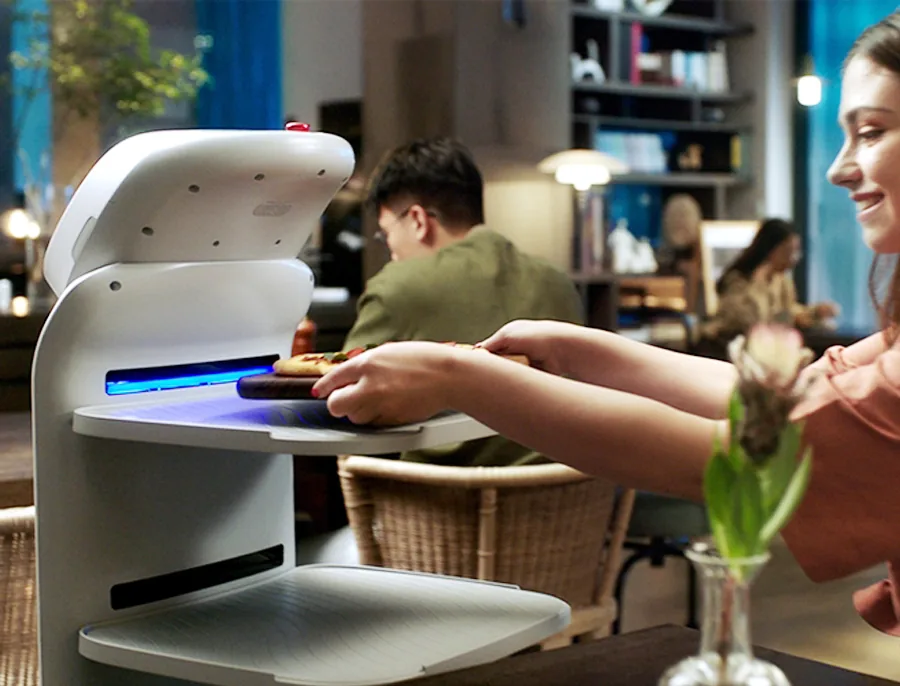
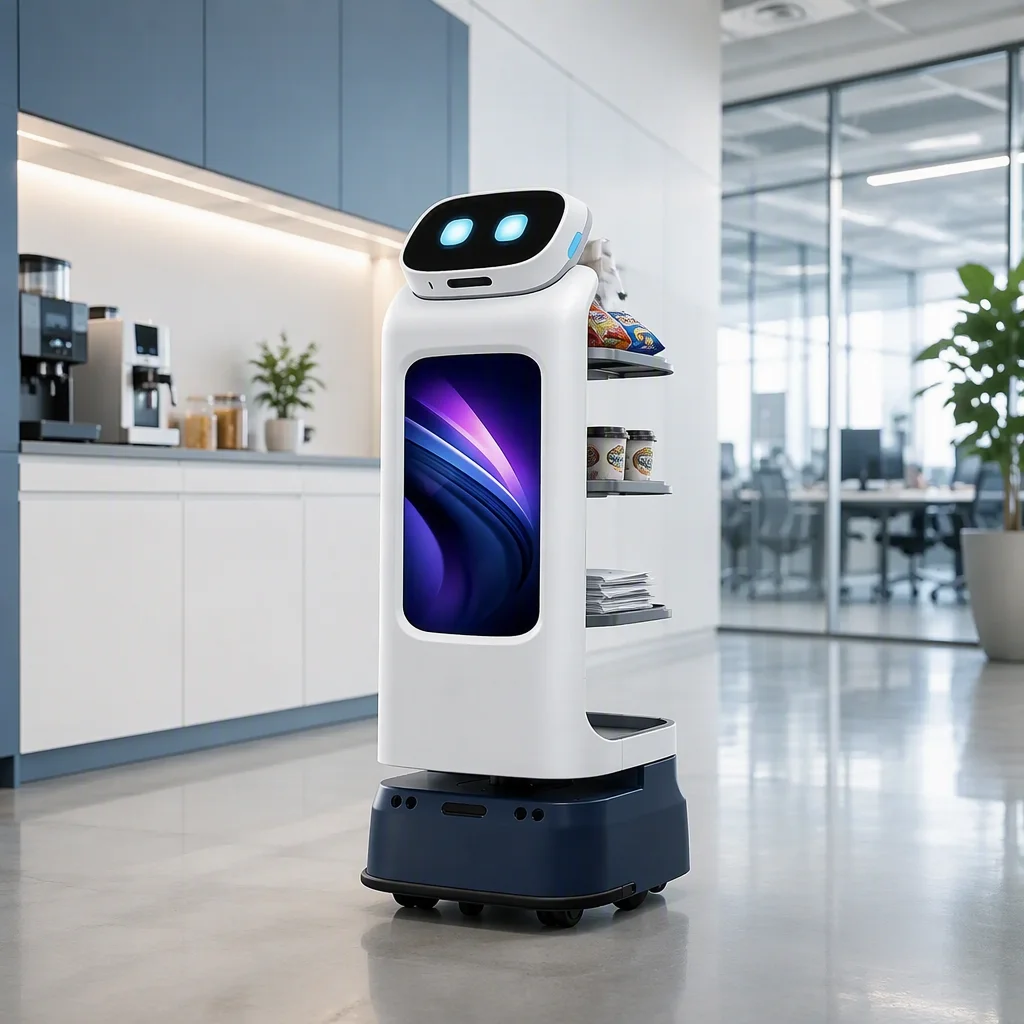
Food plants run a lot of internal movement that is not part of the food process: packaging material from the warehouse to packaging lines, QA samples from the production floor to the lab, sanitizing chemicals from central storage to satellite stations. The AOMAN D1 with its 40 kg payload and four trays automates these moves in non-processing zones, warehouses, corridors and administrative areas.
The key food-safety constraint is zone separation: a delivery robot must not transit directly from raw-product zones to ready-to-eat zones, because that is a HACCP cross-contamination pathway by another name. Handled correctly, this is a software problem. The navigation map carries explicit no-cross boundaries and the fleet log records every route taken. Geofencing turns zone discipline from a supervisor's instruction into a machine-enforced control.
Visitor management and compliance documentation
Food facilities host a constant stream of visitors. Customers, auditors, regulators and corporate teams: each requiring sign-in, gowning checks and health declarations. At the reception desk of a plant, the AOMAN G1 covers the routine: multilingual greeting and guidance, check-in assistance, and direction to the gowning and washrooms areas. G1's six-microphone array picks up speech from up to 5 m away and its 15 DoF upper body supports floor-to-counter interactions, and it returns to its dock on its own when no visitor is present.
The compliance benefit is the audit trail: visitors logged in with timestamps, and the gowning steps acknowledged in the language the visitor speaks. That produces a reception record that satisfies site-security and personnel-practice documentation requirements without adding paperwork to the QA team.
Cold Storage and Cold-Chain Facilities
Cold rooms and freezer facilities are a distinct operating problem. Lithium batteries lose effective capacity at low temperatures, so cold-storage deployments need thermal management in the robot's battery enclosure and low-temperature-rated lubricants in the drive train. Effects that shift runtime below the room-temperature figure and must be factored into fleet sizing and dock placement. Condensation during defrost cycles is the second risk: sealed, vented electronics compartments prevent internal condensation. Third is the floor itself: ice films make surfaces slippery, and squeegees and brushes need cold-rated materials to keep full contact.
None of this is exotic. It is configuration, and it must be verified in a controlled sample before the fleet order is placed. Ask for the cold-chamber test protocol, the temperature range of the drive components, and the measured cycle time at operating temperature, and treat a room-temperature demo as invalid evidence for a -20°C room.
HACCP Integration and Audit Readiness
The strongest argument for autonomous cleaning in food processing is audit readiness, not labour savings. Sanitation documentation is a recurrent source of non-conformance in third-party certification audits. A cleaning robot produces the evidence trail natively:
- What was cleaned . The zone map with positioning data from SLAM-based indoor navigation.
- When . Timestamped cycle start and end, including pauses and interruptions.
- How . Recorded parameters: brush pressure, solution flow, squeegee angle and speed.
- Verification . An ATP swab taken after a pass links to that specific cycle in the log.
- Corrective action . A failed swab triggers an immediate re-clean of the flagged zone, with the re-clean logged as a corrective action.
That is a materially stronger position than a paper log signed at end of shift. The record is generated at execution time and cannot be rewritten retrospectively without leaving evidence of the edit.
Procurement Pathway for Food Processors
Food companies move slowly on capital equipment. Approval cycles are long and evaluated against a crowded capital budget. Three strategies accelerate adoption:
1. Frame it as food safety infrastructure, not cost reduction. A request framed as labour savings competes with every other cost-reduction item. The same request framed as reducing non-conformance risk in the sanitation-category audit findings carries its own budget line and approval track.
2. Start with non-contact surfaces only. Corridors, break rooms, loading docks and packaging areas adjacent to, but outside, primary processing zones avoid the regulatory complexity of validating robots for food-contact environments while capturing most of the benefit. Expansion into contact-adjacent zones follows after documented performance.
3. Use the site survey before the PO. Confront the floor-type list, the zone map and the chemicals in use during the survey. A robot that passes every audit question but slips on the acid-brick grout lines is not food safety infrastructure, it is an expensive mop.
If your facility is mapping this for the first time, send us your floor plan and the zoning diagrams. We will reply with the platform mix, the zone-geofencing design and the validation protocol for your audit. Contact our solutions team or see the full platform range. A venue with a different traffic pattern, and how the configuration changes for it, is covered in restaurant deployments.