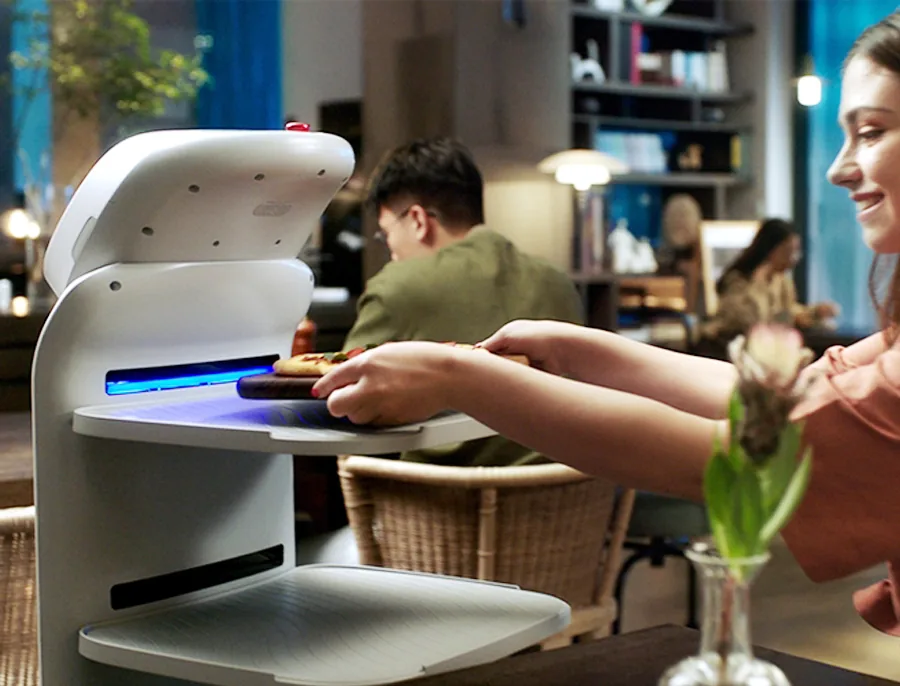
Service Robots for Food & Beverage Manufacturing Plants, Sanitation and Material Transport in 2026
At a glance: A mid-size ready-meals plant runs 90 minutes of floor downtime per shift for manual sanitation, and its transport operators cover 11 km a day just moving trays between lines. This guide covers AOMAN C2 Pro food-grade scrubbers (compact, quiet), C1 large-format cleaning, and D1 logistics for F&B production. With the hygiene, zoning and ROI data a plant manager actually needs.
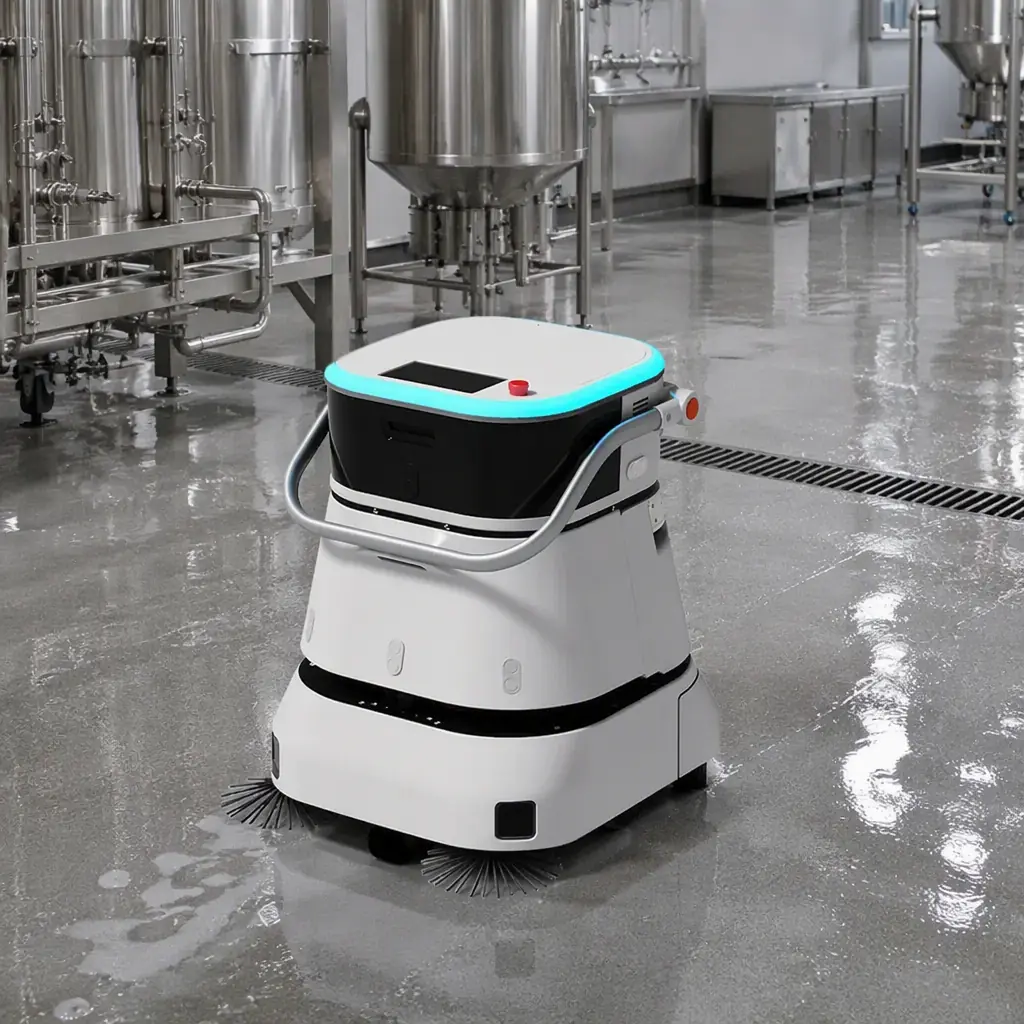
Food and beverage plants are among the hardest environments to automate. Floors are continuously wet, high-grade hygiene governs every surface, and the product itself, flour, sugar, dairy, sauces, creates a hostile operating condition for any moving machine: fine particulates that foul bearings, sugars that congeal on wheels, and sanitizing chemical at concentrations that corrode unprotected steel.
Yet the operational pressure is exactly the opposite of a dry warehouse. Production runs are staggered and the floor must be rapidly released back to food contact, and the highest-cost labor in most plants is not the line operator but the floor and transport staff paid to staff sanitation windows and runs between work centers. That is where service robots, designed for wet, corrosive, food-contact work, now fit.
Why F&B Plants Are Automating Cleaning and Runs
Three forces converge. First, sanitization windows are fixed by food-safety audit schedules and by the line's own changeover logic, so any mechanization that shortens the window pays twice, it frees production time as well as labor. Second, labor is scarce and the worst hours are the ones nobody wants to staff. Third, food-safety compliance (HACCP and the increasingly common BRC/IFS standards) requires documented, repeatable cleaning, exactly what a programmed unit produces.
- Sanitation windows: a single 8-hour shift in a sauce or dairy plant typically burns 60–90 minutes on floor cleaning. Cleaning robots run those zones on a fixed program while the room is released, in a fraction of the time.
- Cross-zone transport: raw materials, work-in-progress, trays, and finished goods moving between departments is a constant walking loop. In a multi-line plant that loop is measurable in kilometres per operator per shift.
- Audit evidence: HACCP hygiene monitoring wants cleaning scheduled and logged. A robot produces a timestamped, coverage-mapped log for every run.
Zone-Based Sanitation in Food Production
Food plants are not one room. They are a set of zones with different risk and different cleaning frequency. The zone map drives the robot selection as much as the total square footage does.
| Zone | Surface | Cleaning Frequency | AOMAN Fit |
|---|---|---|---|
| Raw intake / dry goods | Sealed concrete, dust loads | Daily + after spills | C2 Pro (compact, dust-tolerant) |
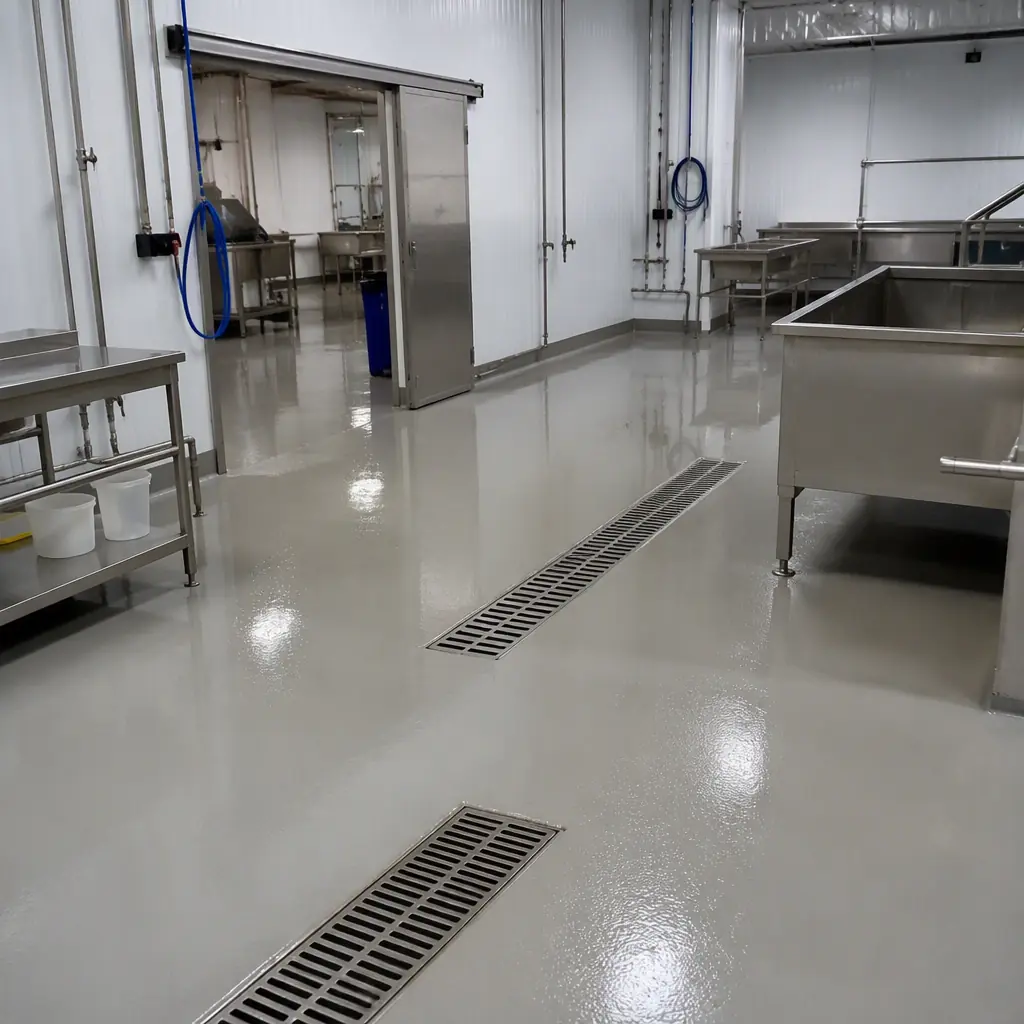
| Processing floor | Epoxy or brushed stainless deck | Per shift + between batches | C2 Pro, the 85 cm corridor class |
| Packaging / finish | Polymer tile or resin | Twice per shift | C1, 2,040 m²/h large format |
| Cold / chill store | Insulated resin, standing water | Daily, low-temperature | C1 with tank separation |
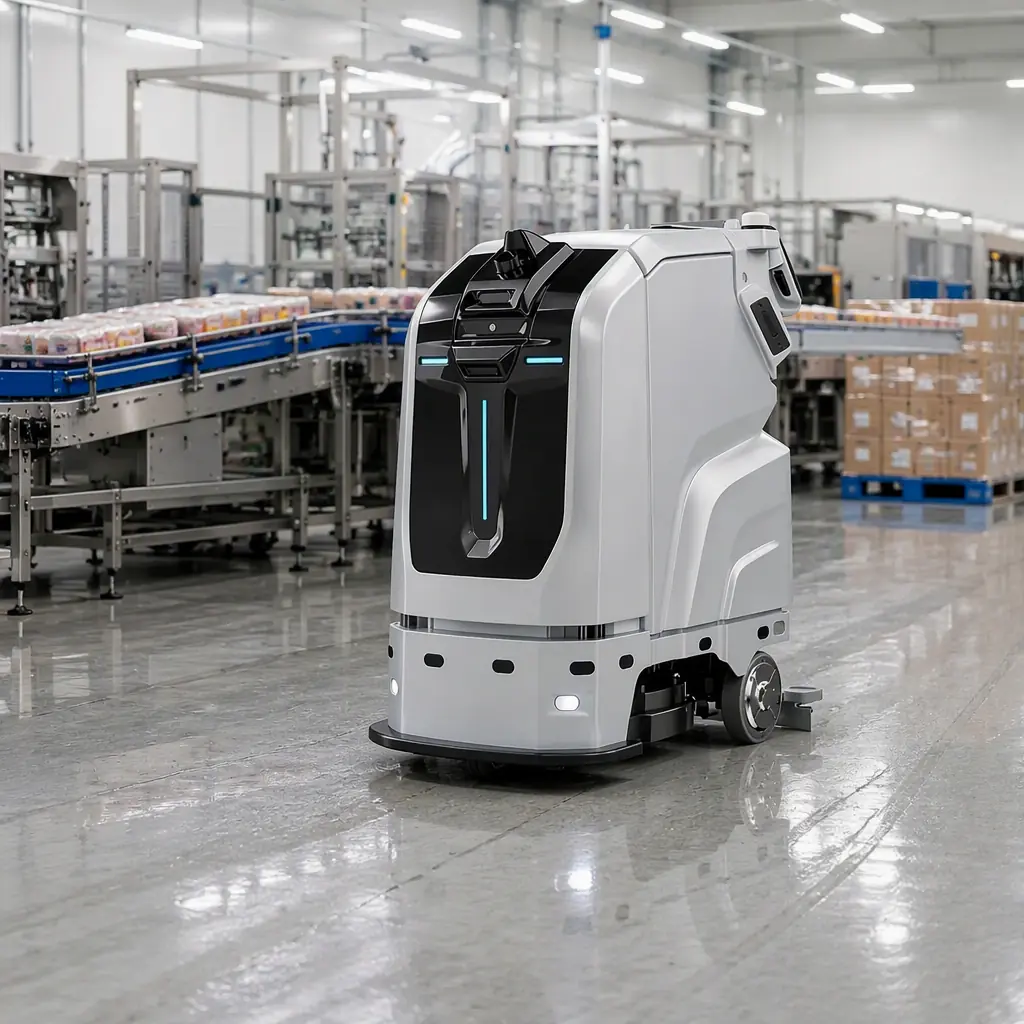
The AOMAN C2 Pro is the workhorse for processing floors: it fits 85 cm aisles between equipment, runs quietly enough to work alongside operators, and its water recovery keeps chemical-strength slurry off clean floors. For the larger packaging and cold-store areas, the AOMAN C1 covers up to 2,040 m²/h with a 790 mm squeegee and separate 70 L fresh / 50 L recovery tanks. Critical in food plants, because recovered water may carry product residue and must never be redistributed. See the commercial cleaning robot buyer's guide for a broader comparison of scrubbing modes.
Material Transport Across the Line
Transport is where service robots pay back fastest in food plants, because the route is fixed and repetitive. The AOMAN D1 runs a dedicated loop: raw ingredients from goods-in to the processing hall, work-in-progress between stations, and finished goods from pack-line to the cold store or dispatch. A 40 kg payload across separate trays lets you keep raw and finished streams physically apart, the same logic as your sanitiser rotation, so cross-contamination never rides on a shared compartment.
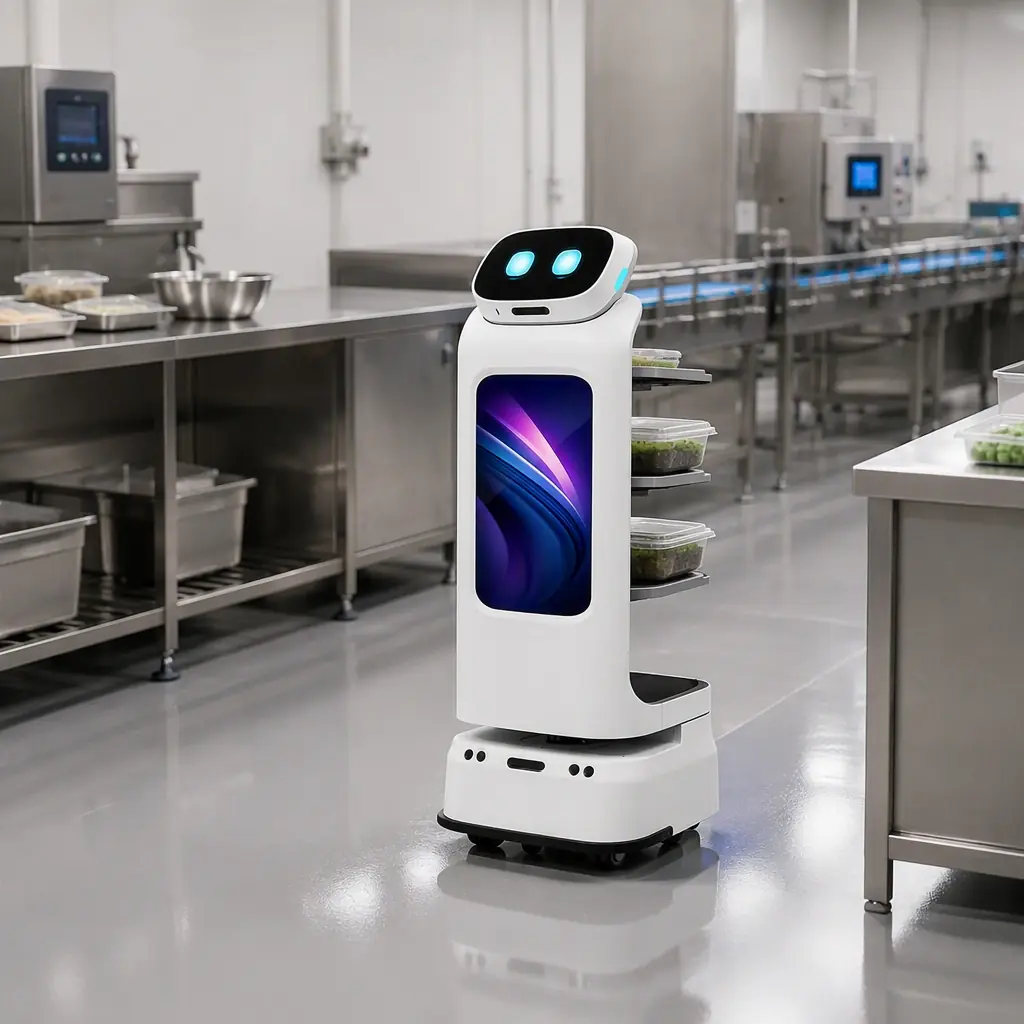
For guidance on matching a single-cabin or dual-cabin design to a given route, the delivery robot selection guide breaks down the trade-offs; the same rules apply inside a processing hall as in a hospital corridor.
Compliance: HACCP, Allergens and Food-Contact Zones
Food-grade robot deployment is governed by the same hygiene logic as the equipment already on your line. The practical requirements are:
- Water recovery separation: recovered slurry must not return to the floor. Look for distinct fresh/recovery tanks.
- Corrosion resistance: sanitizing chemicals (peracetic acid, caustics, quaternary ammonium) demand stainless or coated wetted parts. Sealed, wash-down-ready housings are non-negotiable.
- Particulate tolerance: flour and sugar in the air will clog an open motor. Choose sealed drive and suction assemblies.
- Allergen zoning: a robot that crosses an allergen boundary must be cleaned at the boundary or run separate units. Zone your robot like you zone your trays.
- Documented cycles: HACCP wants repeatable, logged cleaning. A coverage-mapped, timestamped run log is your evidence.
The wider regulatory landscape for service robots in industrial settings is covered in the safety and compliance guide.
Selecting Robots for Food Plants
Beyond cleaning mode, three food-specific criteria dominate the decision:
Sealed, washable construction . The unit itself must tolerate the same cleaning regime as a production tool. Low and predictable sensor profile . It should see pallets, drums and open floor drains, not respond to steam or spray. Fleet telemetry that survives the environment . The fleet-management platform should give you zone-level runtime and cleaning coverage per shift, not just uptime.
Build-Out by Plant Scale
- Small (1–2 lines): one C2 Pro covering the processing floor plus one D1 on the ingredient loop. A single unit is a defensible first purchase and visible within a month.
- Mid (3–6 lines): one C2 Pro per high-wet zone, one C1 for packaging and chill areas, one D1 running materials. Fleet coordination through the fleet management guide.
- Multi-plant / high-volume: centralized monitoring and roll-out planning as described in the multi-site deployment strategy.
What to Verify Before Signing
Floor slopes and drains . Food plants run to drains; a scrubber must cope with standing water, not drown in it. Passage widths . The C2 Pro needs 85 cm, the C1 85 cm also; measure between skirting, equipment and pallet racks. Chemical compatibility . Confirm wetted materials against your sanitiser list. Staff protocol . Schedule the robot into the sanitation window, not against it, so cleaning runs while the room is being released rather than competing with it.
The ROI Picture
An illustrative mid-size plant running two lines, roughly $80,000 a year on floor-sanitation labor plus the equivalent of a full-time operator on transport runs, could trade that against a C2 Pro + C1 + D1 fleet and retain headroom while structurally removing the sanitation-window bottleneck. Model it with your own rates: cleaning time is a production-time saving, not just a payroll one.
The order matters. Cleaning first. It is visible, audit-friendly, needs no workflow restructuring, and immediately de-risks the sanitation window. Transport second. It is the bigger labor win but needs a fixed route and a loading habit. Tell us your floor plan, product types and shift pattern, request pricing on a food-plant fleet and we will match unit types and routes within 24 hours.