
Service Robots for Plant Nurseries & Garden Centers, Cleaning Where Horticulture Meets Retail
At a glance: A garden center is two businesses on one site. An outdoor production and display yard that is wet, gritty and covered in living debris, and an indoor retail and cafe operation judged on the same standards as any premium store. Robots can serve both, but only if the machine is matched to the surface. This guide covers the soil and moss problem, the recovery methods, irrigation conflicts, and the frost-period duty cycle that makes the economics work.
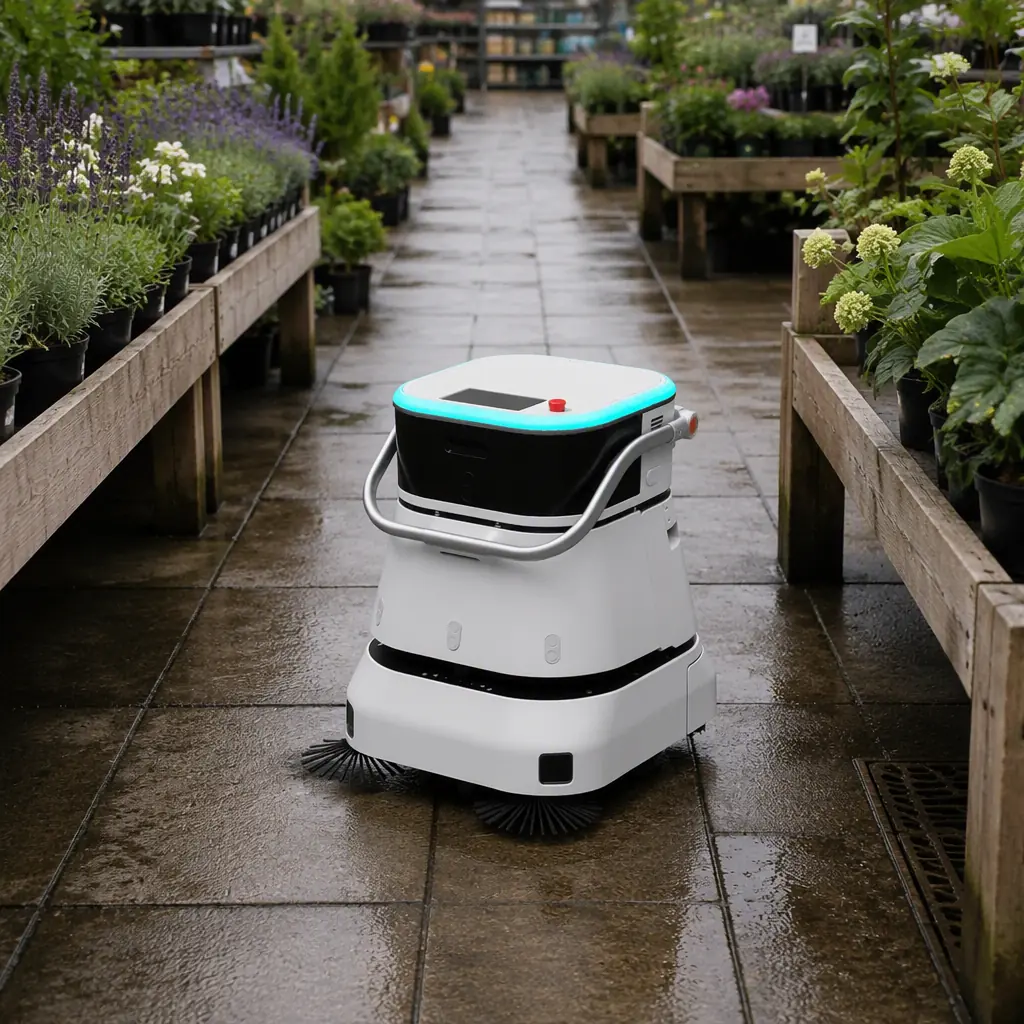
Ask a garden center manager where the cleaning budget goes and the answer is rarely the shop floor. It is the aisles between plant benches, the covered walkways where customers push trolleys loaded with wet compost, the entrance zone that receives every muddy boot on site, the cafe, and the car park. The indoor retail area may be only a fraction of the site, but it consumes a disproportionate share of labour hours because it is cleaned repeatedly while the outdoor areas are cleaned when someone has time.
That imbalance is the commercial case for automation here, and it is also the reason generic cleaning-robot advice fails. A machine specified for an office lobby will not survive a garden center aisle in February. The specification has to follow the surface.
Why This Environment Breaks Ordinary Cleaning Assumptions
Five conditions apply simultaneously at a typical nursery or garden center, and each one invalidates a standard assumption in cleaning machine selection.
| Condition | What It Breaks | Specification Implication |
|---|---|---|
| Living debris | Fallen leaves, petals, seed, potting media and moss fragments are not inert dust, they smear when wet | Requires scrubbing action rather than dry sweeping; brush pressure matters more than suction |
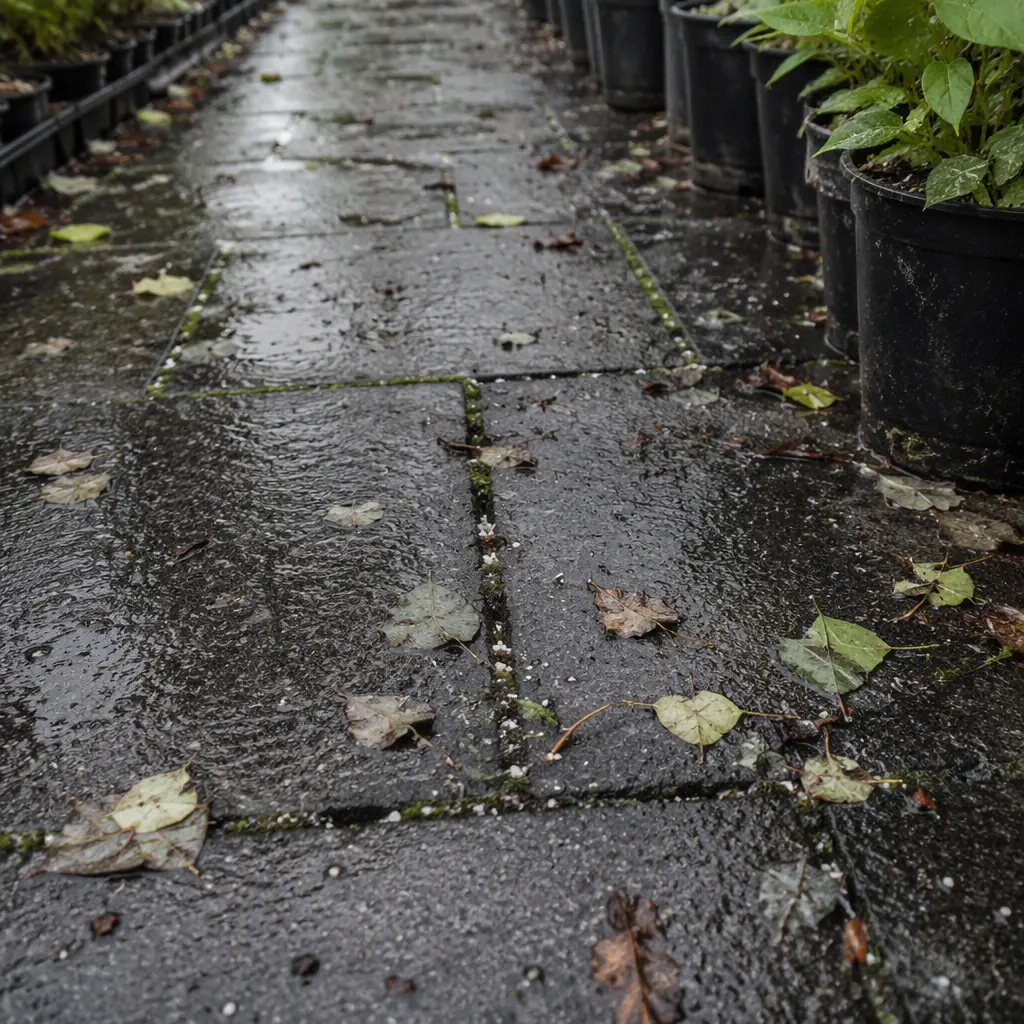
| Moss and algae film | Shaded, permanently damp paving develops biological film that resists single-pass cleaning | Needs repeated passes and working pressure; recovery planning beats cleaning intensity |
| Water conflict | Irrigation, plant watering and drainage mean the floor is frequently already wet before cleaning starts | Scheduling must account for wet surfaces; more energy goes into water recovery than into cleaning |
| Compaction and vibration | Heavy delivery vehicles, pallet trucks and outdoor furniture leave surfaces uneven | 6° ramp capability and 5 cm toe-height obstacle sensing become hard requirements, not nice-to-haves |
| Seasonal polarity | Site traffic can swing by a factor of ten between a July weekend and a January Tuesday | Fleet utilisation depends on finding an off-season duty cycle indoors |
The Moss and Algae Problem, and How Recovery Actually Works
Moss, algae and lichen establish on outdoor paving for one reason: moisture persists. In a nursery, moisture persists almost everywhere, and shade from benches and plant canopies means much of the surface never dries. The resulting film is not surface dirt that a single pass removes. It is a biological layer bonded to the substrate.
The dominant variable in removing it is not chemical concentration, it is mechanical working pressure and pass count. The AOMAN C1 applies 160 RPM disc brushes at 13.2 g/cm² working pressure behind a 790 mm squeegee, and the recovery tank capacity, 50 L of the 120 L total, with float sensors, is what determines how long the machine can work before a drain cycle. That recovery capacity is the binding constraint in moss recovery work, because removing biological film consumes water volume rapidly and the machine must be emptied rather than simply refilled.
Two operational patterns emerge from this. The first is recovery planning: rather than attempt a site in a single campaign, divide the outdoor areas into zones and work one zone across multiple passes over several days, accepting that moss removal is a treatment cycle rather than a cleaning event. The second is timing against rain: cleaning immediately after rainfall on a saturated surface is mostly wasted effort, since the machine's recovery function is competing with groundwater. Cleaning two to three dry days into a settled period removes more film per pass, because the surface is drying from the top down.
Neither of these patterns requires special hardware, but both require scheduling intelligence, and both are the reason an automated fleet outperforms ad-hoc manual cleaning outdoors, the machine reliably performs the passes that a stretched staff team quietly skips.
Matching Machine Class to Zone
A garden center is not one surface, so it should not be one machine. The three-zone split below uses published AOMAN specifications and matches each zone to the unit whose physical characteristics fit it.
| Zone | Surface Character | Machine | Why This Machine |
|---|---|---|---|
| Retail shop floor & cafe | Indoor, hard, indoor-grade hygiene expectation | AOMAN C2 Pro | 440 mm width and 700 mm narrow-aisle clearance suit retail fixture layouts; 3-in-1 dust-mopping, vacuuming and scrubbing handles both dry seed debris and wet spills; ≤32 dB operation is quiet enough to clean during trading hours |
| Covered walkways & entrance zone | Hard paving, continuously soiled, high footfall | AOMAN C2 Pro | ≈4,400 m² per run and up to 11 h dust-mopping endurance covers a large entrance and walkway network without a drain interruption |
| Outdoor plant aisles & display yard | Wet, uneven, biological film, organic debris | AOMAN C1 | 790 mm squeegee width and 160 RPM brush pressure clear coarse organic debris and biological film; 6° ramp and 5 cm obstacle sensing handle the uneven surfaces; 2,040 m²/h rated covers a large yard in a working day |
| Car park & service road | Grit, tyre debris, oil, standing water | AOMAN C1 | Large-format scrubbing with high working pressure is the only practical automated approach to grit and oil on paved surfaces |
The division of labour between the two classes follows directly from the numbers rather than from preference. The C2 Pro's role is defined by access . It fits where the C1 cannot, with a 700 mm narrow-aisle clearance against the C1's 200 cm minimum turning clearance. The C1's role is defined by rate and pressure . A 790 mm squeegee and 13.2 g/cm² working pressure against 440 mm cleaning width. Deploying a C2 Pro to a large outdoor yard is a rate problem; deploying a C1 to a retail aisle grid is a fit problem. Both mistakes are common when a buyer specifies one machine for the whole site.
Irrigation, Drainage and the Scheduling Conflict Nobody Plans For
Nurseries have, by design, the most aggressive irrigation systems of any commercial facility type. Overhead watering, drip lines, misting systems and automatic sprinklers all run on schedules, and those schedules were set long before anyone considered a robot. The conflict is not that robots are harmed by water, the AOMAN C1's 3D ToF surround vision and ultrasonic sensing with roughly 20 ms response handles standing water as an obstacle, but that cleaning a surface being actively watered is close to futile, and repeatedly working a saturated zone accelerates wear on squeegee blades and brush assemblies.
The fix is coordination, and it is the cheapest kind: pull the irrigation controller schedule into the robot's scheduling layer so cleaning windows and watering windows do not overlap. This is the calendar-integration pattern rather than a sensor problem. The system does not need to detect water, it needs to know that watering is scheduled from 05:00 to 06:30 and therefore cleaning runs from 06:30 onwards. The same integration logic and cost structure is set out in the BMS and occupancy integration guide.
Drainage is the second half of the same problem. Outdoor zones where water pools are zones where a robot's recovery function is working against gravity rather than removing a finite quantity of water. Zones with visible standing water after rain should be scheduled last in the rotation and worked only after they have drained, or the machine hours spent on them are largely wasted.
The Frost-Period Pivot: Why Winter Decides the Business Case
Garden centers have a seasonal utilisation profile that is extreme even by retail standards. A peak Saturday in late spring may see several thousand visitors; a Tuesday in January may see a few dozen, mostly in the indoor cafe area avoiding the weather. If the business case for a robot fleet rests on outdoor cleaning volume, it will not survive the annual review. Outdoor cleaning demand collapses exactly when capital costs continue.
The deployments that pencil out are the ones that identify an indoor winter duty cycle before purchase. There are four realistic candidates.
Indoor full-area deep cleaning. The off-season is when shop floors, cafe areas, storage and back-of-house get cleaned properly rather than maintained. A fleet that runs continuous indoor cycles through January and February delivers work that would otherwise be outsourced or deferred.
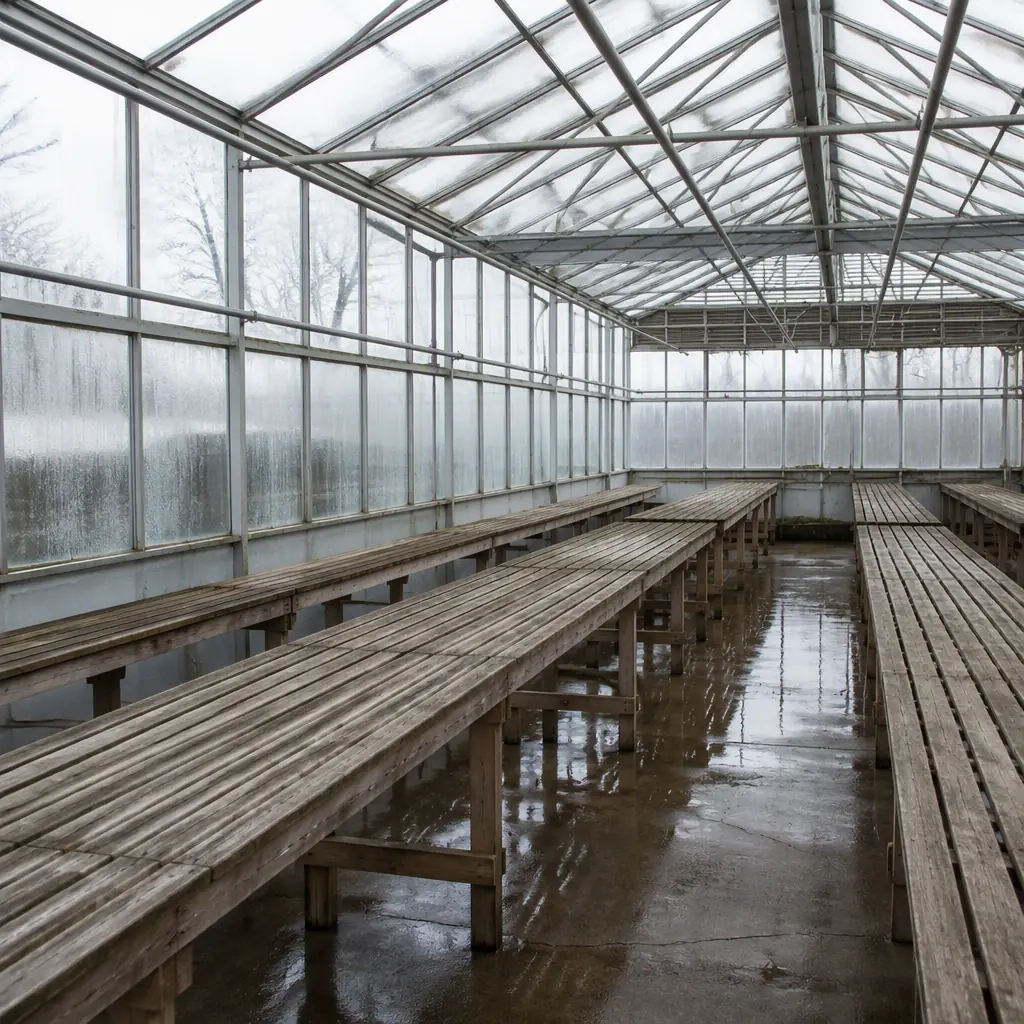
Covered structure cleaning. Glasshouses, polytunnels, covered walkways and display canopies accumulate the same moss and algae film as outdoor paving, and many are never cleaned because the labour is not available in season. Off-season is the only window.
Storage and logistics areas. Potting sheds, compost storage and delivery yard buildings are large, hard-floored areas that are usually cleaned on an annual schedule. Automating them absorbs fleet capacity in the quiet months.
Car park and approach road recovery. Winter gritting and salt deposits leave a residue that degrades paving and defeats spring presentation. A large-format scrubber working the car park in February produces a visibly better spring opening, which is a customer-facing benefit rather than a maintenance one.
Construction of the annual utilisation model is therefore the first analytical task, not the last. Twelve months of machine-hours plotted against twelve months of available windows will show whether the fleet is fully employed or seasonally idle. If it is seasonally idle, the winter duty-cycle list above is what closes the gap. And if even that does not fill the calendar, a smaller fleet used harder is a better decision than a larger fleet parked for a third of the year.
Infrastructure Checks Specific to Horticultural Sites
The standard pre-deployment checklist for a commercial building does not cover the failure modes a nursery site presents. Five additional checks belong on the survey sheet.
Surface transitions. The boundary between a covered walkway and an outdoor yard is typically a drainage channel, a raised lip or a slope change. The AOMAN C1 climbs 6° ramps and senses obstacles from 5 cm at toe height; a channel with a drop greater than that will stop the machine at exactly the point where the route must continue. Measure these transitions rather than assuming they are smooth.
Dock siting and distance. Docks should be sited indoors or under cover, on a dry level surface, with a water point and drainage nearby. Placing docks outdoors means the machine, its contacts and its charger spend the winter in the wet, a service-life problem rather than an immediate failure.
Power and dust. Potting and compost areas generate fine dust. Dock and charger installations in these zones need appropriate ingress protection, and cleaning of the dock contacts themselves has to become part of the maintenance routine described in the maintenance and TCO guide.
Obstacle profiling in the yard. Plant beds, bench legs, irrigation risers and temporary displays create a constantly changing obstacle field. Mapping has to be treated as a recurring task rather than a one-time commissioning step. A nursery's layout changes with the season, and a map that is six months old is a map that will generate repeated interventions.
Public safety in retail zones. Garden centers mix vehicles, trolleys, children and wet floors in the same space. In the retail and entrance zones the machine's operating speed should be constrained through the scheduling layer below its autonomous ceiling, and customer-facing areas should be cleaned outside trading hours where the calendar allows.
What Garden Centers Should Measure
Four metrics tell a nursery operator whether the deployment is delivering, and each one maps to a cost line that already exists.
Recovery passes per zone. The number of passes required to bring a paved zone to acceptable condition, tracked by zone and season. This is the honest measure of moss and algae burden and it drives both scheduling and expectation-setting. A zone that needs four passes will always need four passes, and knowing that prevents the fleet being judged against an impossible single-pass standard.
Labour hours displaced from cleaning. The direct comparison against the pre-automation roster. In garden centers the value is frequently highest in the entrance, walkway and cafe zones, because those are cleaned most often and by the most senior staff.
Off-season machine-hours. The proportion of fleet capacity actually used outside the trading peak. Below roughly 50% utilisation off-season, the fleet is oversized for the site and should be reviewed.
Water and consumable consumption per 1,000 m². Tank refills, drain cycles and brush replacement intervals tracked per unit area. This number feeds directly into the total cost of ownership, and on horticultural sites it is consistently higher than a comparable indoor facility because biological film and coarse debris consume consumables faster.
The pattern that holds across deployments is that outdoor zones deliver the labour savings and indoor zones deliver the utilisation. The split between them is what makes the year balance. A fleet sized only against the summer outdoor peak will look over-specified for eleven months and under-used in twelve; a fleet sized against the annual duty cycle including the winter indoor programme is the one that survives the second-year review. The structure of that analysis is the same one applied in the fleet management framework, and the same year-round utilisation logic that decides fleet size in our greenhouse and vertical-farming guide . A business whose output swings with the calendar needs the fleet sized against the annual curve, not the peak week.
Where the capital needs to sit as operating expense so a seasonal business is not carrying year-round financing on a seasonal asset, a RaaS structure matches the payment to the utilisation curve, and the consumable and water budgets behind that curve are worked through in the maintenance and TCO guide.
Tell us your site layout, the split between covered and outdoor paving, and your winter trading pattern. We will help you match machine classes to zones and build a twelve-month utilisation model before you commit to a fleet size. Contact us.