Service Robots for Fitness Centers & Gyms, Autonomous Cleaning Meets the 24/7 Hygiene Challenge
At a glance: The AOMAN C1 covers 2,040 m²/h, so a 2,500 sq ft weight-room floor gets a complete pass in roughly 7 minutes. One robot can repeat that circuit hourly while the club is open. This guide maps the three gym cleaning zones to AOMAN C1 and C2 Pro, and covers member-experience ROI.
Fitness centers have a cleaning problem that no staffing schedule solves: the facility is open 16 to 24 hours a day, and contamination is continuous, not episodic. An office lobby gets dirty on a predictable pattern, morning arrival, lunch rush, end of day. A gym floor is being re-contaminated from the first class to the last member, hour after hour, by sweat, chalk and tracked-in grit. A cleaning strategy built around pre-open, mid-day and post-close passes is delivering three cleans across a sixteen-hour contamination curve. Members do not start the contamination clock at shift change, so cleaning must follow the load, not the roster.
The Three Cleaning Zones to Automate First
Gym floors divide into three zones with different machines, chemistries and schedules. Automate them in this order.
Zone 1: Weight and functional training floors
Rubber flooring absorbs impact and traps chalk dust, sweat residue and, at a microscopic level, skin debris that becomes a substrate for bacterial growth within hours at gym temperatures. The floor also needs frequent passes: the interval that keeps it looking and testing clean is counted in hours, one to three times per day.
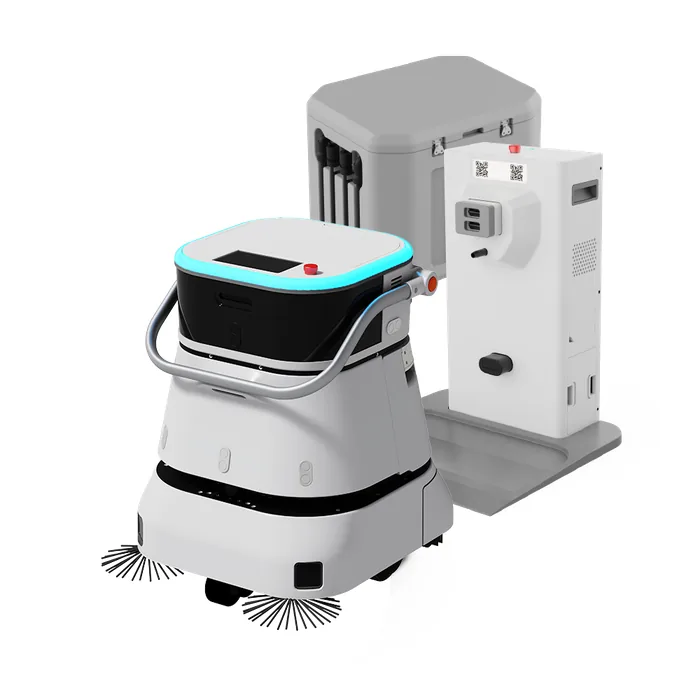
The AOMAN C1 is the machine for this zone. It covers up to 2,040 m²/h, so a 2,500 sq ft weight-room floor receives a full pass in about 7 minutes. Meaning one unit can run the circuit hourly, around class and member traffic, without anyone cordoning off the zone. Its 790 mm squeegee leaves the floor dry enough to resume use immediately, and the 70 L clean / 50 L recovery tank set spans multiple cycles between refills.
Zone 2: Locker rooms, sauna corridors and wet zones
Locker rooms are a different problem: continuously wet, non-porous tile and epoxy floors, shower runoff, steam-room condensation, and grout lines that trap moisture and produce the smell members rate as the number-one complaint. The primary risk is slip liability; the aesthetic problem is the locker-room smell that follows members out the door.
Here the AOMAN C2 Pro is the right fit, compact enough for the 85 cm aisles between lockers and benches, quiet enough to run without disturbing the space, modular water tanks that simplify refills, and a squeegee that lifts runoff instead of smearing it. One unit on a timed circuit, 12 to 15 minutes per pass, repeating through peak hours, holds the wet zone at a standard no afternoon crew rotation can hold. Note the no-go zone priority: map the sauna heat sources and electrical zones out of the robot's route and keep the pool deck on the manual roster.
Zone 3: Group fitness studios
Studios have the tightest window in commercial cleaning: the 10 to 15 minutes between back-to-back classes. Yoga on hardwood, spin on sealed concrete or vinyl composite, HIIT on rubber with turf sections: each needs different pad pressure, solution concentration and drying time.
The C1 handles this when its zone profiles are set per studio: a pH-neutral, soft-pad profile for hardwood; a protein-residue, medium-abrasion profile for the HIIT floor. Scheduling against the class calendar, ideally read from the booking system, has the robot staged at the studio door three minutes before the class ends. C1's coverage rate means a 900 sq ft studio is done in roughly four minutes, inside even the tightest turnover.
| Zone | Platform | Pass frequency | Profile notes |
|---|---|---|---|
| Weight and functional floor | AOMAN C1 | Hourly circuit during open hours | Rubber floor cleaning mode, anti-slip left almost dry |
| Locker rooms and wet zones | AOMAN C2 Pro | Every 90 minutes through peak | Squeegee first, dry pass second; open drains as manual checkpoints |
| Group studios | AOMAN C1 | Each class gap, class-schedule-aware | Per-studio profiles: pad, pressure, solution |
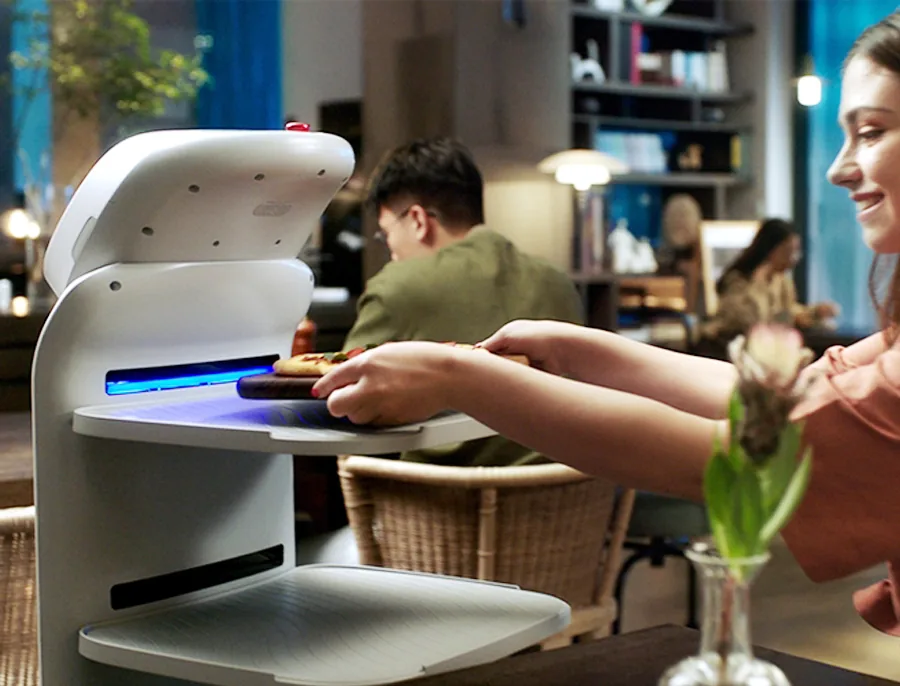
One more zone is worth an honourable mention: the back areas. A AOMAN D1 on a scheduled loop keeps towels, wash-down bins and filtered water supplies moving between laundry and locker rooms, the lowest-complexity automation in the building and the easiest first purchase.
Durability and Unattended Operation: What to Look For
The differentiating factors between gym-capable and hallway-capable scrubbers show up in the details:
- Obstacle handling around moving people. Members do not stop for robots. Sensor fusion that slows, waits and passes on the left is table stakes; continuous operation alongside traffic is what separates the units that survive a gym from the ones that get parked.
- Noise. A scrubber loud enough to interrupt a yoga class will be run off-peak and never reach its full value. The C2 Pro's quiet operation and the workflow benefit of silence in studios are worth price for the difference.
- Mapping and no-go zones. Free-weight drop zones, stretching areas with floor-level equipment, sauna rooms and electrical rooms must be mapped out; with SLAM-based navigation the map is built once and revised when layouts change.
- Selectivity. The robot picks the pass frequency, not the staff. Solution and pad economy follow from the record of what was actually cleaned.
The Member-Experience Payoff
Most operators evaluate cleaning robots on a cost-savings spreadsheet: labour hours multiplied by wage, divided by lease. That captures only half the return, because a clean club is a retention tool and a premium-pricing enabler. The mechanism is direct: if cleanliness dissatisfaction contributes to churn in your market, then the members you keep are worth the acquisition cost you do not spend, and the members who experience a fresh floor all day rate the club higher. Which is what moves renewal conversations before they turn into cancellation conversations.
An illustrative example: a 1,200-member club where 5% of the roster moves to a premium tier that costs $60 per month more. That shift adds roughly $43,000 per year in recurring revenue before a single new member is acquired, compare it with the subscription cost of a two-unit C1 fleet and the spreadsheet starts to read differently. The arithmetic is yours to run; the structure is the point.
The point is that the spreadsheet should have two columns: labour saved and retention value. Clubs that include the second column fund the first more comfortably.

The Multi-Site Playbook for Fitness Franchises
Franchise operators face the harder version of the problem: consistency across locations. A member who sees a spotless locker room at Location A and a wet floor at Location B makes a judgment about the whole brand. For a multi-site rollout, a three-phased sequence is the safest shape. Phase 1: a lighthouse site. The highest-traffic location gets 2-3 units across the three zones, with 60 days of data collection, cleaning measurements, member feedback and incident logs, plus a written playbook. Phase 2: a regional cluster. Three to five sites in the same metro, which validates that schedules, zone profiles and staff training transfer across buildings without per-site re-engineering. Phase 3: network rollout. Remaining sites, with a centralized fleet dashboard giving the operations director a single view of completion rates, battery health and maintenance alerts across every location.
The lesson from multi-site operators is that phase 2 is not a scaled-up phase 1. New failure modes appear at cluster scale. Fragmented Wi-Fi in older buildings, staff adoption differences at one location versus another, and franchisee capital cycles that do not align with the deployment timeline. Lease-structured procurement and a per-site training visit are the two most effective mitigations.

A Six-Week Deployment Checklist
- Week 1: Mapping. One off-hours SLAM mapping pass builds the floor plan with zone boundaries, no-go zones and dock placement.
- Week 2: Zone profiles. Set per-studio cleaning parameters and the hourly circuit for the weight floor.
- Week 3: Parallel run and staff training. Robot and crew run together for a week; train the team on refills, error recovery and the reallocated labour scheme.
- Week 4: Member communication. Frame the programme as a member-experience investment, more frequent cleaning, not as a cost cut.
- Weeks 5-6: Data collection. Capture measured cleaning coverage, member feedback and incident counts to secure the wider rollout.

The Bottom Line
Gyms do not close for cleaning, so cleaning has to fit the flow of the club instead. The C1 and C2 Pro, 2,040 m²/h of continuous coverage on the open floors, and quiet, compact service in the locker rooms, make that possible with a fraction of the labour of crew-based spot cleaning, and the machines do not fatigue as the shift goes on. If cleanliness affects retention in your market, the machine pays for the better part of the lease twice: once in saved labour and once in the members it keeps.
Tell us your footprint, square footage, studio count and peak hours, and we will return a zone-by-zone plan with platform recommendations within 24 hours. Request pricing or view the full platform range. The zone-by-zone routing and cycle-time side of the same decision is worked through in car wash bay maintenance.