
Service Robots for Pharmaceutical GMP Manufacturing, Cleanroom Logistics, Batch Compliance & Serialization
At a glance: GMP plants validate the reactor but still move materials between validated steps by hand, and document it on clipboards. This guide covers how AOMAN D1 (40 kg, four trays) and C1 (2,040 m²/h) get qualified into production.
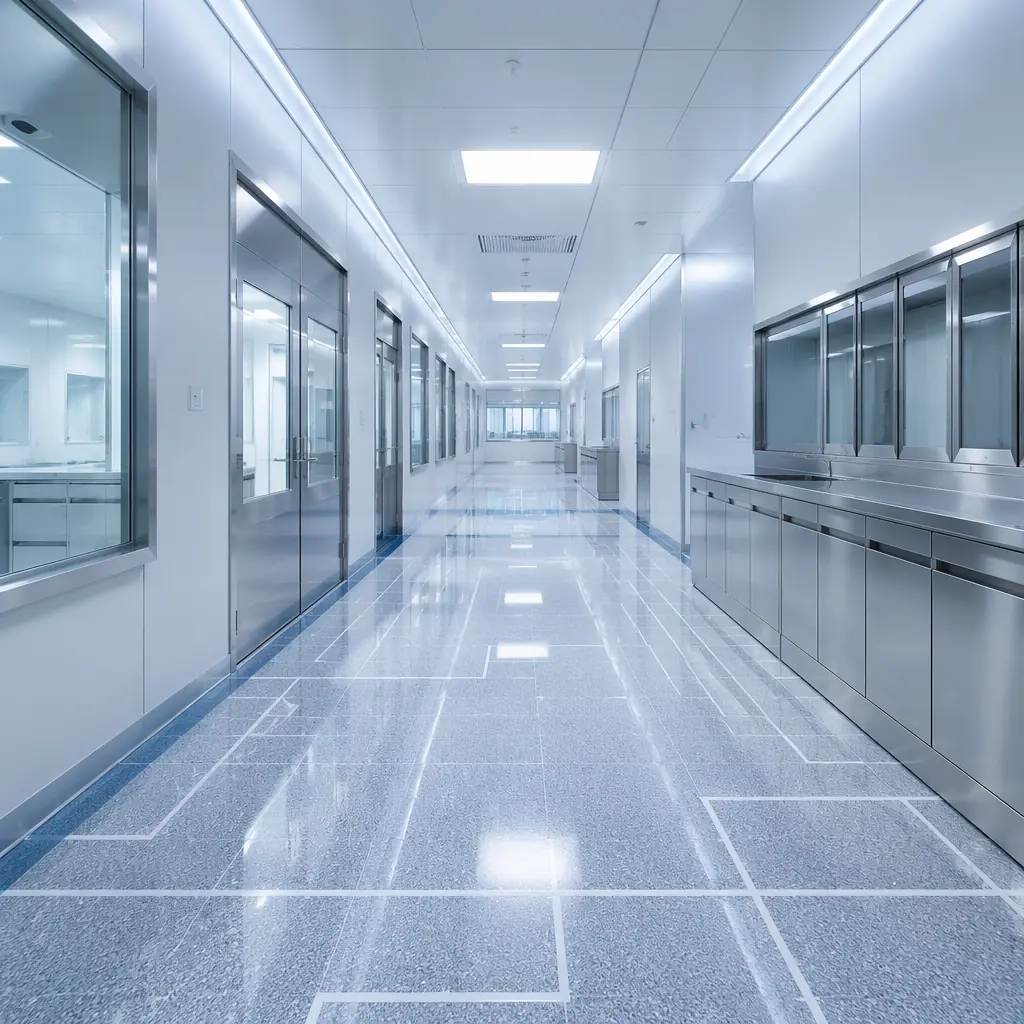
Pharmaceutical manufacturing runs on validated processes: reactors, isolators, and fill-finish lines are automated, validated, and inspected. The logistics between those steps still run on pull-carts, paper records, and operator memory. That corridor gap is where service robots enter GMP production.
Plant managers, quality directors, and manufacturing operations leaders face a different set of questions than their R&D colleagues, validation burden, batch record integration, multi-product changeover. This guide maps them.

Why GMP Production Needs a Different Class of Automation
Validation burden
A production robot carrying active ingredients through Grade C and D corridors needs validated cleaning procedures, documented changeover between product campaigns, and environmental monitoring data proving it does not compromise the classified space, all maintained audit-ready for FDA and EMA inspectors.
Batch record integration
Every material movement must be logged to a batch record with timestamp, robot ID, material lot number, origin, destination, and verification that the move happened within validated environmental conditions. The robot is a qualified component of the manufacturing execution system, not an accessory.
Multi-product changeover
Plants produce multiple drug products on shared lines. Cross-contamination between campaigns is not a deviation to investigate, it is a regulatory event. Robots that cross production suites need surface cleaning SOPs, dedicated material-contact surfaces, and documented changeover procedures aligned with 21 CFR Part 211.67 on equipment cleaning and maintenance.
The regulatory stack
| Regulation | Scope | Robot-Specific Requirement |
|---|---|---|
| 21 CFR Part 211.67 | Equipment cleaning & maintenance | Cleaning SOP, residue limits, changeover documentation |
| 21 CFR Part 211.68 | Automatic / electronic equipment | Reviewable system documentation, audit trail, authority checks |
| 21 CFR Part 211.184 | Component / drug product records | Material movement logged to batch record with traceability |
| EU GMP Annex 1 | Sterile manufacturing | Environmental data during robot operation in classified zones |
| EU GMP Annex 11 | Computerized systems | Data integrity, backup, disaster recovery for fleet software |
| DSCSA (US) / Falsified Medicines Directive (EU) | Serialization | Robot-handled materials must not break the serialization chain |
Vendors selling into GMP production must provide more than hardware: installation qualification (IQ), operational qualification (OQ), and the documentation framework for performance qualification (PQ). An evidence package the site quality unit can actually review and approve.

Four High-Impact Applications in GMP Production
1. Validated inter-zone material transport
In a typical solid-dose facility, raw materials move from dispensary through granulation, compression, coating, and packaging, tens to hundreds of meters per transfer through corridors classified Grade D (ISO 8). Each transfer is a gowning cycle, a documentation event, and a contamination risk.
The AOMAN D1 runs those corridors with a 40 kg payload across four trays and a 70 cm aisle footprint. Every material movement is logged with robot ID, timestamp, origin and destination zone, scanned lot number, and environmental conditions during transit. Straight to the electronic batch record via REST API. When an inspector asks how a lot was transported, the answer is a database query, not a file search.
2. Environmental monitoring and QA rounds
Environmental monitoring routes, viable and non-viable particulate counts, temperature and humidity logging, surface samples, are walked routes carrying instrumentation and logbooks. The D1 automates the walking: it transports the monitoring cart and logbooks between Grade C and D corridors and the QA station, on programmed routes with timestamped stops, and the day’s records return without manual transcription. The unit is a logistics asset for the monitoring program, not a substitute for the measurements themselves.
3. Serialization-ready chain of custody
Under DSCSA and the Falsified Medicines Directive, individual saleable units carry a unique identifier in a 2D data matrix, and the chain of custody extends backward into manufacturing. When material sits unattended in a corridor, the quality unit has to address it. Robot transport keeps the record continuous: loading at an authenticated point, trays locked in transit, release only at the validated destination, and departure, arrival, route, and conditions all in the record.
4. Validated cleaning and changeover
Floor and non-product-contact surface cleaning between campaigns is the most common source of variability in changeover hygiene. The AOMAN C1 executes the same route, dosing, and coverage at up to 2,040 m²/h with a 790 mm squeegee and 70 L / 50 L tank separation, an 85 cm aisle class that matches Grade C and D production corridors. QC and R&D lab zones use the AOMAN C2 Pro, the compact unit that cleans under benches and along 85 cm aisles at low operating volume.
Robots do not replace cleaning validation, recovery studies, rinse sampling, and swab testing still run per the site’s validation master plan. What the robot removes is execution variability, which is the usual cause of cleaning failures and the recurring headache during inspections.

The GMP Qualification Pathway
Installation qualification (IQ)
- Environmental compatibility: verify the unit’s particulate emission at rest and in operation against the classified zone’s limits, measured with a calibrated particle counter at 0.5 and 5.0 µm.
- Materials of construction: document every surface exposed to the classified environment, with certificates of conformance.
- Cleaning agent compatibility: verify the exterior withstands the site’s qualified cleaning agents, including typically 70% IPA, quaternary ammonium compounds, or sporicidal agents, without degradation.
- Network qualification: confirm the unit’s connectivity meets the site’s cybersecurity and data-integrity requirements for GMP networks.
Operational qualification (OQ)
- Navigation accuracy: route repeatability within the site’s own acceptance limits across repeated cycles.
- Payload and integrity: transfer events complete without spillage, tipping, or environmental excursion at minimum and maximum loads.
- Alarm response: compartment temperature excursion, route obstruction, and low-battery alerts reach the designated operator within the response window the site specifies.
- EBR integration: every transfer transaction lands correctly in the electronic batch record with all required fields populated.
Performance qualification (PQ)
- Run the robot on live but non-critical material movements over a defined cycle count.
- Compare environmental monitoring data from robot-serviced corridors against baseline data from manual periods.
- Run at least one mock audit using only robot-generated batch record entries. Verify an auditor can reconstruct material movement history from the logs alone.
The Business Case
Illustrative example, take a solid-dose facility where a few transport and cleaning operators occupy a meaningful share of production labor, plus investigation hours spent on batch record errors and changeover deviations. Against that, model a fleet of four D1 units and two C1 units: transport labor largely redirected, deviation investigation effort down, and consumables costs partly offset by dosing precision. Under typical lease and maintenance rates, fleets in this configuration pay back in roughly 12–18 months once IQ/OQ/PQ are complete. What matters more than the specific numbers is the pattern: the payback math is dominated by labor reallocation and avoided deviation investigations, both of which you can measure on your own site.

Implementation Roadmap: 120 Days to Validated Operations
Days 1–30, site assessment and vendor selection: map inter-zone material routes; quantify transfer frequency and current documentation burden; select one pilot route, including typically dispensary-to-granulation or granulation-to-compression; issue an RFQ requiring validation support packages (IQ/OQ/PQ templates, materials documentation, cleaning agent compatibility data).
Days 31–60, qualification documentation and quality unit review: vendor delivers IQ/OQ templates; the quality unit adapts them to site SOPs; run IQ on one or two pilot units in a non-production area; the unit approves the IQ report before OQ, this is the regulatory gate. Train operators and QA staff in parallel.
Days 61–90, parallel operation and PQ: run pilots on live non-critical movements in parallel with manual processes; execute OQ; begin PQ with concurrent environmental monitoring; compare robot-generated batch record entries against manual ones for completeness.
Days 91–120, go-live and expansion: quality unit approves the IQ/OQ/PQ package; units transition to production on the qualified route; submit change control for fleet expansion; schedule the first inspection-readiness walkthrough using robot-generated records.
The common thread in successful deployments: quality unit engagement from day one. When QA is brought in after procurement, the units sit in a holding area while documentation catches up. When QA helps write the qualification protocols, they own the acceptance criteria, and the deployment moves at production speed.
The Bottom Line
Pharmaceutical manufacturing has automated the chemistry, the filling, the inspection, and the packaging. The material logistics between those steps, a large share of production labor hours, have been waiting for an automation solution that satisfies regulators as thoroughly as it satisfies operations. Service robots with qualification packages, EBR integration, and documented cleaning protocols are that solution. The facilities that qualify them first gain a compliance and cost advantage on the long logistics corridors. The next frontier of pharma manufacturing efficiency is not in the reactor, it is in the corridor. See the manufacturing and logistics industry page for the broader fleet picture. A comparable deployment with different traffic, dock and shift constraints is documented in food and beverage plant sanitation.
Tell us your facility layout, production schedule, and quality unit expectations, request pricing on a GMP robot deployment.