Service Robots in Manufacturing. How AMRs and Cobots Are Reshaping Factory Floors in 2026
At a glance: The AOMAN D1 delivery robot carries 40 kg per trip down 70 cm aisles, while the AOMAN C1 covers up to 2,040 m² per hour with a 790 mm squeegee. This guide maps those platforms to the three factory workflows that absorb the most manual floor labour.
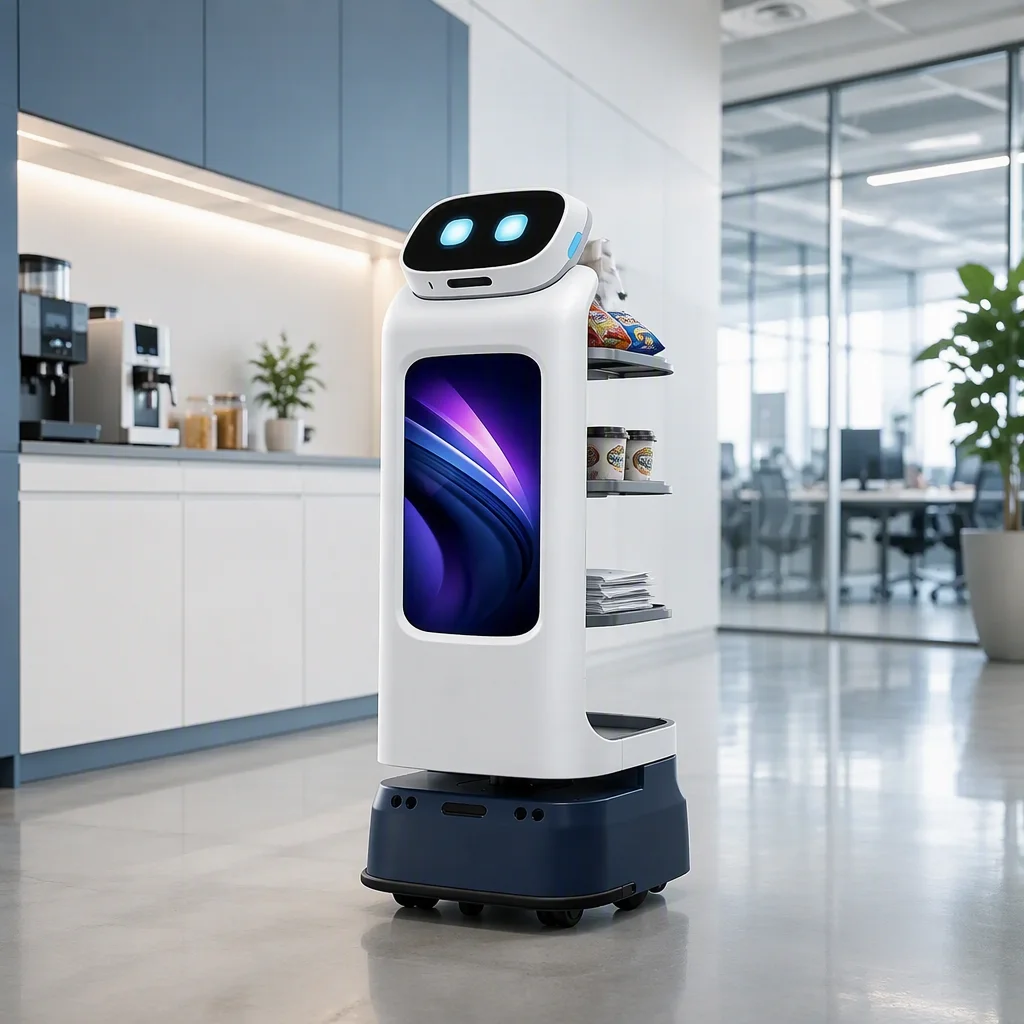
Industrial robots have handled welding, assembly and pick-and-place for decades, but they are fixed automation: bolted to the floor, caged off from workers, programmed once and left alone. The work that stays manual on a factory floor is different in kind, carrying a tote between stations, scrubbing the aisle where a forklift dropped its load, walking a tool to a line, moving a sample to the QC room. That work has no fixed position, so it needs mobile machines. Autonomous mobile robots (AMRs) and autonomous cleaning platforms form a second automation layer that moves with the process instead of holding it still.
Three workflows absorb most of that manual floor labour, and each maps cleanly onto a specific AOMAN FUTURE platform.
The Three Factory Workflows Absorbing Manual Floor Labour
1. Material transport between workstations
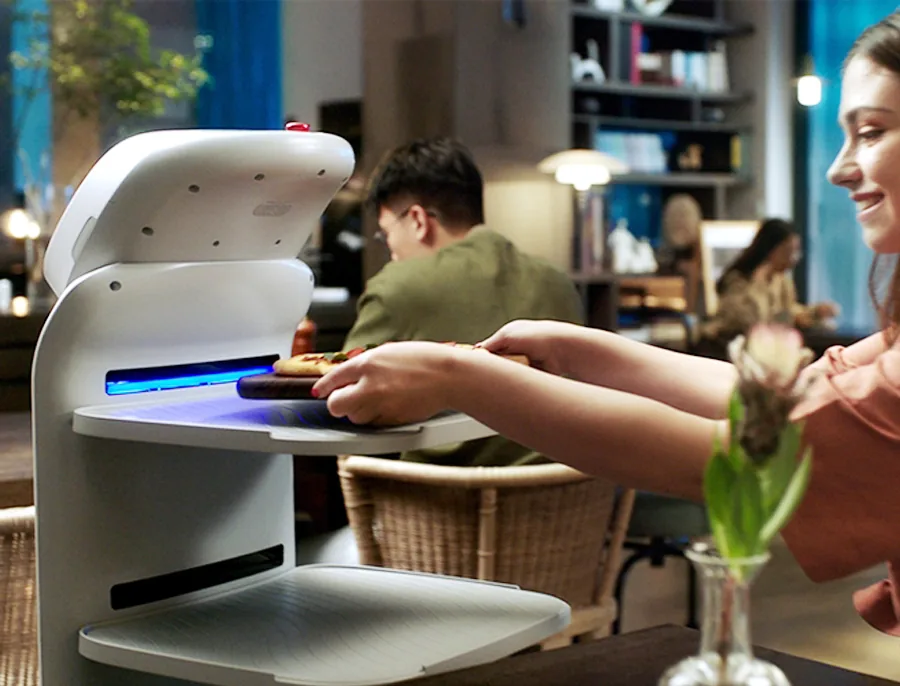
Moving raw materials, work-in-progress and finished goods between stations is usually the largest non-value-add activity in a plant. The traditional answers both have hard costs: forklift routes consume operator time on every trip, and conveyors lock a layout in place for years and need modification every time a line moves. The AOMAN D1 takes a third approach, no fixed infrastructure: no floor tape, no floor QR codes, no ceiling markers. Its SLAM-based navigation builds a live map of the facility and re-plans routes in seconds when a rack or a wrapper blocks a lane.
The D1 platform is built for exactly this work. It carries 40 kg per trip across four trays, clears aisles down to 70 cm, and runs a 21.5-inch display that shows the current task, the destination and up-to-the-minute status. When a line is fed by a delivery AMR, the specification that matters most is per-trip payload times trip frequency. And 40 kg with a fast swap back to the staging dock keeps a single workstation fed continuously. Against a conveyor, the payback logic is different too: the robot serves every station on its route, not just the one it was built for.
2. Industrial floor maintenance
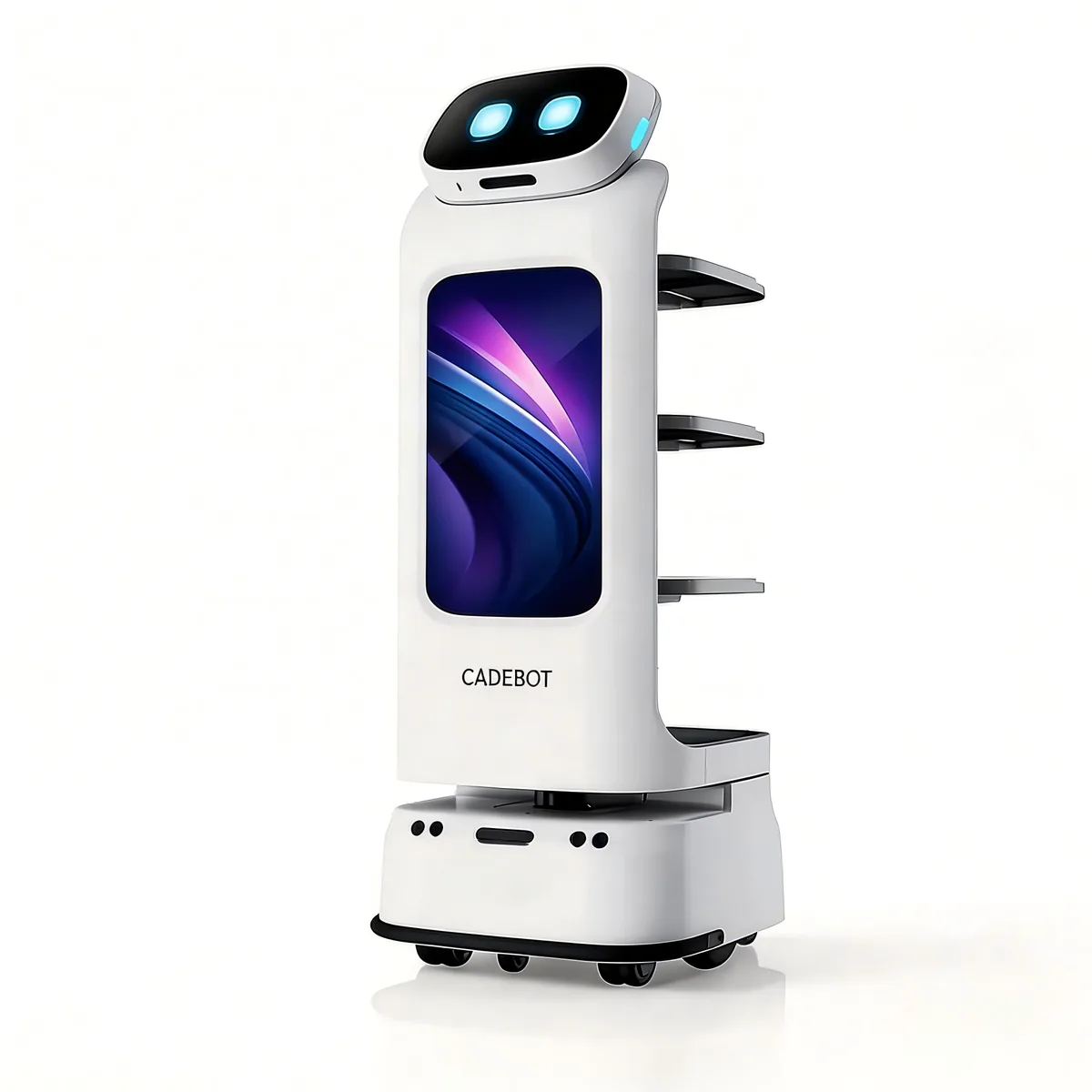
Factory floors collect dust, metal swarf, oil residue and chemical traces. And those residues are not only a housekeeping nuisance. In precision machining and electronics assembly, particulate in the air is a direct quality variable, and oil films on aisle floors are a slips, trips and falls exposure. The AOMAN C1 platform is sized for this: 2,040 m²/h cleaning coverage, a 790 mm squeegee, 70 L clean-solution and 50 L recovery tanks, and an 85 cm aisle footprint that lets it work in the same lanes as pallet trucks. Coverage at that rate also changes the schedule logic: instead of one deep clean per shift, the floor can be maintained on short, continuous cycles, a pass before shift start, spot passes during breaks and at line changeovers.
For break rooms, control rooms and office-adjacent areas inside the plant, the AOMAN C2 Pro covers the same job in a compact, quiet form: it clears 85 cm aisles, fits its base under office furniture, runs a modular tank set that is simple to refill and maintain, and stays audible enough to run alongside day staff.
3. Tool, PPE, sample and document delivery
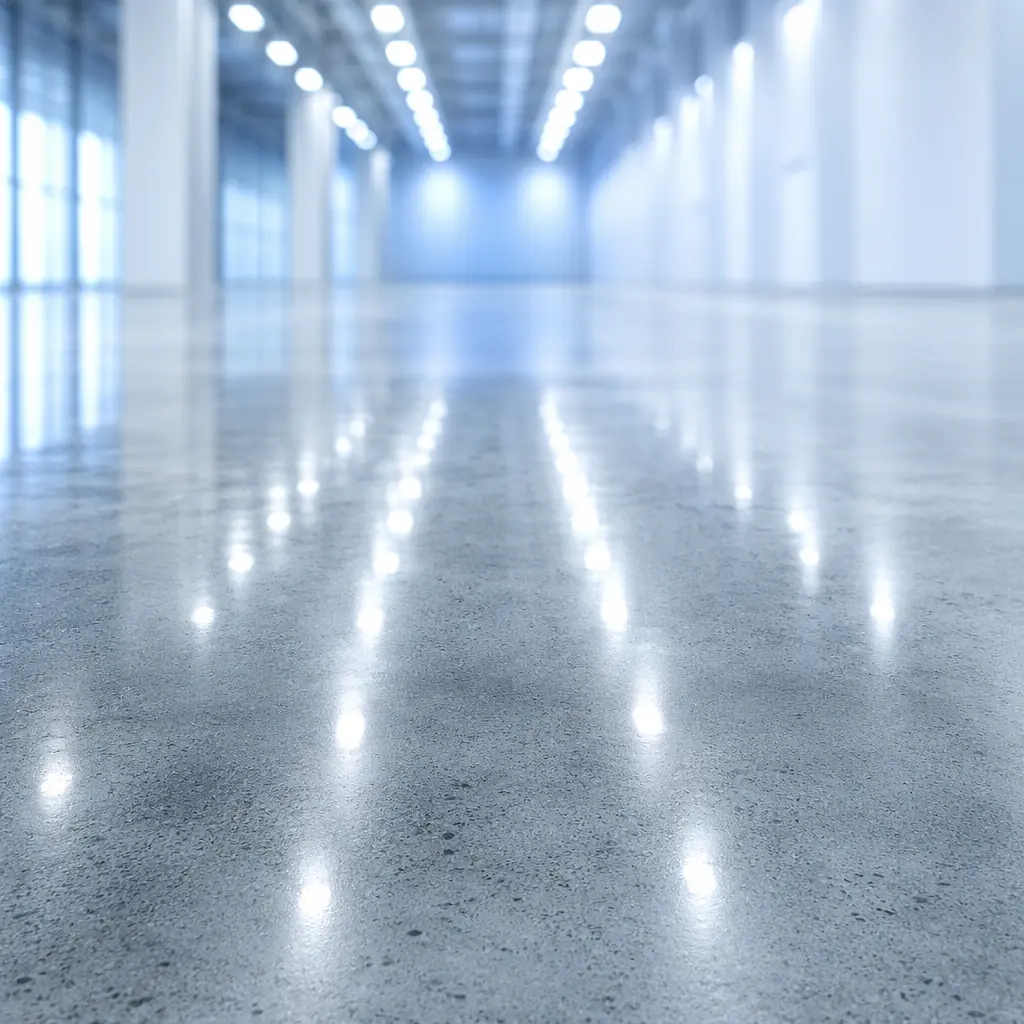
Any item that has to be hand-carried across a factory floor is a candidate for automation. And the list is long: tools and fixtures to a machine that is down, PPE to a changeover team, samples to the lab for first-article checks, paperwork between the line and the planning office. Each hand-carry takes a production worker off the task they are paid for, and the journeys repeat on every shift. An AOMAN D1 on scheduled loops absorbs that walking: workers fill a tray, the robot runs the route, and the 21.5-inch screen shows the SOPs, maintenance history or batch records at the point where the work happens.
Route-clearance checks belong on the same robot. While delivering, the D1 records blocked aisles, spills and debris in the walkways it traverses, and the fleet log turns those observations into a strip of repair tickets instead of relying on someone to remember the blocked lane at the end of a shift.
Which Platform for Which Job: A Spec-Level Map
The four AOMAN FUTURE platforms cover the factory jobs that remain manual. The decision is mostly about aisle width, payload and where the work sits on the plant-information boundary.
| Platform | Factory role | Key specifications |
|---|---|---|
| AOMAN D1 | Inter-station transport of parts, tools, PPE and samples; route documentation | 40 kg payload, four trays, 21.5-inch display, 70 cm aisle clearance, SLAM navigation |
| AOMAN C1 | Production aisles, corridors and covered bays, continuous floor maintenance | 2,040 m²/h, 70 L / 50 L tanks, 790 mm squeegee, 85 cm aisle |
| AOMAN C2 Pro | Break rooms, control rooms and office-adjacent zones | Compact footprint, quiet operation, modular tanks, 85 cm aisle |
| AOMAN G1 | Admin-building reception, visitor log, multilingual guidance | 15 DoF upper body, six-mic array with 5 m pickup, 13 MP camera, auto recharging |
Two of these roles stay invisible in most automation plans: the AOMAN G1 at the front building, and the compact cleaner in the offices. They are not factory automation in the usual sense. They are plant infrastructure, and they close the last remaining manual pockets on the same paperwork a capital request for transport AMRs already tracks.
Integration: Where Most Deployments Stall
The robots themselves are rarely the failure point. The failure point is the connection to the plant digital backbone, the manufacturing execution system (MES), the warehouse or inventory system, and the EHS incident log.
Three integration points decide how much value a transport or cleaning fleet returns:
MES. When delivery tasks trigger from a workstation completing its batch, human dispatching disappears entirely. The robot is ordered the moment a line needs material. A REST API to the MES is the minimum requirement; if a plant runs a MES without an API, a phase-one standalone run still works but the dispatch stays manual.
Warehouse and inventory. Pick lists delivered straight to the robot fleet let one robot combine several workstations on a single run and turn the round trip into a serving route. In the simplest loop, consumption at stations generates replenishment requests without a planner in the middle.
EHS and maintenance logs. Route-clearance findings and delivery exceptions should land in the system the EHS team already reviews, not in a separate dashboard. A spill found at 09:14 and logged into the same incident register as every other hazard finding gets a corrective action assigned; the same finding sitting in a robot app gets read at the next quarterly review.
The consistent pattern: a robot deployed as standalone hardware is a labour-saving device; a robot connected to the planning and safety workflow is a control on material flow. Budget the integration days before you budget the robots.
A Selection Checklist for Factory Floors
- Map the material flow first. Count the trips per shift and the minutes each trip takes. If transport-plus-waiting is a meaningful share of process time, start with the delivery AMR. It is the fastest-ROI entry point in most plants.
- Audit the floor condition. If particulate correlates with defects, or if the incident log shows slip hazards clustering in certain zones, add an autonomous cleaner before you add anything else. Continuous cycles beat one-per-shift deep cleaning everywhere the floor doubles as a work surface.
- Count the hand-carry. Add up the hours per week that skilled workers spend carrying tools, samples and paperwork. That is direct, measurable, recoverable time. And it does not require any process change to realize.
- Check integration readiness. Confirm the MES and inventory system expose APIs. If they do not, plan a sequencing window or a middleware layer; the standalone phase is still worth running, but the connected phase is where the fleet earns its keep.
- Start with one workflow, one shift. The deployments that scale ran two or three robots on one shift in one workflow first, proved the arithmetic, then expanded. The deployments that stalled ordered a fleet before anyone had measured a single trip.
Costs: What to Model Before You Order
Run the numbers as an illustrative example, not an industry formula. A single AOMAN D1 on a 250 m loop, completing eight round trips per hour at full 40 kg trays, moves roughly 320 kg of material per hour. So the question is not what the robot costs, it is how many runner hours on your OR layout that equals, given your actual trip lengths and tray-loading rates. On the cleaning side, an illustrative 2,000 m² hall receives a full pass roughly every hour at 2,040 m²/h coverage; compare that to the fraction of a projected day your current crew can maintain a floor at under normal shift coverage.
Model the three line items that matter: the runner or crew hours displaced, the hours of skilled labour that no longer walk between stations, and the waits that disappear when a station stops needing a material delivery to arrive on the third follow-up call. Pricing and financing are per-deployment; request pricing with your aisle widths and trip counts and the quote comes back against your floor plan, not a catalogue page.
Before You Buy: Questions for Your Vendor
- What is the real per-trip payload, and how fast does the tray swap back out between runs?
- How does the robot re-route when a lane is blocked, and who reviews its blockage and spill findings?
- Does the platform connect to the MES and warehouse systems via a documented API, and what middleware is charged separately?
- How many dock stations and on-board swap bays does a single-battery plant actually need. And where do the docks sit relative to the forklift lanes?
- What does the cleaning platform report per pass, area covered, cycle time and solution usage, and does that report feed your quality and EHS files?
Tell us your floor plan and the workflow you want to fix first. We will match the platform, the dock layout and the integration path, and give you a deployment plan within 24 hours. Request pricing or browse the platform range. A venue with a different traffic pattern, and how the configuration changes for it, is covered in industrial laundry deployments.