Service Robots for Events, Trade Shows & Exhibitions, The Complete Guide to Automated Venue Operations
At a glance: AOMAN D1 moves 40 kg across four trays per run -- one unit carries exhibitor kits, catering and AV spares in a loop. This guide maps the wayfinding, logistics and cleaning roles for trade shows, with the deployment tiers that match venue scale.

Event operations fail in predictable ways: attendees miss the session they registered for because they could not find Hall C; exhibitor kits queue at the loading dock on setup morning; spills sit on the floor of the hall through the afternoon session. AV, booth design, and digital registration have modernized -- the physical flow of people, materials, and information in the venue is usually the last holdout. Service robots close exactly that gap.

Where events break down
Wayfinding. Post-event feedback across B2B shows consistently ranks "could not find it" as the top attendee complaint: temporary signage gets occluded by booths, layouts change between events, and crowds move faster than paper arrows. A robot that answers "how do I get to booth 742" at the point of confusion removes the problem rather than another layer of it.
Material movement. Exhibitor kits, catering runs, AV spares, and collateral restock between halls is a constant stream with time pressure and no tolerance for trips that fail halfway. In a multi-hall show this is dozens of staff-hours per day, spent by people hired for guest engagement.
Floor condition. High-traffic halls accumulate spills, scuffs, and dropped brochures on an hourly cycle, while crews traditionally work overnight. The gap between the spill and the cleanup is the part the exhibitors see.
Staffing volatility. Setup day and opening morning need multiples of normal headcount for 48-hour bursts, and the worst position to be in is "two staff called in sick on opening day." A robot fleet's headcount does not call in sick; its reliability converts planning from hope-based to schedule-based.
Five roles that transform event operations
1. Concierge and wayfinding: the AOMAN G1
Stationed at registration, hall entrances, and elevator banks, the AOMAN G1 handles the wayfinding loop end to end: 15 degrees of freedom for natural gesture, a six-microphone array with 5 m pickup for a noisy hall, a 13 MP camera, and multilingual guidance. Attendees state their destination -- booth number, keynote, lounge -- and the unit either gives turn-by-turn guidance, escorts part of the way, or pushes the route to a phone via QR code. Scheduled show changes (session rooms, hall relocations) belong in the unit's data before show day, not after the confusion happens.
2. Material transport: the AOMAN D1
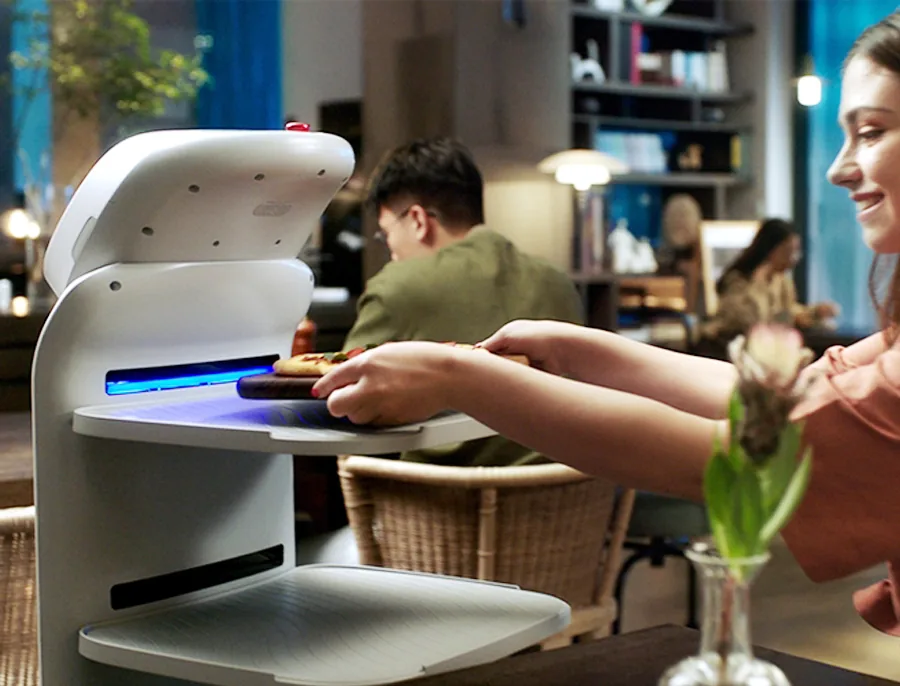
The AOMAN D1 carries up to 40 kg across four trays and clears a 70 cm aisle -- a loop of exhibitor kits, catering trays, AV spares, and restock supplies, with loading staged at a dock-adjacent bay. It uses the same SLAM-based navigation architecture as the whole platform, with venue maps built in a day. Working through a crowded hall is the honest test; schedule heavy transfers through the pre-opening windows and lighter ones between sessions.
3. Continuous floor maintenance: the AOMAN C1 and C2 Pro
The AOMAN C1 scrubs at 2,040 m²/h with dual 70 L and 50 L tanks and a 790 mm deck -- enough to run scheduled passes through a hall floor during the show instead of only at night. The AOMAN C2 Pro (compact, quiet, modular tanks, 85 cm aisle) covers registration zones, meeting rooms, and corridor edges while attendees are present.

4. Registration and check-in triage: the AOMAN G1
Queue management at registration is the most visible failure point of any event. A G1 stationed beside the self-service badge printers handles the common questions -- where the speaker ribbon is, where the cloakroom, what time the keynote starts -- and redirects complex cases to human staff. Illustrative example: with 5,000 attendees and an average check-in that drops from 4 minutes to 90 seconds, the arithmetic is 5,000 x 2.5 minutes, roughly 208 attendee-hours returned to the floor instead of the queue.
5. VIP and speaker escort: the AOMAN G1
Speakers, VIP buyers, and board members expect a consistent welcome regardless of how many arrive at once. A dedicated unit meeting guests at the entrance and bringing them to the green room by the least-crowded route is a consistency layer, not a replacement for human hospitality -- and it keeps the check-in host free for exactly the moment that matters.
Tiers that match venue scale
| Tier | Typical shape | Units | Staff-hours reclaimed (illustrative) |
|---|---|---|---|
| Starter | Single-day conference | 2-3 units (wayfinding + light logistics) | ~ 45-60 h over the day |
| Professional | 3-day trade show | 5-6 units (wayfinding, logistics, cleaning) | ~ 120-160 h over the run |
| Enterprise | Multi-hall exhibition | 10+ units across roles and halls | ~ 300-400 h over the run |
Cost depends on rental window, unit count, and on-site support -- for lease-versus-buy and seasonal structures, see the RaaS financing models guide. Staff-hours in the table are illustrative planning numbers drawn from the same arithmetic: a unit that clears a wayfinding stop in seconds, plus a logistics run that would have been a 20-minute staff round trip, plus a cleaning pass that runs on schedule rather than when someone is free.
Dispatch patterns across show days
Event days are three different operations wearing one ticket. Setup shifts favor logistics: exhibitor kits, flooring, prep runs -- schedule the heavy transfer windows in the pre-opening hours and let the units chain loops back to back. Live days favor wayfinding and maintenance: surface calls on the floor, continuous cleaning passes in the halls, and materials moving only in less-crowded ruts. Teardown is logistics again, less structured, but exactly the pattern a mapped venue handles better than a human retrieval queue.
The versioning note matters for repeat events: an exhibition venue that hosts a new show every month gets a fresh map every month. Map updates are a scheduled task, and the venue that treats "import the new floor plan" as part of the show package is the one whose robots are not confusing booth 321 for booth 312.
Role timing at a glance
| Show phase | Role on duty | Why |
|---|---|---|
| Build-up | D1 logistics loops | Kits, AV, catering staging at the dock |
| Registration morning | G1 at the badge queue | Fast, repeated answers; escalate the unusual |
| Live hours | G1 wayfinding + C1 surface passes | Crowd density is the test; cleaning runs between sessions |
| Evening events | G1 escort + VIP support | Foundation of the premium spend |
| Teardown | D1 return loops | Materials back to dock; floor reset for next booking |
The four-week path to show day
Week 1 - venue assessment: map the floor plan into the navigation system; identify choke points, registration zones, VIP routes, and catering corridors. Most venues need a morning on site with the mapper.
Week 2 - programming: wayfinding destinations, delivery schedules, cleaning zones, greeting scripts for the specific event. Show-schedule data (session changes, hall relocations, parade-style crowd movements) lands here, not on the morning of.
Week 3 - staff training: a half-day session on interaction, escalations, and manual intervention. Crews that see the units before opening day treat them as part of the location; crews that meet them at 7 AM on day one treat them as an obstacle.
Week 4 - dry run: run the full system in the empty venue two or three days before opening, with simulated deliveries and verified cleaning patterns.
Crowd flow and safety coordination
Robot paths in a venue intersect attendee flow, which is why the routing design belongs to the show plan, not to the robot vendor: which corridors are one-way during rush, where exhibitor loading overlaps attendee circulation, what the lift-and-dispatcher movements look like during the keynote changeover. The units should run on a mapped lane plan shared with security and event ops, with a hard rule: in a crush of crowd, speed down and make room -- never push through. Exits, stairs, and emergency routes are non-negotiable zones; schedule units away from them during changeovers.
The on-site support note: whoever runs the show needs one contact for robot behavior and one escalation channel for guest-facing incidents, on every show day. A single support page in the ops binder is the difference between a fix in four hours and a fix recounted at the post-show review.
Why organizers are moving now
Attendee expectations have been reset by hospitality: people who expect robot-assisted check-in at a hotel expect at least as much at a convention -- see the hospitality robots guide and the hotels and resorts deployment guide for the exact same interplay. Staffing economics remain the underlying pressure. And venue operational quality has become a rebooking factor: when exhibitors compete for attention inside a crowded hall, a venue that keeps its floors clean all day and finds its VIPs reliably differentiates itself in the next RFP.

Event technology evolves in layers: first registration, then AV, then attendee apps. The next layer -- physical venue operations -- is what changes how a show actually feels. Robots do not replace the human energy that makes events memorable; they carry the logistics that, when they fail, prevent anyone from seeing the energy at all. For the change-management side of the rollout, see the human-robot collaboration guide.
Tell us your venue size, show schedule and attendee volume -- contact the AOMAN FUTURE events team and we will scope the tier, the rental window, and the on-site support plan for your next show.