Service Robots for Cruise Ships, Maritime Automation Guide for 2026
At a glance: AOMAN D1 carries 40 kg across four trays on a 70 cm aisle -- a fit for shipboard corridors -- while C1 covers 2,040 m²/h of public deck. This guide maps the shipboard roles and the compliance questions marine buyers must ask.
A modern cruise ship is a hotel district with every constraint turned up: narrow corridors, salt in the air, thousands of guests at full occupancy day after day, and maintenance windows measured in the hours between ports. The three robot roles that transfer cleanly from landside hospitality are the same three that dominate it -- delivery, cleaning, and guest information -- each with specific adaptations before anything goes on a vessel.

Three roles with real shipboard traction
Cabin delivery: the AOMAN D1
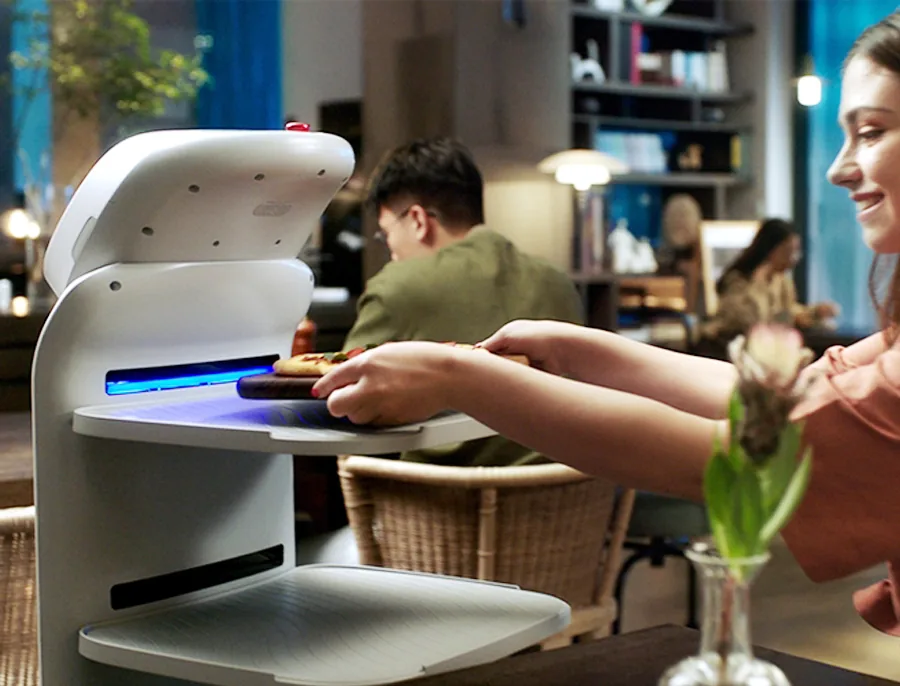
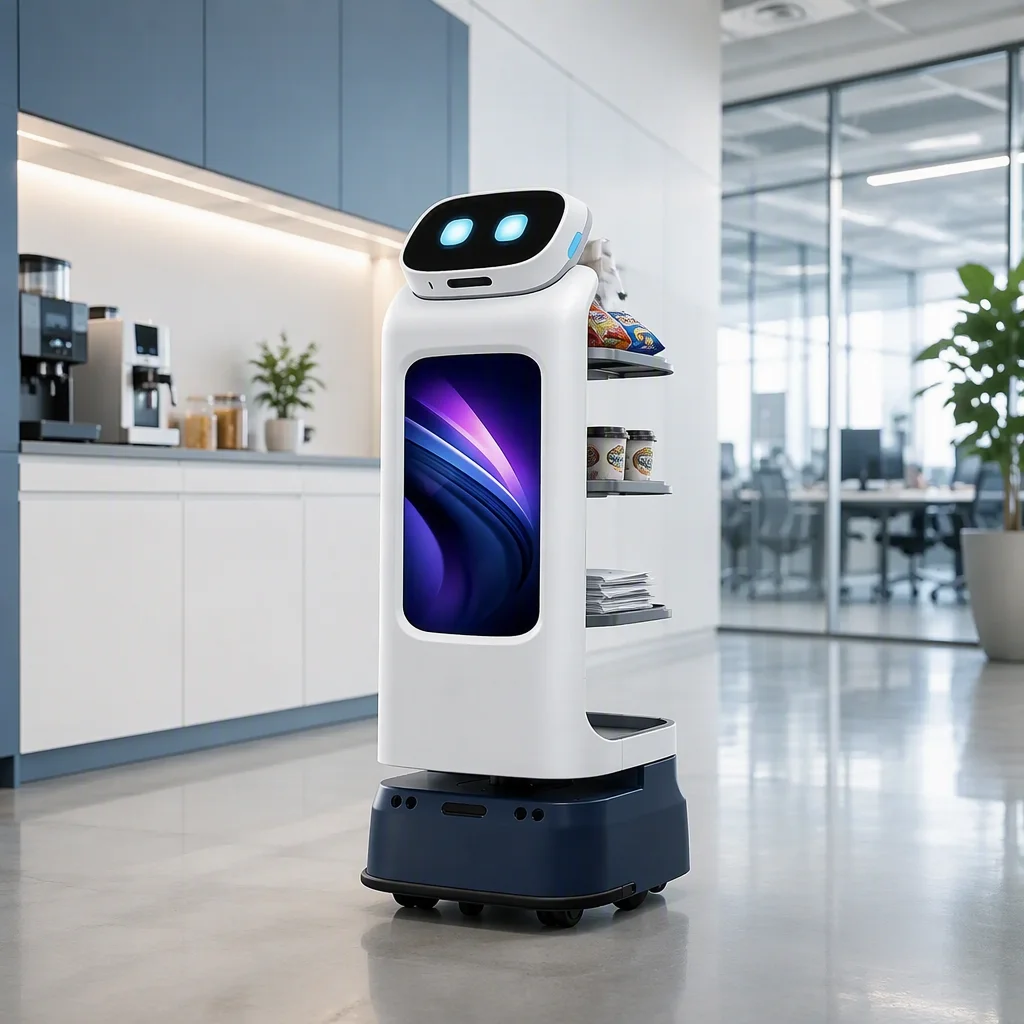
Cabin requests -- towels, amenity kits, small purchases, room-service orders -- are the highest-frequency service task on board, and they repeat in the same corridors every day. The AOMAN D1 carries up to 40 kg across four trays, making multiple cabin stops in one loop, and clears a 70 cm aisle -- a fit for the corridor widths of modern vessels and the service doors most cabins sit behind.
Two ship-specific adaptations come first. Elevator integration is mandatory: the fleet manager must call and ride the bank of elevators itself, typically via a bridge to the ship's elevator control system. And guest notification should use the cabin telephone or the ship's service channel at the door, with a defined no-answer protocol so the unit returns on schedule rather than idling.
Deck and public-area cleaning: the AOMAN C1
Public-area floors on a cruise ship are the highest-scrutiny square meters at sea: salt spray on open decks, food residue around buffets, walking-track grime in atriums and corridors. The AOMAN C1 scrubs at 2,040 m²/h with dual 70 L and 50 L water tanks and a 790 mm squeegee deck -- sized for the indoor public zones of a large vessel (atrium circles, corridor systems, promenade-adjacent indoor decks).
For the engineering side: saltwater is the primary enemy. A marine deployment spec should name corrosion-resistant fasteners, sealed bearing assemblies, conformal-coated electronics for the humidity of lower decks, and an IPX5-or-better rating for units that touch enclosed exterior areas. Ask the vendor for maritime references explicitly -- the answer to "it worked in a shopping mall" is not the answer you need on a vessel.
The second engineering reality is the motion. Vessels roll and pitch even at moderate seas; a unit that assumes a level world needs its inertial handling and wheel behavior validated on roll, not on a carpeted demo floor. Validation is cheap on shore and expensive after the warranty sails.

Guest information: the AOMAN G1
Embarkation halls, atriums, and guest services desks carry the same repeated questions every sailing: dining reservations, show times, deck directions, excursion briefing points. The AOMAN G1 -- 15 degrees of freedom for natural gesture, a six-microphone array with 5 m pickup, a 13 MP camera, and multilingual guidance -- handles welcome, orientation, and queue triage, then escalates anything complex. With passengers from many countries on every sailing, multi-language support is not a feature; it is the requirement.
Maritime engineering questions for the spec
- Inclines and transitions -- shipboard decks connect by ramps; confirm the unit's cliff/edge sensors and drive behavior on the vessel's actual grades.
- Humidity and temperature -- lower-deck ambient conditions sit far above landside norms; sealed electronics matter.
- Battery and charging placement -- follow the vessel's requirements for lithium-battery storage and charging areas, and use IMO guidance on the safe storage and charging of batteries aboard ships. Charging is a marine-engineering decision, not a plug-in decision.
- Vibration and motion -- run units through the fleet's planned maintenance system from the start, with inspection intervals documented.
Regulatory lines: SOLAS, ISM, and flag state
Shipboard equipment sits inside a regulatory framework landside installations do not touch. SOLAS Chapter II-2 governs fire safety and bound electrical equipment in passenger areas, so the units need the flame-spread and smoke-and-toxicity material documentation; the flag state (Panama, Bahamas, Malta, or whichever registers the vessel) adds its own acceptance process. The ISM Code further requires that shipboard equipment be documented in the vessel's Safety Management System: inspection intervals, crew training records, remote stops, and shutdown procedures. Plan the documentation and crew training alongside the equipment order -- it is part of the deployment, not paperwork after it.
Charging placement sits at the intersection of all three: choose locations in vents and covered zones away from passenger traffic, follow the vessel's battery-storage rules rather than the dock's power outlet, and make the docking position part of the crew's weekly inspection schedule. A unit that cannot be reached in a drill or during a mealtime provisioning run will be parked permanently, whatever the paperwork says it can do.
Zone-based scheduling
A galley-to-cabin route crosses crew areas, passenger corridors, and service elevators, each with different access permissions. The fleet manager needs zone-based schedules: units assigned to specific decks during peak hours, redeployed in off-peak windows, and aware of the schedule-driven crowd surges that shows and shore excursions cause. For the orchestration architecture behind this, see the fleet management systems guide.
| Zone | Unit | Schedule note |
|---|---|---|
| Guest corridors, cabin decks | D1 (delivery) | Runs through the day; reschedules around dinner hours |
| Atriums, casino, shopping arcade | G1 (information) | Stationed at peaks; moves during shows |
| Indoor public decks, corridors | C1 (cleaning) | Overnight and low-traffic windows |
| Outdoor decks and promenade areas | C1 (marine-rated) | Early morning and quiet-state windows |
An illustrative capacity example
Illustrative example -- run the arithmetic against your own vessel before you plan around it.
| Assumption | Value | Derivation |
|---|---|---|
| Vessel guest capacity | 3,500 | Cruise line deck plan |
| Cabin-request loops per D1 per day | ~ 35 | Loading, elevator dwell, delivery calls |
| Stops per loop | 4 | Four trays, one stop each |
| Coverage with 4 delivery units | ~ 560 stops/day | 4 units x 35 loops x 4 stops |
| Indoor public-area floor | ~ 8,000 m² | Ship drawings |
| Overnight clean time, one C1 | ~ 4 h | 8,000 m² at 2,040 m²/h |
The useful reading is the same as on land: robots carry the middle of the day and the overnight reset, while crew cover the human-edge cases at mealtimes and in response to unpredicted guest behavior.
A realistic three-phase roadmap
Phase 1 (months 1-3): two or three cleaning units on one indoor public zone and one enclosed deck, for maritime durability validation -- corrosion, humidity, salt, motion logging.
Phase 2 (months 4-6): three or four delivery units on a single deck zone, elevator integration through the ship's control system, and crew training on operator duty (a hands-on role, not a theory session).
Phase 3 (months 7-12): expansion across decks, guest information units at embarkation and atrium locations, and integration with the ship's hotel operations system for task dispatch.
The critical success factor is crew acceptance. Position the units as tools that remove the worst shifts -- the 3 AM corridor clean, the towel run at dinner service on Deck 14 -- not as replacements for skilled hospitality roles. The change-management framework is in our human-robot collaboration guide.
What a shipboard pilot should validate
- Corridor and door clearance -- measure the tightest guest-deck corridor and the cabin-door approach on the actual vessel, not the brochures.
- Elevator behavior -- wait times, door-hold behavior, and the crew-duty floors that coincide with guest service hours.
- Motion and heel -- a rolling day at moderate sea state is the test, not a calm harbor day.
- Dock and maintenance angle -- where charging lives in the crew zones, and whether the crew path conflicts with laundry, provisioning, or drill locations.
- Drill and abandon-ship posture -- what happens to the units in a scheduled drill, and who is responsible for them.
Crew training and documentation
The ISM-side expectations shape the crew roster more than the tech does: unit operator duty (one per deck, per shift), weekly inspection check on the maintenance system, and a named responsible officer on the bridge side for the ISM documentation. Training on board follows the same shape as any safety-relevant equipment -- recorded, assessed, and refreshed on the cycle your safety management system already uses. Crew acceptance is the predictor of the whole program, and it is won by positioning units as tools that remove the worst shifts, not as replacements for filled roles.
Terminals and ports
The automation case extends beyond the ship. Turnaround ports handle thousands of embarking and disembarking guests in a single morning: terminal floors need continuous resets between sailings, wayfinding in an unfamiliar hall is at its worst, and small materials move between zones constantly. Terminal deployments reuse the same units and the same map workflow as the airport and transportation-hub playbook.
For the financing structures that keep a two-week voyage asset off the capital budget, see the RaaS and financing guide. To walk through the vessel-specific spec, contact the AOMAN FUTURE team -- bring your deck plans and your crew-training capacity, and we will scope the marine version of the deployment.