Service Robots in Airports, The Complete Guide to Terminal Automation in 2026
At a glance: AOMAN C1 scrubs 2,040 m² per hour with a 790 mm squeegee, enough to keep a mid-size terminal concourse presentable all day. This guide maps the three robot roles that fit airports, the deployment constraints unique to secure terminals, and what a first 90 days looks like.
Airport terminals run 24/7, and the floor area that must stay presentable does not shrink overnight. Red-eye banks and tightened overnight maintenance windows have compressed the hours available for manual cleaning, while retail, catering, baggage and ground operations all move goods across terminals that can span several kilometres end to end. The result is a building that needs continuous cleaning and continuous delivery. Two demands that match what service robots actually do.
Three robot roles cover most terminal workload: cleaning, delivery and passenger guidance. Each role maps to a specific platform, and the deployment advice below is limited to what those platforms' published specifications support.
Three Robot Roles in Airport Terminals
Airports mix controlled zones, peak passenger waves and long corridors, which is why a small role-specific fleet performs better than a single generalist machine.
Autonomous Cleaning for Concourses and Halls
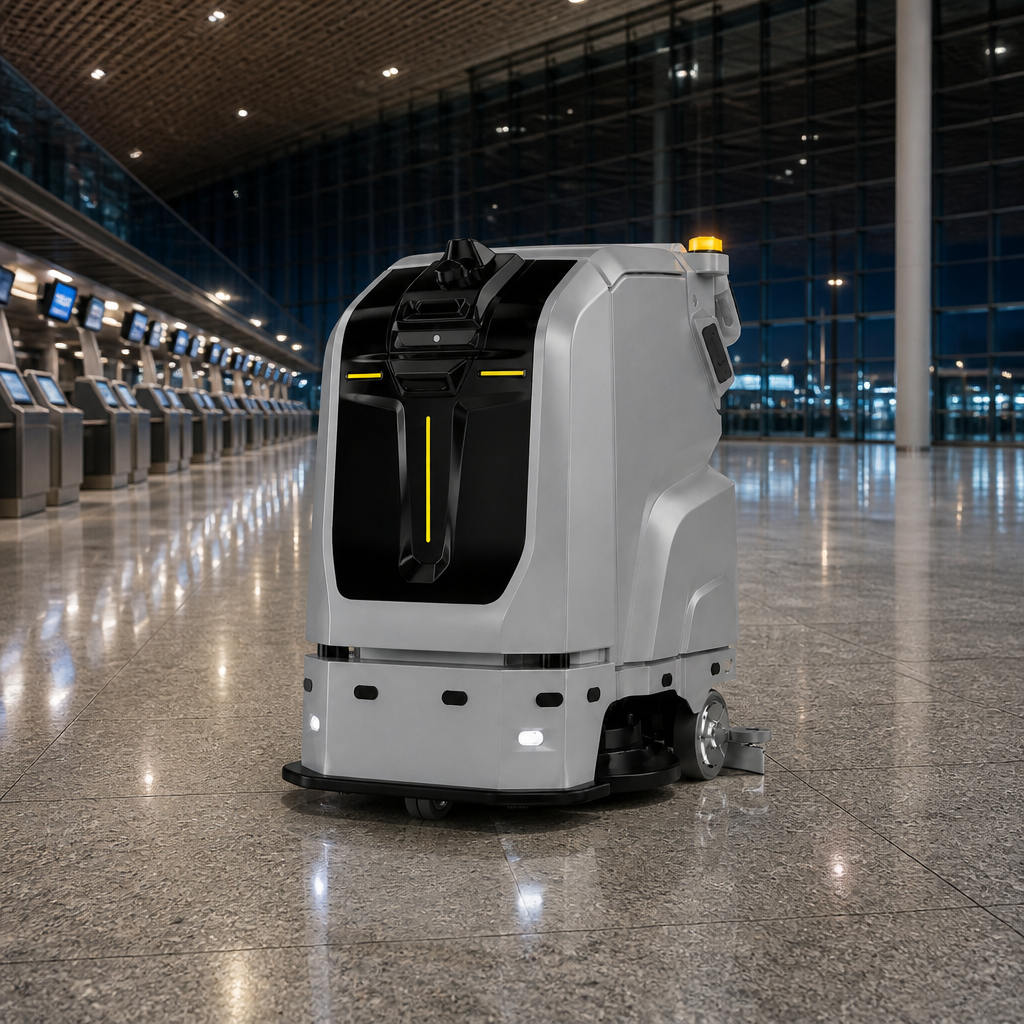
The AOMAN C1 scrubs 2,040 m² per hour with a 790 mm squeegee and a 70 L + 50 L split water tank, and it is sized for exactly the surfaces an airport has most of: check-in halls, baggage claim and departure lounges. Its 85 cm passage width lets it work the aisles between seating rows and along shopfronts without blocking flow.
For tighter areas, retail corridors, restroom approaches, elevator lobbies, the AOMAN C2 Pro operates under 70 cm of desk clearance and through 85 cm aisles, runs quietly so it does not disturb travellers, and carries modular tanks that swap quickly. Adding two C2 Pro units extends covered cleaning into every zone a full-size scrubber cannot practically reach.
Cleaning robots do not replace the overnight crew; they close the gap between scheduled passes. A spill at mid-morning on a boarding walkway is picked up by the nearest unit dispatched through the fleet platform rather than staying underfoot until the next night shift.
Delivery: Gate Catering, Duty-Free Restock and Documents
Behind a smooth passenger experience sits a continuous logistics operation: gate-side meal delivery, retail restocking across dozens of outlets, lost-baggage items moving between carousels, and paperwork shuttling between operations offices. All of it happens at the same time, across a footprint that can run to 2 kilometres between endpoints.
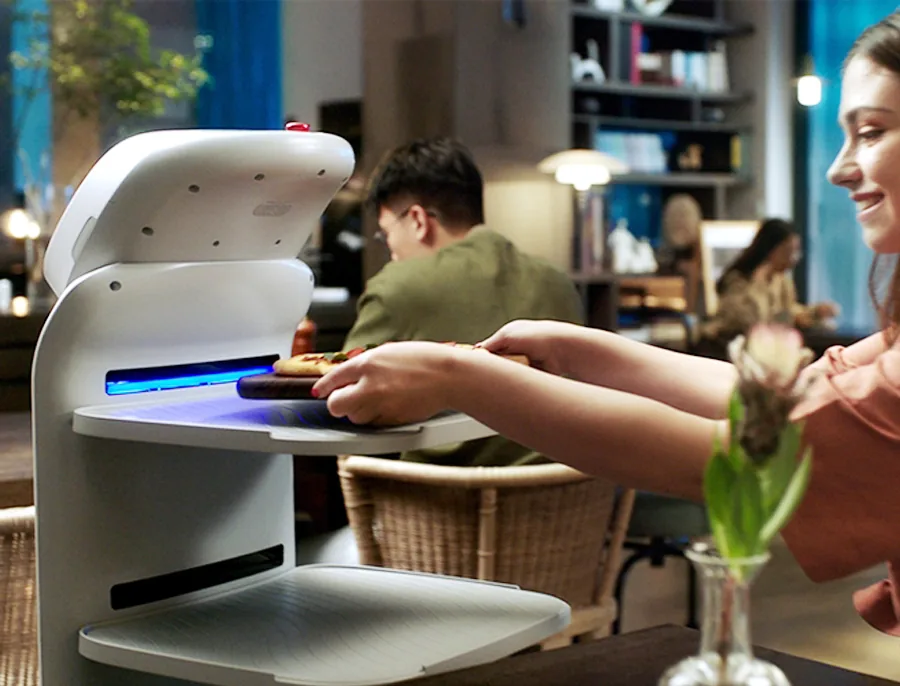
The AOMAN D1 carries 40 kg per trip on four trays with 270° rotation, displays its current task on a 21.5-inch screen, and negotiates 70 cm aisles. On a single planned route it can drop catering at two gates, collect returns from a duty-free outlet and end at the loading dock, batching outbound deliveries and return pickups to cut empty running. That is exactly the workload that used to consume staff walking the same corridor with a cart.
A delivery robot that cannot call an elevator is useless in a multi-level terminal, so D1 deployments integrate with standard building elevator and automatic-door control interfaces; older terminals are fitted with relay modules on the elevator panel during commissioning rather than rewiring the whole building.
For the navigation layer that makes this work without fixed infrastructure, no rails, no floor tape, see our explainer on SLAM navigation technology.

Passenger Guidance: Where a Guidance Robot Fits
Navigation is the number-one passenger pain point in large airports, and static signage cannot answer a follow-up question. Gate changes, delays and "where is the lounge with showers?" are real-time, conversational needs that stretch desk staff thin at peak.
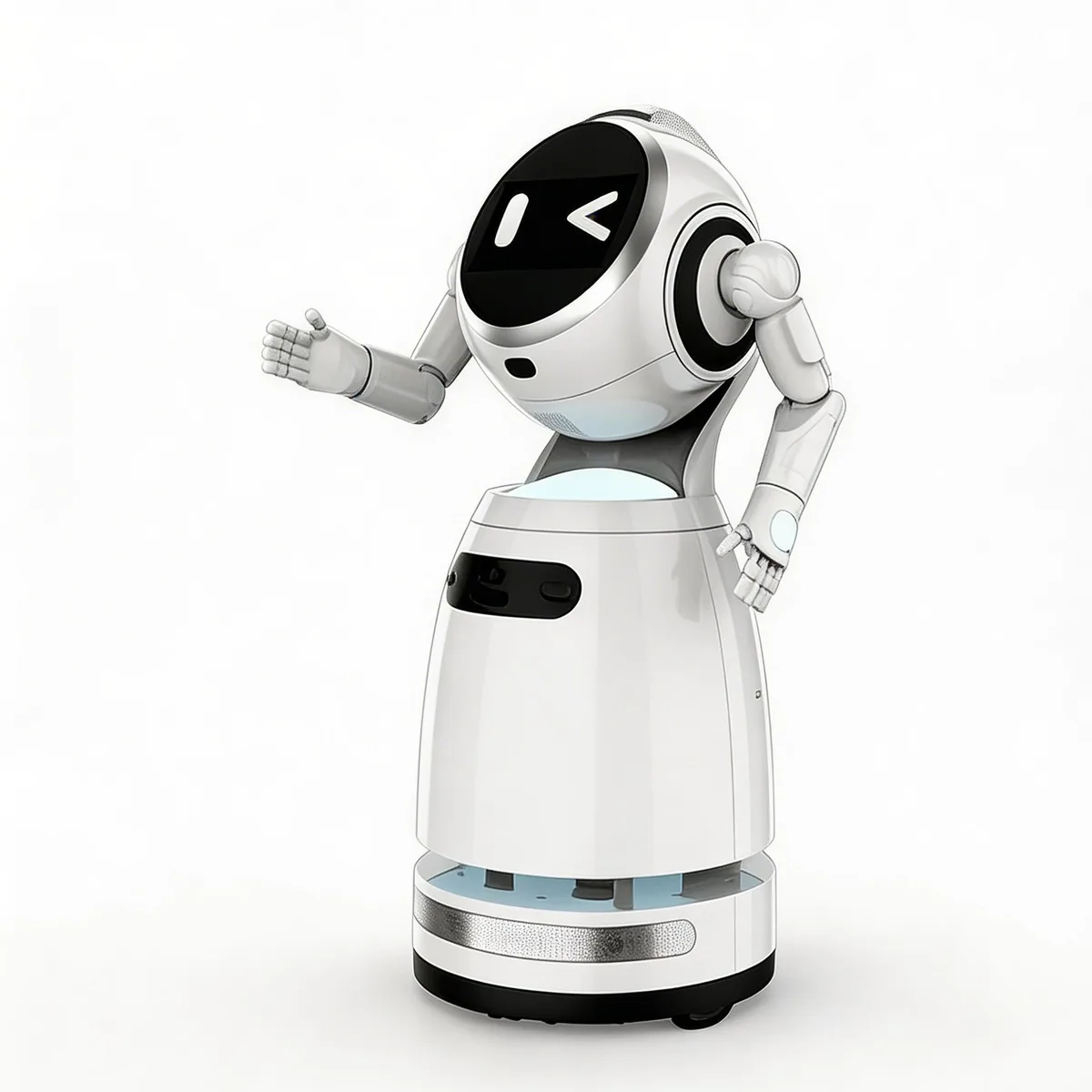
The AOMAN G1 guidance robot is built for exactly this: 15 degrees of freedom for natural motion, a 6-microphone array with 5 m pickup range, a 13 MP camera, multilingual guidance and check-in assistance, and automatic return to its charging dock. In a publicly documented deployment at Paris Charles de Gaulle Airport, G1 units provide wayfinding and check-in assistance to travellers in one terminal area, front-line passenger service that scales without adding desk staff.
Where the airport exposes a flight information feed, the unit can also display live gate status and walking-time guidance on screen. The human staff's time goes to the cases that genuinely need judgement, rebooking, accessibility assistance, complaint resolution, while the routine questions resolve themselves at the unit.
What Makes Airports Different From Other Facilities
Airports are not just large buildings; they are regulated environments with security perimeters that do not exist in warehouses or shopping centres. Three considerations are airport-specific.
Security zone boundaries. The line between landside and airside is a hard boundary for autonomous machines. AOMAN deployments configure polygon-based exclusion zones on the fleet platform, and units do not cross into airside areas unescorted; the boundaries can be updated when terminal construction or emergency protocols shift them. Geofencing enforcement is part of every airport deployment, not a software option you remember to switch on.
Elevator and door integration. Floor-to-floor movement and automatic doors are planned at site assessment, using standard retrofit interfaces on the building side.
Network reality. Airport Wi-Fi is congested at peak. Navigation and obstacle avoidance run on-device using SLAM, so a robot does not stop mid-scrub because a passenger is streaming 4K nearby; cloud-based fleet reporting uses cellular as primary with Wi-Fi fallback.
This division, safety-critical functions on-device, reporting over the cloud, is the same architecture explained in our SLAM navigation deep dive.
Fleet Orchestration Across Terminals
One terminal with four robots is straightforward. Twenty robots of three types across two terminals is an orchestration problem, and the fleet platform is where it is solved. Agents, from time to time a cleaning robot blocks a delivery path; without coordination, that happens whenever units of different types share a corridor.
| Function | Without orchestration | With centralized fleet manager |
|---|---|---|
| Task dispatch | Manual, per-robot schedules | Automated from demand signals |
| Peak-hour routing | Units queue at choke points | Dynamic rerouting around congestion |
| Charging rotation | Units idle when depleted | Charging scheduled into low-demand windows |
| Cross-type conflict | Scrubber blocks delivery route | Path reservations prevent conflicts |
| Compliance reporting | Manual log extraction | Automated audit trail per security zone |
Airport demand is strongly cyclical, a 5–8 AM departure bank, a lull, a 4–8 PM evening bank. A properly configured fleet manager pre-positions units before a wave arrives: cleaning units toward the gate area before an arrival bank, delivery units toward retail zones before a departure wave. The alternative, reacting after the mess accumulates, is what manual scheduling looks like.
An Illustrative Return-On-Investment Model
The figures below are an illustrative example, not a promise. Assumptions: a mid-size hub with 200,000 m² of covered floor; North American labour at roughly $22 per hour fully loaded; robots operating about 20 hours a day with staggered charging; lease terms around three years.
| Deployment | Units | Illustrative annual labour offset | Illustrative annual fleet cost |
|---|---|---|---|
| Terminal cleaning | 5 C1 + 2 C2 Pro | $330,000 | $58,000 |
| Gate and retail delivery | 6 D1 | $265,000 | $42,000 |
| Passenger guidance | 4 G1 | $180,000 | $31,000 |
| Integrated fleet | 17 units | $775,000 | $131,000 |
On these assumptions, the integrated fleet shows a payback inside 15 months. The same model closes faster where labour rates are higher, Western Europe, the Gulf, Singapore, and slower where they are not. Every airport does its own arithmetic from its own wage tables and shift patterns; the structure above is what belongs in the spreadsheet, not a claim about your site.
Safety, Compliance and Public Comfort
Autonomous machines in spaces with tens of thousands of people a day deserve conservative engineering and a certification paper trail:
- Certifications: AOMAN platforms ship with CE, FCC and RoHS compliance; batteries are UN 38.3-tested.
- Detection and stopping: LiDAR, depth cameras and ultrasonic sensors with redundant processing, configured so any single-sensor fault forces a safe stop.
- Emergency behaviour: units clear pathways when fire-alarm protocols trigger, move to pre-designated safe positions and remain stationary.
- Crowd behaviour: speed is reduced automatically in dense zones, and units announce their presence with subtle audio cues.
- Accessibility: robot routes preserve accessible paths, and screen height and viewing angle are set to be readable from a wheelchair.
First 90 Days
Days 1–14: assessment. Map zones and security boundaries, catalogue elevator and door interfaces, survey Wi-Fi and cellular coverage along planned routes, and fix charging positions, at least one per four units, within 50 m of the main routes.
Days 15–30: pilot cleaning. Two to four C1 units in one post-security area. Supervised for the first week, then unsupervised with remote monitoring; collect utilisation, intervention and passenger-feedback data.
Days 31–60: add delivery. Four to six D1 units for retail and gate logistics in the same terminal, coordinated through the fleet platform, with one G1 guidance unit at a key junction.
Days 61–90: expand. Replicate the cleaning-then-delivery sequence in a second terminal, enable cross-terminal orchestration, and reduce human oversight to exception handling.
Where to Start
Start with cleaning in one terminal, measure for 30 days, then layer in delivery and guidance once the integration architecture has been proven. Tell us your terminal layout . Gate counts, floor area, existing elevator and door controls. And we will size the first phase against real numbers before you commit anything. A comparable deployment with different traffic, dock and shift constraints is documented in courier and express hub deployments.