
Service Robots for Telecommunications Facilities, Central Office Automation & Infrastructure Site Maintenance
At a glance: Telecom equipment runs continuously, so dust and parts handling have no maintenance window to hide in. An AOMAN C1 scrubs 2,040 m² per hour of central-office floors in the low-traffic window, while an AOMAN D1 moves 40 kg of line cards and modules in protective packaging between bay and staging.
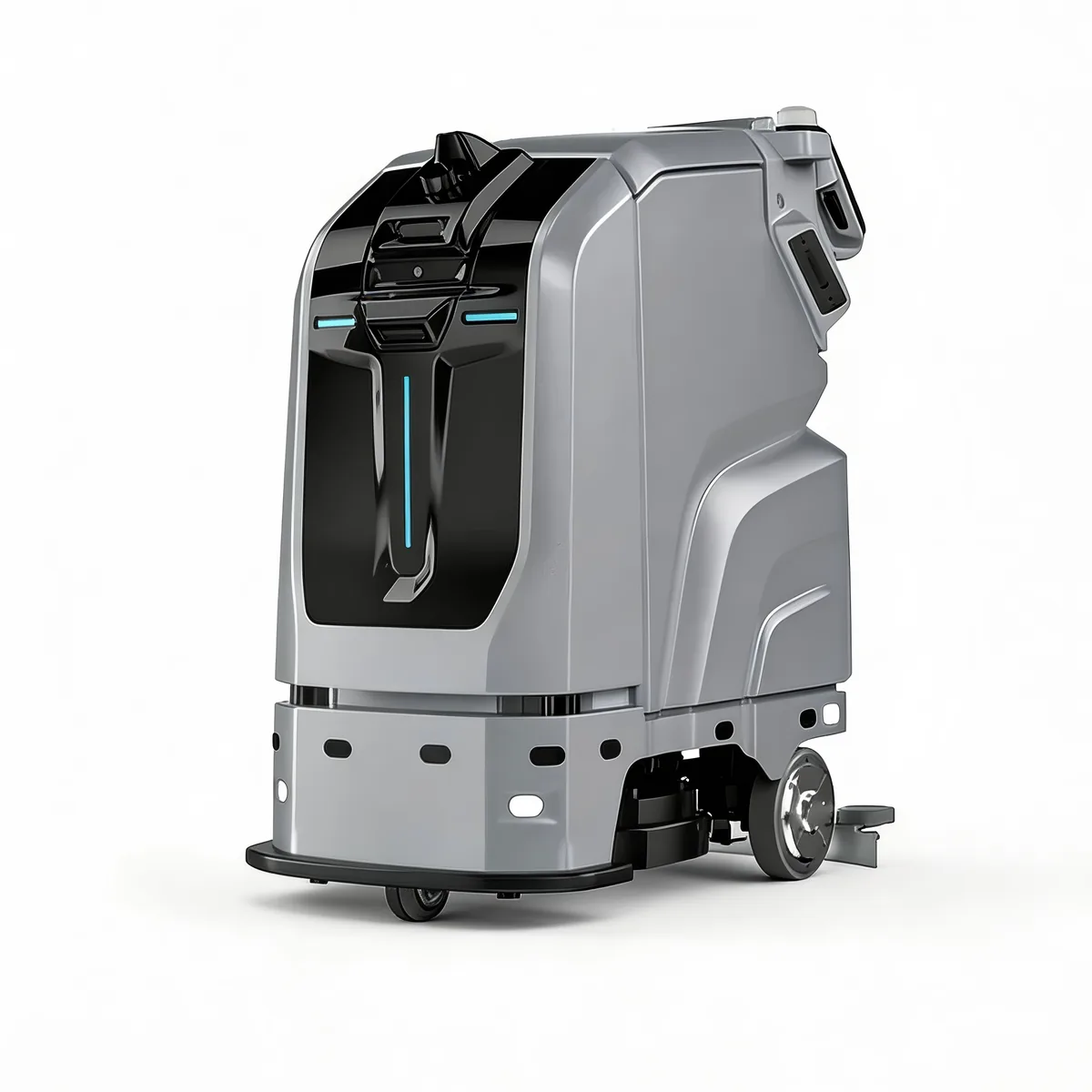
Telecommunications facilities run on a constraint most buildings do not face: the equipment cannot be stopped. A central office's switching shelves, transport systems and power plant are designed to run continuously, and cleaning around them is scheduled into the same windows the power plant needs. The longer the equipment runs, the more dust it draws in, and the more moving a maintenance deadline becomes.
This guide covers the AOMAN fleet's role in central offices, remote shelters and landing stations: the cleanliness layer, the parts-movement layer, and the deployment model that fits each site type. Product figures are AOMAN FUTURE platform specifications; financial figures are illustrative examples.

The dust problem in a building that never shuts down
Optical and switching systems are more sensitive to particulate contamination than facility teams usually budget for. Connector interfaces inside transport shelves operate at signal levels where even small particulate reduces margin. The network engineers call the consumed headroom "optical budget," and its largest non-aging consumer is contamination. In a facility whose floor is swept on a janitorial schedule of once a week, the standard near the equipment drifts; in a central office with raised-floor cabling and air circulation, the floor is a continuous source.
The fix is frequency, not intensity: keep the floor cleaned on a cycle that prevents accumulation instead of reversing it. That is exactly what an autonomous unit does on a nightly program. The AOMAN C1 scrubs 2,040 m² per hour in a wet-scrub-and-squeegee pass, 70 L fresh water and 50 L recovery tanks, 790 mm squeegee width, so the pass recovers the dirty water rather than leaving it to dry back into the plenum. Operating on a schedule in the 2 AM–6 AM window, a single C1 maintains the continuous standard that weekly manual pass cannot reach.
For the tight equipment aisles where racks and cable ladders leave little clearance, the compact AOMAN C2 Pro covers the 85 cm aisle routes and staff offices with quiet operation and modular tanks.
Illustrative economics: if a 100,000 sq ft central office runs a night cycle of about five C1 hours, the unit replaces a seasonal deep-clean program as the standard. And the unit's annual cost is compared not against janitorial labor but against the component-replacement budget of contamination-related degradation, which is typically the larger number. Run the comparison at your own failure rates.
Programming the night window: the 2 AM–6 AM window is shared space, maintenance crews, fiber work, power plant checks. The C1's route is programmable per floor and per aisle, so it moves around the crews rather than through them, and the deployment rule is that the robot schedule gets published where the technicians read, the same maintenance board the crews sign, rather than staying in the fleet app. In practice that simple visibility is the difference between a robot accepted as equipment and a robot discovered as a surprise.

Moving line cards and modules without a hand-carry route
Parts logistics in a central office, line cards, optical modules, rectifiers, test equipment from staging to bay, is a walk-heavy loop, and the loop runs through carpet and corridor. In an ESD-controlled environment the discipline is standard practice: components travel in protective packaging per the institution's electrostatic control program (the IEC 61340 family is the usual reference), and packaging stays sealed until the point of installation.
The AOMAN D1 takes those movements: 40 kg per run on a four-tier tray, 70 cm aisle clearance, complete route logging. Modules go into the unit in their protective packaging at staging, travel closed, and are unpacked at the bay by the installing technician. The operational wins are concrete: fewer hands in the path, no components carried through carpet corridors, and a timestamped movement record for the asset base against the inventory records.
The unit's 21.5-inch screen doubles as the movement manifest: the run label names the destination, which keeps the logistics visible to the technicians at both ends of the route.
Two patterns fit telecom logistics especially well: the scheduled staging run (spare modules moved from the staging area to the bay once a day as the run set is restocked) and the event move (a full bay refresh during a maintenance window, where the D1 cycles between the dock and the aisle). The 40 kg per-trip payload covers line cards, module trays and test equipment; bulk rack sections still move the way they always did, with people and a lift.
Remote shelter sites: the cleaning nobody schedules
Tower shelters, the small prefabricated buildings at the base of cell towers, are visited when alarms fire, not on a schedule. Dust, insect debris and agricultural particulate accumulate at the intake vents, accelerating the failures that cause the next visit. The pattern is circular: the sites are least maintained exactly because they fail rarely enough to be ignored.
The model that breaks the circle is a periodic-deployment fleet rather than a permanently installed unit: a C2 Pro on a service vehicle visiting a cluster of sites on a monthly rotation, compact enough to stow and lift easily, with modular tanks that make the stop fast, running a short autonomous cycle per site while the technician handles the scheduled checks. The shelter floors recoup without an alarm; the fleet covers 8–12 sites per rotation instead of 8–12 alarm-driven truck rolls.
Illustrative economics: a network of a few thousand tower sites at a fully loaded cost per unplanned dispatch to a shelter site, vehicle, technician, drive time, makes even a single-digit percentage reduction in alarm-driven dispatches the dominant line in the model. The same preventive shift has been the driving logic in adjacent critical-infrastructure environments; see the logistics and industrial infrastructure overview for the surrounding context.
Two practical constraints shape the rotation. First, power: a shelter with a standard service connection can charge a compact unit between sites, but the fleet plan should confirm outlet capacity before the first visit. Arriving with a discharged robot is a worse outcome than not arriving. Second, the rotation works best when the robot's visit is paired with the technician's worklist: the 45–60 minutes the C2 Pro spends cycling the shelter floor is the same window in which the battery check, filter swap and rectifier inspection happen. The machine and the person should not each travel to a rural site separately for a task that takes half an hour.

Where precision work stays human
Some telecom tasks are not automation candidates: connector end-face inspection, fusion-splice repair, wallplate-level work inside cable systems, and any task requiring microscopic judgment. The division of labor that works is continuous background hygiene by the fleet plus precision work by the technicians, the machines keep the environment under control inside the maintenance windows, and certified staff perform the work that demands their judgment in the windows they hold. That split is exactly why the fleet is measured on its own line (hours of environmental control maintained) and not on a false comparison with the work it does not do. Landing stations are the extreme case. Terminal equipment for cables carrying cross-ocean traffic, where cleaning inside the equipment hall is restricted to scheduled windows and performed by certified technicians under microscopy. The fleet's role there is background only: keeping the hall environment at a continuous standard between those windows, while the connector inspection and splice work stays in the technicians' hands. The same division between continuous documented hygiene and judgment-based precision is where the fleet belongs in every other telecom facility type.
Choosing platforms for telecom environments
Four requirements matter more in telecom than in office buildings:
- Continuous floor standard . A wet-scrub pass with water recovery (C1) rather than dry-dust redistribution.
- Compact footprints, 85 cm aisle clearance (C2 Pro) for the tight bay routes a full-size unit cannot enter.
- Payload and packaging discipline, 40 kg, four-tier configuration (D1) so parts move in closed packaging, never hand-carried.
- Logged operation . Route and activity records that support regulatory and audit documentation (FCC outage-reporting procedures and the like), the same record-keeping discipline described in the AOMAN product platform notes.
The record layer feeds the compliance file too: route logs, per-floor coverage maps, run durations and battery state are the kind of documented evidence that supports the facility's reporting obligations, the same discipline a telecom operator applies to everything else in the building. It costs nothing to keep, and it prevents the month-end argument about what was cleaned when.
For the navigation technology that keeps units operating in RF-dense indoor environments where wireless can be unreliable, see the SLAM navigation overview.
Tell us your central office and shelter footprint, maintenance windows and movement volumes. We will propose a configuration per site type and return indicative pricing within 24 hours. Request pricing. A venue with a different traffic pattern, and how the configuration changes for it, is covered in security patrol deployments.