Service Robots in Senior Living Facilities, Enhancing Care, Safety, and Independence in 2026
At a glance: The US 85+ population is projected to double by 2040 while direct-care staff turnover stays high. Senior living must automate meals, corridors, and the after-hours gap. AOMAN D1 delivers 40 kg per run; C1 cleans 2,040 m²/h; here is how.
Senior living communities in the US sit between rising demand and a shrinking workforce. The 85+ population is projected to double by 2040, direct-care turnover remains stubbornly high, and most facilities run below target staffing. Robots will not replace caregivers. But they do absorb the repetitive, non-care work that burns staff out: meal tray delivery, corridor cleaning, visitor guidance, and pieces of the after-hours gap.
Four workflows capture most of the value in 2026.
The Staffing Math
Illustrative example. In a 100-bed community, the robot-addressable labor sits primarily in dining service, housekeeping, front-desk coverage, and night checks. Qualitatively that means: several people per shift whose hours are dominated by carrying, pushing, and walking. A fleet of two D1 units, one C1, and one G1 at lease plus maintenance costs a small fraction of the addressable labor value per year, so capturing even part of the share pays the fleet back within two years. What matters is the structure, not any single number: transport, cleaning, and guidance are the tasks robots absorb best, and they are exactly the tasks that are hardest to fill at night.
Autonomous Meal Delivery
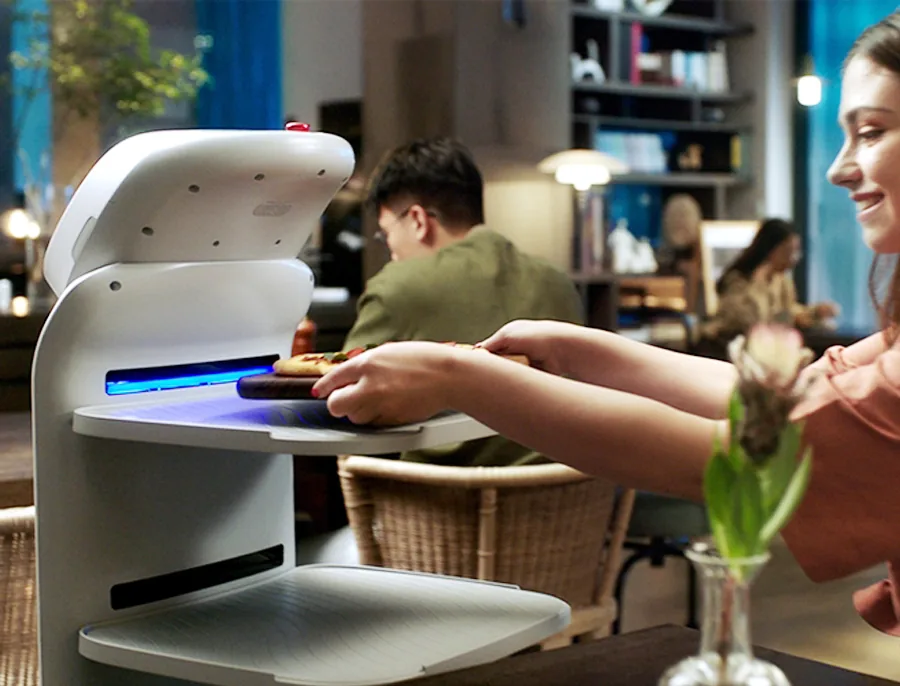
Three meals a day times a hundred residents is hundreds of tray movements, plus between-meal snacks, hydration rounds, and scheduled medications. A AOMAN D1 handles the transport layer: 40 kg payload across four trays, running programmed routes between kitchen, dining area, and residents’ apartment doors on 70 cm corridors. Tray separation lets hot meals ride on one set of trays while medication cartons travel separately on the same trip.
The division of labor is the entire point: the robot moves the tray; the caregiver stays at the table with the resident, opening containers, adjusting textures, and talking. That is the part of the meal experience residents actually value, and it is the part a robot cannot do.
What matters in a senior living context
- Elevator integration: multi-story communities need the VDV elevator interface (commonly over BACnet or Modbus) so units can call and ride autonomously.
- Clearances: measure corridors and doorways first, the D1 operates in the 70 cm aisle class, which fits most assisted living corridors.
- Route scheduling: staggered routes clear the lunch window in a fraction of the time a manual cart team needs, with no carts staging in the hallway.
Cleaning for Infection Control
Common areas in a community are still a surface-transmission environment with vulnerable residents, and manual cleaning is inconsistent across shifts. The AOMAN C1 runs scheduled passes over corridors, dining halls, activity rooms, and lobbies: up to 2,040 m²/h in open areas, a 790 mm squeegee, and 70 L fresh / 50 L recovery tanks that keep dirty water off clean floors, overnight deep passes and between-meal refreshes, both on one schedule.
Two values facility directors tend to undercount:
Fall prevention through floor condition. Wet floors, debris, and uneven surfaces are among the most common environmental contributors to resident falls. A scheduled corridor pass removes the leading floor-condition risk. And dry, debris-free walkways after meals are the visible result.
Family confidence. Adult children touring a community see autonomous cleaning in operation and read it as operational competence. Visible facility technology ranks high among the factors influencing family decision-making.
For individual apartment corridors and resident wings, the AOMAN C2 Pro runs the compact version, 85 cm aisles, quiet operation, modular tanks. In a publicly documented deployment at a Tokyo nursing care facility, a compact cleaning unit runs scheduled passes through care corridors, keeping floors clean and dry without disturbing residents.
In memory care wings specifically, two things matter. Noise: loud machinery in proximity to residents with dementia creates agitation, so acoustics are part of the spec sheet, not an afterthought. And predictability: a quiet unit on a regular route becomes part of the environment; residents stop noticing, and the risk of a walker walking into a machine's path drops sharply. Runs through memory care corridors are best scheduled after lunch rest periods and before evening dining, when corridors are empty and quiet matters most for settling.

Resident Engagement and Family Concierge
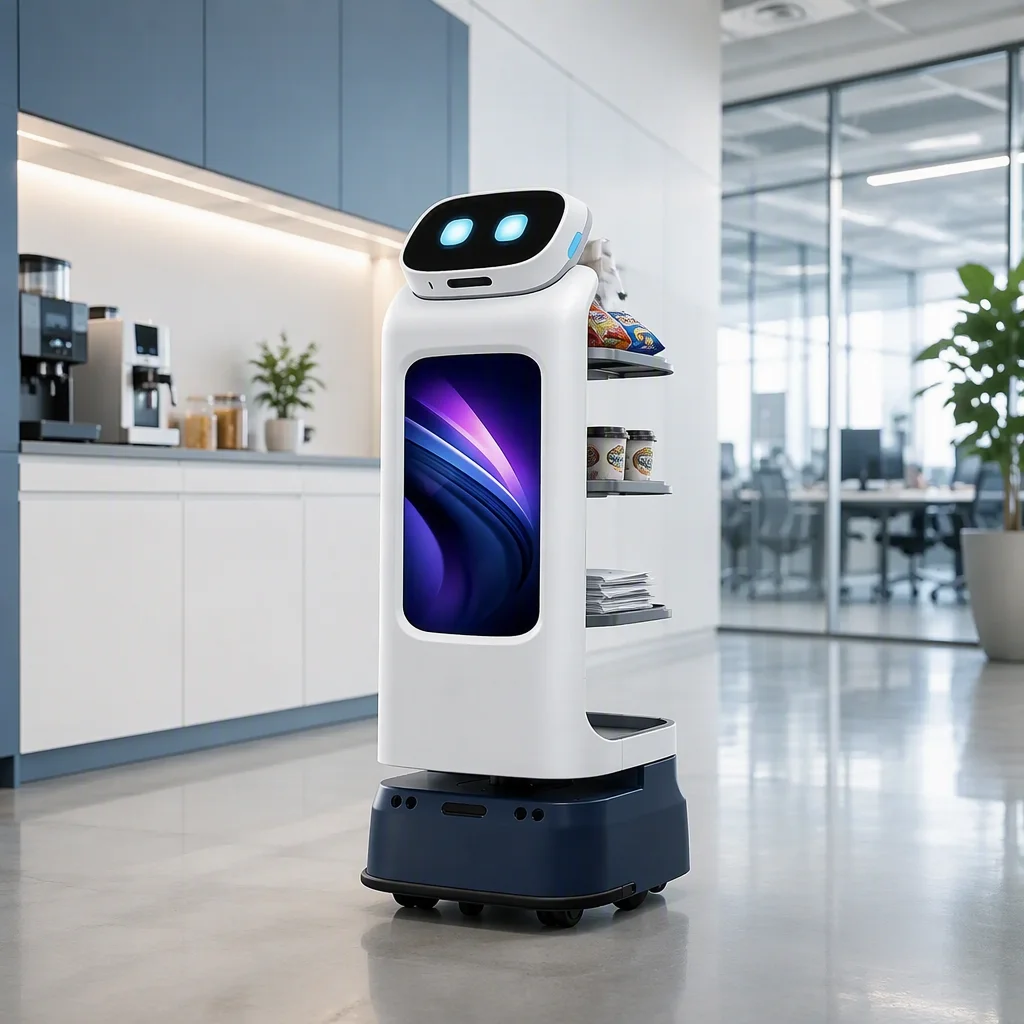
Senior living receives more visitors than almost any hospitality environment, adult children, grandchildren, prospective residents, home health aides, and most front desks are staffed only on business hours. A AOMAN G1 covers the gap: it greets visitors and assists with check-in, points them toward the right wing or apartment, and answers the common questions, where’s the dining room, what’s on today’s schedule, using a six-microphone array that picks up speech over 5 m in a busy lobby, with multi-language guidance for diverse resident and family populations. It returns to its dock to recharge automatically.
There is an unexpected benefit. Residents initiate interactions: a G1 with a place in the common area becomes a low-friction social contact. Residents ask about schedules and events because asking a robot is easier than interrupting busy staff. It is not a substitute for human connection; it is a conversation starter that costs no caregiver minutes.
After-Hours Coverage
Night is where understaffing bites hardest. Two mechanisms help. First, D1 delivery run verification: each scheduled stop that completes is logged, and a missing or late stop raises an exception with a timestamped location to the night supervisor. The tray account, not the corridor, is what gets checked. Second, G1 lobby presence: visitors arriving after hours still get a greeting and directions. Camera processing happens on-device and no video feed is recorded or streamed; the exception is what gets logged, not the residents.
The habit that makes these mechanisms real is cheap and boring: a five-minute morning review of the night's exception log, folded into the day-lead's opening checklist. Robots produce clean, complete records of what went wrong at 2 AM. The value of that record is zero if nobody reads it. Facilities that review the log nightly catch the open-handrail issue or the failed stop before it becomes a resident-safety event; facilities that ignore it have bought an expensive diary.

What to Evaluate Before Deploying
- Clearances and thresholds: the C1 class needs 85 cm lanes; the D1 operates in 70 cm corridors and the C2 Pro in 85 cm aisles. Check doors and floor transitions against the platform footprint before the demo.
- Elevator readiness . As above; budget the interface retrofit where the system predates it.
- Wi-Fi coverage: a site survey through every zone the fleet will cross is the cheapest risk reduction in the project.
- Docking placement: docks in utility closets or housekeeping alcoves, never in resident corridors where they become trip hazards.
- Resident consent: most communities add a line to the residency agreement noting robot operations in common areas, with interaction always voluntary; opt-out rates in existing deployments are low.
- First exposure path: introduce the fleet zone by zone, starting on the least visible corridors. Residents who see a unit appear in their own hallway without warning raise more questions than residents who have watched it operate from a distance for a week. Pair the first run with a member of staff present to answer questions, a ten-minute walkabout the day the robot debuts prevents a month of hallway whispers.
Staff adoption
Deployments succeed or fail on the team, not the hardware. The pattern that works: start with the most hated task, including usually meal trays, and let staff see the robot absorb their worst two hours before it appears anywhere shiny. Name the unit; residents and staff engage differently with a named robot than with unit 4. And never frame it as a replacement. The message is: this handles the transport so you can spend more time with residents.
The Bottom Line
Demographics and workforce are the two constants of this industry, and the technology has matured past the pilot stage. The right first step for most communities is one delivery unit on one floor for one meal service, measured over 90 days, then add cleaning and guidance in the order of the pain they remove.
A practical blueprint for the first year: months one to three run one D1 on the main dining floor; months four to six add the C1 on common-area corridors and the C2 Pro on resident wings; months seven to twelve add the G1 in the lobby once the team has navigated the simpler workflows. Each stage funds the next out of measured savings, and each stage keeps the change small enough for staff and residents to absorb. A venue with a different traffic pattern, and how the configuration changes for it, is covered in security patrol deployments.
Tell us bed count, floors, and staffing ratio; request pricing for a senior living deployment and we will model the fleet for your community.