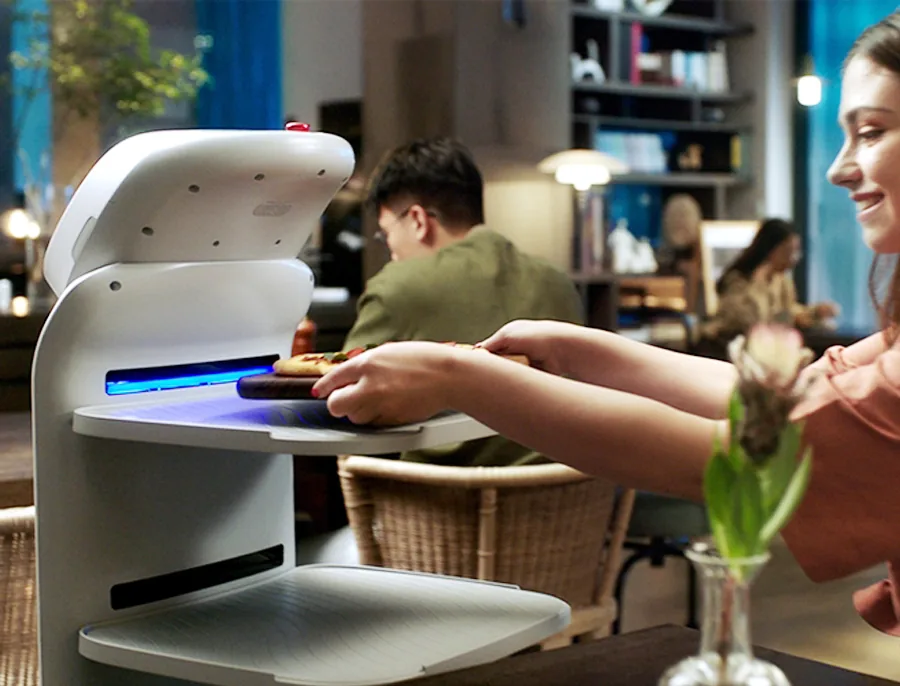
Service Robots for Automotive Dealerships, Showroom Experience & Facility Management at Scale
At a glance: An AOMAN C1 scrubs 2,040 m² per hour, which lets a 1,000 m² showroom floor be refreshed twice an hour during trading hours. This guide covers showroom greeting and model walkthroughs with the G1, plus the floor-care math for dealerships and dealer groups.
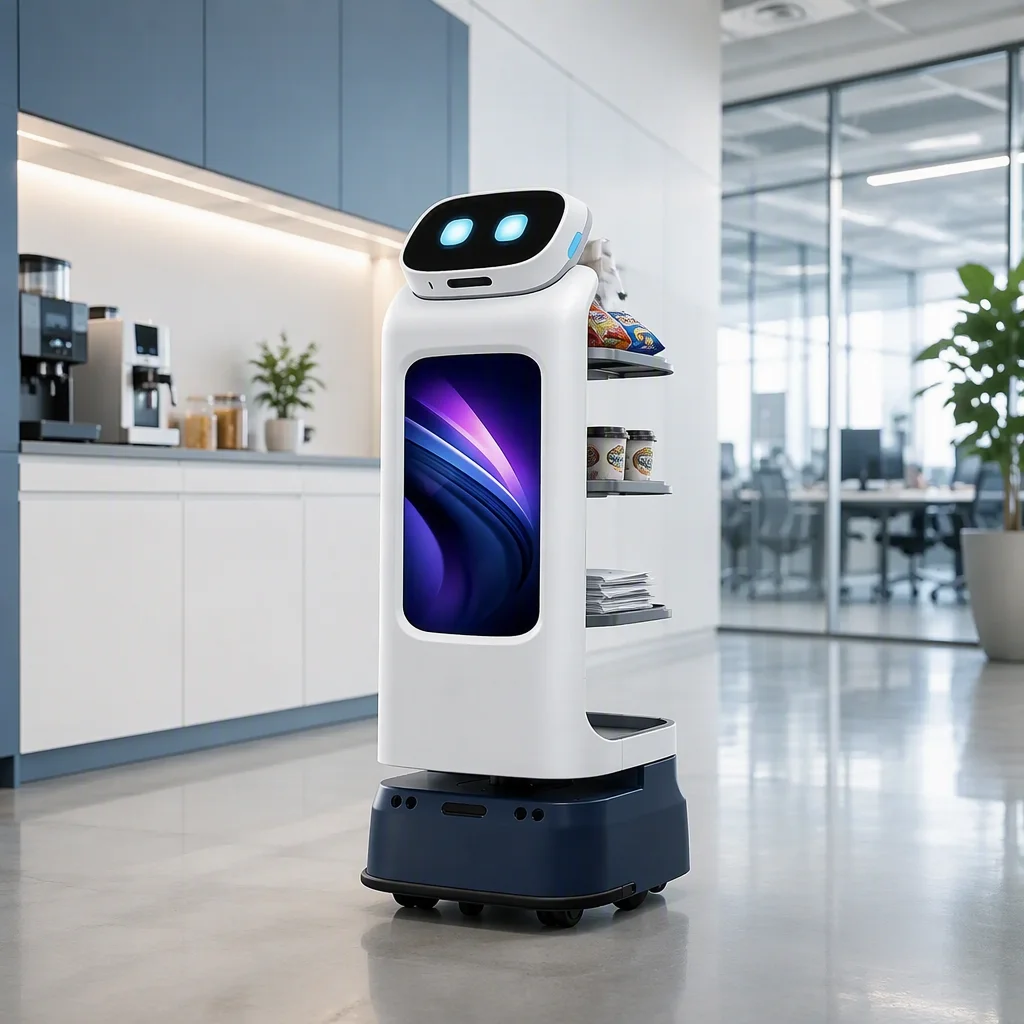
Automotive dealerships operate on a paradox: they sell the most technologically advanced consumer products on the market, yet many showroom experiences are still built on a greeting lag. In dealer customer studies, a detractor comment about not being acknowledged promptly keeps showing up near the top, not price, not inventory, not financing. The mechanical difference between a store that greets in under a minute and one that greets in several is rarely staffing budget; it is process allocation.
This guide covers how service robots address both halves of a dealership: the showroom experience (greeting, qualification, vehicle walkthroughs) and the facility management half (floors that accumulate tire marks, road salt, and dust during trading hours). We use the AOMAN line where the scenario calls for it, AOMAN G1 for guest interaction, AOMAN D1 for in-dealership delivery runs, AOMAN C1 and AOMAN C2 Pro for floor care.

The Showroom Experience Problem: Acknowledgment Is the Complaint
Walk into any volume-brand showroom on a Saturday and time it: the seconds between entering and being acknowledged. In premium and luxury stores the expectation is near-immediate, customers are greeted by name, escorted, offered coffee. In volume stores, first contact routinely takes minutes, and the staff are not at fault: they are on the floor with a customer, in the service lane, or on the phone. The economy of the greeting gap is an illustrative calculation: a store doing roughly 180 customer visits per month, closing 18% at an average gross profit of $2,400 per unit, and losing a handful of deals per year to slow acknowledgment ends up with a five-figure annual gross-profit drain that shows up in no budget line. Rerun it with your own ups, close rate, and gross; the structure, not the specific number, is the point.
What the G1 Actually Does at the Door
Positioned at the showroom entrance, the AOMAN G1 detects entry and presents a greeting within seconds. It faces visitors with a 15-DoF mobile upper body, listens across a 6-microphone array with a 5 m pickup range, and displays tenant-style directed content on its screen. It does not replace the sales associate, it buys them time. Its greeting and route logic are configurable per shift: if the visitor taps "sales," the G1 asks one qualification question and routes the response to the next available associate; if nobody is free within a set interval, it offers a self-guided overview of the models on the floor.
Model Walkthroughs: The G1 as Product Specialist
When a customer expresses interest in a specific model and no associate is immediately available, the G1 can navigate to that vehicle and present a feature walkthrough on its display, the infotainment and driver-assistance highlights, cargo capacity and configuration, range or efficiency figures (for the EV displays), and the two or three selling points the dealership wants to emphasize. The walkthrough is programmed by the dealership's product training team, model by model. The operational benefit is not that the robot replaces the specialist. It is that the customer arrives at the sales conversation with their preferences crystallized, so the conversation starts at "let's talk numbers" instead of "what does this thing do?"
The same idea is documented in a publicly deployed form outside cars: an AOMAN G1 at an art museum in Osaka greets visitors and guides them through exhibits. A showroom is the same guided visit, with a selling intent. For the deeper question of navigation reliability indoors, how the robot keeps its place between a white sedan and a window wall, see our SLAM navigation technology.
The Delivery Side: Keys, Documents, and Parts Runs
Dealerships run continuous small deliveries that eat salesperson time: keys between showroom and service write-up, signed documents to finance, parts-cart orders from the parts counter to a service bay, test-drive kits. An AOMAN D1 (40 kg payload across four tray positions, 21.5-inch display) handles them in batches. The finance folder sits in one tray, the delivered keys in another, and the route runs between buildings without staff walking across the lot. On dealership campuses with dedicated EV showrooms or separate delivery centers, the D1 also runs inter-building document loops that would otherwise cost a staff member 5-10 minutes per trip.
Facility Management at Dealership Scale: The 2-Brain Cleaning Problem
The showroom floor: typically several thousand square meters of polished tile or coated concrete, accumulates tracked-in road debris, tire marks from vehicles moved for test drives, and fine particulate from garage doors that open dozens of times a day. A nightly janitorial crew leaves a clean floor at 06:00; by mid-morning, after the first test drives and customer entries, the floor is visibly degraded; by close it looks unserviced. This is a frequency problem: the accumulation rate exceeds the cleaning frequency.
Automated care inverts the dynamic. An AOMAN C1, 2,040 m²/h with a 790 mm squeegee and 85 cm passage clearance, can sweep the whole showroom in under an hour during operating hours. A AOMAN C2 Pro (85 cm aisle clearance, 70 cm under-furniture profile, quiet operation) keeps the customer lounge, corridors, and restroom approaches clean while patrons are present. The night crew still does the deep clean, edge scrubbing, grout lines, baseboards, with the machines maintaining the standard between deep cleans.
| Zone | Typical Size | Cycle Approach | Machine |
|---|---|---|---|
| Showroom floor | 1,000-2,000 m² | Full pass on a 1-2 hour cycle during trading hours | AOMAN C1 |
| Service drive and write-up area | 200-400 m² | Continuous short-cycle passes | AOMAN C2 Pro |
| Service bay floors | 800-2,000 m² | High-frequency cycles, petroleum-tolerant pads | AOMAN C1 |
| Customer lounge and restroom corridor | 150-300 m² | Quiet off-peak and midday cycles | AOMAN C2 Pro |
| Delivery bay | 100-200 m² | Event-driven pass per delivery | AOMAN C2 Pro |
The service bay is the safety-sensitive case: oil drips, tire rubber deposits, and metal shavings create variable traction that technicians in oil-resistant boots are used to but customers in dress shoes are not. Continuous cleaning removes the oil-and-fluid accumulation process rather than waiting for the night crew to scrub a week of buildup. (For the reference case of quiet operational cleaning, in a publicly documented deployment an AOMAN C2 Pro runs daytime floor care in a Tokyo nursing care facility, staff move through the same corridors while it works.)

The Multi-Rooftop Deployment Playbook for Dealer Groups
Dealer groups with 10-40 rooftops face a challenge single-point stores do not: brand-level variance. A volume-brand showroom and a luxury-brand showroom in the same group operate at different experience standards and different customer expectations. A one-size-fits-all deployment produces under-adoption at the luxury end ("our customers expect human interaction") and over-scope at the volume end ("we can't afford the same configuration as the luxury store").
| Tier | Pilot Scope | Rationale |
|---|---|---|
| Volume brands | G1 greeting plus C1/C2 Pro floor care, then D1 for service-lane runs | Highest walk-in volume, most acute greeting lag, largest showroom footprints |
| Premium brands | Floor care first; G1 optional at the service desk | Greeting standard is already met; facility presentation benefits the most |
| Ultra-luxury | Machines restricted to service bay, back-of-house, and prep areas | In-house detailing staff own the customer-facing floor; white-glove continuity wins |
Brand-tiered deployment is also the change-management choice: volume-brand stores get the biggest visible win from the robot, while luxury sales teams are not asked to hand the front of house to a machine, and the staff concern that "the robot is here to replace me" is answered by the role-redesign sequence before it becomes a complaint.
The Electric Vehicle Showroom Angle
EV showrooms and brand experience centers change the staffing math: fewer product specialists, more consultation-led conversation. The G1 fills the greeting and triage gap the leaner staffing model creates, so the specialists on duty are not consumed by routine reception. The floor-care requirement rises too. EV buyers skew technology-literate and environment-sensitive, and the showroom's appearance carries more of the decision weight. The on-screen walkthrough also integrates with digital retail: a customer who configures a vehicle online and arrives for a test drive can be greeted by a G1 that already knows the configured model, color, and options, and directed to the exact car matching their configuration, the online-to-dealership handoff that used to be rebuilt at the front desk.
Start With the Floor, or Start With the Door?
Tell us your rooftop count, your brands, and your showroom square meters. We will recommend the entry unit for your tier (most groups start with floor care because it needs zero integration, then add the G1 greeting after the first 60 days of utilization data). Request pricing or a group-level assessment, and let the deployment team map the tiered rollout with you. The zone-by-zone routing and cycle-time side of the same decision is worked through in the cleaning labour cost model.