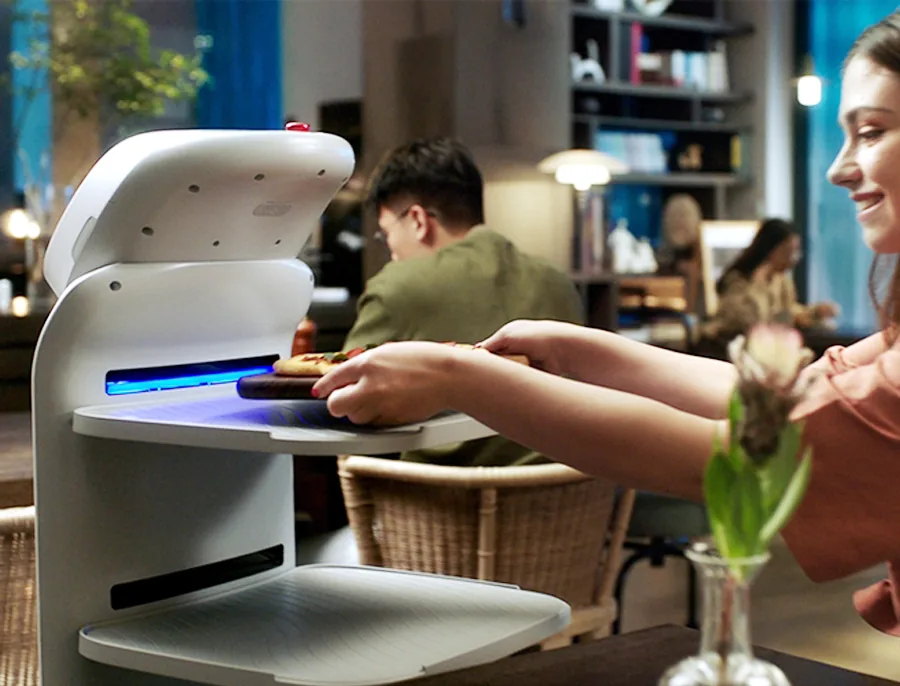
Wayfinding Robots in Supermarkets: Store Directory, Aisle Navigation and the Cost of a Lost Shopper
At a glance: A wayfinding robot is not a talking store map. It earns its place when it closes the gap between a shopper who cannot find an item and a shopper who abandons the trip. This guide covers what the robot must know about your store before it can guide anyone, how aisle routing actually works when the shelf layout changes weekly, the five metrics that decide whether the deployment pays back, and the failure modes that turn a guidance robot into an expensive lobby ornament.
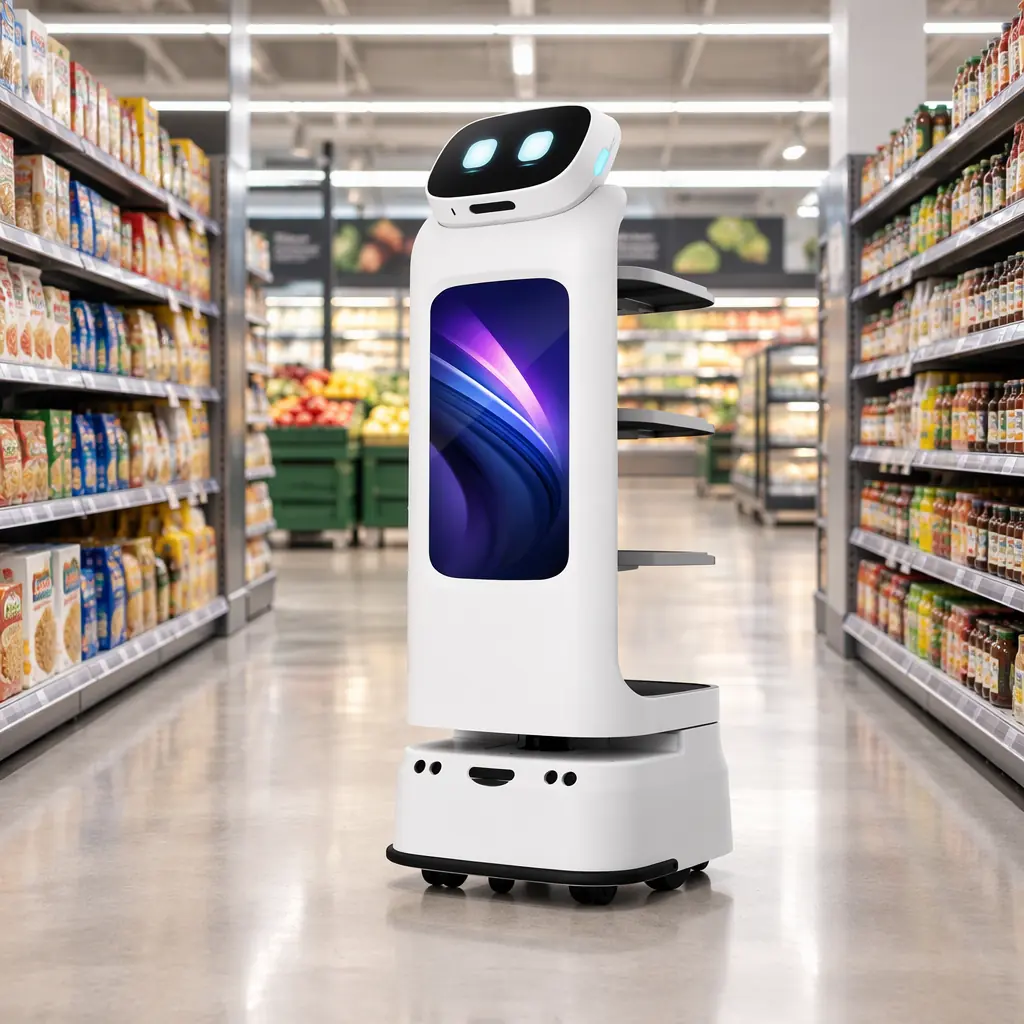
What a Wayfinding Robot Actually Does (and What It Does Not)
Strip the marketing language and a wayfinding robot performs three physical jobs. It detects that a shopper has stopped moving in a way that suggests they are searching. It identifies the destination the shopper asks for, either by voice, by touching the torso screen, or by scanning a shelf label. Then it either displays the route or physically leads the shopper to the shelf bay. A fourth job, measuring what happened, is the one that most deployments skip and the one that decides the business case.
What it does not do is replace your aisle signage. A shopper who is already walking confidently toward the dairy case does not need a robot. The addressable population is the subset of shoppers who pause, backtrack, or stop a staff member. In a large-format grocery store that subset is not small. Industry basket research consistently puts the share of shoppers who leave without a planned item in the high single digits to low teens, and a meaningful part of that is a findability failure rather than a price or stock failure.
The distinction matters commercially. If a shopper cannot find an item because it is out of stock, no robot can fix it. If a shopper cannot find an item because the store moved the category during a reset, a robot that knows the current planogram can. That is the entire premise of the investment, and it is worth stating plainly before anyone signs a purchase order.
The Data Problem Comes First: Your Store Has to Be Machine-Readable
Every wayfinding deployment on record fails for the same reason before it fails for any other. The robot arrives with a beautiful navigation stack and no idea what is on your shelves. SLAM gives it centimetre-accurate position in the building. It says nothing about which bay holds the tin foil.
Before a robot can guide anyone, four data layers have to exist and stay current.
| Layer | What it contains | Who owns it | Refresh trigger |
|---|---|---|---|
| Map geometry | Aisle polygons, corridor centrelines, no-go zones, dock and back-of-house boundaries | Facilities / store planning | Any fixture move, refit or seasonal extension |
| Bay addressing | Unique ID per shelf bay, side (left/right), tier heights, adjacent-bay links | Merchandising | Every planogram reset |
| Product-to-bay mapping | SKU or category to bay ID, with a confidence flag for multi-location items | Space planning plus the PIM | Weekly, or on every reset |
| Destination vocabulary | The words shoppers actually say, mapped to bay IDs | Store operations | Monthly review of unmatched utterances |
The fourth layer is the one teams underestimate. A shopper does not ask for bay 14B. They ask for "the gluten-free pasta", "where the batteries are", or "the thing my wife wrote on the list". If the vocabulary layer is thin, the robot's recognition accuracy collapses on exactly the population it was bought to help.
A practical rule from projects that succeeded: do not launch with full-store coverage. Launch with the two hundred highest-traffic queries, mapped by hand, in the six aisles that generate the most search behaviour. A robot that answers two hundred questions reliably beats one that half-answers nine thousand. The mapping work is unglamorous, and it is the difference between a guidance asset and a novelty.
How Aisle Routing Works When the Layout Keeps Changing
The navigation challenge is not getting from A to B in a corridor. It is doing so while the destination is a moving target at the semantic level, because the store is a live retail environment. A reset can relocate an entire category over a single night. A seasonal extension can block a corridor for six weeks. A promotional island can appear in the middle of the main aisle on Thursday and be gone by Monday.
Robust deployments separate three concerns that amateurs bundle together.
Static geometry, versioned
The robot's map should be a versioned artefact with a change log, not a file that gets re-recorded when someone remembers. When a refit happens, the map version increments, and the bay addresses are re-linked to the new geometry. If the mapping between map version and bay address is stored in a spreadsheet, it will drift within a quarter. Put it in the same system that holds the planogram.
Dynamic obstacles, handled locally
A shopper standing in front of the shelf the robot is trying to reach is not an exception, it is the normal case. Guidance robots should stop at a comfortable standoff distance, indicate the bay, and finish the interaction verbally rather than trying to squeeze into the gap. Attempting to navigate to the exact bay in a busy aisle produces the two worst outcomes at once: a robot that blocks the aisle and a shopper who feels herded.
Physical vs virtual guidance
There is a real operational choice here and it is usually made badly. Leading a shopper physically means walking at human pace through a live trading floor, which is slow, sometimes obstructive, and hard to do in a narrow aisle at peak. Virtual guidance means the robot stops and points, or pushes the route to the shopper's phone. Hybrid means the robot escorts to the mouth of the aisle and stops. In grocery stores above roughly 2,000m², hybrid almost always wins: the escort covers the ambiguous part of the journey, the shopper covers the easy part.
The Five Metrics That Decide Payback
Wayfinding is one of the harder robot investments to justify because the benefit shows up as avoided abandonment rather than a visible labour hour saved. That does not mean it is unmeasurable. It means the measurement has to be designed before the robot arrives, not reconstructed afterwards.
| Metric | Definition | How to capture it | Realistic planning band |
|---|---|---|---|
| Guidance completion rate | Interactions that end with the shopper at the correct bay, divided by interactions started | Robot logs plus a spot check of 50 interactions per week | 70–85% once the vocabulary layer is mature |
| First-answer accuracy | Share of queries the robot resolves without escalation or repetition | Unmatched-utterance log, reviewed monthly | 60–80% on a curated 200-query set |
| Assisted basket value | Average basket of shoppers who used guidance versus a matched control group | Loyalty ID join, four-week windows | Lift in the low single-digit percent, not double digits |
| Abandonment delta | Change in findability-related abandonment in the guided zones | Exit survey on a sampled basis, before and after | Measure it, do not assume it |
| Interactions per operating hour | Completed interactions divided by robot hours on the floor | Directly from the fleet platform | Depends entirely on placement; 3–15 is the observed range |
Be sceptical of anyone quoting a clean payback number for wayfinding alone. The honest framing is that guidance is usually bundled with a second duty, most often advertising or cleaning, and the combined unit carries the investment while the guidance data makes the bundle better. Treat the metrics above as the evidence that guidance is contributing rather than as a standalone ROI claim. A guidance robot whose logs show a guidance completion rate in the seventies and a few hundred interactions a week is doing real work. One that shows a completion rate in the thirties is a map with wheels.
Placement: Where the Robot Stands Decides Everything
The single largest controllable variable in wayfinding performance is not the model, the screen, or the speech recognition. It is where the robot spends its day. Three placements dominate, and they behave very differently.
The entrance lobby catches shoppers at the moment of maximum uncertainty, which is immediately after they walk in. Interaction volume is highest here. The trade-off is that many lobby interactions are not really wayfinding, they are "where are the trolleys", "where is the toilet", or "is the pharmacy open". Those are still useful, but they do not test the product-to-bay layer, and the lobby is also the worst place to obstruct during a peak Saturday.
The aisle intersection catches shoppers mid-journey, which is when a true findability failure surfaces. Volume is lower, quality is far higher. This is the placement that produces genuinely useful abandonment data, because the shopper who stops at an intersection is already lost.
Seasonal roaming covers the peak trading pattern, moving to the zones that are busiest that week. It maximises exposure and minimises the depth of any single zone's data. Roaming also stresses battery and cleaning between duties, so schedule it against the same duty-cycle arithmetic you would use for a cleaning fleet.
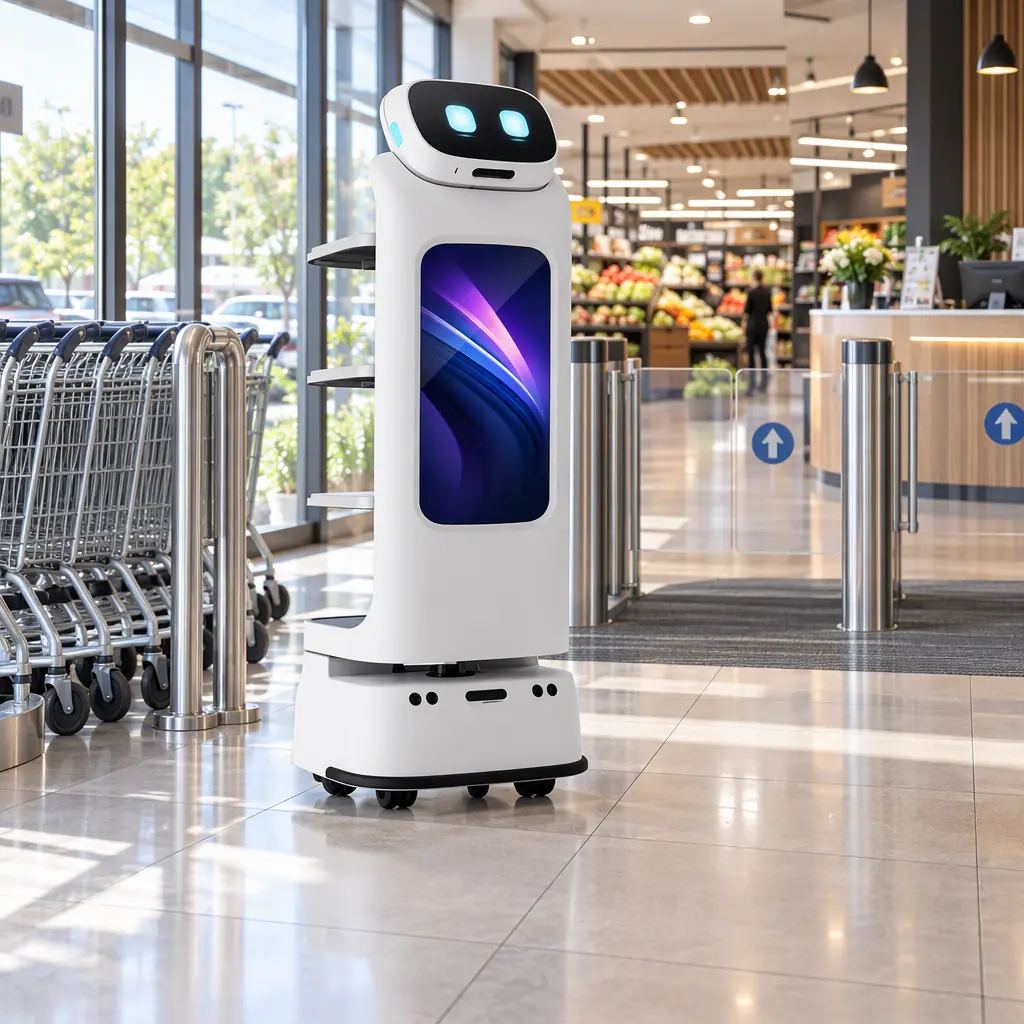
A workable schedule for a mid-size grocery store: entrance lobby from opening until the first footfall peak, aisle intersection through the two busiest hours, then back to the lobby for the evening peak and the close. That pattern keeps the robot where the searching is happening without parking it in the way during the rush.
Failure Modes That Kill Wayfinding Deployments
Five failures account for most of the wayfinding projects that quietly stop being used.
Stale bay data. The robot confidently sends a shopper to a bay that held the product before last month's reset. This is worse than no robot, because it burns trust in a single interaction. The fix is procedural, not technical: no planogram change ships until the bay mapping is updated in the same change window.
Vocabulary drift. Shoppers use regional and generational words for the same product. The unmatched-utterance log is the most valuable file the robot produces and it is almost always ignored. Review it monthly and add the top twenty misses.
Over-escalation to staff. If the robot hands off to a human for every ambiguous request, staff quickly learn to avoid the robot's zone. Cap escalation and route ambiguous queries to the screen instead.
Screen time competing with guidance. If the robot is also an advertising asset, the screen is being sold by the minute. Guidance interactions that get pre-empted by a pre-roll lose the shopper. Reserve a hard share of screen availability for guidance and honour it in the media contract, not just in the operations manual.
No owner. Wayfinding needs a named owner in merchandising, not in IT. The data that keeps it accurate is planogram data. If the robot is owned by the technology team, the mapping goes stale within one reset cycle.
What to Ask a Supplier Before You Commit
Six questions separate vendors who have deployed guidance at scale from those who have demonstrated it.
Ask how the bay addressing is authored and who maintains it after go-live. Ask to see the unmatched-utterance workflow, not just the accuracy figure. Ask what happens to the guidance route when the map version changes overnight. Ask whether guidance can be reserved against advertising screen time and how that reservation is enforced. Ask for the guidance completion rate from two reference sites at comparable store size, not from a flagship. And ask who owns the interaction logs, because those logs are the asset that makes the second year better than the first.
Guidance is a data product wearing a robot. The hardware is now commodity. The mapping discipline, the vocabulary curation and the ownership model are what separate a deployment that lifts basket value from one that gets switched to advertising-only mode within six months. If you want to see how the guidance function sits alongside the rest of a retail robot estate, the fleet-level view in our fleet management guide covers the operational layer, and the peak-hour scheduling arithmetic covers the case where guidance shares a robot with a media contract. The supermarket deployment guide walks through the wider store-level picture, and shelf scanning versus electronic shelf labels covers the adjacent question of how price and location data stay accurate. For the reception-side interaction design that guidance borrows from, see our reception and concierge guide.
If you are scoping a guidance deployment and want to sanity-check the data model against a real store layout, the team can walk through the AOMAN G1 configuration and the bay-mapping workbook with you. G1 reception and guidance covers the platform itself, and the industries pages show how the same guidance stack is deployed in malls, airports and hospitals.