Service Robots for Industrial Laundries & Linen Services, Automating the $78 Billion Global Textile Rental Industry
At a glance: AOMAN D1 carries 40 kg per trip and runs a 12-minute soiled-linen loop continuously, the transport volume of two material handlers minus the heat and the lifting. This guide maps the robot roles in a textile plant and the compliance data they generate.
Industrial laundries operate on a linear flow with a hidden cost: every transition between stages is a person pushing a cart. Plants run 20-plus hours a day in heat that exceeds 38°C at 70%+ humidity, and the material-handling roles, soiled-linen transport, cart staging, folding-station feeding: typically carry the plant's highest turnover and injury rates. This guide maps the AOMAN platform line onto that workflow, and keeps every figure labelled illustrative where it is a model rather than a measurement.
The Workflow and Its Six Transitions
Receiving, weighing, sorting, washing, drying, finishing, pack-out. Between each pair of stages sits a manual transition: cart from receiving to sorting, sorted batches to wash hoppers, clean damp linen to dryers, dry linen to finishing, folded product to pack-out, carts to dispatch dock. Combined, those transitions cover 100–150 m of plant-floor distance per load, in a building where the humidity and the sound level are both working against the staff.
Illustrative plant arithmetic: a facility processing 22 million pounds of laundry a year moves a proportional 100-plus million pounds of material between stages in that same period, almost all of it by muscle. That is the automation opportunity, not replacing the skilled roles at sorting, washing and finishing, but removing the unskilled repetitive pushing that connects them. Note the direction of the flow: the gravity-fed design moves material downhill through the first half of the plant and uphill, physically, against ramps and door thresholds, through the second. Which transitions a plant elects to choreograph manually is usually the first thing mapped for automation.
Transport Automation: What D1 Actually Delivers
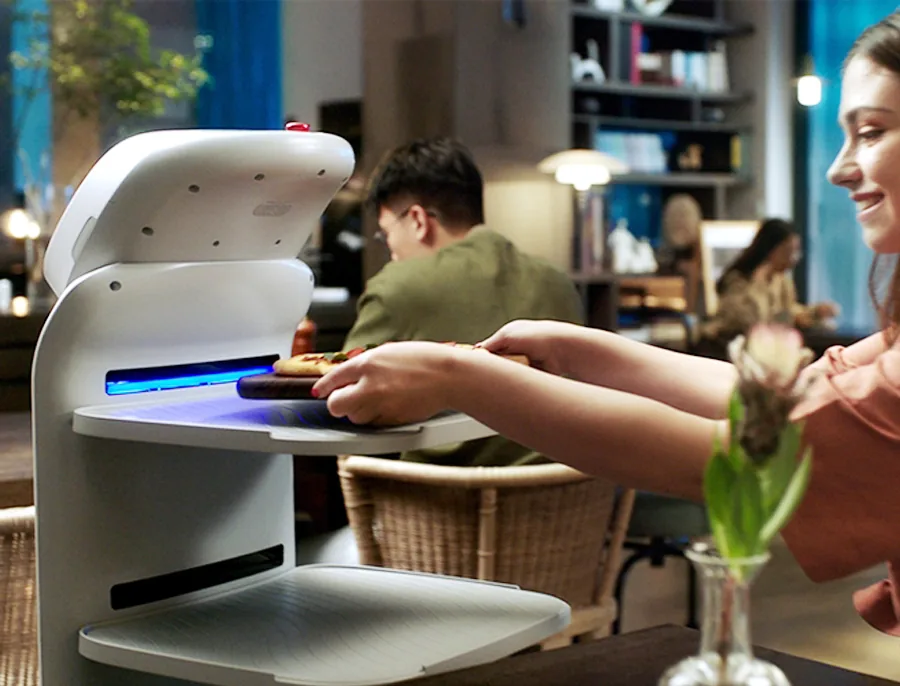
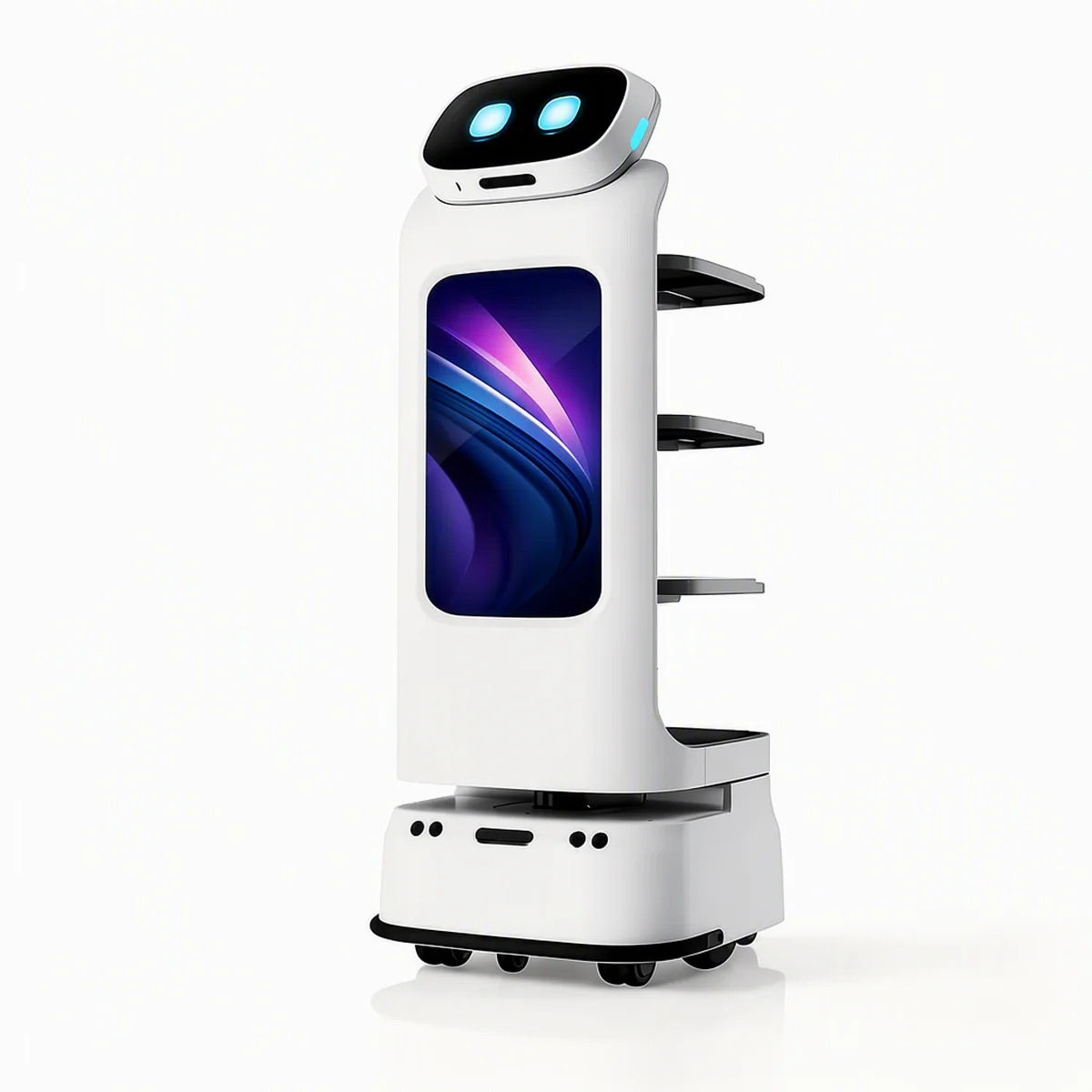
The AOMAN D1 carries 40 kg per trip on four 270° tray positions, works 70 cm aisles, and shows its task on a 21.5-inch screen. On the soiled-linen loop, dock to weigh to sort, three units running a 12-minute loop cadence dispatch a 40 kg load every few minutes, continuously. Forty kilograms is roughly one heavy linen bundle, which is exactly the right granularity for this route: the machine does not need to replace a forklift, it needs to replace the walking carry.
RFID fits naturally: the weigh step's tag scan can be matched against the unit's manifest, giving the plant a per-batch chain of custody that a hand-pushed cart never had. And that the plant's quality system can query when it needs to.
Workforce outcome, described honestly: the four handlers who walked the loop move to the sorting stations, where the work is stationary and the spot cooling is, and the plant keeps its headcount while losing the heat exposure and the 60–80 lb lifts. The 40 kg per trip figure is the spec; the shift-level benefit is about which humans stop doing what, not about headcount. On a good shift, the loop's trips-per-shift number is produced by machines that do not file compensation claims, while the plant's headcount and its contract commitments remain the same. And the sorting stations, which were the bottleneck before, get the extra hands they were always missing.

Why the Robot, Not the Conveyor
Laundries considering internal automation usually start with conveyors or floor-level rail loops. Both work. And both are fixed infrastructure: they cannot be moved when the plant's layout changes, they occupy aisle space, and they ask for civil works above concrete that keeps taking container weights.
A mobile robot takes the opposite trade. No fixed installation, re-routable in an afternoon when a sorting station is reorganised, matched to the plant's own granularity, a load is 40 kg, not a train. The trade-back is throughput: a mobile unit carries less per hour than a conveyor line, and closing the gap takes more units rather than more scaffolding. The honest rule is that the robot wins where the flow is irregular and the conveyor wins where the flow is true-steady, and the soiled-linen loop is emphatically the former. The usual compromise, a short conveyor just for the loop, fails for the same reason it initially attracts: the flow is irregular, and an irregular flow on fixed steel is a queue in steel.
Floor and Lint Management
Cotton sheds lint, and industrial plants generate it continuously. Airborne lint settles on floors, pipework, motor housings and ducting; accumulated lint is simultaneously a combustible-dust hazard, NFPA 652 requires documented housekeeping programs for combustible dust hazards in plants that generate them, and an equipment-efficiency problem as motor housings and conveyors pick up insulating layers.
The open plant floor is the AOMAN C1's territory: 2,040 m² per hour, a 790 mm squeegee, 70 L + 50 L split tanks, and 85 cm passage between machine rows. Continuous cycles through the accessible floor area keep settled lint within the documented housekeeping limits, and the scrubbing module handles the oily-detergent film that makes lint stick to concrete in the first place. One practical note: lint capture on an open industrial floor is a frequency game, short cycles, frequent bin emptying, and the schedule documented in the plant's own housekeeping procedure rather than in the robot's brochure. Machine plus documented frequency is what satisfies the combustible-dust paperwork.
The pack-out and clean-pack areas are AOMAN C2 Pro territory: compact clearance under 70 cm, 85 cm aisles, quiet operation and modular tanks, so finished-area cleaning continues while pack teams work alongside. Where the pack area's particulate specification is documented (ISO Class 8 is the common benchmark for clean-packing zones), the unit's logging provides a floor-level record for that requirement.
Healthcare Linen and the Documentation Layer
Healthcare is the largest linen segment, and it runs on accreditation. HLAC audits review documented process control from soiled-linen receipt through disinfection to clean pack: segregation of isolation linen from standard soiled linen, thermal disinfection holding conditions (around 71°C under HLAC guidance), and the clean-pack area's environmental documentation.
Robotics contributes the audit-ready record, not the disinfection control: RFID-derived chain of custody, transport timestamps, cleaning-cycle logs and environmental readings flowing into the same quality management file the audit already reviews. The plant's own wash controls are not replaced by the fleet, the fleet makes their evidence easier to find. On the hospital side of the loop the same point lands differently: few things reassure an infection-preventionist more than a clean-pack area whose cycle logs are generated, filed and retrievable without anyone asking the night shift to remember what happened at 3 AM.
Illustrative Plant Economics
Illustrative example on the plant described above, 22 million pounds a year, 90,000 ft², three D1 units on the transport loop, one C1 on the plant floor and one C2 Pro in the pack area:
| Line item | Pre-robot (annual) | Post-robot (annual) |
|---|---|---|
| Soiled-linen transport loop (4 positions) | $268,000 (labour + turnover + injuries) | $75,600 (3 D1 lease) |
| Plant-floor lint removal | $72,000 (1.5 FTE nightly) | $36,000 (1 C1 lease) |
| Pack-area maintenance | $48,000 (1 FTE) | $24,000 (1 C2 Pro lease) |
| Sorting throughput from reallocation | , | +15% (value ~$86,000) |
| Transport-function injury claims | $26,000 | $0 |
| Total annual cost | $414,000 | $135,600 |
Assumptions: per-unit lease at illustrative commercial rates; the four loop handlers redeployed to sorting rather than laid off; sorting reallocation valued at the plant's own throughput margin. On these assumptions the fleet's direct savings repay the annual fleet cost within the year, with the throughput gain additive. Run the same columns on your own labour, turnover and lease numbers before drawing conclusions.
Deployment in Four Phases
Month 1. Plant-floor mapping and route planning: the soiled-linen loop, the cleaning zones and the pack area; RF backfill for the tunnel sections; RFID read points confirmed at the weigh station.
Months 2–3. Transport-loop pilot with three D1 units for 60 days. Measure trips per shift, sorting throughput after reallocation, and recorded incidents on the transport function. The target for the loop is consistent loop cadence and zero transport-function injuries.
Month 4. Cleaning deployment: C1 on the open floor cycles, C2 Pro in the pack area, with the environmental logs integrated into the plant's quality management system.
Month 5. Full integration: robot data streams into the QMS, documentation package assembled for the next audit, shift supervisors trained on the fleet dashboard, and a monthly KPI review cycle established before the audit ring arrives.
Where to Start
Send us your plant profile . Annual throughput, floor area, loop distances and your current turnover and injury numbers. And we will model the transport loop on your actual pay rates. Request pricing once the pilot scope is agreed. A comparable deployment with different traffic, dock and shift constraints is documented in industrial park cost modelling.