
Service Robots for Libraries & Knowledge Centers, The 2026 Deployment Guide for Patron Services, Collection Management & Wayfinding
At a glance: Libraries run on directional questions, collection logistics and continuous cleaning. Work that does not need a librarian's degree but consumes their hours. An AOMAN G1 guides patrons from 5 m over a six-microphone array in multiple languages, while an AOMAN D1 moves 40 kg of returns and holds between desks.

The modern library is study space, community hub, media lab and event venue at once. And patron expectations for wayfinding and service in that space were set by retail and hospitality, not by the 20th century reference desk. The practical consequence is that library staff spend a large share of their day on repetitive work: the same three questions, the same book cart, the same spill. Robots are not a replacement for librarians; they are a way to stop paying for the parts that do not need a librarian.
This guide covers the robot roles for public and academic library environments, the integration and privacy requirements that apply, and a phased procurement path. Product figures are AOMAN FUTURE platform specifications; operational figures are illustrative examples based on standard library layouts.

Why libraries suit robot deployment
Four operational characteristics make library floors a fit:
- Repetitive queries at volume. Directional questions, where is the children's section, how do I find a book, where is the restroom, when does the lab close, form a high-volume, low-complexity layer at any busy branch.
- Complex layouts. University libraries span tens of thousands of square feet across floors with reference, periodicals, special collections, study rooms, media labs and archives. Orientation is a real time sink for first-time visitors.
- Collection logistics. Returns, holds, inter-branch loans and shelving carts move continuously, the physical spine of library operations.
- Program load. Libraries run hundreds of events a year, story times, author visits, workshops, exam-period extended hours: each with its own wayfinding and crowd-management overhead.
Three roles for the library fleet
1. Patron guidance and wayfinding, AOMAN G1
The highest-visibility and lowest-risk role. A G1 stationed at the branch entrance or the main lobby greets patrons and handles the directional layer: where a section is, where a study room is, how to find a call number, when a program starts. Its six-microphone array picks up speech from 5 meters, which matters in a foyer with children and street noise, and its 15-DoF platform makes it approachable rather than kiosk-like.
Multilingual guidance is the differentiator in an international-catchment branch: a first-year visitor who would hesitate at a busy reference desk can ask freely in their own language. The 13 MP camera lets staff observe the interaction and take over when a question needs judgment, the correct division of labor. The G1 can escort a patron to a shelf or book a study room at the point of demand, then returns to its dock and charges automatically. The practical benchmark is the desk's own query log: count the top weekly questions now, then again in month three. The delta is the story the library board wants. For the guidance platform in detail, see the AOMAN G1 product page.
2. Collection and inter-branch logistics, AOMAN D1
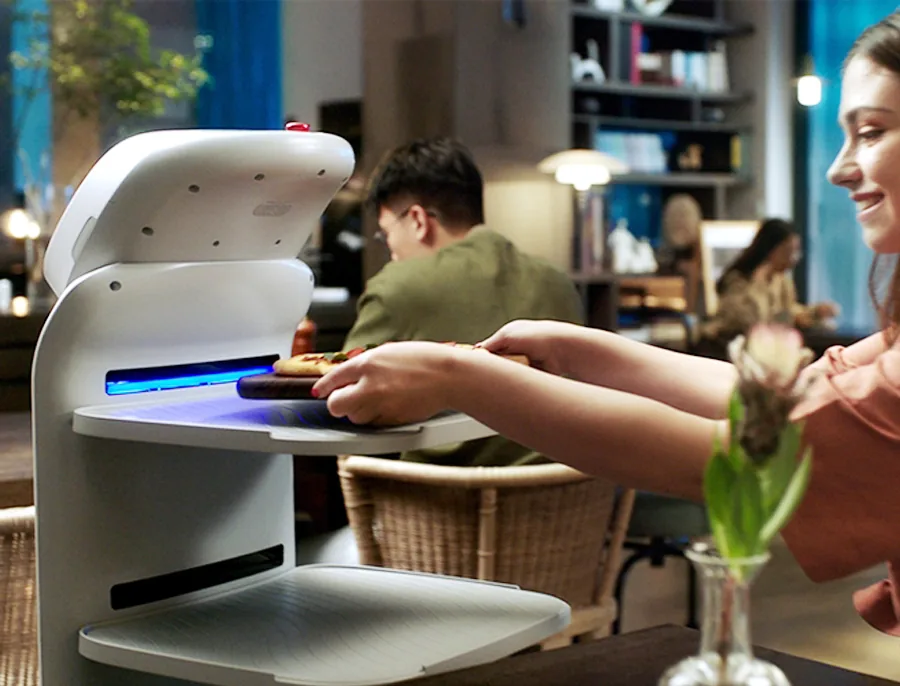
The logistics layer, returns to sorting shelves, holds between branches, AV kits and program materials to rooms, documents between desks, moves through the library all day. The D1 takes the recurring runs: 40 kg on a four-tier tray, 70 cm aisle clearance which fits the 90–120 cm shelving aisles typical of stack floors, and navigation that follows the same map the guidance unit uses.
A common configuration is the front-desk-to-sorting-route on a fixed daily schedule (morning returns and hourly holds sweeps), with on-demand dispatch when a patron's hold arrives from a branch. The screen shows the run's purpose, "holds being transferred" rather than anonymous black boxes, which is the low-effort courtesy that makes robots received as service rather than machinery. The platform matches the delivery robots used in the AOMAN D1 product line for restaurants and hotels.
The route set is small and fixed: a morning cycle from returns to the sorting room, an hourly holds sweep to the pickup shelves when volume justifies it, program materials from the loading dock to the event floor before the 10 AM start. Fixed routes are the right shape for libraries. The schedule is known months in advance, and exceptions (a rush title, an inter-library loan, a donation cart) are additions to a running schedule rather than new systems.
3. Cleaning around collection, AOMAN C2 Pro, with AOMAN C1 for grand floors
Library cleaning is constrained by occupancy: shelves should not be wet, water should not reach rare material zones, and noise must not disrupt study. The C2 Pro fits that profile, quiet, 85 cm aisle clearance, 70 cm clearance beneath desks and counters, modular tanks swapped at a janitorial closet. It runs at opening and in the mid-afternoon lull, which is the difference between a library that looks clean in the morning and one that stays clean all day.
For the big floors, the main entrance hall, the reading rooms with wide aisles, the atrium in a megabranch, the AOMAN C1 covers 2,040 m² per hour on hard surfaces with 70 L fresh water and 50 L recovery tanks and a 790 mm squeegee, ideally in the closing window or an early-morning pass before opening.
Event support: the robot as program assistant
Libraries run hundreds of programs a year, story times, author visits, workshops, citizenship classes, maker sessions, and each one carries the same overhead: where is it, when does it start, how do I get in, which way to the room. Stationed outside an event space during program hours, the G1 handles exactly that layer with the same voice and guidance functions the entrance uses, assists with attendance check-in on the library's existing sign-up flow, and points late arrivals to the right seat.
For children's programming the unit can become part of the program itself, a guided, interactive format that suits the story-time sessions many branches already run, with content and duration chosen by the librarians. Either way, the same unit that serves the entrance serves the event, which is why robot hours are best planned as program hours.
Integration: catalog systems and infrastructure
The two integration points that matter are the library management system and the network. A guidance robot that can answer "do you have this title, and where is it" requires a read path into the ILS record. The standard shape is a read-only API connection through the institution's middleware layer rather than direct database access, so any change in the catalog is visible at the point of demand. The network requirement is straightforward: continuous connectivity across the operating floor, which for older branch infrastructure may mean an access-point upgrade along the robot's route. For the underlying navigation systems, see the SLAM navigation overview.
Privacy requirements
Library patron privacy is a hard institutional line, so robot configurations should be defined with it in mind:
- Voice processing configurable to handle queries without storing conversation.
- No biometric identification by default. Interactions should run on membership cards, barcode or opt-in identity only.
- Anonymous usage logging: counts and query categories, never patron identity.
- Clear signage at the unit explaining data handling, mirroring what the library already publishes for its terminals and digital services.
These are policy settings the institution owns, and the deployment plan should state them out loud before procurement. And the RFP language should carry them, because a post-deployment disagreement about data handling is one dispute per branch.

Procurement path: a four-phase pilot
- Weeks 1–2, needs assessment. Log query types and volumes at the front desk for two weeks; identify the top directional questions; audit hours spent on directional, logistic and repetitive work; survey staff on attitudes up front.
- Weeks 3–4, pilot design. Choose one deployment model (a single G1 at the entrance is the lowest-risk start); define success metrics, queries handled, staff hours recovered, patron satisfaction; map the operating area and check connectivity.
- Weeks 5–8, 30-day pilot. One to two units with staff training and patron-facing sign; collect daily interactions and escalations; survey patrons at day 15 and day 30; review with staff.
- Week 9, scale decision. Decide to extend, more branches, or an additional role such as D1 logistics or C2 Pro cleaning, from data, not enthusiasm; if mixed, fix the friction points first.
For budget comparability: evaluate the fleet cost against the fully-loaded hours it recovers at your institution's pay scales, over the same three-year window a lease covers. That line, not an abstract productivity claim, is the decision the finance committee needs. Platform options across roles are on the AOMAN product line page. The zone-by-zone routing and cycle-time side of the same decision is worked through in car wash bay maintenance.
Tell us your branch footprint, circulation volume and front-desk staffing. We will propose a pilot configuration and return indicative pricing within 24 hours. Request pricing.