Service Robots for Casinos & Integrated Resorts, 24/7 Premium Operations for Gaming & Hospitality
At a glance: The AOMAN G1 greets arriving VIPs with multilingual check-in assistance through a six-microphone, 5 m pickup array, while the AOMAN D1 delivers 40 kg per trip across the back of house. This guide maps a 24/7 property's service floor to AOMAN C1, C2 Pro, D1 and G1.
An integrated resort running 24/7 with zero closed hours has a structural problem: guest expectations are set at peak, Saturday 9 PM, full staffing, every amenity measured in seconds, but the cost structure requires staffing to fall by close to half in the overnight window. A resort with thousands of rooms, a large gaming floor and a score of food-and-beverage outlets still has hundreds of guests on property at 4 AM, and those guests compare the 4 AM experience against the 6 PM standard they paid for. The service floor must not drop below the experience floor, even when the staffing floor does.
The 4 AM Problem
Illustrative example: a property with 3,200 rooms at roughly 70% occupancy on a Tuesday night has about 800 occupied rooms, more than a thousand guests in the gaming areas and a handful of in-room dining orders in flight. At a time when housekeeping, floor operations and room service are staffed at half the swing-shift level. The deltas during those hours. The dining order that takes 30-plus minutes, the floor that visibly carries the evening's debris, the VIP arrival with no one at the lounge: each resolves into the same conclusion: the property is not worth the rate. The fixes are not new staff; the overnight economics will not carry them. The fix is to decouple service capacity from staffing headcount for the tasks that can be automated.
Gaming Floor Maintenance: The Floor That Cannot Close
A casino floor, 40,000 to 150,000 sq ft of patterned carpet and hard flooring, cannot be taken offline for cleaning. There is no closed period, no shift change gap, and any cordoned-off section is gaming revenue taken out of play. That makes the continuous-cycles model the only viable one: maintain the floor on short, repeated passes rather than one clean per shift.
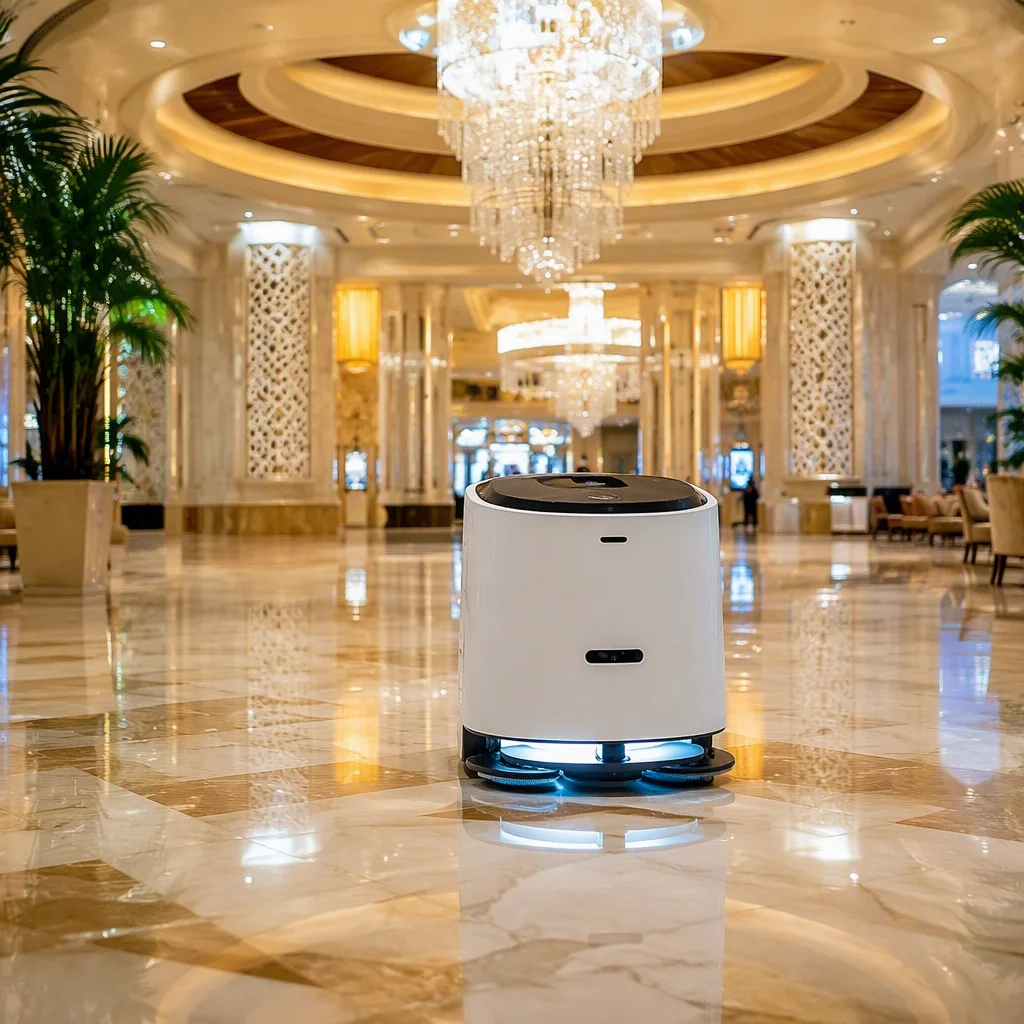
The AOMAN C1 is sized for this: 2,040 m²/h coverage, a 790 mm squeegee for spills and tracked moisture, 70 L clean and 50 L recovery tanks, and an 85 cm aisle footprint that works alongside slot rows and table pits. With one unit per 30,000-40,000 sq ft, the main aisles, bar perimeters and cashier queues get handled every 90 minutes, while the human custodial crew concentrates on the work robots cannot reach, slot base detailing, table underside cleaning, chair rails and the perimeter edges. The audit score that used to drop across the shift now stays within a few points at every hour.
Two specification notes for casino floors: the platform's noise profile, because an obtrusive scrubber in a bar catchment area is worse than a dirty spot, and the chemical registry, because cleaning products on a gaming floor are a regulated list at most jurisdictions. Confirm the robotic cleaning chemistry against the approved-substances list before it is loaded.
VIP Arrival: Reception When the Lounge Is Unstaffed
The most expensive arrival at a resort is the one nobody staffs. A hosted VIP arriving on a private flight or an off-schedule connection does not reset their travel to the evening desk hours. Historically the options were a walk to the main desk or a wait. And for a guest whose theoretical value to the property runs to a meaningful share of a front-desk salary, the error is expensive.
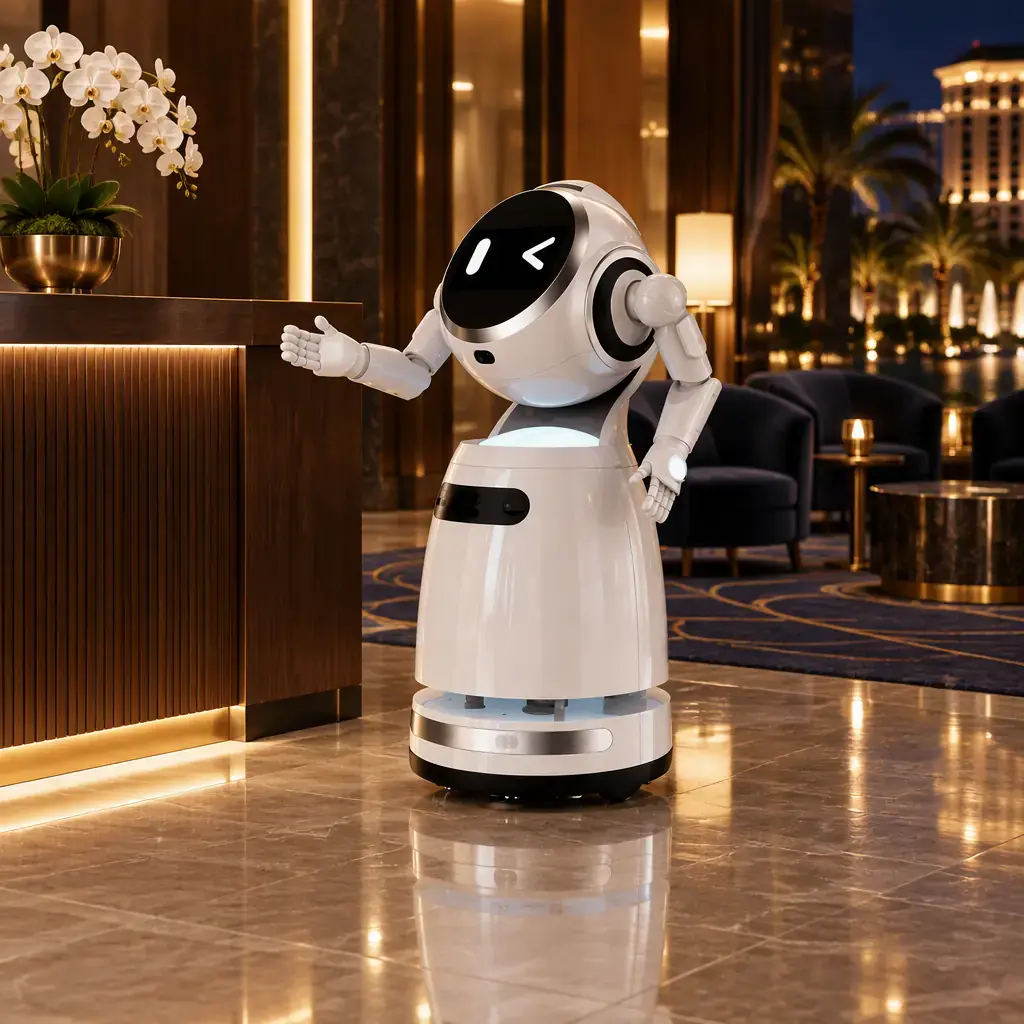
The AOMAN G1 covers the arrival lane that deserves the standard: multilingual greeting and guidance through its six-microphone array with 5 m pickup range and 15 DoF upper body, check-in assistance through its touch interface, 13 MP camera supporting identity verification against the reservation, and automatic return to its dock when the lane is quiet. The human host remains at the lounge for the exceptions, room moves, billing, comp table, while G1 absorbs the acknowledgement, the orientation and the escort guidance at 3 AM as consistently as at 3 PM.
In-Room Dining: Overnight Demand, No Servers
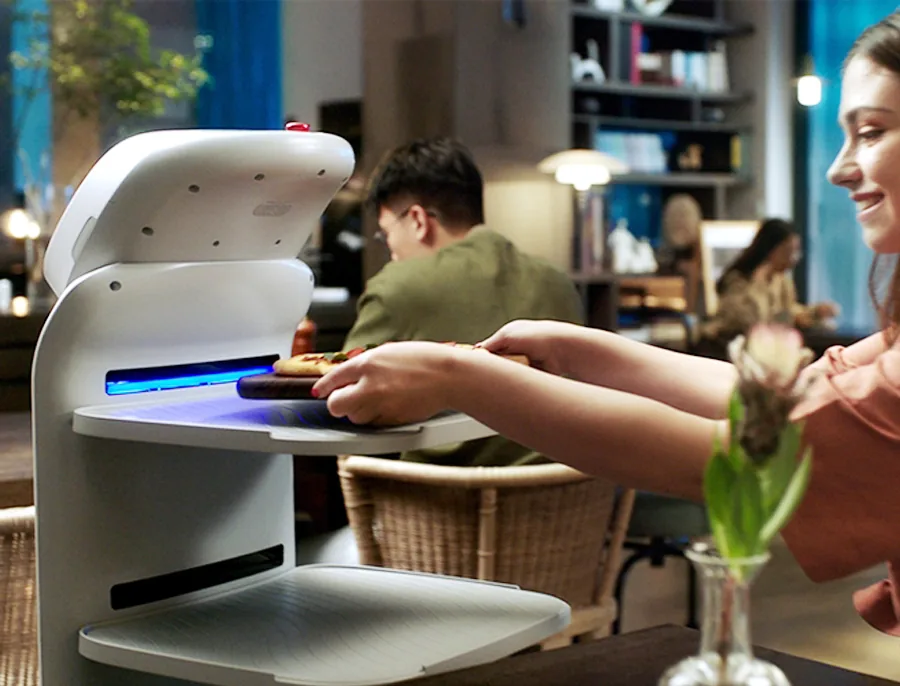
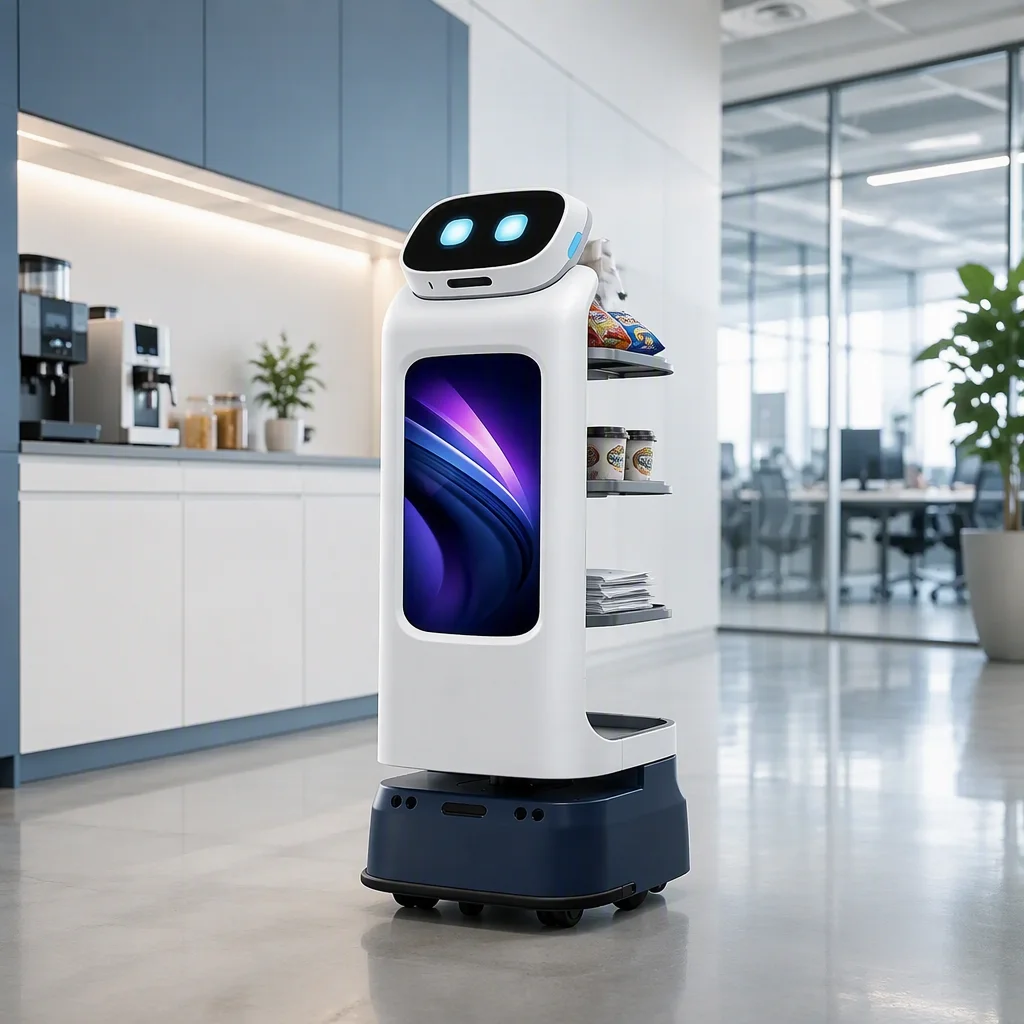
Overnight room service is the classic underperformance story: demand exists, supply does not. With a thin night staff, the delivery window stretches, guests cancel, and the kitchen report shows orders that never completed. The fix is to let the robots take the distance. An AOMAN D1 with 40 kg of payload across four trays, staffed by one server per tower who plates and loads at the kitchen station, holds the delivery promise through the night: the robot travels the corridor, the server stays at the point of value.
D1's 21.5-inch display closes the loop at the guest door with order confirmation and re-order prompts. The measured effect on a property running this model is not just faster service, it is the orders that are not lost. Guests who would have cancelled on the estimated wait instead receive the tray in a reasonable window, and the overnight kitchen starts seeing volume it used to convert on the cancellations line. On the worst night of the week, the modelled upside is new orders filled that would previously have been turned away; in an operation where food cost is already paid and the kitchen is already on duty, that is near-pure contribution.
Back-of-House Resupply: The 4 AM Logistics Rush
Behind every outlet is a resupply loop: receiving, main kitchen, cold storage, dry storage, outlet prep stations. The window when all outlets are at minimum operation is short, and the old method, carts and runners, burns the highest-turnover jobs in the building, which is also the lowest-trust string in a property, because a runner is a contractor walking behind the curtain with access to a dozen kitchens.
The AOMAN D1 moves 40 kg per trip with room for four delivery trays and transit screens showing the outlet, item set and drop time. Runners keep the loading and unloading, judgment about placement and FIFO rotation, while the robots keep the transit. In practice the resupply fleet settles at one robot per two or three outlets, sharing the dock between the main kitchen and the dispatch area.
Regional Property Scale: Where the Numbers Work First
Illustrative example, a 1,200-room regional property with a 65,000 sq ft gaming floor, five to ten outlets, no convention wing: two C1 units for the floor, one C2 Pro for the administrative and employee areas, one D1 for overnight room service and one D1 for resupply, one G1 at the lobby and the player's club desk. The robotic capex and lease sit against three overlays. The graveyard custodial difference, the overnight dining revenue that the current delivery-time distribution is losing, and the player-activity hours that a maintained floor and a staffed arrival lane keep in the product curve.
For the property running the arithmetic, the platform catalogue and a site-scoped quote from our solutions team take about a day. And the pilot lane is short: one outlet, one arrival lane, one floor zone.
Regulatory Considerations
Gaming floors are among the most controlled environments in commercial operation. A robotics deployment on a property should assume the following review points, confirmed with the jurisdiction and the facility compliance team before ordering:
- Device approval paths . Gaming regulators typically distinguish between devices operating in non-gaming areas and devices operating on the gaming floor; the application triggers, timing and documentation differ.
- Camera and data policy . Onboard cameras may be subject to the property's surveillance data-retention policy, and should be treated as surveillance and storage assets, not as robot convenience.
- Route approval . Navigation routes may require pre-approval and should respect the table pit, cash handling and count-room boundaries rather than passing through them.
- E-stop and staff visibility . An accessible emergency-stop mechanism and clear supervisory ownership are typically non-negotiable on the floor.
- Approved chemistry . Cleaning materials on the gaming floor are usually subject to the approved-substances list; robot consumables must be confirmed against it.
Routing boundaries and emergency-stop placement are configuration decisions that cost nothing to plan and a lot to redesign, bake them into the design review, not into the deployment.

Where to Start at a Property That Never Closes
Start on the lane where value is visible in the first 30 days: one D1 on overnight room service in one tower, one C1 on the busiest gaming-floor aisle, one G1 in the VIP arrival lane. Each of those three is independently measurable, delivery time and completion rate, floor audit score by hour, arrival NPS for the unstaffed window, and together they form the prototype for the property-wide roll. It is a pattern that works at a boutique property and at a 5,000-room integrated resort where the operating model is the same and the scale is not.
Tell us your property profile, room count, gaming floor square footage, F&B outlets, and we will match the platforms and return a deployment plan within 24 hours. Request pricing or browse the full platform range. A comparable deployment with different traffic, dock and shift constraints is documented in entertainment theme parks.