Service Robots for Entertainment Venues, The Complete Guide to Theme Parks, Museums, Casinos & Cruise Ships in 2026
At a glance: AOMAN C1 covers 2,040 m² per hour -- one unit resets 12,000 m² of park floors in about six overnight hours. This guide maps the four robot roles for entertainment venues and the crowd-density requirements behind each.
Entertainment venues share one operational profile: guest-facing demands at peak, throughput logistics behind the scenery, and crowd densities that change the rules for autonomous navigation. A theme park, a museum, a casino resort, and a cruise ship differ in size and seasons, but the four robot roles that apply are remarkably consistent. This guide is written for the operators of those venues -- the people deciding whether and how to introduce them.

Why entertainment venues are a different case
Peak absorption is the whole problem. Staffing needs at 1 PM are not a multiple of needs at 9 AM -- they are a different schedule. Robots close the gap because utilization, not headcount, is the flexible resource.
Guest expectations have moved. Visitors who have seen robot-assisted check-in at a hotel or an airport expect self-service wayfinding at a theme park gate. The deployment model is augmentation, not replacement: the unit handles the standard questions everyone asks, and the human team handles the relationships.
Crowd density is the engineering gate. Standard navigation assumes a mostly static scene. A crowded plaza is a moving scene. The honest question to any vendor is not "does it navigate" -- it is "what pedestrian density does it handle before it slows to walking pace and uses audio cues instead of trying to thread the needle."
The four roles
1. Guest engagement and wayfinding: the AOMAN G1
Positioned at high-traffic nodes -- park entrance, museum atrium, casino lobby, cruise atrium -- the AOMAN G1 covers the standard five interactions: directional queries, show and ride times, facility locations, accessibility questions, and promotional engagement. It carries 15 degrees of freedom for natural gesture, a six-microphone array with 5 m pickup in a noisy environment, a 13 MP camera, and multilingual support for international visitors. Auto-recharge docking keeps it at the gate for the opening wave instead of idling at midday.
Placement follows venue shape: parks run several units at intersection points (or one per land), museums run one or two in the atrium with exhibit-oriented data, casinos place units in lobbies for escort initiation and floor orientation, and ships run them at atriums and gangway exits for excursion briefings. The data loading is the actual work -- ride schedules, show times, exhibit maps -- and should be carried in the unit before opening, not added during the first crowd.
2. Food and merchandise delivery: the AOMAN D1
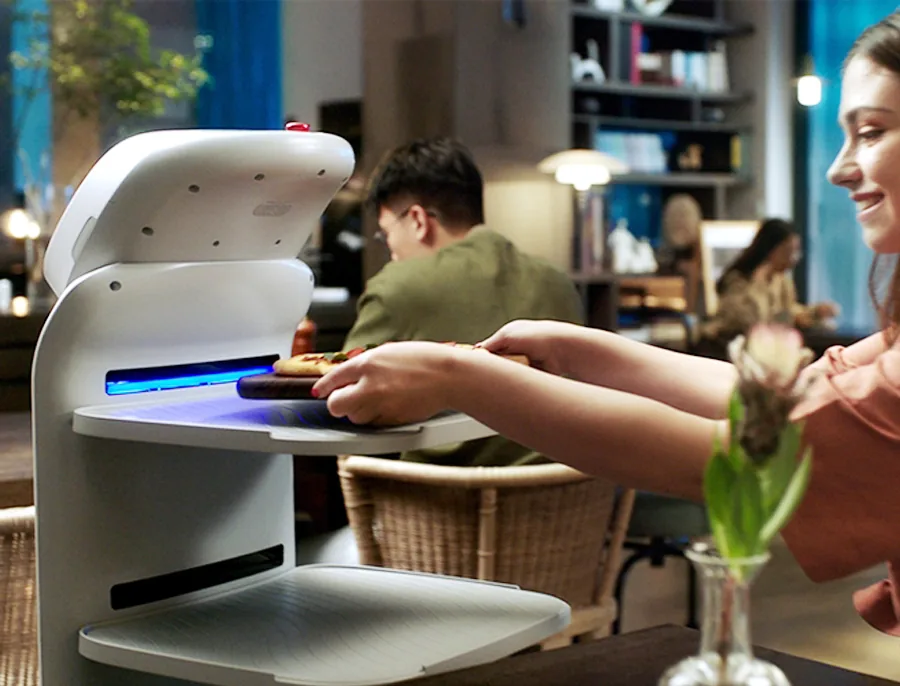
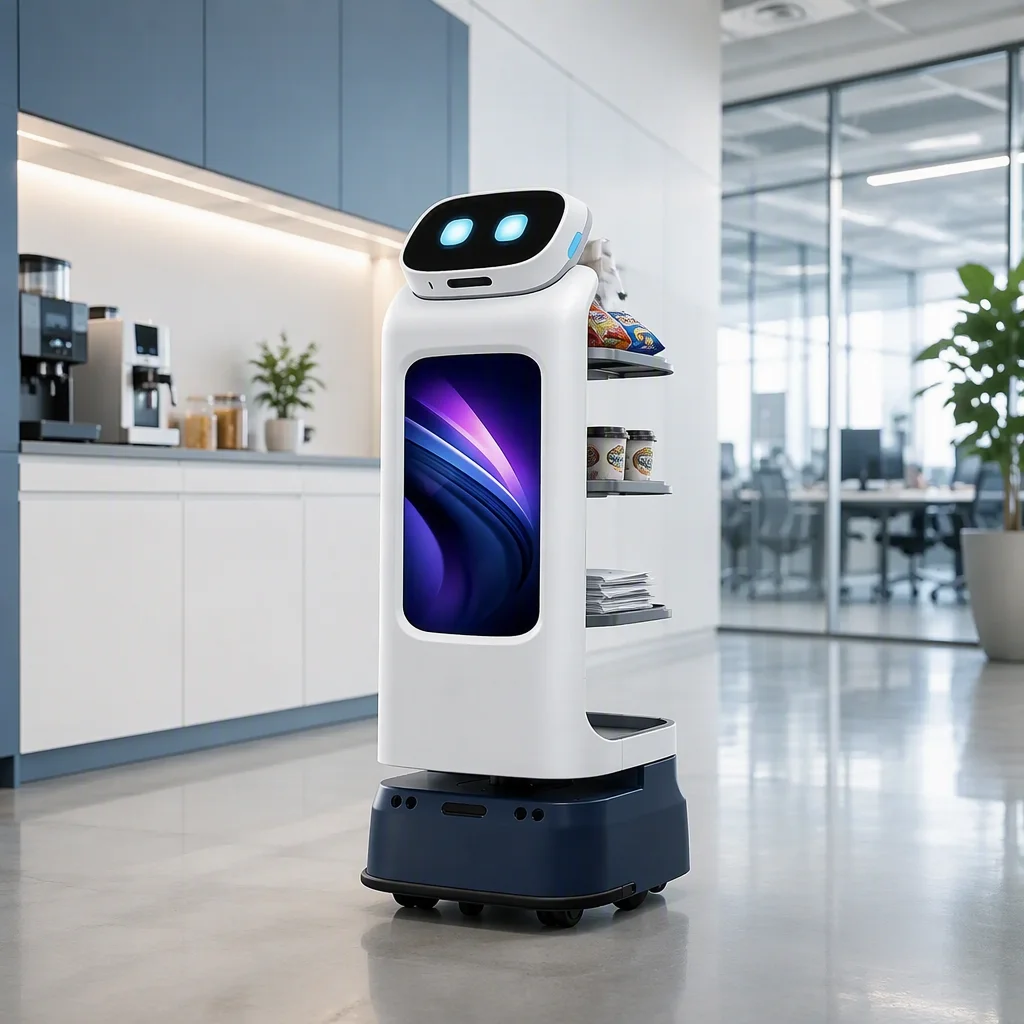
The bottleneck in venue F&B is distance: the walk from a fast-casual station to the table lane, or from a cart shop to the lawn. The AOMAN D1 carries up to 40 kg across four trays and clears a 70 cm aisle -- queue bypass, meal delivery to a specific zone, or VIP cabana service without dedicated runners. Its 21.5-inch screen gives guests and staff at the station live order status, which is useful exactly when the crowd is thickest.
For outdoor midways the environmental spec is the requirement: direct sunlight, heat, sudden rain, uneven paving. Rain-reactive routes that return to cover, and wheel and drive components guarded against grit and moisture, belong in the RFP.
3. Large-scale cleaning: the C1 overnight reset
A park's public floors accumulate more in one operating day than most commercial buildings see in a week: spills, confetti, mud, tracked debris. The AOMAN C1 scrubs up to 2,040 m²/h with dual 70 L + 50 L tanks and a 790 mm deck -- one unit resets roughly 12,000 m² of indoor floor in about six overnight hours. The second requirement most procurement processes miss: event-triggered routes. After fireworks or a concert, the plan says "reset the plaza," not "wait for the nightly schedule."
4. Compact and back-of-house tasks: the C2 Pro and D1
The AOMAN C2 Pro (quiet, modular tanks, 85 cm aisle, 70 cm desk clearance) handles offices, meeting rooms, and restroom corridors while people are present. The AOMAN D1 in staff-only corridors is the least glamorous and often the fastest payback: costume, linen, and merchandise movement in service corridors, where routes are simple, no crowds exist, and the payload matters more than the polish.
A day in the life
| Time | Activity | Unit |
|---|---|---|
| Night | Overnight venue reset | C1, full-area routes |
| Pre-opening | Wayfinding units checked, data loaded | G1 at gates and atriums |
| Opening wave | Gate and queue handling | G1 + D1 for deliveries |
| Peak hours | Midday food runs, scheduled surface passes | D1 + C2 Pro |
| Show calls / close | Show-time suspension on parade routes; post-event trigger routes | Fleet manager scheduling |
The integration requirements that are entertainment-specific
Show control. Parks and venues run on a clock: parades, fireworks, character appearances, show calls. A fleet that does not know the show schedule will be in the wrong place at the wrong minute. The scheduling interface between the venue's show plan and the fleet manager -- suspend and resume on parade routes before and after each event -- is the single most effective anti-failure measure in entertainment deployments.
Crowd-dense navigation tuning. Expect the robot to slow to walking pace in dense crowds and use audio cues; require graceful degradation over freeze-in-place behavior. Predictively estimating where a moving pedestrian will be in the next two seconds is what separates a plaza simulation from a plaza deployment.
Environmental hardening. IP54 minimum for outdoor zones, daylight-readable displays, and electronics rated for the range of outdoor heat and humidity. The outdoor specification is the difference between a robot that works at the entrance canopy and one that works by the water park.
Weather contingencies. Thunderstorms in an open-air park are a schedule event, not a surprise. The plan should cover: where units return when rain rolls in, what happens to temporarily exposed docks, and how the cleaning routes re-sequence once the rain clears -- mud tracking from a wet midway is a large, immediate cleaning job, and a fleet that already has the plaza in its map does it in the same night.
Vendor questions worth asking
- What pedestrian density does the navigation stack handle before it slows to walking pace? Ask for the number and for the venue where it was measured.
- Has the vendor deployed in a venue with a comparable daily visitor volume? A hospital corridor is not a reference for a park midway.
- Does the fleet platform support show-schedule integration -- suspend zones, time-based resumes, event-triggered cleaning routes?
- What is the outdoor enclosure rating, and what happens to the unit in sudden rain?
- What training and change-management support is included -- the staff side of the ledger is usually the harder half?
Readiness by venue type
| Venue type | Ready signal | Caution signal |
|---|---|---|
| Theme park | Multiple F&B outlets, existing guest app, multi-day visitors | Single-entrance park, low daily volume |
| Museum / gallery | Multiple floors, multilingual audience, guided-tour program | Single floor, local-only visitors |
| Casino resort | Hotel + F&B + entertainment complex | Gaming-only floor, no ancillary services |
| Cruise ship | Multi-venue ship, 7+ day itineraries | Short-crossing vessel, single deck |

An illustrative staffing-shift example
Illustrative example, not a customer disclosure: a venue running a 14-hour operating day with three robot roles -- wayfinding units, delivery units, and overnight cleaning -- can move the majority of round-the-clock repeated work onto schedule. The honest modeling happens against your own shift baseline: ask how many of your stand-time hours in each department are spent on the same repeated loop, and that is the number to build the case on.
What to measure after month one
- Route completion rate per role -- wayfinding, delivery, cleaning -- on live operating days, not on test runs.
- Clean coverage logged against the plan in square meters and zones touched, and whether the pre-opening reset window was actually respected.
- Delivery loops per unit per day during peak hours, and where the queue backed up.
- Guest-facing incidents and how fast the escalation path worked -- the speed of recovery is the metric, not the absence of error.
- Staff usage pattern -- who uses the units and who works around them; that pattern changes after the first onboarding, not during it.
Sequencing the deployment
The lowest-regret sequence is: back-of-house logistics first (simple routes, no crowds, immediate measurement), then cleaning on a fixed overnight rhythm, then guest-facing wayfinding once the team knows the platform's behavior in live operation. The full speed path for parks, museums, and mixed venues is mapped stage by stage in our multi-site deployment strategy guide, and the economics in the ROI guide.
For a venue assessment -- floor plan, visitor volume, and your shift structure -- contact the AOMAN FUTURE entertainment team. We will tell you which of the four roles fits your venue first, with the honest sequencing and the staff-side plan that makes it stick.