Service Robots for Coworking Spaces & Flexible Offices, Automated Operations for the Shared Workplace
At a glance: Coworking operators sell hospitality on margins that leave little slack. A quiet AOMAN C2 Pro maintains floors during member hours, an AOMAN G1 welcomes members from 5 m over its six-microphone array, and an AOMAN D1 carries 40 kg of mail and catering to desks.
Coworking spaces sell the experience of a boutique hotel with the economics of a shared office. Occupancy rates have recovered strongly in the post-pandemic cycle, but the operating cost of that hospitality standard, continuous cleanliness, front-desk responsiveness, mail and catering logistics around the clock, sits on thin margins. The answer is not to reduce the standard; it is to stop paying humans to do the parts a machine covers.
This guide covers the three roles that fit a coworking operation, the integration with membership platforms, and a staged four-step rollout. Product figures are AOMAN FUTURE platform specifications; operational figures are illustrative examples based on typical location layouts.
The margin problem, and why robots help
Member expectations have settled at a high standard: the space should feel staffed and clean the moment anyone walks in, spills should be handled quickly, mail should appear, visitors should be greeted. Across a typical 15,000–25,000 sq ft location, delivering that with a front-desk team means either staffing the full window or accepting the valleys. The hours when response is slow and reviews drift.
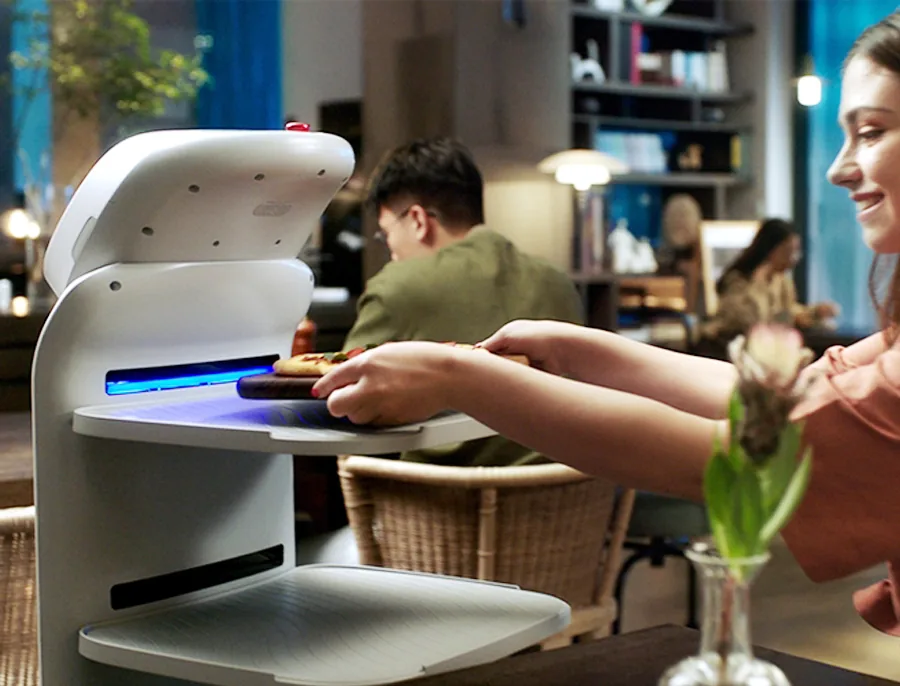
Robots change the shape of the staffing curve. The routine, recurring parts of the job, floor passes, welcome and check-in, parcel runs, are exactly what a fleet absorbs, and they are also exactly the parts that consume community manager hours during the busiest member-facing windows, when onboarding tours and enterprise visits compete with a spilled latte and fifteen parcels. In a publicly documented deployment, an AOMAN D1 runs table delivery service at a Dutch Korean BBQ restaurant, the same unit type that delivers mail and catering inside a flexible office space.
Three roles for the coworking floor
Role 1: Continuous floor maintenance, AOMAN C2 Pro, with AOMAN C1 for large common areas
Coworking floors mix four surfaces within a few meters: hardwood or luxury vinyl at the hot desks, carpet tile in private office corridors, stone or polished concrete in the event space, tile in the kitchen. The constraint for coworking is not coverage, it is noise: the pass has to happen while people work. The C2 Pro is the fitting choice, quiet, compact, modular tanks that swap at a janitorial closet, 85 cm aisle clearance, and clearance beneath 70 cm counters and desks in the kitchen and lounge. It runs a short continuous cycle instead of a once-a-day deep pass, which keeps the space presentable rather than just clean at 8 AM. And a machine that runs at conversation level can share the floor with a phone booth instead of forcing a seating shuffle.
For the larger common areas, the event hall, the entrance lobby, the multi-floor stair corridors, the AOMAN C1 adds 2,040 m² per hour on hard surfaces, with 70 L fresh water and 50 L recovery tanks and a 790 mm squeegee. Its natural window is closed or low-occupancy hours; the C2 Pro covers the member-facing day.
Role 2: Member welcome and visitor handling, AOMAN G1
The front-of-house role in a coworking space is three tasks wrapped in one: member check-in, visitor badging and host notification, and wayfinding for newcomers. The G1 handles all three at the door. Six-microphone array with 5 m pickup so a quiet "hi, I booked the phone booth" is heard over the espresso machine, multilingual guidance for internationally mixed member bases, check-in assistance that confirms the member and tells them where they are booked, and a 13 MP camera so the community manager can watch and step in on tricky visits. It returns to its dock automatically between interactions.
The workflow shift is real: instead of the community manager dropping the tour to badge a visitor, the visitor is badged and notified while the manager stays with the tour. For details on guidance-robot deployments in comparable front-of-house roles, see the AOMAN G1 product page.
The visitor workflow follows the space's own policy: details captured, badges issued by the platform the operator already runs, the host notified, and the visit logged to the member record. Nothing about the interaction should create a second paper trail, the G1 participates through the same access the community manager would use, and records land in the operator's system rather than the robot's.
Role 3: Mail, parcels and catering logistics, AOMAN D1
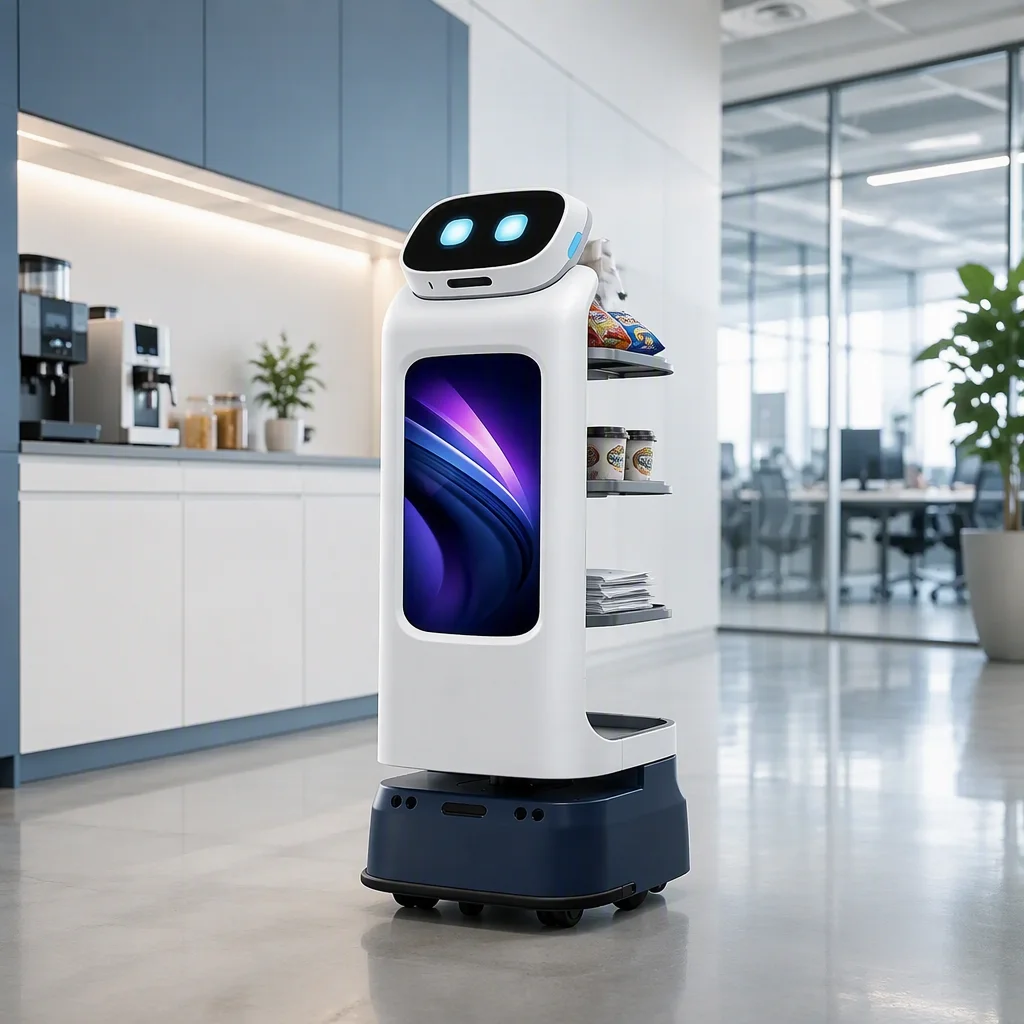
A 300-member location typically runs a parcel and mail set each day plus ad-hoc catering for enterprise tenants. That set arrives during the morning window, the same window as the tours and onboarding, which is the worst possible overlap. The D1 absorbs it: 40 kg on a four-tier tray, 70 cm aisle clearance that fits between lounge furniture and meeting rooms, delivery to member-designated drop points, and catering runs from the front desk to the booked meeting room door.
The 21.5-inch screen is a bonus rather than the point: onboarding messages, event notices and partner promos ride along on the runs. The unit is the same platform used across the AOMAN D1 product line for restaurant and hotel delivery service.
Integration with the membership platform
Robot-driven check-in and visitor handling only feel right if they live inside the tools the operator already uses. The standard integration pattern is a REST API bridge: the robot pulls member profiles and bookings from the membership management platform, and it writes back interaction logs, check-in timestamps, visitor notifications, delivery confirmations, to the member record. That keeps the robot's activity in the same view as the community manager's touchpoints instead of a separate dashboard nobody checks.
For multi-location operators, the integration should be implemented as a reusable middleware layer so each new location deploys the same configuration without custom engineering. That is what makes portfolio-wide rollout a copy operation instead of a project.
The four-stage rollout
- Weeks 1–3, Overnight cleaning validation. One C2 Pro (or C1 for a large floor) on overnight cycles first, where no members are present. This proves navigation and coverage on the actual floor plan before the unit is seen by anyone.
- Weeks 4–6, Daytime cleaning. Move into member hours at low-volume times, confirming the noise and navigation behavior are compatible with an occupied workspace. Member feedback at this stage is the gate for the next stage.
- Weeks 7–10, Welcome robot. Deploy the G1 as a supplement, not a replacement: measure how many check-ins and visitor interactions it handles, and survey members on preference.
- Weeks 11–14, Logistics robot. Deploy the D1 on the morning parcel run and measure the community manager's reallocated hours. The honest metric is what the manager did with those hours.
Give each stage one control metric and name its owner before the unit arrives: stage 1 measures pass coverage and opening condition; stage 2 measures member sentiment about the daytime unit; stage 3 measures the share of check-ins and visitor interactions handled autonomously plus the member preference split; stage 4 measures the hours reallocated away from logistics and toward member-facing work. The pilot's only job is to produce numbers the operator believes.
Each stage is individually reversible, and each produces the data for the next one. For platform choice across roles, see the full AOMAN product line, and for the office-sector context, the corporate office industry page.
Where a robot is not the answer
The honest limits are worth stating, because they are what makes the case credible. A community manager's judgment work, member conflict, an enterprise walkthrough, a bespoke request, is not the robot's job, and deploying a machine into those moments reads as cost-cutting rather than service. Deep cleaning also remains a staff-and-equipment task: the C2 Pro and C1 maintain continuously, which reduces the frequency of deep passes but does not replace the monthly scrub or the post-party recovery. And robots do not fill relationships, they buy the manager time, and the manager spends it on people. That is the correct framing, and it is the frame that survives contact with the membership.
The economics: an illustrative example
Model the location on three lines: the front-desk window you would otherwise fully staff, the morning logistics window, and the cleanliness standard your member reviews depend on. Illustratively, if a single community manager absorbs 90 minutes a day of check-in, visitor and wayfinding work and 60 minutes a day of parcels, that two-and-a-half hours is roughly 30 FTE-equivalent hours per month, compare that to the G1 and D1 lease cost at your rates. The C2 Pro's case is set by the cleanliness standard: a daily continuous pass versus the current pattern, and the review risk attached to each. The zone-by-zone routing and cycle-time side of the same decision is worked through in the cleaning labour cost model.
Tell us your location floor plan, member count and current staffing. We will return a staged proposal with configurational pricing within 24 hours. Request pricing.