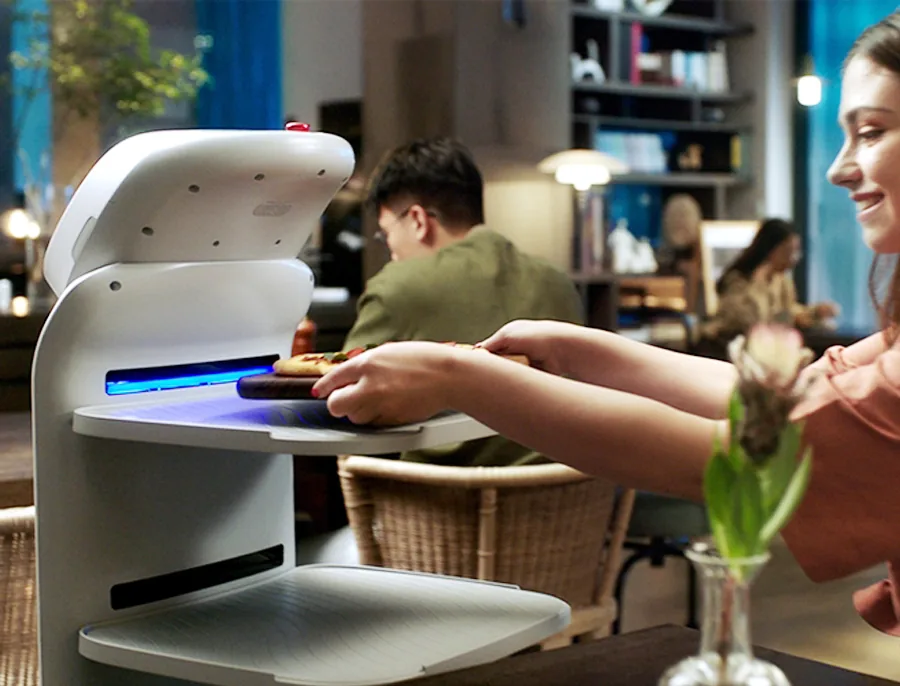
Service Robots for Bus & Rail Transit Stations, Autonomous Operations for High-Throughput Public Facilities
At a glance: AOMAN C1 covers 2,040 m² per hour, so a single unit can keep a platform-level concourse clean through an entire 16-hour operating day. This guide maps AOMAN G1, C1 and D1 onto the three roles high-volume transit stations actually need.
Bus terminals, subway stations and railway hubs have a shape of demand that few other facilities do: continuous open-access passenger flow through multiple entrances, hard scrutiny on every operating dollar, and wayfinding demand that spikes twice a day. This guide maps three robot roles onto that structure, and keeps every recommendation to what the platforms' published specifications support.
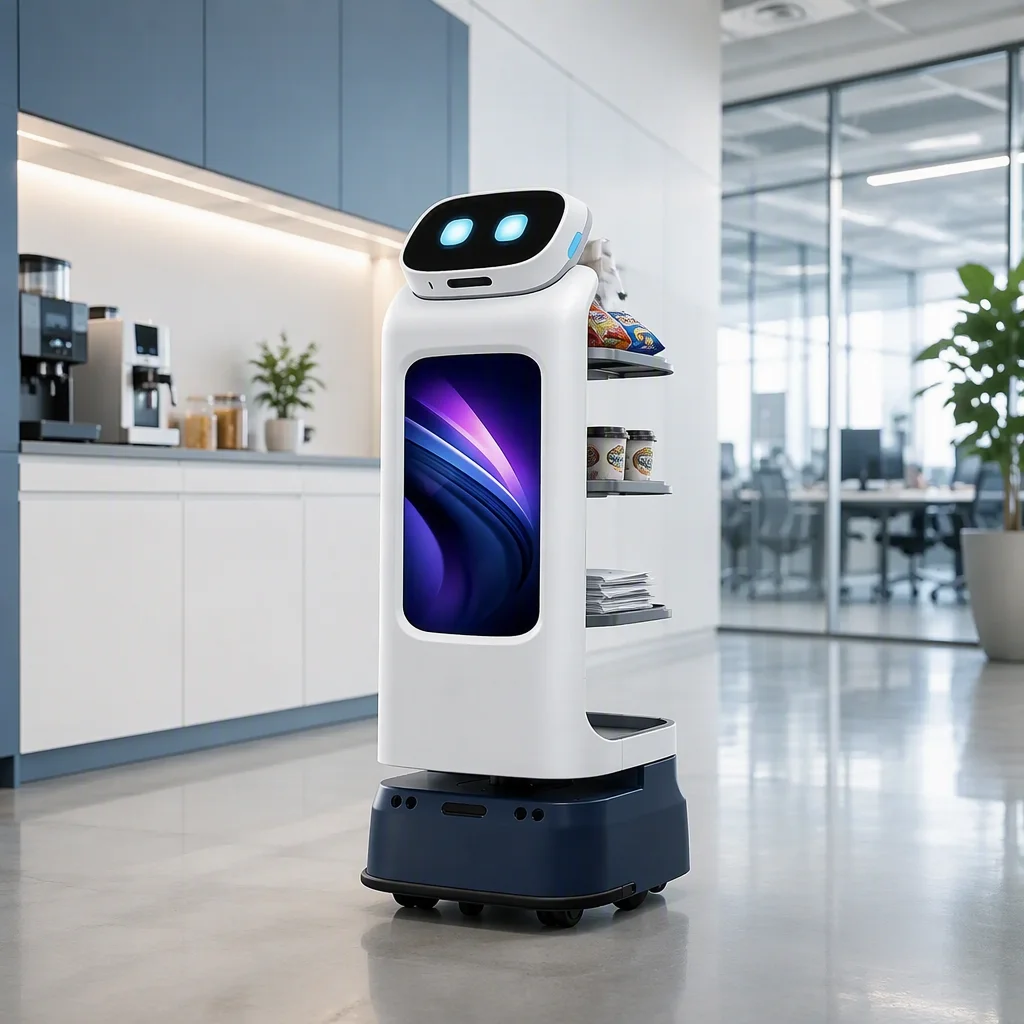

Three Structural Problems in Transit Stations
Continuous passenger flow defeats scheduled cleaning. A crew that works 11 PM to 7 AM can deep-clean a platform floor, but after 45 minutes of rush-hour foot traffic it looks uncleaned. The only real remedy is cleaning during operating hours, which autonomous scrubbers do without blocking passenger flow.
Wayfinding demand is spiky, but staffing is flat. Between 7–9 AM and 4:30–6:30 PM, questions at information desks multiply several times above baseline. Staffing for peak demand means idle workers off-peak; staffing for the average means queues at rush. A self-contained guidance unit absorbs the routine queries whenever they arrive, at the same marginal price at 8 AM as at 2 PM.
Perceived safety is a coverage problem, not a crime problem. Rider concerns cluster around dim corridors, empty mezzanines and isolated stairwells. Visible, connected devices provide continuing presence in those places without stationing a person in each one. And the same platform observes the station floor at the same time, which is a second benefit of the same hardware.
The Three Robot Roles
Role 1: Passenger Information and Wayfinding
The AOMAN G1 guidance robot is the right fit for station entrances and corridor junctions: 15 degrees of freedom for natural interaction, a 6-microphone array with 5 m pickup range, a 13 MP camera, multilingual guidance and check-in assistance, and automatic return to its charging dock.
G1 answers compound questions on its own screen, platform directions, next-arrival estimates, restroom and exit locations, accessibility routes. Where the authority exposes its real-time schedule feed (GTFS is the common open format), the operator can display schedule and disruption details from that feed rather than keeping a second copy; events like track maintenance or signal failures can be pushed to the units and shown to passengers entering the station, which is where the information desk bottleneck forms during disruptions.
Multilingual service on these units is a configuration matter, not a staffing matter. The same interface across language switch is what makes it useful in cities where a large share of residents speak a different language at home than the one printed on the signage. And it costs the authority nothing on the rota.
By design, the unit does not chase the hard cases: ticket disputes, fare adjustments and accessibility assistance remain staff tasks. The point of a guidance robot is that the routine questions stop consuming staff time at all.
Role 2: Continuous Concourse and Platform Cleaning
The AOMAN C1 scrubs 2,040 m² per hour with a 790 mm squeegee and 70 L + 50 L split tanks, sized for concourses, platform halls and mezzanines; its 85 cm passage width lets it run beside seating rows and ticket lines during service hours. For the tighter corners of a station, ticket-office corridors, staff rooms, toilet-approach tiling, the AOMAN C2 Pro goes under 70 cm of desk clearance, turns in 85 cm aisles, runs quietly, and takes rapid tank swaps.
The cost structure changes when units work during passenger hours rather than behind a closed roof. A spill on the platform at mid-morning is dispatched to the nearest unit through the fleet platform within minutes instead of waiting for the evening crew; routine routes run regardless of the hour. This is also why a transit cleaning fleet is a candidate for the orchestration layer covered in our product overview . Zone priorities, multi-unit coordination and charging rotation belong in one fleet manager, not in three separate apps.
Mapping is the hidden schedule cost in station deployments. Every entrance, mezzanine and corridor junction gets walked once with the unit; stairwells and paid zones are typically excluded rather than crossed; and the map is re-issued when a concourse is relaid. Budget the mapping days as real time, because stations keep operating while they are mapped. Which is the point, but it also means the first mapping morning happens on the busiest morning.
Bus terminals and station entryways, where tracked-in dirt, salt and debris accumulate, extend the same continuous model outdoors; that perimeter is best handled by the same large-format scrubber on dedicated outdoor routes.
Role 3: Back-of-House Logistics
Stations run invisible logistics: consumables from central stores to station-level closets, maintenance parts from depot to equipment rooms, documents between control offices and every platform level.
The AOMAN D1 carries 40 kg across four 270° tray positions, works 70 cm aisles and displays its current task on a 21.5-inch screen. On a five-station scale, two or three units absorb most of the "materials runner" hours spent pushing carts through tunnels and service corridors, and materials that used to wait for the next scheduled run arrive within minutes of a request instead of hours.
Integrating With Stations That Were Not Built for Robots
Most transit stations predate autonomous machines, so integration is retrofit work. Three points decide whether a pilot succeeds:
Elevators and doors. Options are wireless relay modules on elevator control panels, a four-to-six-hour installation per elevator with the station staying operational, or human-assisted floor calls for lower-traffic stations, phasing full control interfaces in over a couple of years. Door interfaces follow the same path.
Coverage. Underground platforms and concrete service tunnels frequently have dead zones. A pre-deployment RF survey identifies gaps; remediation ranges from PoE mesh access points to passive repeaters where new cabling is impractical. Do this before the pilot, not after the first mid-corridor dropout.
Passenger flow. Units navigate around passengers, not the reverse. Baselines are planned from the authority's own turnstile and platform-sensor data so routes avoid the highest-density corridors during rush; on-device path planning handles the rest when a delayed train shifts crowding unexpectedly.
An Illustrative Cost Comparison
The table below is an illustrative example for a three-station bundle, two janitorial shifts replaced over concourse zones by six autonomous scrubbers. It is a framework for your own numbers, not a quotation.
| Line item | Traditional (annual) | Robot fleet (annual) |
|---|---|---|
| Cleaning labour, two shifts, three stations | $312,000 | $0 |
| Lease/amortisation, six C1 units | $0 | $72,000 |
| Consumables and maintenance | $18,000 | $24,000 |
| Supervision and management | $45,000 | $15,000 |
| Total | $375,000 | $111,000 |
Assumptions: six C1 units on a 36-month term, one retained supervisor for exception handling, and the night shift kept for deep cleaning. Change any of those and the arithmetic changes with it. That is the honest way to run the comparison in front of a budget committee.
Procurement Paths for Public Authorities
Transit procurement differs from enterprise buying. Three practical paths:
Operating-budget pilots. A 90-day demonstration at one or two stations, funded as a technology demonstration, produces the measurement a scale-up proposal needs: query deflection, cleaning coverage, overtime hours, incident reports. Measured outcomes, not anecdotes, are what boards accept.
Subscription rather than capital. Robotics-as-a-service converts the purchase from CapEx to OpEx, routing it through annual operating budgets; a short subscription term for a few units is often approvable at general-manager level where a multi-unit capital purchase would need board review and a public comment period.
Framework alignment. Federal transit grant programs in the United States have covered technology-based service improvements, and several authorities classify robot fleets as capital assets with defined service lives rather than recurring expenditure, a classification that shapes depreciation, not approval odds.
Safety and Accessibility Requirements
- Code compliance. Robot deployments reference the same accessibility rules station construction does: for example the 36-inch clear-width standard for accessible walking routes. And units are configured so they never block one; station fire and egress requirements apply to robot materials and parking positions, and battery and materials documentation is part of the delivery package.
- Navigation safety. Multi-sensor navigation with redundant processing (LiDAR, depth cameras, ultrasonic); any single-sensor fault forces a safe stop. Units announce their presence with audio cues in public areas.
- Certifications. AOMAN platforms ship with CE, FCC and RoHS compliance; batteries are UN 38.3-tested.
One test to apply before budgeting: count the routine questions your information desks answer on a weekday, then compare that against what your static signage answers. The difference is what a guidance unit absorbs for you at a fixed price.
Conclusion
Transit stations map unusually well onto robot capabilities: continuous cleaning need, spiky wayfinding demand and repetitive back-of-house logistics. Start with cleaning in one concourse, add a guidance unit at the main entrance once the schedule-feed integration is ready, and put a delivery unit on the depot-to-platform loop last: each step produces the measurement that justifies the next.
Send us your station layout . Entrance counts, platform configuration, existing elevator and door controls. And we will sketch the first phase against your real hours and wage tables. Request pricing once the pilot scope is fixed. A venue with a different traffic pattern, and how the configuration changes for it, is covered in petrol station deployments.