
Service Robots for Petrol Stations & Highway Service Areas, Automation Guide 2026
At a glance: AOMAN D1 carries 40 kg per run on four trays, enough to restock a long c-store shelf run in fewer trips. This guide covers the three robot roles for fuel retail and highway service areas, multi-site fleet management and the compliance boundary.
The modern highway service area is a mobility hub: fuel, EV charging, quick-service restaurants, grocery retail, restrooms and truck parking under one operator, open 24/7, across a network that can exceed a hundred sites. Staffing that patchwork has become the operational constraint. Overnight shifts at isolated locations, with the same labour pool competing against warehousing and delivery work that does not require a 3 AM start.
Robots fit this environment better than the popular image of a "fuel station robot" suggests, provided the deployment respects the dispensing zone. This guide covers the three roles AOMAN platforms actually support, the network-level fleet model that makes distributed sites economical, and the compliance boundary to design around.
Why Fuel Retail Is Ready
Distributed 24/7 staffing. A chain operating 200 locations needs thousands of shift hours per day just for shop and forecourt coverage, and the overnight hours are the ones nobody budgets for. The binding constraint is not the wage, it is the shift.
EV dwell time. Drivers charging for 20–40 minutes now evaluate the whole facility: restroom condition, stocked shelves, available help. A site that fails the facility test gets a poorer review from the same customer it is trying to keep.
Margins. Fuel margins are thin and c-store margins carry the site. Every hour of cleaning labour redirected to food preparation or customer assistance is margin recovered directly. Robots absorb the non-revenue hours.
The 2 AM problem. The hours that decide restroom hygiene and shop-floor appearance are the ones no one budgets for. A unit covering the c-store floor and restroom approaches at 2 AM costs exactly the same as at 2 PM. Which is what makes continuous operation affordable at a site that would otherwise never run a crew for those hours.
Three Roles at the Site
Indoor and Forecourt-Adjacent Cleaning
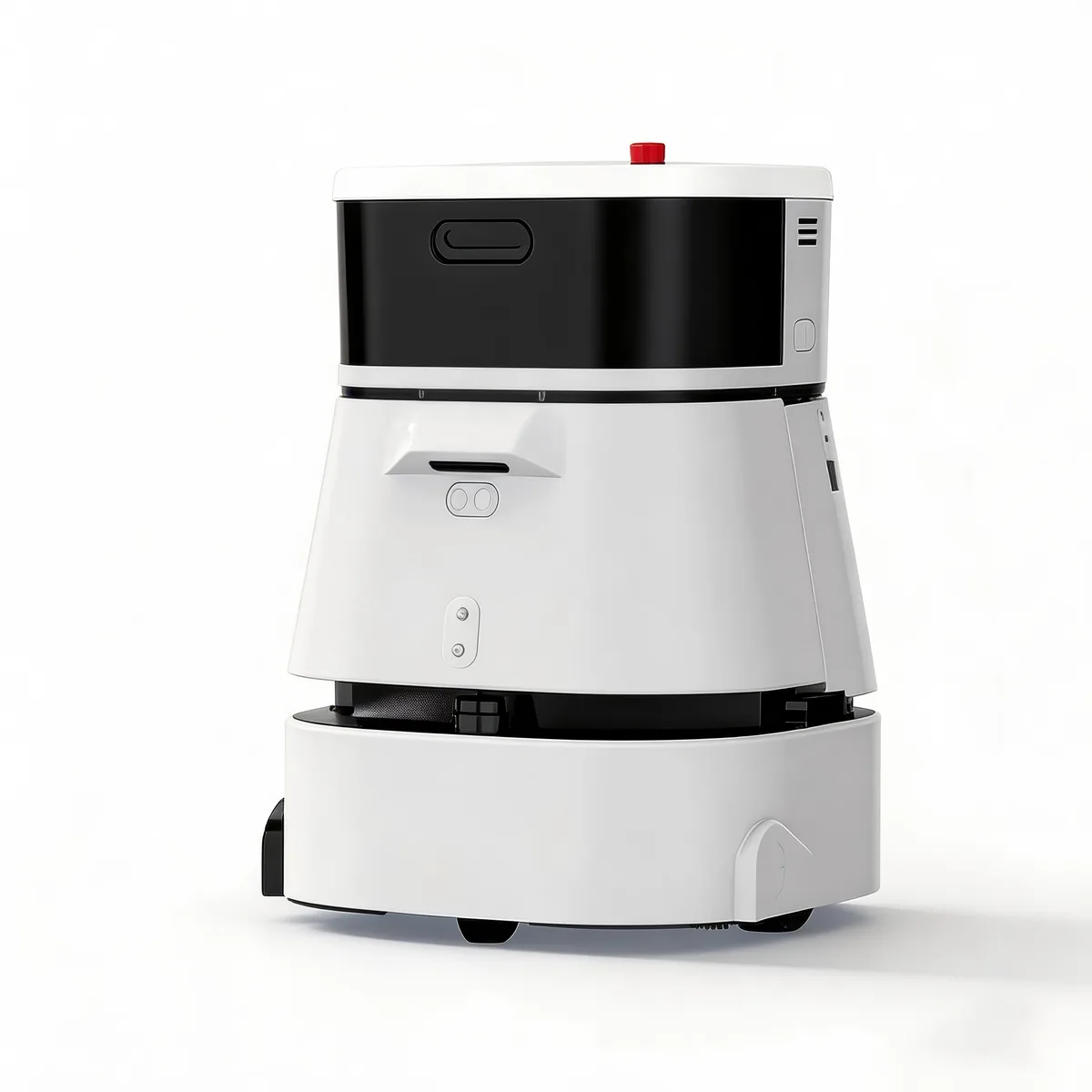
The AOMAN C2 Pro suits shop floors, staff areas and storage rooms: it works under 70 cm of desk clearance, turns in 85 cm aisles, runs quietly so it does not disrupt a 2 AM transaction, and carries modular tanks that swap quickly. The AOMAN C1 covers c-store floors, restroom approaches and seating zones at 2,040 m² per hour with a 790 mm squeegee and 70 L + 50 L split tanks. Illustrative arithmetic: a mid-size site with roughly 1,400 m² of indoor floor area reaches full coverage in about 40 minutes of continuous operation. Meaning a couple of cycles per shift keeps the whole interior consistent.
Honest boundary: the forecourt itself, the dispenser island and its surroundings, is out of scope for these platforms. Fuel-spill response on the forecourt is a certified, PPE-discipline task; robot platforms are not it. The practical design is indoor-plus-perimeter cleaning with keep-out geometry around dispensers.
C-Store Replenishment
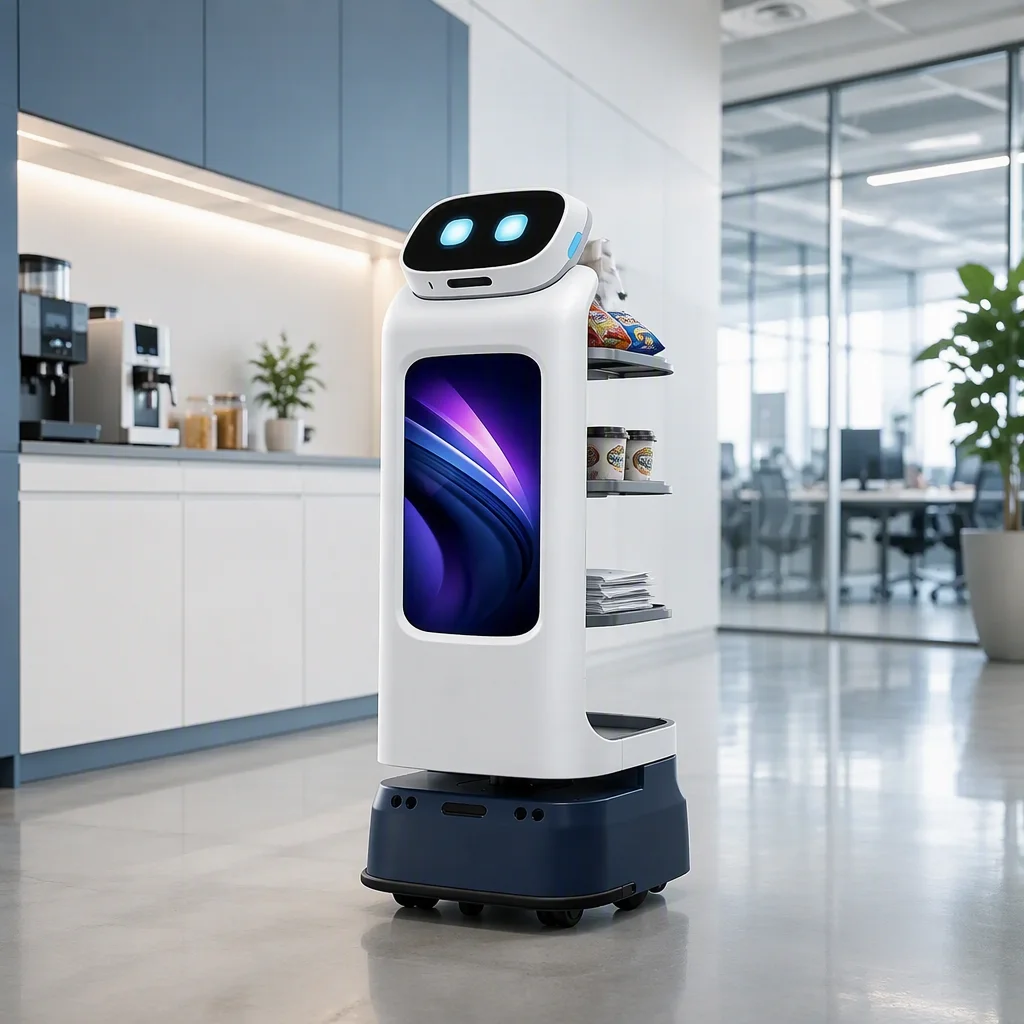
The AOMAN D1 carries 40 kg per run on four 270° tray positions, works 70 cm aisles and shows its task on a 21.5-inch screen. On a service area, that means stockroom-to-shelf replenishment during operating hours, cases of beverages, snack boxes and auto supplies moving to the sales floor as demand takes them, plus kitchen supply runs where a quick-service restaurant is attached. The 11 PM shelf check that finds the energy-drink bay empty no longer has to wait 14 hours for the next truck; it waits for the next robot loop, minutes away.
Retail-restocking robots in larger stores are covered by our delivery robot selection guide; service-area operation is the same mechanics at a much smaller warehouse distance.
Traveler Guidance at the Door
The AOMAN G1 handles the door position: 15 degrees of freedom, a 6-microphone array with 5 m pickup, a 13 MP camera, multilingual guidance and check-in-style assistance, automatic return to dock. Restroom locations, restaurant queue status, truck-wash hours, charger availability from the operator's feed, the questions every first-time visitor asks, served on the unit's own screen. A service area's customer base is unique in one way: nearly every guest is a first-time visitor, so the small interactions at the door multiply by throughput. The unit also quietly handles a second role at the door, language. On corridors that serve international traffic, it asks and answers in the driver's own language, at a fixed cost per site whether the site sees 100 visiting drivers a day or 500.

Multi-Site Fleet Management
Distributed economics only close with one operations centre across 50–200 sites: firmware, routes, cleaning priorities and exceptions from a single dashboard. Every service area has a different floor plan, every site a different demand profile, a site near a construction zone needs more cleaning cycles than a quiet rural location, and seasonal loading shifts priorities across the network.
The advantage of a central platform is lead time. When traffic telemetry shows a load spike approaching a particular service area, cleaning and replenishment priority can be raised before the queue peaks instead of after the mess accumulates. Fuel retail is also where seasonality is most visible, holiday traffic, summer caravans, winter de-icing stops, and re-prioritising cleaning across a network is a scheduling operation that one dashboard does easily and fifty phone calls do not.
The Compliance Boundary
Fuel retail triggers regulations beyond typical commercial facilities. In the EU, ATEX Directive 2014/34/EU governs equipment in atmospheres where flammable gases may occur; in North America, NFPA 30A covers motor fuel dispensing facilities. AOMAN's platforms are not ATEX-certified devices, and the design avoids the requirement rather than chasing it: keep-out geometry keeps every unit outside dispensing areas, and the site retains its dedicated spill-response procedure, staff training and equipment. Batteries are UN 38.3-tested; units ship with CE, FCC and RoHS compliance.
What These Robots Are Not
They are not fuel-spill responders, and they do not remove the need for the site's spill plan and trained personnel. They are not security patrols, they do not work beside dispensers, and they do not handle cash or fuel transactions, the asset-protection layers of a service area stay with the site's own procedures.
They are also not a replacement for a site manager. A site without someone who decides what good looks like, cleanliness thresholds, replenishment priorities, the hours the machine may enter the c-store, becomes a site where the robot runs on defaults. The deployment document should name who owns those decisions, for the same reason it names who owns the spill kit.
Illustrative Network Economics
Illustrative example for a 50-site chain, two cleaning units and one D1 per site under typical lease terms, labour reallocation at a representative loaded wage:
| Cost category | Per site (annual) | Network total (annual) |
|---|---|---|
| Robot fleet (2 cleaning + 1 delivery, lease) | $54,000 | $2,700,000 |
| Installation and site mapping | $8,500 | $425,000 |
| Central fleet management platform | $3,600 | $180,000 |
| Maintenance and support | $5,200 | $260,000 |
| Total cost | $71,300 | $3,565,000 |
| Labour reallocated (cleaning and racking hours) | $153,000 | $7,650,000 |
| Net return before tax | +$81,700 | +$4,085,000 |
Assumptions: average 4.5 FTE-equivalent of monthly cleaning-and-stocking labour reallocated per site; $34,000 loaded annual cost per FTE-equivalent; robotic hours live within the site's existing opening pattern. On these assumptions the pilot sites break even inside their first year, and the per-site cost falls as the network grows because mapping, training and maintenance spread over more units. Run the model on your own wage and lease rates, that is what the structure is for.
Rollout Plan
Phase 1 (months 1–3): 3 sites, cleaning only. Two C1 units per site, 90 days of operational data: coverage, intervention frequency, customer feedback and reallocated labour hours. This is where the network's real acceptance questions get answered.
Phase 2 (months 4–8): 15 sites, add delivery. Twelve more sites spanning the network's diversity, urban, rural, highway, neighbourhood, plus D1 replenishment at the highest-volume sites and the central fleet dashboard.
Phase 3 (months 9–12): network-wide. Remaining sites, G1 guidance at the highest-traffic locations, and demand-driven scheduling from traffic signals.
Site-selection note. Power and connectivity are the constraining assets. Sites need charging positions and coverage across indoor areas; budget for power and network upgrades at the site-selection stage rather than after the pilot expands. It is cheaper to pick a site that already has outdoor power and decent coverage than to retrofit it.
Where to Start
Tell us your network shape . Site count, average indoor area, store and kitchen configuration, overnight staffing pattern. And we will draft the first three-site pilot on your cost basis. Request pricing once the pilot scope is set.