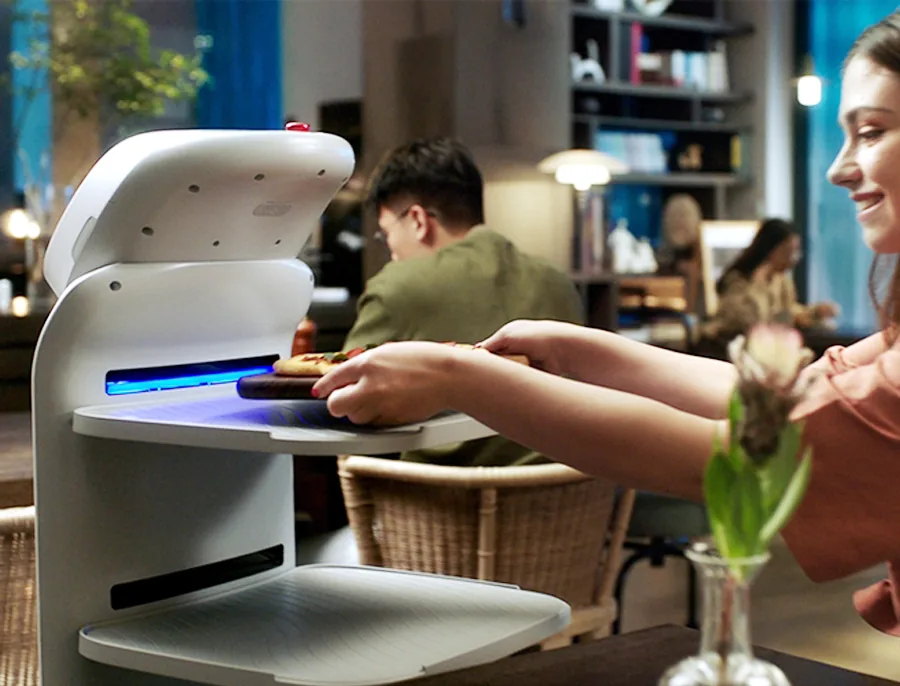
Restaurant Robot Tray Return: The Table-Turn Math
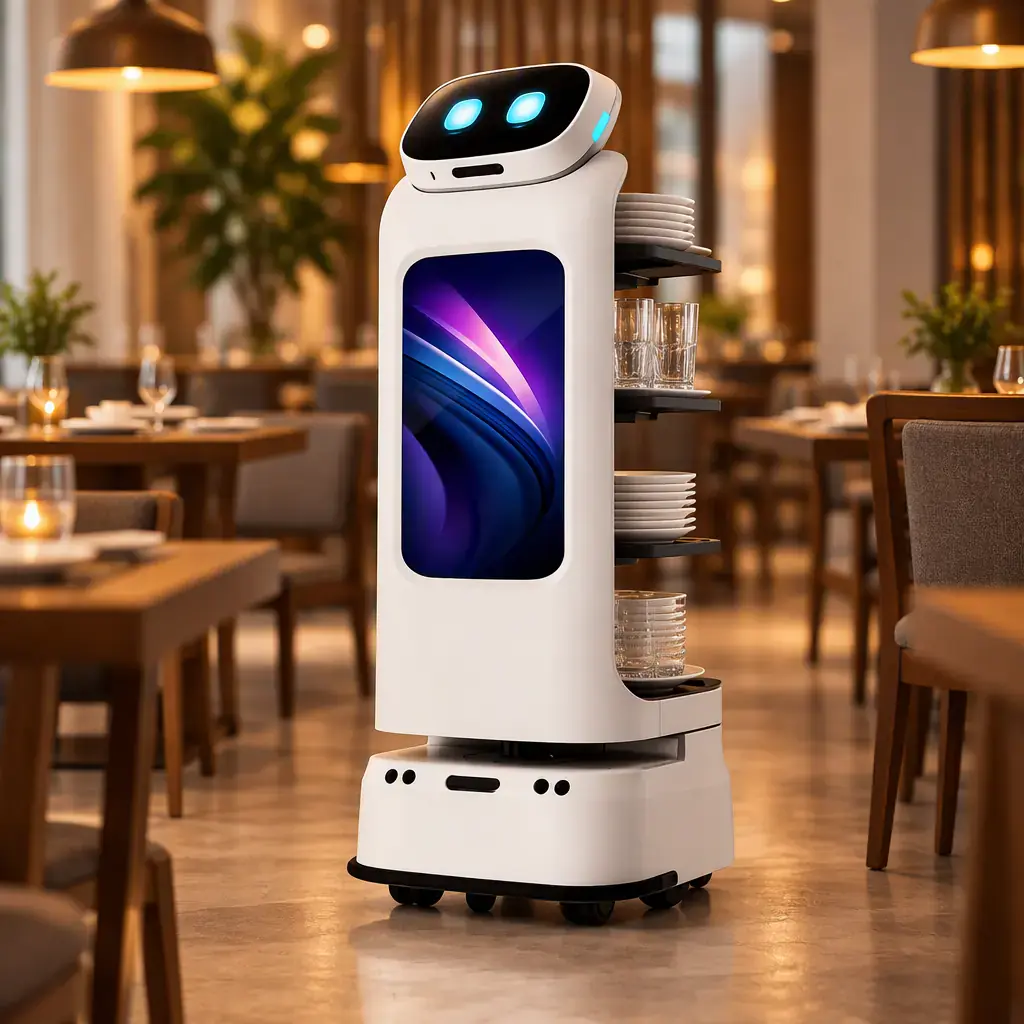
The Bus-Back Loop Is Where the Money Is
Almost every restaurant that trials a serving robot measures the wrong thing. It measures how many dishes arrive at the table without a waiter walking, declares the trial a success because the servers say their feet hurt less, and then cannot explain why labour cost per cover has not moved six months later.
The reason is structural. Food going out to a table is only half of a service cycle. The other half is everything coming back: dirty plates, glasses, napkins, cutlery, and the debris field left on the table. If the robot carries food outward but a server still walks to the table to clear it, the walk has not been removed, only halved, and the bus-back pass is the pass that sets how quickly a table becomes sellable again.
So the useful question is not how many deliveries a robot makes per hour. It is how much of the clear-and-reset loop it can absorb, and what that does to the interval between one party leaving and the next party being seated. That interval is the table-turn time, and in a full restaurant it is the single most valuable clock in the building.
This article works the arithmetic on the return loop: how much a machine can physically carry, how many trips a turn actually needs, what clean and dirty separation demands, and how to convert the saved minutes into covers rather than compliments.
What One Machine Can Physically Carry
Start with payload, because it caps everything downstream. Take a mid-size delivery platform with 40 kg of rated payload across four tray positions at 10 kg each, and trays that open on three sides so a server can load and unload without turning the machine.
| Item | Unit weight | Per tray position | Per full load |
|---|---|---|---|
| Dinner plate with food residue | 0.9 to 1.2 kg | 6 to 8 plates | 24 to 32 plates |
| Side plate stack | 0.4 kg | 10 to 12 plates | 40 to 48 plates |
| Water and wine glasses | 0.3 to 0.5 kg | 12 to 16 glasses | 48 to 64 glasses |
| Cutlery bundle | 0.2 kg | 20 bundles | 80 bundles |
| Napkins and debris | negligible | fills remainder | n/a |
In practice a full clear of a four-top is one tray position plus a share of a second, because plates stack and glasses do not. A 60-cover restaurant turning twice in an evening produces 120 covers of dirty ware, and at roughly 1.6 tray positions per four covers that is about 48 tray positions, or 12 full machine loads across the service. That figure is the whole business case in one line: the machine can move 12 loads of dirty ware a night without a server carrying them, provided the return route is short enough that a load takes less time than the walk it replaces.
Two physical details decide whether that number survives contact with a real dining room. First, tray lips. Trays need a raised lip or a non-slip mat, or a machine accelerating at 1 metre per second will redistribute the cutlery across the floor. Second, glass retention. A stack of glasses with nothing holding them will not survive a 15 mm threshold, so either the route avoids thresholds or the loading pattern puts glasses low and inboard.
The Trip Cycle, Measured Not Assumed
A tray-return trip is not one movement, it is five, and each has a floor on how fast it can go.
| Leg | Typical duration | What governs it |
|---|---|---|
| Call to table | 25 to 50 s | Distance from staging point, guest traffic, aisle width |
| Load at table | 20 to 35 s | Tray count, whether staff pre-stack, table access |
| Travel to wash-up | 30 to 60 s | Route length and whether it shares the guest aisle |
| Unload and sanitise | 35 to 55 s | Whether a porter meets the machine or the machine waits |
| Return to staging | 25 to 45 s | One-way loop or a dead end that must be reversed |
A single loop therefore costs 2.3 to 4.1 minutes, and the median is about 3 minutes. Against a server carrying the same load by hand at 2 to 3 minutes including the walk both ways, the machine's advantage is not speed. It is that the machine's 3 minutes do not consume a person, so the server is doing something else while it happens.
That distinction is the entire reason trip count matters more than trip speed. If the machine runs 12 loads a night at 3 minutes each, it occupies 36 machine-minutes and zero labour-minutes. If the same 12 loads were carried by hand, that is 24 to 36 labour-minutes that have to come out of somewhere else in the shift. On a 4-hour dinner service with six servers, that is between 10 and 15 percent of the floor labour available for guest service, returned.
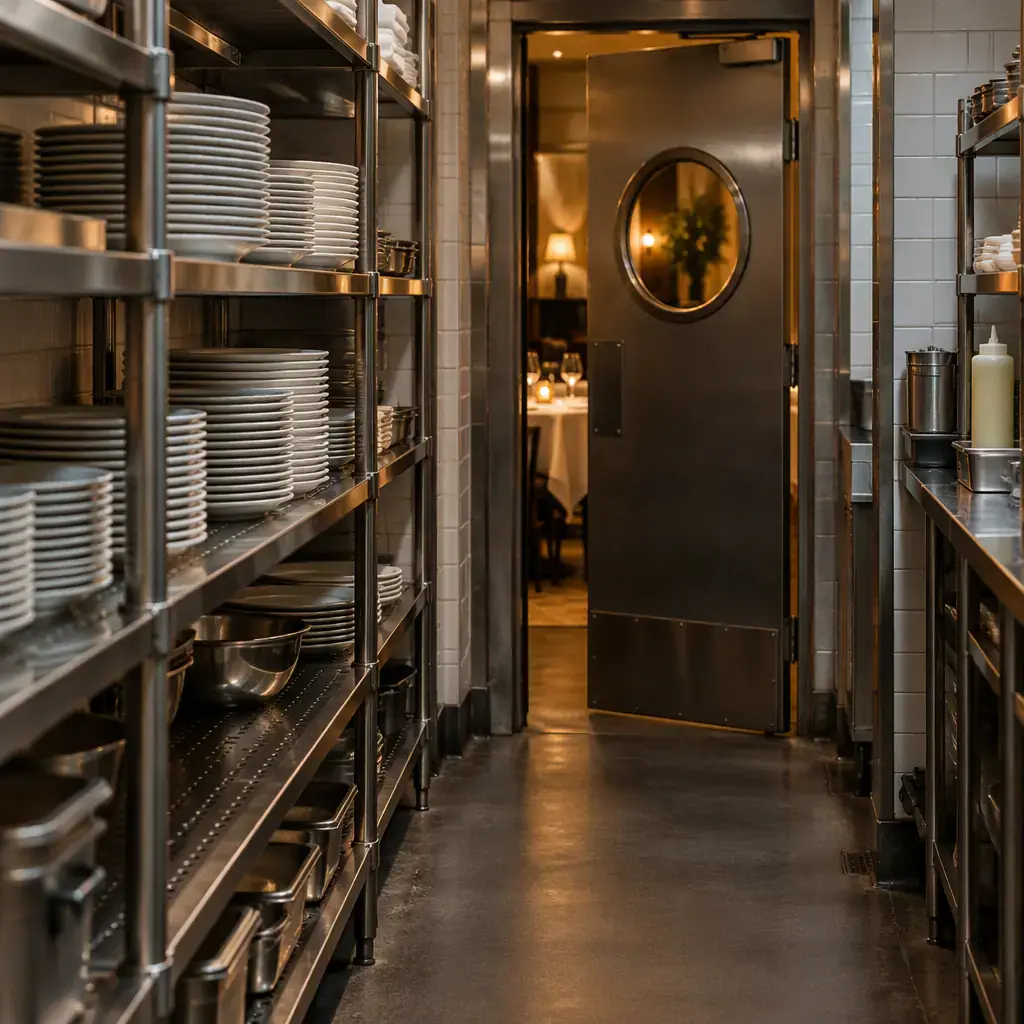
The arithmetic has a hard boundary though. If the wash-up is more than about 45 seconds of travel from the furthest table, the return leg dominates and the machine spends its evening in transit. Route length, not payload, is the constraint that decides whether a robot works in a given floor plan.
Clean and Dirty Must Never Share a Route
Food-safety law, in every jurisdiction with a HACCP-style regime, draws a line between clean and dirty ware handling. A machine that carries clean plated food outward and dirty plates inward on the same trip is not merely inelegant, it is a cross-contamination path that a health inspector will write up.
Three rules keep a fleet compliant without crippling throughput.
- Separate tray positions, permanently assigned. Upper positions for clean service, lower positions for dirty return, marked and never swapped. The physical separation is what makes the practice auditable.
- Sanitise at the wash-up, not at the table. Every machine load that touches dirty ware gets a wipe-down at the unload point, which is why the unload leg has a 35 to 55 second floor in the table above. Skipping it to save 20 seconds is how a compliance failure happens.
- Never return dirty ware through the guest aisle if a service route exists. Guest-visible dirty tray stacks read as poor service and, more practically, they invite a guest to intercept the machine.
The written programme matters as much as the hardware. What inspectors ask for is a documented cleaning schedule for the machine itself, a record of who sanitised what and when, and evidence that staff were trained on the separation rule. The programme structure is set out in HACCP and food safety compliance for service robots.
Turning Saved Minutes into Table Turns
Recovered labour-minutes are a cost story. Table turns are a revenue story, and in a full restaurant the revenue story is bigger. A clear-and-reset that finishes faster shortens the dead interval between parties, and that interval is directly convertible into covers.
| Interval component | Manual today | With a return loop | What changed |
|---|---|---|---|
| Guest leaves to table cleared | 4 to 9 min | 2 to 4 min | Machine dispatched on a fixed round rather than on a server passing by |
| Cleared to wiped and reset | 2 to 3 min | 2 to 3 min | Unchanged, still a human task for hygiene and standard |
| Reset to next party seated | 1 to 4 min | 1 to 3 min | Host stand sees the table available sooner |
| Total dead interval | 7 to 16 min | 5 to 10 min |
Take a 60-cover restaurant at 2.2 turns a night. Total dead interval per table across an evening is the count of turns times the interval, so shaving 120 seconds off the interval on a 15-table room returns 15 x 2.2 x 2 minutes, or 66 table-minutes. At a 75-minute average dwell, that is 0.9 additional covers, and at a 95-minute dwell on a fixed-menu concept it is 0.7. Either way the honest range is 0.5 to 1.0 extra covers per evening in a full room.
One extra cover on a 60-cover night sounds trivial until it is priced. At a 22-currency-unit average check and a 68 percent contribution margin, 0.5 to 1.0 covers recovers about 7 to 15 currency units a night, which is 2,500 to 5,500 a year on a five-night operation. That is a real number but it is not a business case on its own, which is why the labour story and the turn story have to be added, not chosen between.
Cost per delivery has been worked in detail in serving robot total cost per delivery, and the same discipline applies here: the machine's capital and running cost divided by the number of useful loops it actually completes, not the loops the datasheet allows.
Where the Return Loop Does Not Work
Being straight about the failure cases is more useful than another success story, because most disappointing restaurant robot deployments are floor plans rather than machines.
- Open-plan rooms with no service aisle. If the only route from the furthest table to the wash-up crosses the dining room, every loop is a guest-interaction event. Below roughly 1.6 metres of clear aisle the machine will be stopped by chairs more often than it moves.
- Split-level or stepped floors. A platform rated for a 15 mm threshold and a 5 degree slope handles a lip and a shallow ramp, not a staircase or a 40 mm step. Any level change beyond that needs a lift or a second machine.
- Very short services. A 90-minute lunch where every table turns once does not generate enough return loads to justify a dedicated machine, because the loop count is low and the machine sits idle between peaks.
- Wash-up behind a single swing door with no hold-open. A door the machine cannot open or hold is a wall. Either fit a hold-open or route through a doorway it can pass.
- Banquet and event formats with chafing dishes. Heavy hot-holding equipment and clearing 200 covers in 15 minutes is a human team task; a 40 kg platform in a crowded room is a hazard rather than an asset.
Each of these is a survey finding rather than a reason to abandon the category, and the survey method that surfaces them before a purchase order is in site survey and readiness assessment.
The Rota Change That Makes It Real
A robot that is added to an unchanged rota produces a cleaner-looking shift and no financial result, because the recovered minutes are absorbed by a hundred small interruptions. The rota has to be re-cut at the same time as the machine arrives, or the case is fictional.
The workable pattern in a 60 to 120-cover restaurant is to move one role from runner to a combined runner-and-expo position with an explicit bus-back ownership, and to give the machines two fixed rounds rather than on-demand calls. Fixed rounds are the important part: on-demand dispatch makes the machine reactive and unpredictable, while a round that runs every 12 minutes makes clearing the default state of the room rather than a task someone remembers.
That change also settles the training question. Staff need to know which tray positions are clean, when the machine leaves, what to do when it is blocked by a guest, and who sanitises it. The induction structure for that is covered in staff induction and training plans.
What to Specify Before You Buy
- Payload and tray geometry. Require the payload per tray position, the tray lip height, and the loading direction. A machine that can only be loaded from one side will lose you 15 seconds per load in a crowded room.
- Threshold and slope rating. State your actual thresholds in millimetres and your steepest ramp in degrees. A machine rated for 15 mm and 5 degrees will not cross a 40 mm step regardless of marketing copy.
- Sanitisable surfaces. Tray positions must survive a quaternary ammonium wipe several times an hour without clouding. Ask for the material, not the claim.
- Blocked-path behaviour. What happens when a guest stands in the aisle for 30 seconds? A machine that waits forever next to the plate pass is worse than no machine. Timeout, reroute and return-to-staging behaviour all need to be specified.
- Loop telemetry. Require a record of loops completed, aborted and average duration. Without it the credit and turn claims in this article cannot be audited, and the case degrades into anecdote.
Restaurants that get this right are rarely the ones that bought the most capable machine. They are the ones that measured their own return loop first, found where the 3 minutes actually went, and specified a machine against that route rather than against a brochure.