
Buy or Lease a Serving Robot: The Acquisition Decision for Food and Beverage Operators
At a glance: The first question a food and beverage operator asks about a serving robot is whether to buy or lease it. The more useful question is what fraction of a runner's shift the robot actually covers, because that fraction sets the labour offset that every financing structure is compared against. This guide builds the offset first, then runs buy, lease and robotics-as-a-service against it, and names the contract clauses that decide which one wins.
Why a Serving Robot Is Not a Headcount Replacement
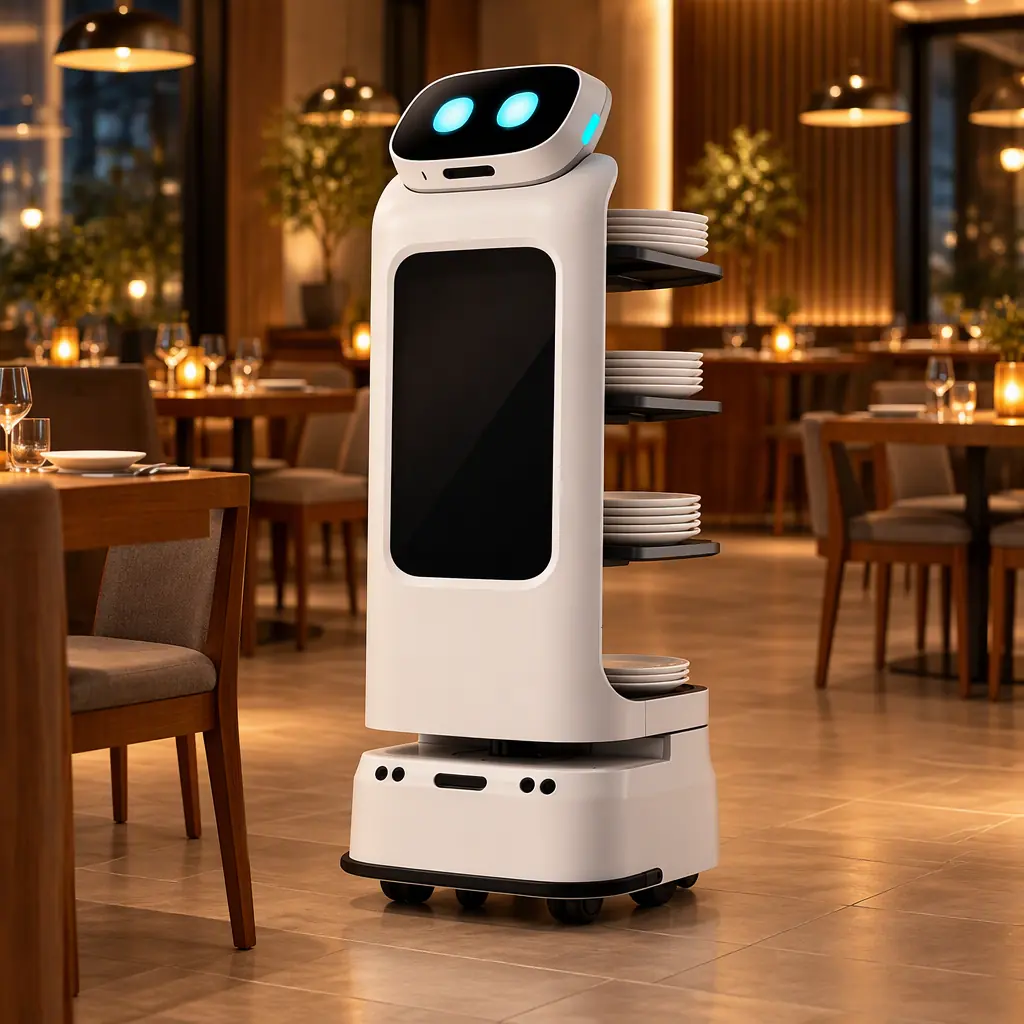
A serving robot carries trays from the pass to the table and returns them. It does not take an order, it does not handle an allergen query, and in most jurisdictions it does not touch a plate at the guest side. That means the robot covers the transport segment of a runner's task list and leaves the rest. Operators who model a serving robot as one full-time-equivalent saving build a business case that fails in month two, when the labour line has not moved as far as the spreadsheet promised.
The right unit of analysis is the covered shift fraction. Break the runner role into its transport tasks and its guest-facing tasks, measure the transport share, and treat that share as the ceiling on labour offset. In a full-service restaurant with a long pass-to-table trip, transport can be 40 to 55 percent of a runner's time. In a hotel breakfast room or a staff canteen with a short, repetitive route, it can be higher. In a fast-casual counter-service model there is often no runner role to displace at all, which is why serving robots fit table-service and buffet formats far better than counter formats.
That single number, the transport share of the runner role, is what the financing decision is actually about. Every lease payment, purchase price and service fee is compared against it. The worked example later in this guide uses a mid-market restaurant: 60 covers per service, two services per day, a pass-to-table run of 18 metres, and a runner role that spends 45 percent of its time on transport. From that we build the annual offset, and against that offset we compare the three acquisition structures.
The Three Structures, and What Each One Really Is
Buy, lease and RaaS are not three versions of the same transaction. They transfer different risks to different parties, and the correct choice depends on which risk the operator is least able to carry. Getting the structure right matters more than shaving the monthly figure, because the clause that decides the deal is usually the one about the end of term, not the one about the payment.
| Structure | What the operator owns | Risk that transfers to the operator | Best fit |
|---|---|---|---|
| Outright purchase | The robot, the battery, the spares liability | Technology obsolescence, residual value, all downtime cost | Operators with multiple sites, in-house maintenance, and a long horizon |
| Lease or finance lease | Use of the robot for a fixed term | Excess wear, damage beyond fair wear and tear, early-termination penalty | Single sites wanting a fixed monthly line without capital outlay |
| Robotics-as-a-service | Nothing; a per-hour or per-outcome service | Only the scope of the service agreement and the service-level credit | Operators testing the format, or those who will not hold hardware risk |
A purchase puts the residual value question on the operator's balance sheet. At the end of year four a serving robot is a used machine with a battery that has cycled several hundred times, and its resale value is whatever the secondary market will pay, which for service robots is thin and unpredictable. A lease moves that question to the lessor, who prices it into the monthly figure. RaaS removes it entirely, because the operator never holds the asset, but in exchange the operator pays for availability as an operating cost forever and builds no owned capacity. The full mechanics of the middle structure are set out in lease versus buy for service robots, and the per-outcome variant is covered in RaaS financing models.
The Labour Offset Arithmetic
Build the offset before looking at a single quote. The model below uses conservative inputs and shows the shape of the calculation rather than a universal answer; substitute your own covers, wage rate and run distance.
| Input | Value used | Where it comes from |
|---|---|---|
| Covers per service / services per day | 60 / 2 | POS average for two weeks |
| Runner hours per service | 3.0 | Rota, excluding breaks |
| Transport share of runner time | 45% | Task sampling or a two-day time study |
| Robot covers per transport hour | 70 | Trial run, trays per trip x trips per hour |
| Fully loaded runner cost per hour | GBP 13.50 | Wage plus employer contributions |
| Operating days per year | 350 | Calendar minus closures |
The transport hours available per day are 3.0 x 2 x 0.45, which is 2.7 hours of transport work. If the robot can move 70 covers per hour and the site serves 120 covers per day, the transport demand is 120 / 70, or about 1.7 robot-hours, which sits comfortably inside the 2.7 hours of transport work available. Not all of that converts to labour saving: a robot running the pass does not let the venue cut a whole runner from the rota unless the remaining guest-facing load can also absorb the change. In practice the saving lands as a reduction in overtime and a shift pattern that runs with one fewer runner on the busiest service rather than a permanent cut across the week.
Assume the achievable displacement is 60 percent of the transport hours, or 1.6 hours per day. At GBP 13.50 fully loaded that is GBP 21.90 per day, or about GBP 7,665 per year across 350 operating days. That figure, not the robot's sticker price, is the annual benefit the financing structures must beat. It is deliberately modest, and it is the number to defend when the general manager asks why the labour line has not fallen by a whole salary.

The Break-Even Against Each Structure
With an annual offset near GBP 7,700, the structures sort themselves quickly once their true annual cost is laid out. The table below uses indicative figures for a mid-size serving robot with a dock and a battery, and includes the costs operators routinely forget.
| Cost line | Purchase (year 1) | Lease (annual) | RaaS (annual) |
|---|---|---|---|
| Capital or subscription | GBP 24,000 | GBP 6,600 | GBP 9,000 (usage-based) |
| Battery replacement reserve | GBP 1,400 | Included | Included |
| Maintenance and consumables | GBP 900 | GBP 500 deposit-return risk | Included |
| Insurance uplift | GBP 300 | GBP 300 | GBP 300 |
| Training and changeover | GBP 600 (year 1 only) | GBP 600 (year 1 only) | GBP 400 |
| Indicative annual cost, steady state | GBP 13,200 year 1, then GBP 2,600 | GBP 7,400 | GBP 9,700 |
Against a GBP 7,700 annual offset, the purchase pays back in roughly three years once the battery and maintenance lines are included, then runs at a strong margin for the rest of its life, which is why multi-site operators with in-house technicians tend to buy. The lease clears the offset in the same year it is signed, because the annual cost sits just under the benefit, but it never accumulates owned capacity, so the saving stops the day the lease ends. RaaS costs more per year than the offset in this example, which is the correct outcome for an operator who is testing a format: they are paying a premium for the right to walk away. The wider cost architecture of a fleet, including the lines this table compresses, is worked through in the maintenance and total cost of ownership guide.
The Clauses That Decide a Serving Robot Deal
Three clauses move the economics more than the headline price, and all three appear in serving-robot contracts specifically because the duty cycle is hard and repetitive.
- Battery replacement ownership. A serving robot on a two-service day cycles its pack once or twice daily. Over a three-year lease the pack will pass its degradation threshold. Whether the lessor or the operator pays for the replacement pack, and at what state of health the replacement is triggered, is worth more than a few percent on the monthly rate. The health thresholds and their cost consequences are set out in battery health and replacement planning.
- Fair wear and tear definition. A food-service robot lives near heat, grease and moisture. The contract must state what counts as fair wear rather than leaving it to the return inspection. Vague wording here is how a clean lease becomes a damage claim.
- Early-termination and mid-term swap. Formats change. A clause that lets the operator swap the unit for a different configuration, or exit at a defined cost, is worth paying for if the venue's service model is not yet settled.
Two smaller lines also matter. Who insures the robot against damage and theft during service hours, and who pays for the dock installation and any electrical work. Dock installation can add four figures and is easy to omit when comparing a purchase against an all-in service.

When a Serving Robot Is the Wrong Answer
This acquisition case only closes in a specific operating envelope, and an honest model says so before the contract is signed. A serving robot is the wrong answer when the venue has no runner role to displace, when the pass-to-table route is under a few metres, when the floor is crowded enough that a robot creates more obstruction than it removes, or when the service is so variable that a fixed route cannot be defined. Counter-service outlets, small cafes and venues with narrow, turning floor plans fall into these categories more often than not.
It is also the wrong answer when the operator cannot commit to the workflow change the robot requires. A serving robot is not a drop-in appliance; the pass has to be re-laid-out so trays are loaded at robot height, the floor has to be clear at defined times, and staff have to change how they work around it. The change-management side of a kitchen deployment is covered alongside the format question in service robots for restaurants and food service. Buying the robot and skipping the workflow work is the most common way a serving-robot project stalls after commissioning.
The Takeaway
Decide the structure last. Build the transport share of the runner role, convert it to a defensible annual labour offset, then test each financing structure against that number and against the risk the operator can actually carry. Buy if the site has a long horizon and in-house capability; lease if it needs a fixed monthly line and does not want residual risk; take RaaS if it is testing a format and values the exit more than the saving. The serving robot will not replace a headcount, and any model that assumes it will is the reason so many of these projects are declared a failure before they have had a fair test.
Tell us your covers per service, rota pattern and pass-to-table distance, and we will run the transport-share model with you and show which structure clears it. Contact us.
Continue Reading
Get a Quote
Tell us about your space and workload, we reply within 24 hours.