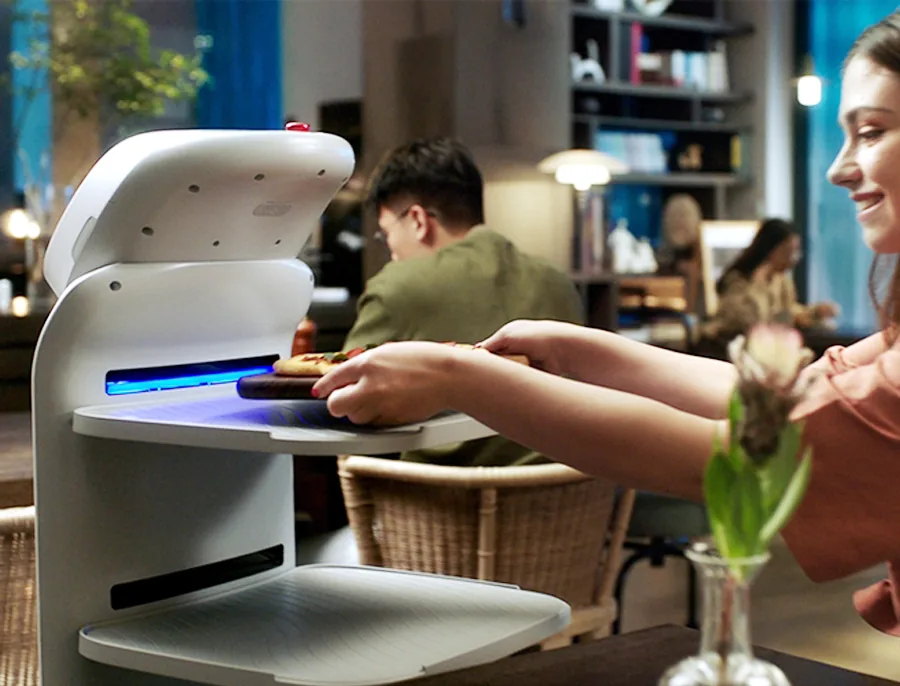
Advertising Robots in Consumer Electronics Retail: Demo Tables, Dwell Time and the Attention Arithmetic
At a glance: Consumer electronics retail behaves nothing like grocery. The shopper visits a handful of times a year instead of weekly, spends twenty to forty minutes rather than eight, and buys on discovery and comparison rather than on a list. That changes every assumption behind an in-store robot deployment. This guide covers what an advertising robot is actually for on a demo floor, why dwell time on electronics is measured differently, the placement arithmetic that decides whether a robot earns its space, and how to price the media without overclaiming reach.

Why Electronics Retail Is a Different Advertising Problem
In a supermarket, an advertising robot competes for a shopper's attention measured in seconds and a basket measured in dozens of items. In an electronics store the shopper is already stopped. They are standing at a demo table with a phone in their hand, reading a spec card, comparing two models they have already shortlisted online. Attention is abundant. What is scarce is a reason to stay one model longer, or to walk twelve metres to a category they did not come in for.
That inversion has three consequences that a deployment plan has to respect.
First, the value of an impression is higher but the number of impressions is far lower. A busy supermarket lobby can log thousands of passer-by events a day. A mid-size electronics store doing four hundred transactions on a Saturday might see that many visitors all week. Quoting supermarket impression forecasts at an electronics retailer is the fastest way to lose credibility, and it is the single most common mistake in this category.
Second, the robot's best job is often not advertising at all. In a store built around demonstration, a robot that queues a demo, holds a position at a hot product, or walks a shopper to the accessory wall that converts a device sale into an attach-rate sale is worth more than the same robot playing a looping brand video. The media function is a byproduct of presence, not the product itself.
Third, the attribution problem is harder and more tractable at the same time. Harder, because electronics baskets are single-unit and high-value, so a small basket lift on a few hundred transactions is noisy. More tractable, because electronics retailers overwhelmingly run loyalty programmes with phone-number lookup at point of sale, which gives a clean join key from robot interaction to completed transaction that grocery loyalty schemes often blur across a household.
What the Robot Actually Does on a Demo Floor
| Function | What it replaces or adds | Measurable output | Priority for electronics |
|---|---|---|---|
| Category wayfinding | Replaces the "where are the laptops" question to staff | Interactions resolved, staff time released | High — stores are large and categories move |
| Demo queueing and slot booking | Adds an orderly mechanism for a single demo unit | Queue length, demo completions per hour | High where demo units are constrained |
| Attach-rate escort | Walks the buyer to cases, cables, extended warranty desk | Attach rate on escorted transactions | High — direct margin effect |
| Promotional screen time | Supplement to end-caps and window displays | Verified ad plays, dwell events | Medium — contract-dependent |
| Assisted comparison | Displays a two-model spec diff the shopper asks for | Comparison sessions completed | Medium — needs curated spec data |
| Stock and price check | Confirms whether a display model is in stock | Queries resolved without escalation | Medium — needs live inventory feed |
The ordering matters. Retailers who buy an advertising robot for electronics and discover it also does wayfinding get a pleasant surprise. Retailers who buy the media case and find the robot cannot answer a stock question get a returned unit. Lead with the operational functions and let the media revenue be the second line of the business case.
Measuring Dwell: What the Number Means and What It Does Not
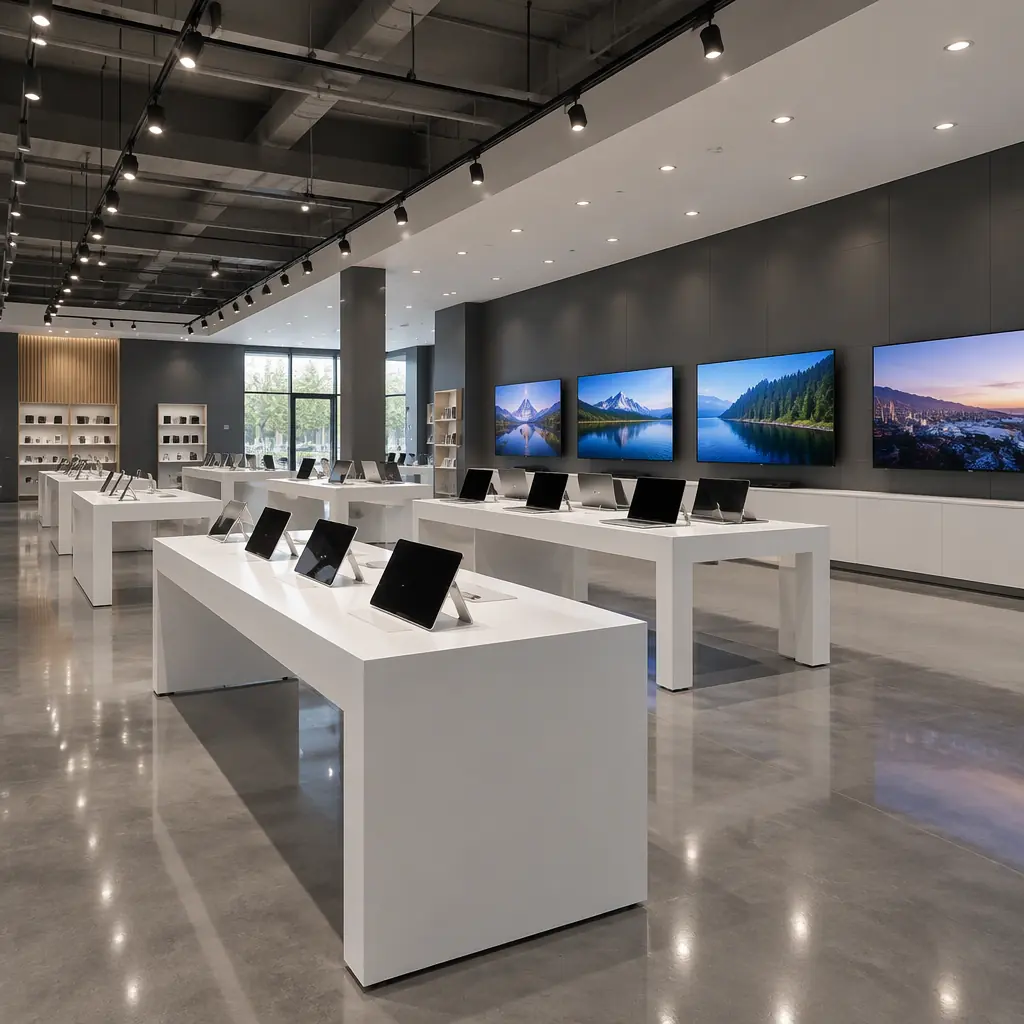
Every retail media rate card for a robot is built on dwell. Almost none of them define it the same way twice, which is why two vendors can quote wildly different figures for the same store.
Three definitions are in circulation. Passer-by dwell counts anyone detected within a radius who slows below a speed threshold. It is generous, vulnerable to counting staff and adjacent-aisle traffic, and unsuitable as a billing basis. Face-the-screen dwell counts time with head pose oriented toward the display. It is closer to an attention measure, but on a robot the screen is often chest-height and below eyeline, so head pose under-counts. Engaged dwell counts interaction time after a deliberate trigger — a touch, a spoken question, or a stop within a defined zone that lasts beyond a threshold.
Engaged dwell is the only one worth contracting against, and even then it needs a floor. A workable contract specifies the sensor used, the radius, the speed and time thresholds, the exclusion of staff by badge or schedule, and the reconciliation method when the robot's count and the retailer's own footfall counter disagree by more than an agreed tolerance. In practice the tolerance clause does more work than the definition, because it forces both parties to agree which number is authoritative before money depends on it.
One number worth internalising: on a demo floor, an engaged interaction of thirty seconds is a meaningful outcome. Electronics shoppers do not cluster around a robot the way a supermarket queue does. Expecting three-minute dwell on a demo floor is expecting the wrong behaviour and leads to deployments tuned to chase the wrong metric.
The Placement Arithmetic
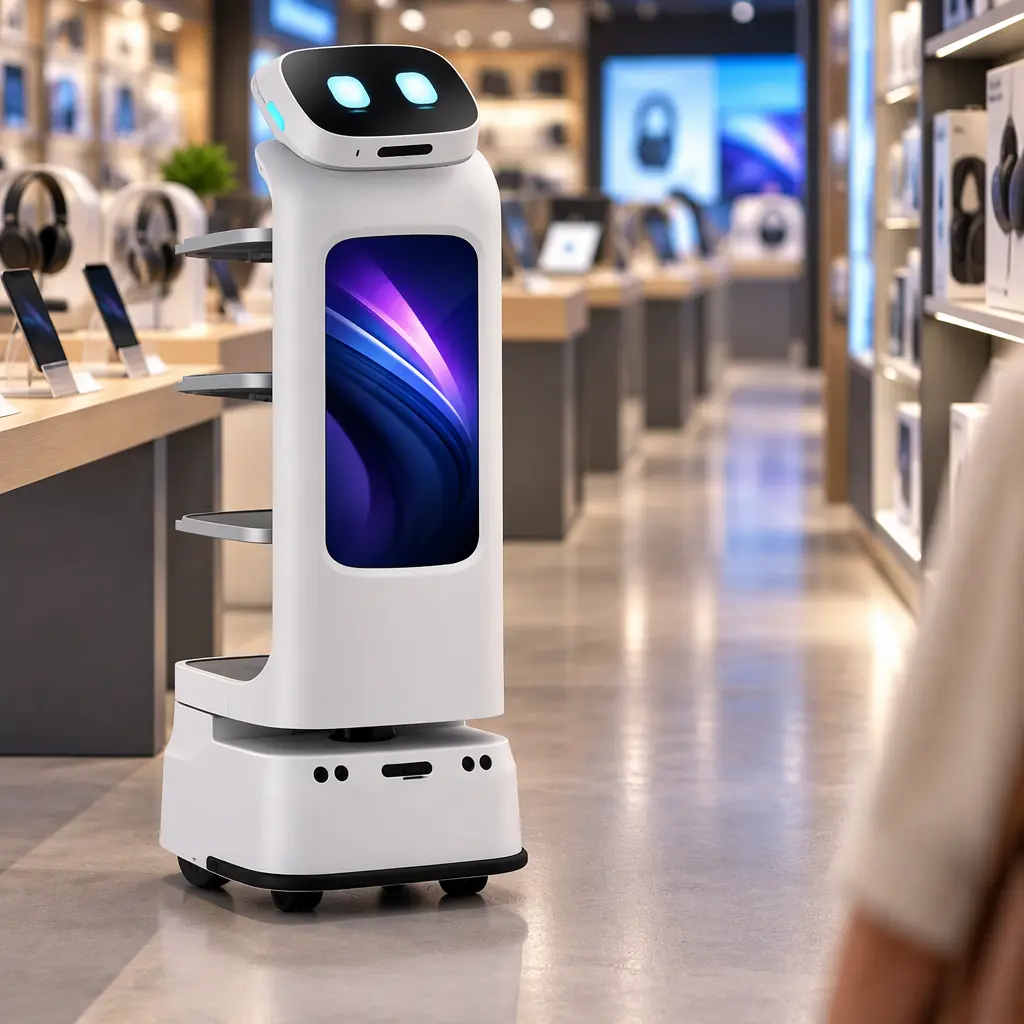
Electronics stores have a specific geometry: a wide entrance with high ceilings, a demo-heavy front third, accessory and cable aisles in the middle, and the large-format and kitchen appliance zones at the back. Where the robot sits decides which of the six functions above it can perform at all.
Entrance gives maximum traffic and minimum engagement. Shoppers entering a consumer electronics store are usually on a mission and moving fast. Useful for wayfinding, poor for media.
The demo promenade — the aisle between the phone and laptop tables — gives the best balance. Shoppers here are already stationary, decision-making, and receptive to a comparison prompt or an attach conversation. This is where the media function performs best and where the escort to accessories is shortest and most natural.
The appliance zone at the back is where shoppers spend the longest per item and where the staff-to-customer ratio is worst. A robot here releases the most staff time, but the traffic is thin and media exposure is correspondingly low. Deploy here only if the operational case is the primary justification.
A workable default for a store in the 1,500 to 3,000 m² band: demo promenade through the trading day, entrance during the first hour and the last hour, appliance zone only by exception. Test the schedule for four weeks before committing to a media contract based on it, because the footfall curve in electronics is spikier than grocery and far more weather- and promotion-sensitive.
Attach Rate Is Where the Money Is
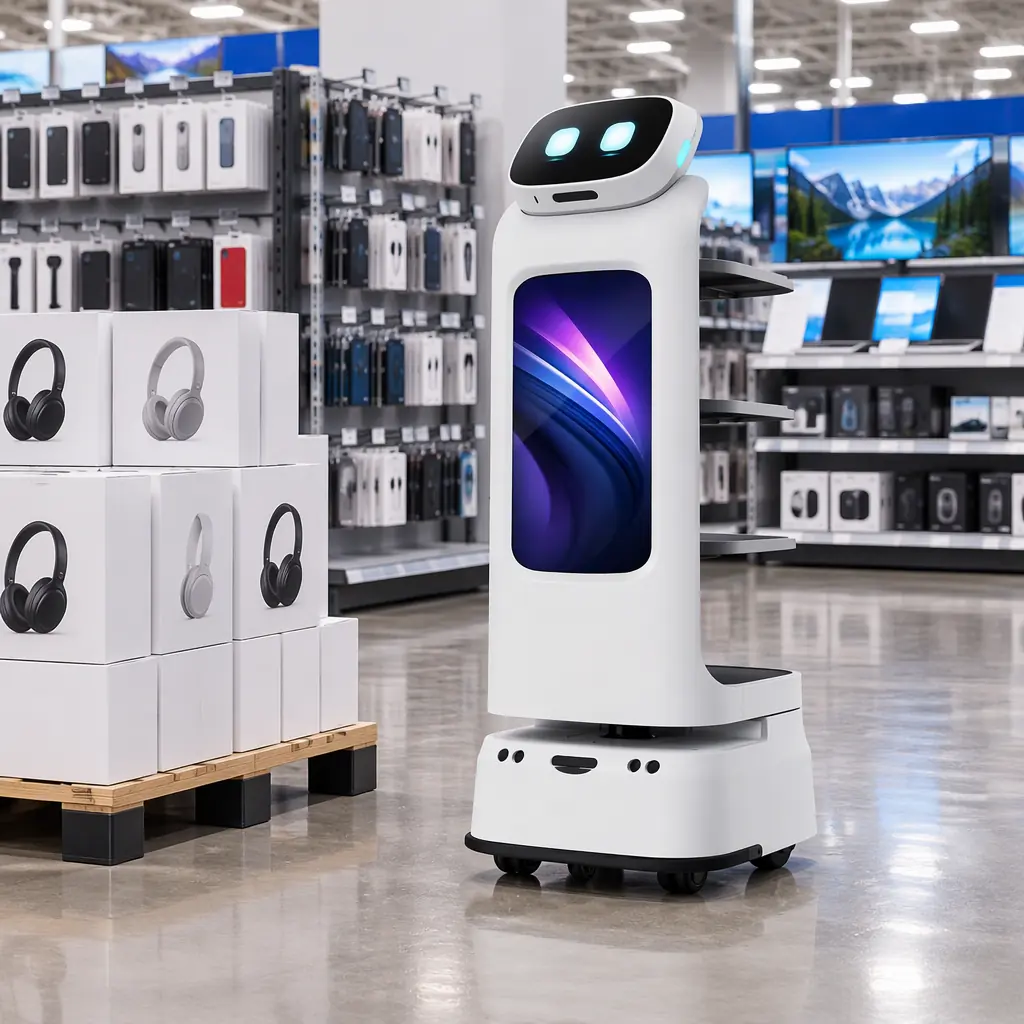
The strongest commercial argument for a robot in electronics retail is not advertising revenue. It is attach rate. A device sale with the right case, cable, protection plan and setup service carries materially more margin than the device alone, and the single largest reason attach fails is that the buyer does not know where the accessory is or that it exists.
A robot that walks the buyer from the demo table to the accessory wall, and names the item on the way, attacks that failure directly. The measurement is straightforward: join loyalty ID to transaction, compare attach rate for shoppers who received an escort against a matched control group over four to six weeks, and control for basket value because higher-value buyers attach more anyway. A double-digit percentage-point lift in attach rate on escorted transactions is achievable; a double-digit absolute increase in overall store attach rate is not, and anybody claiming it has not controlled the comparison group.
This is also the argument that survives a budget review. Media revenue is a new line item that has to be sold twice — to the retailer and to the brand. Attach rate is money already in the store that is currently being left on the shelf. Lead the business case with attach, and let the media revenue improve the payback rather than justify the purchase.
Where These Deployments Fail
Treating it as grocery. Importing impression forecasts, route designs and dwell assumptions from a supermarket pilot into an electronics store produces a media plan that cannot be delivered and an operational plan that ignores the demo floor entirely.
Screen height and eyeline. Demo floors are built around eye-level product presentation. A robot whose screen sits well below the shopper's natural gaze loses attention to the televisions behind it. Prefer a platform with a tall body and a screen in the upper third for this environment.
Blocking the demo promenade. The most valuable placement is also the most congested one. A robot that stops in the middle of a busy promenade during a Saturday promotion creates a complaint, not an impression. Set standoff distances and dwell points against the actual traffic, and move the robot out of the promenade during launch events.
No stock integration. Electronics shoppers ask "do you have this in black" constantly. A robot that cannot answer that question authoritatively teaches shoppers to ignore it within two weeks.
Media contract without a guidance reservation. If the screen is sold by the minute, guidance gets pre-empted and the operational functions — the ones that actually carry the case — get starved. Reserve a hard share of screen availability in the contract.
What to Ask Before You Sign
Ask the vendor for engaged-dwell figures from two electronics reference sites of comparable size, not from a supermarket. Ask how staff exclusion is implemented. Ask what the robot does when a shopper asks a stock question it cannot answer. Ask whether guidance can be reserved against sold screen time and how that is enforced. Ask who owns the interaction logs. And ask how the platform handles the sensor-height problem on a floor where the competing displays are mounted at eye level.
If the answers are thin on stock integration and thick on impression forecasts, you are being sold a grocery product into an electronics store. The rest of the retail picture is covered in our supermarket advertising robot guide, which is the right reference for rate cards and revenue streams but the wrong one for demo-floor tactics. The scheduling arithmetic that governs when a shared robot is available for media is in the peak-hour scheduling guide, and the buy-versus-lease decision is in the advertising robot payback analysis. For how guidance data is structured before any of this works, see the wayfinding data model guide, and for the neighbouring showroom format, the automotive dealership and showroom guide covers the larger-format variant.
If you are scoping a demo-floor deployment, the team can work through the AOMAN G1 configuration and a placement plan against your floor plan. G1 reception and guidance covers the platform and its screen geometry, and the industries pages show comparable retail deployments.