
Retail Advertising Robots in Supermarkets
At a glance: A supermarket that buys a robot usually buys it to clean, deliver, or guide. The same unit, once it carries a display, becomes something else: an in-store media channel that a brand can rent. This guide sets out how retail advertising robots actually work in a supermarket, the impression and dwell arithmetic behind the media rate card, the brand-safety limits, and the revenue model that turns the robot from a cost line into a floor that pays for part of itself.
What a Retail Advertising Robot Actually Is
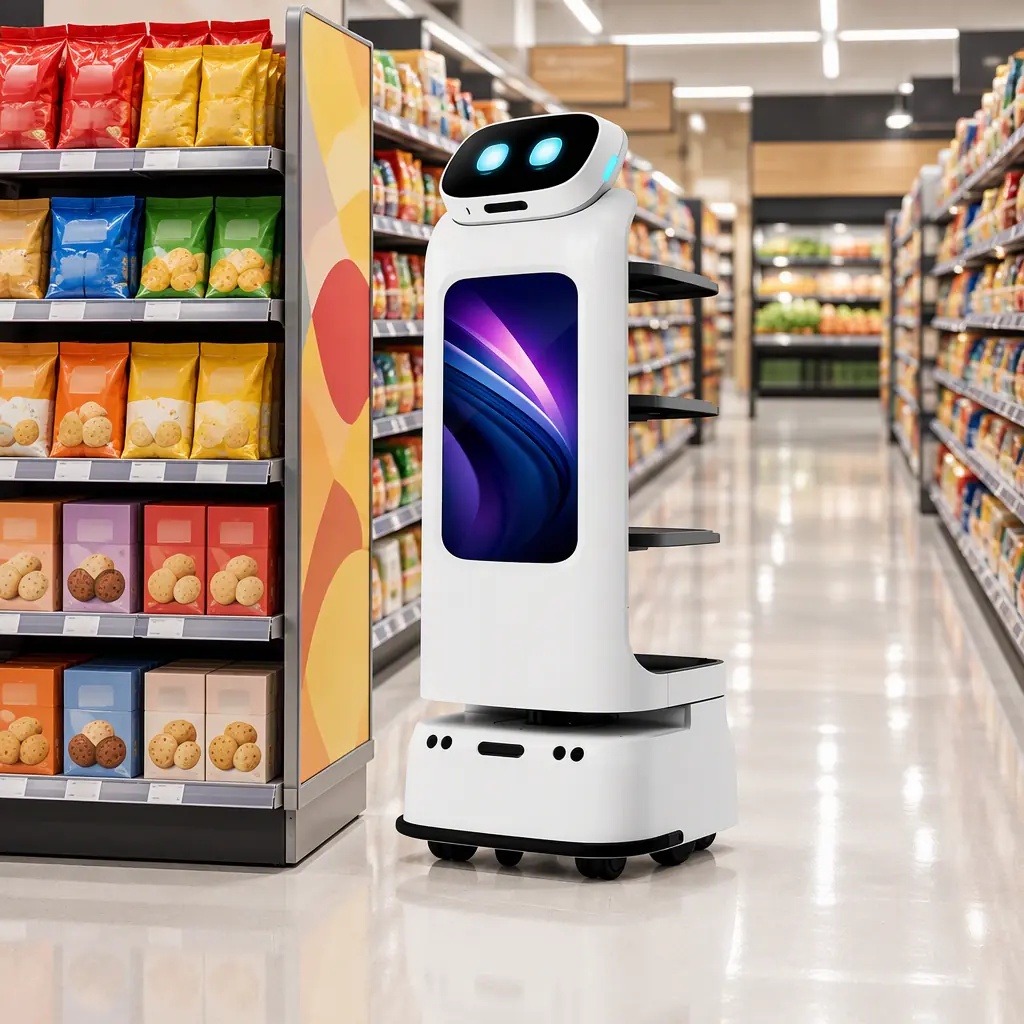
A retail advertising robot is a service robot whose screen is the product. In a supermarket the chassis does a second job (delivery, cleaning, or guidance) while the display sells advertising impressions to consumer-goods brands. The robot is not a digital sign on wheels. The distinction matters, because a fixed screen cannot follow the shopper, cannot stop at the point of decision, and cannot dwell in the aisle where a purchase is being made.
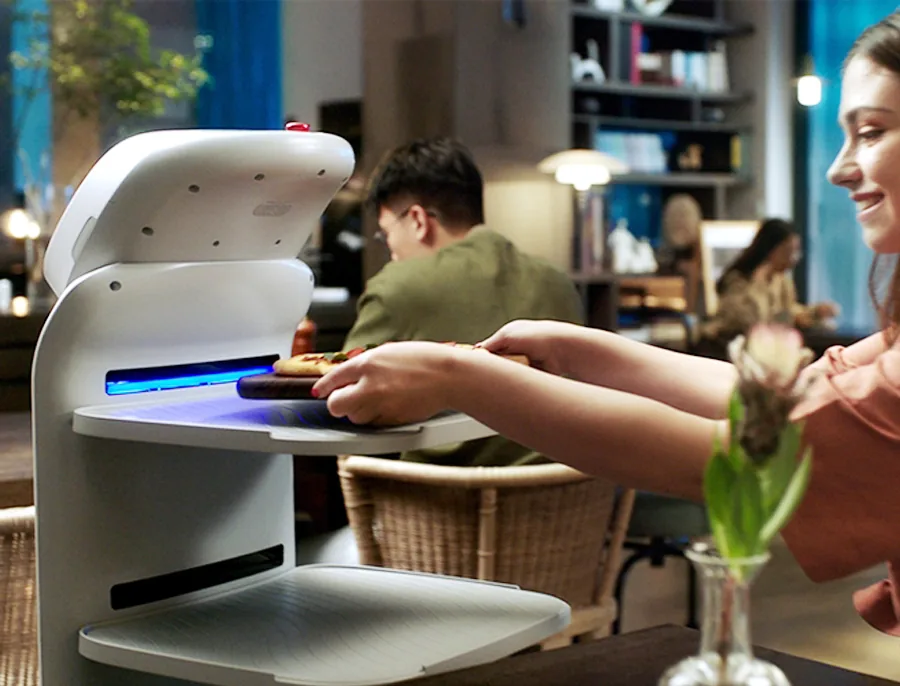
The three form factors that reach supermarket floors in 2026 are the guided assistant (a reception and guidance unit that patrols a zone and answers queries), the delivery unit with a top-mounted display (courier runs between a pick station and a shelf), and the advertising-first floor unit built around a tall panel. Each has a different dwell profile, and dwell is the unit of sale. A unit that stops beside a shopper for 40 seconds at the shelf generates far more media value than one that drives past at speed. The delivery chassis, covered in the guide to delivery robot selection, is the most common base for supermarket deployments because it already travels the busiest routes.
The buyer of the robot and the buyer of the advertising are two different companies. The supermarket (or the robot operator it hires) buys the hardware and sells the impressions. The consumer-goods brand buys the impressions. Keeping those two roles separate is the whole business model, and it is why a robot with no media strategy is just an expensive scrubber.
How Advertising Robots Work on the Shop Floor
The mechanics are simple and worth stating plainly, because the buyer of a supermarket robot is usually asked to justify it twice: once as an operations tool, once as a media asset. The robot runs a mapped route through high-traffic aisles, pauses at pre-set decision points (end caps, promotional bays, the entrance decompression zone), and plays a scheduled loop of brand creatives on its screen. Onboard sensors count the traffic that passes, and the pause logic sets how long each creative is exposed.
What separates a working deployment from a novelty is the campaign scheduler and the audience counter. The scheduler decides which creative plays in which aisle at which hour, so a breakfast-cereal brand can buy mornings and a beer brand can buy Friday evenings. The audience counter is the measurement layer: it logs footfall in front of the panel, dwell time, and pass-by rate, and that log is what the rate card is billed against. A deployment without honest counting is unsellable to a media buyer, because no brand will pay for unproven impressions.
Two operational constraints shape the design. First, aisle width: a supermarket aisle is typically 1.8 to 2.4 metres, and a robot advertising panel that widens the unit beyond about 60 centimetres creates a traffic conflict at peak. Second, dwell versus throughput: every second the robot stops to play a creative is a second it is not delivering or cleaning, so the media schedule must be costed against the primary task. That trade-off is the same coverage arithmetic used in deployment throughput planning.
The Impression and Dwell Arithmetic Behind the Rate Card
Retail media is priced on impressions, so a supermarket that wants to sell the channel has to be able to forecast them. The forecast is built from four numbers, and getting them wrong is the fastest way to an unsellable inventory sheet.
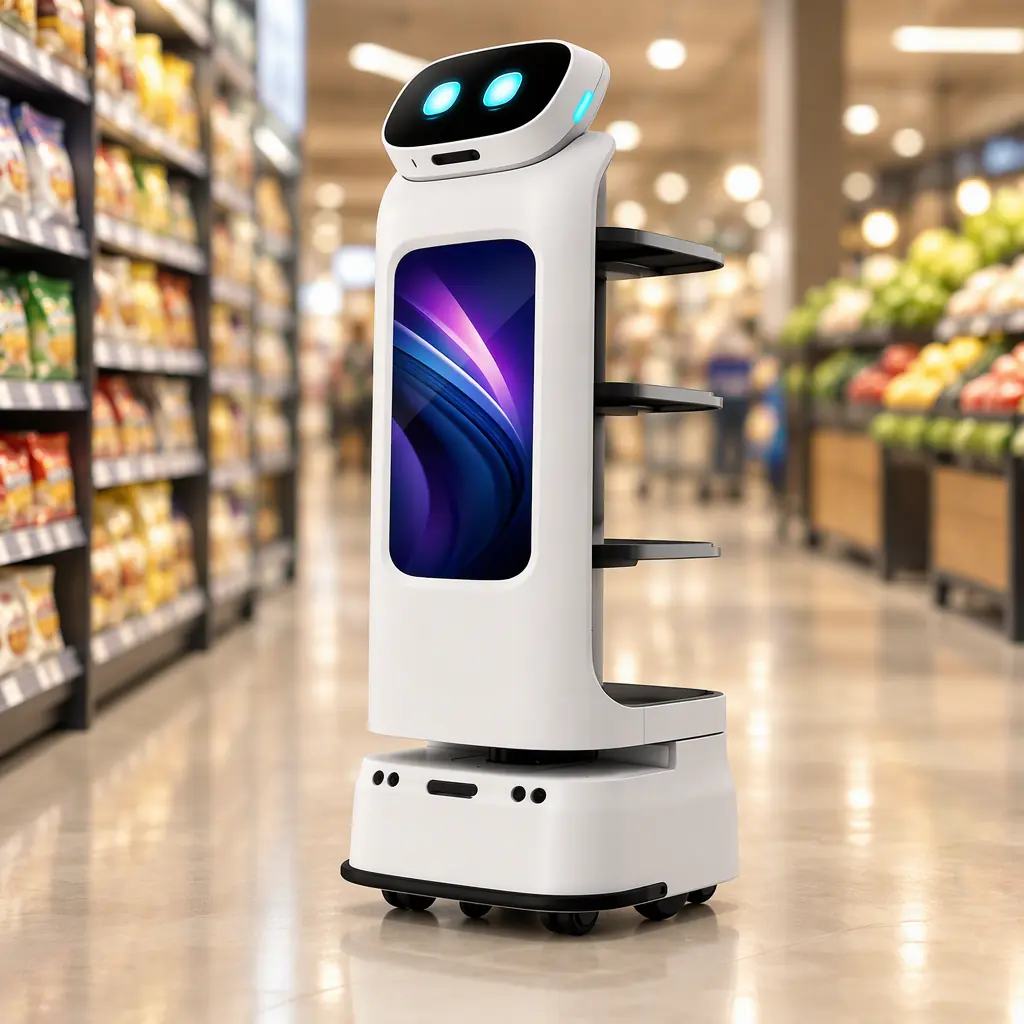
The first number is daily footfall in the robot's zone. A mid-size supermarket sees several thousand customer visits a day, but only a fraction pass a given aisle, so the zone footfall is the relevant figure, not the store total. The second is pass-by rate at the panel: of the shoppers who enter the zone, how many pass within viewing distance, typically 1.5 to 2 metres. The third is dwell time: the modelled seconds a shopper spends in front of the panel, which for a paused robot runs 15 to 45 seconds depending on the decision point. The fourth is play count per hour, which is bounded by the creative length and the share of the route the robot spends on media duty.
| Metric | Typical supermarket range | How it is measured |
|---|---|---|
| Zone footfall | 800 to 2,500 shoppers/day | Robot audience counter, cross-checked with store traffic counters |
| Pass-by rate at panel | 40 to 65 percent of zone footfall | Sensor log within 2 m of the panel |
| Dwell time at decision point | 15 to 45 seconds | Time-in-view logged per pass |
| Creatives per hour | 20 to 40 plays (media duty dependent) | Scheduler play log |
| Billable impressions per unit per month | 15,000 to 45,000 | Verified pass-by count, deduplicated |
The monthly billable impressions figure, not the raw pass-by count, is what the rate card is applied to. Media buyers discount heavily for unverified or duplicated counts, so the robot's counting method should be defensible before the first brand is approached. The revenue side also depends on the creative mix: a 15-second loop is worth more per slot than a 30-second one because it turns the inventory faster, which is why a typical supermarket rate card is quoted per 15 seconds of screen time rather than per play.
The Revenue Model: Who Pays and How It Pays Back
A supermarket advertising robot pays back through three revenue streams, and a dealer or operator should be able to model all three before proposing a fleet.
The first stream is media inventory sold to brands, billed monthly per creative slot or per verified impression. The second is promotional space sold to the store's own suppliers, who already pay for end-cap placement and will pay a premium for a moving, stopping display at the point of decision. The third is the primary task the robot still performs, whether that is delivery, cleaning, or guidance, whose labour value is the same whether or not a screen is mounted. That third stream is the one that de-risks the investment: the media revenue is upside on an asset that was justified on operations.
Payback should be modelled as the fleet cost minus the cumulative media revenue minus the primary-task labour value. In a store that sells the inventory honestly, media revenue can cover a meaningful share of the monthly robot cost, but it will not usually cover all of it, and a proposal that claims otherwise will fail at the first deal review. The realistic position is that media revenue shortens the payback, while the operations value carries the base case. The fleet-level version of that calculus, including how media revenue stacks against per-unit running cost, follows the method in the payback period calculation and the full ledger in the total cost of ownership model.
| Revenue stream | Who pays | Typical cadence |
|---|---|---|
| Brand media slots | Consumer-goods brands / their agencies | Monthly per slot or per impression |
| Supplier promotional placements | The store's existing suppliers | Campaign-based, tied to a promotion |
| Primary-task labour value | The store operations budget | Ongoing, same as any service robot |
Brand Safety and Content Rules
A screen that a supermarket does not control is a liability. The content rules are therefore not optional decoration; they are what makes the channel sellable to a serious brand.
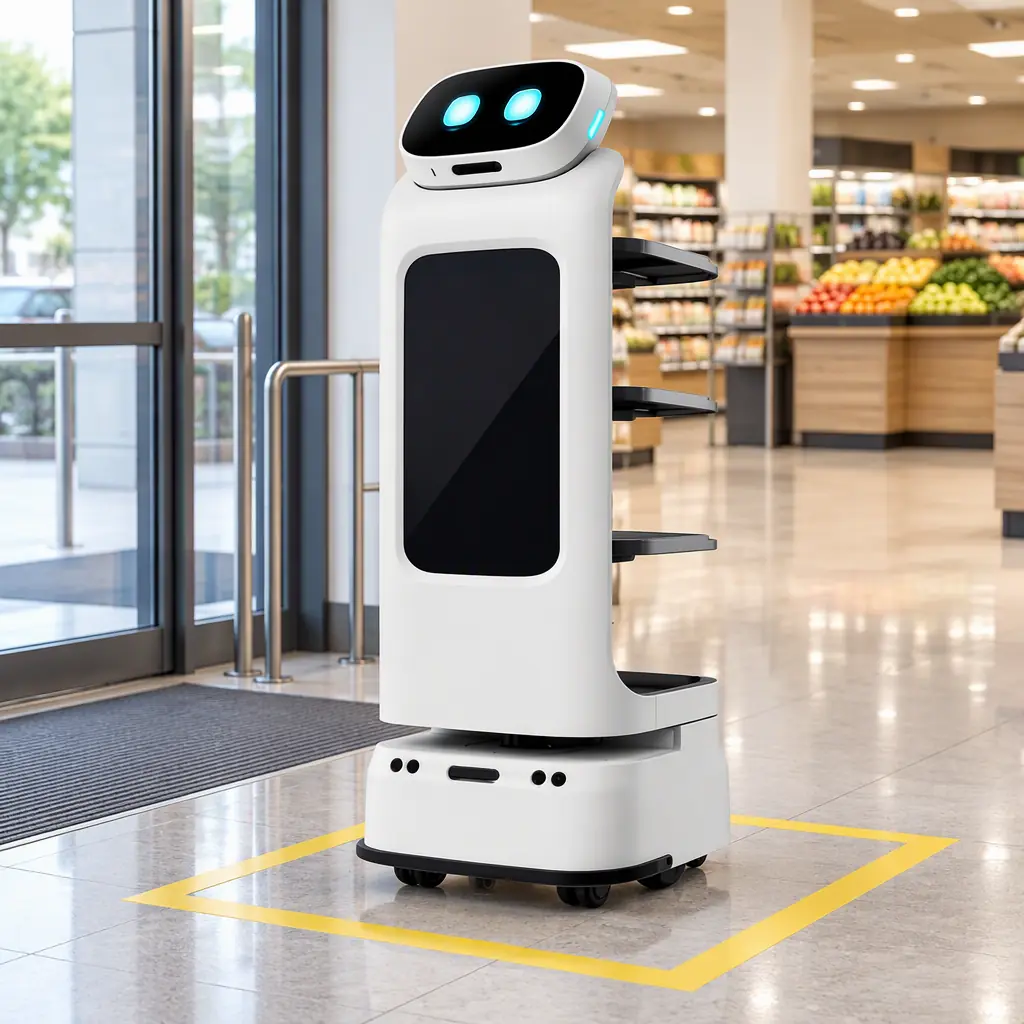
Four rules define a brand-safe deployment. First, no creative plays in a food-handling zone that shows anything the store's own food-safety policy would prohibit, which means the creative library must be pre-cleared against the store's category rules. Second, alcohol and gambling creatives are geo-timed, never shown during school-run hours in a family zone. Third, the robot's own screen never carries third-party text alongside the store's price signage in a way that could be read as a price claim. Fourth, every creative is logged with its play time and location, so a brand can audit exactly what ran and where, which is the evidence base for the next contract renewal. The logging discipline is the same as the audit-trail practice used to prove work was actually done, applied to media instead of cleaning.
On top of content, there is a physical safety layer. A robot that stops in an aisle must still yield to a shopper with a trolley, must not block a fire route, and must obey the same speed and sensing rules as any service robot on a public floor, which the site treats in the guide to safety standards and compliance. A media deployment that ignores the safe-floor rules will be shut down by the store's risk team before it earns a single impression.
Evaluating a Robot as a Media Asset
When a supermarket or an operator compares advertising robots, the buying criteria are different from those for a cleaning fleet. Six questions separate a sellable media asset from a rolling screen.
- Is the audience counter honest and auditable? An uncertified counter produces inventory no media buyer will pay for.
- Is the screen readable at aisle distance? A panel that needs the shopper to stand still does not work on a moving floor.
- Does the media schedule respect the primary task? A robot that stops too often to play creatives stops cleaning.
- Can creatives be geo-timed and zoned? Without zone targeting, the inventory is a single blunt slot.
- Is the creative library pre-cleared for the store's categories? Clearance in advance avoids a campaign pulled mid-run.
- Does the unit match the aisle geometry? A panel that widens the robot past roughly 60 cm conflicts with trolley traffic.
The hardware on the floor matters less than this list, because the media revenue depends on the counting, the scheduling, and the clearance, not on the chassis. That is also why a supermarket should treat the robot vendor and the media operator as two separate decisions. For the operations half, the evaluation discipline in the vendor evaluation framework applies unchanged; for the media half, the question is whether the operator can sell and measure the inventory.

The Realistic Verdict
In-store advertising robots work in supermarkets when three conditions hold: the store has enough footfall to generate sellable impressions, the operator can count and clear creatives honestly, and the robot was already justified on its primary task. When all three hold, media revenue is a genuine reduction in the cost of an asset the store needed anyway. When any one of them fails, the screen is a mounted cost. The supermarket that buys the robot for the cleaning, the delivery, or the guidance, and then monetises the inventory as a second act, is the one that gets the economics right.
Get a Quote
Tell us about your space and workload, we reply within 24 hours.