Hotel Housekeeping Robots: The Room-Credit Model
Why Hotel Robots Get Rejected in Finance, Not Operations
A hotel that evaluates a cleaning robot almost always evaluates it the wrong way. Operations runs a trial in one corridor, the corridor looks clean, and the business case arrives at finance written in headcount. That single framing decision is why so many pilots die between the trial report and the capital request: a hotel with 180 rooms and 26 housekeepers on the rota is not going to delete 26 jobs because a machine cleaned the corridors, and finance knows it before the meeting starts.
Hotels already have an accounting unit for labour that is not the headcount. It is the room credit. Housekeeping budgets are built in credits: a departure double is worth one credit, a stayover refresh is worth a fraction, a turndown is worth another fraction, and productivity is quoted in credits per shift rather than rooms per hour. A robot that is costed in credits can be compared against the existing labour budget line by line. A robot that is costed in headcount cannot, and the conversation stalls there.
This article sets out how to build that credit model, what the real ratios look like, and where the arithmetic breaks. The number that matters is not how fast the machine cleans. It is how many credits per shift the existing rota can no longer absorb, and whether the machine covers that gap before peak occupancy.
The Three Units a Hotel Actually Buys
Before the arithmetic, strip the purchase back to physical capacity. A supplier will quote coverage in square metres per hour, which is the right engineering figure and the wrong hotel figure. Translate it into the three things a hotel schedule contains.
- Square metres per shift. A large-format scrubber rated around 2,000 square metres per hour does not deliver 2,000 square metres per hour across a shift. Public-area cleaning is interrupted: guests cross the lobby, breakfast service blocks the restaurant floor, and the machine has to be re-tasked. Plan on 55 to 70 percent of the headline figure as shift-average throughput, which keeps a 6-hour public-area window at roughly 7,000 to 8,500 square metres of real coverage.
- Corridor-linear metres. Guest floor corridors are the highest-credit-adjacent areas and the least efficient to clean, because the machine spends a share of every metre turning at room doors and lift lobbies. A corridor bank of 60 rooms on a 1.8-metre-wide corridor is about 900 linear metres of run plus turning; budget 1,100 to 1,300 metres of machine travel for it.
- Lift-and-floor cycles. Every floor change costs an elevator handoff. If the building needs a staff lift to move the machine between floors, each hop is 3 to 6 minutes of non-cleaning time plus the human escort, and the escort requirement is usually what kills the business case rather than the cleaning rate.
Those three units are what a hotel can schedule. The question is how many credits they retire.
Converting Cleaned Area into Credits
The conversion works from a time study, not from a vendor claim. Take the public-area task list the hotel already pays for and record the minutes each task takes today. Then allocate machine time to those tasks and see what minutes come back.
| Task (180-room, 4-star hotel) | Minutes per day today | Machine-addressable | Recovered minutes |
|---|---|---|---|
| Lobby, reception and lounge hard floor | 105 | Yes, scrub and dry | 70 to 80 |
| Guest-floor corridor runner vacuuming | 170 | Partly, depends on carpet attachment | 90 to 120 |
| Breakfast room and bar floor after service | 85 | Yes, after 10:00 | 55 to 65 |
| Function space between events | 60 | Yes, in a short window | 35 to 45 |
| Gym, spa corridor and pool surround | 50 | Yes, with wet-floor controls | 30 to 35 |
| Public restrooms | 120 | Partly, scrubbing only | 25 to 40 |
| Back-of-house and service corridors | 70 | Yes, night only | 45 to 50 |
Total recovery in that example is 350 to 435 minutes a day, which is roughly one 7-hour shift of public-area labour, not the two shifts the sales deck implies. That is the honest number and it is still useful, because one shift of recovered public-area time is exactly what a hotel needs to stop backfilling a vacancy.
Now convert to credits. If a room credit equals 28 minutes of housekeeping labour (the usual convention, derived from a departure clean standard), then 350 to 435 recovered minutes equal 12.5 to 15.5 credits per day. At an average occupancy of 78 percent on 180 rooms, the hotel produces about 140 credits of departure work a day, so the robot is worth roughly 9 to 11 percent of the departure load. That is a number finance can place in a budget without anyone losing a job.
The comparison for the total cost of ownership already set out in the five-year cost ledger should use this credit figure, not a headcount figure, because credit recovery is what the hotel can actually bank.
The Credit Ratio: When a Robot Replaces a Room, Not a Person
The most useful metric in hotel robotics is the ratio between recovered credits and the credits one full-time housekeeper produces. A full-time room attendant on a 40-hour week at 28 minutes per credit produces about 85 credits per week, or roughly 12 credits per shift.
That gives three regimes, and the hotel's response should differ in each.
| Recovered credits per day | Ratio to one attendant shift | Correct action |
|---|---|---|
| Under 8 | Below 0.7 | Do not buy. Either the task list is too small or the machine is confined to one area. Re-scope before re-quoting. |
| 8 to 14 | 0.7 to 1.2 | Buy for vacancy absorption and overtime control, not headcount. The payback case is the overtime line and the agency-shift line. |
| 15 to 24 | 1.2 to 2.0 | Buy and restructure one shift. This is the range where a second machine or a night shift becomes the next question. |
| Above 24 | Above 2.0 | Audit the time study before believing it. Recovery above two attendant shifts in public areas almost always means the baseline included work the machine cannot do. |
The middle row is where most 150 to 250-room hotels land, and it is the regime finance finds easiest to approve, because it never requires a redundancy conversation. The payback calculation is overtime premium avoided plus agency cover avoided, both of which are visible lines in the monthly P&L.
Where the hotel is already running an outsourced cleaning contract, the ratio has to be converted again, because the contract is priced per square metre or per shift rather than per credit. The tender arithmetic for that case is covered in robot pricing inside a cleaning tender.
The Night Window Is the Real Constraint
Hotels buy cleaning capacity in a window, not in a day. Public-area cleaning has to finish before breakfast service and cannot run through it. That gives a typical window from 23:00 to 05:30, and the machine has to cover the full public-area task list inside it, including the lift cycles.
Work the window backwards. A 6.5-hour window with a 15 percent allowance for battery exchange, tank changes and unplanned guest interference leaves about 5.5 productive hours. At a shift-average 1,300 square metres per hour for a large-format scrubber, that is roughly 7,100 square metres. If the hotel's public hard-floor area is 9,000 square metres, one machine does not fit the window, and buying one machine is the wrong answer regardless of price.
That is also why night-shift scheduling deserves its own design pass rather than being folded into the day plan. The machine is sharing a building with a night auditor, a security round and possibly a late bar, and the interference pattern is entirely different from daytime. The scheduling logic is set out in night shift scheduling for cleaning fleets.
Two operational rules protect the window and are routinely skipped:
- Do not start with the lobby. Clean the lobby last, 40 to 60 minutes before the window closes, so the first area guests see is the freshest and any interruption is absorbed elsewhere.
- Stage the machine on the floor it finishes on. If the machine ends the night on level 2 and the next night starts on the ground floor, the morning shift pays a lift cycle it did not budget. End where you will begin.
Lifts, Doors and the Handoff Cost Most Hotels Miss
The cleaning rate is the number a supplier can defend. The handoff is the number that decides the case in a multi-floor building. Three handoffs matter, and none of them is optional in a real hotel.
The staff lift. Guest lifts are usually off limits at night for hygiene and liability reasons, so the machine uses a service lift. If that lift needs a key or a fob, the machine needs an escort, and an escort for 40 minutes a night is a real cost. Elevator integration through the building's lift API or a retrofit controller removes the escort, and the integration decision is documented in elevator integration for multi-floor deployments.
The fire door. Guest-floor corridors are compartmented. A door closer set for accessibility compliance is not always set for a machine pushing through it, and a machine that cannot open a fire door is confined to one compartment. This is checked during survey, and the survey method is in site survey and readiness assessment.
The linen and refuse route. If the machine's dock is in the basement and the dirty-linen route crosses the same corridor, the cleaning and the linen run contend for the same 20 minutes. Sequence them, or place the dock on the floor with the highest cleaning load. Multi-floor sequencing generally is covered in multi-floor building deployment.
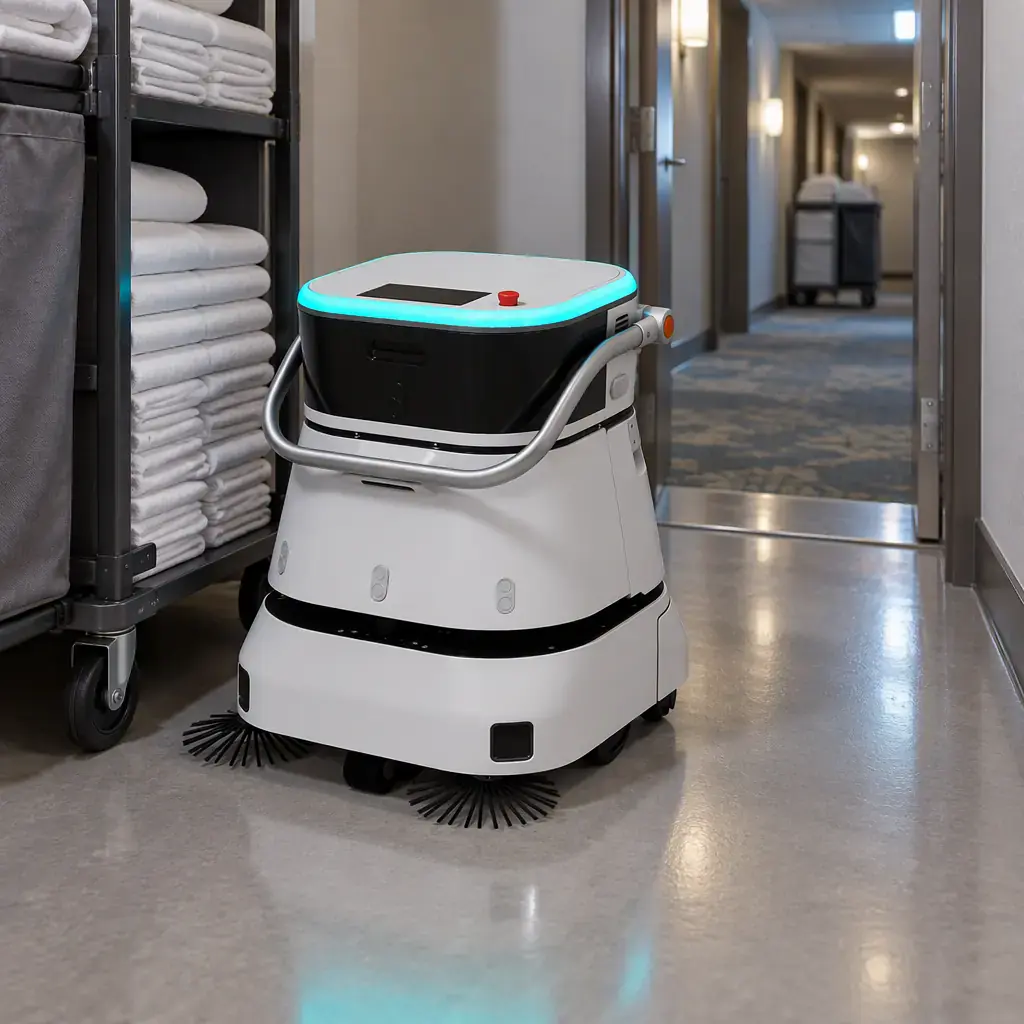
What the Housekeeping Contract and the Rota Must Say
A credit model is only bankable if the employment documents allow it. Four clauses decide whether the recovered time turns into money or into slack.
| Document | Clause to check | Why it decides the case |
|---|---|---|
| Room attendant contract or collective agreement | Whether credit targets are set per shift and whether exceeding a target triggers a bonus | If over-credit pays a bonus, recovered time becomes a cost increase, not a saving |
| Outsourced cleaning contract | Whether scope is fixed per square metre or per shift headcount | A fixed square-metre scope lets the contractor keep the saving; a shift-headcount scope lets the hotel reclaim it |
| Agency and bank-staff terms | Minimum call-out hours | A 4-hour minimum on a 3-hour gap means the robot does not remove the call-out, only shrinks it |
| Night security contract | Whether the guard is permitted to escort or intervene | Escort duties are frequently outside the guard's scope document and get billed as an extra |
The first row is the one that quietly destroys business cases. A hotel with a productivity bonus scheme has effectively pre-committed the recovered credits to staff, and the robot then has to be justified on service quality or on avoiding agency cover, not on productivity. Knowing that before the trial changes which machine you should buy, because the value shifts from coverage per hour to consistency of standard.
A Worked Case: 180 Rooms, Four Floors, One Machine
Put the whole model together on a mid-market property.
| Input | Value | Source |
|---|---|---|
| Rooms / floors | 180 / 4 plus ground public areas | Property schedule |
| Public hard floor | 6,800 square metres | Floor plan measurement |
| Guest-floor carpet | 2,400 square metres | Floor plan measurement |
| Night window | 23:00 to 05:30, 6.5 hours | Operations |
| Productive machine time after allowances | 5.5 hours | Window minus 15 percent |
| Shift-average hard-floor throughput | 1,300 square metres per hour | Measured, not quoted |
| Shift-average carpet throughput | 800 square metres per hour | Measured with carpet attachment |
Hard floor needs 5.2 hours, carpet needs 3.0 hours. Total 8.2 hours against 5.5 available: one machine covers about two-thirds of the night. The property therefore buys one machine and sequences the remainder, running carpet on alternate nights and keeping a manual carpet pass on the off night. Recovered minutes land near 300 to 360 a day, which is 10.7 to 12.9 credits, placing the property in the vacancy-absorption regime.
The honest conclusion is that this hotel should not expect a shift to disappear. It should expect to stop paying agency cover on Saturday and Sunday nights, which in most European and North American markets is the single largest avoidable line in a housekeeping budget. That is a defensible capital case, and it is the one a finance director will sign.
A property with 9,000 square metres of public hard floor and a 6-hour window is in a different position: it cannot cover the area with one machine, and the correct answer is either two machines or a narrower scope. The point of running the arithmetic before the trial is to find that out while there is still time to change the scope.
What to Ask Before Signing
- Which credits, exactly? Ask the supplier to state the recovered credits per night they expect, in the hotel's own credit convention, and to name the task list those credits came from. A supplier who cannot answer in credits has not modelled the hotel.
- What is the throughput on our floor? Require a measured figure on your own surfaces, not a datasheet figure. Polished stone, unsealed concrete and short-pile carpet give materially different numbers.
- Who changes the tanks? Fresh and waste tanks have to be emptied and refilled inside the window. If a night porter does it, that is 10 to 15 minutes of their shift, every shift, and it belongs in the model.
- What happens on a missed cycle? A machine that aborts at 03:20 leaves a corridor unready for breakfast. The failure handling, retry behaviour and the fallback rota are contractual, and the general framework is in service robot failure modes.
- How is performance verified? Agree an inspection standard before the trial, not after, so the credit claim can be audited. The verification method is set out in cleaning verification and audit trail.
A hotel that runs this model arrives at the supplier conversation with a number rather than a hope, and that is usually the difference between a pilot that reports well and a machine that is still working in year three.