
Pricing Robots Into a Cleaning Tender: A Contractor's Bid Build-Up
At a glance: A cleaning tender priced with robots added as a capital line loses to a bid that treats robots as a productivity change inside the labour build-up. This guide sets out how facility services contractors should construct a robot-inclusive bid: the labour rate build-up, the amortisation line, the productivity loading that converts robot hours to charged hours, the risk margin, and the presentation that survives a public-sector evaluation.
Why the Usual Robot Bid Loses
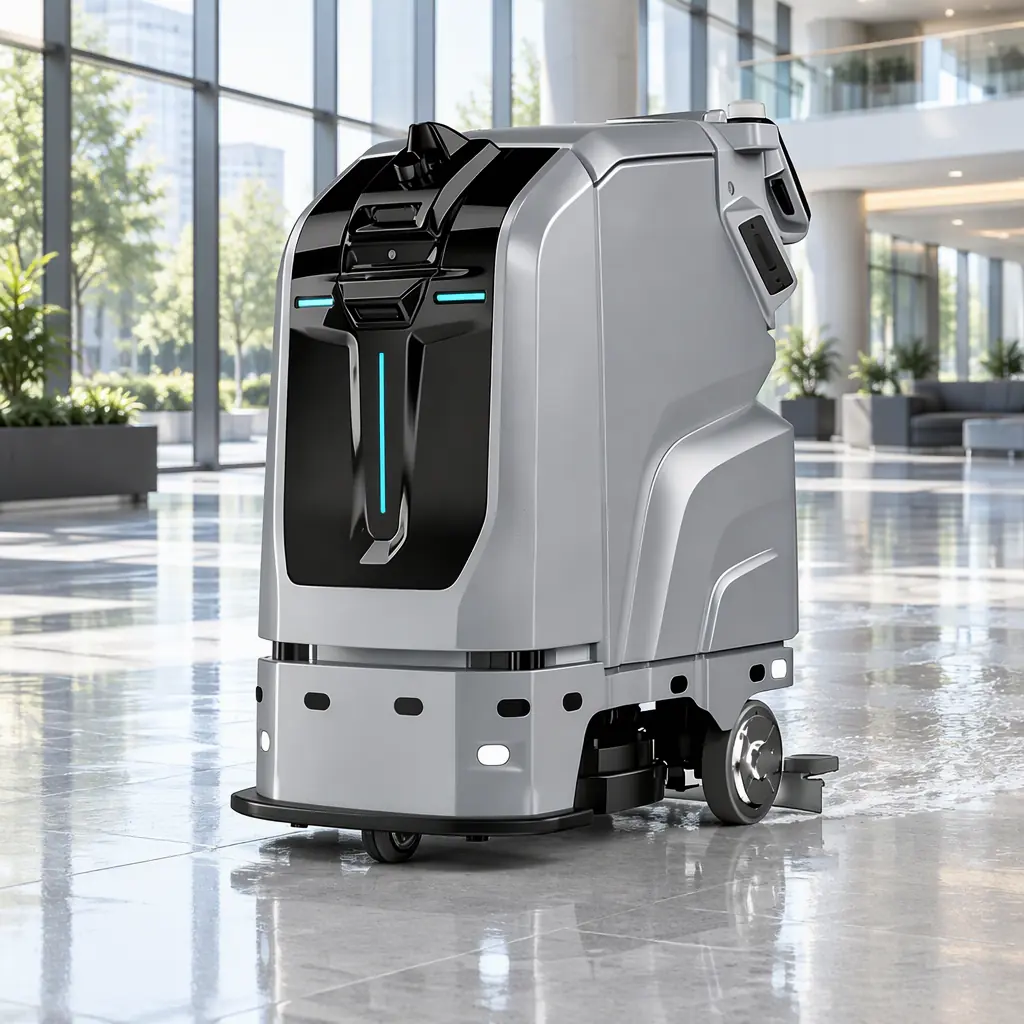
The conventional approach to a robot-inclusive cleaning bid is to price the contract exactly as before and add the robot as a capital or rental line near the bottom. On paper the bid covers the cost. In evaluation it loses, because the buyer's comparison is not the total price alone but the price against the service level, and the added capital line has not reduced the labour line it was supposed to change. A tender panel that sees a higher price with the same headcount concludes that the robot is a cost rather than a saving and scores the bid accordingly.
The bids that win do the opposite. They rebuild the labour line first, showing how robot hours replace charged labour hours, then show the robot's cost inside that rebuilt structure. The buyer sees a service model that delivers the same specification with fewer charged hours and a defensible equipment line, and the total contract price falls or holds while the specification is met. This guide builds that bid from the labour rate up, because every robot line in a cleaning tender is ultimately derived from the labour rate the contract is priced against.
The Labour Rate Build-Up Is the Foundation
Almost every cleaning contract, public or private, is priced on a charged hourly rate applied to the manning schedule. Before a robot can be priced in, the rate itself must be built honestly, because the robot reduces the hours component of the rate base and not the supervision, consumables or management overhead that sits above it.
| Rate component | What it includes | Robot effect |
|---|---|---|
| Direct labour | Basic pay for cleaning staff, productivity allowance | Reduced in proportion to displaced hours |
| Employer on-costs | National insurance, pension, holiday pay, sick cover | Scales with direct labour |
| Supervision | Team leader and area manager time | Largely unchanged; may rise during transition |
| Consumables and materials | Chemicals, cloths, liners, pads | Broadly unchanged, sometimes reduced on scrubber routes |
| Equipment, including robots | Capital or rental, maintenance, battery, spares | Rises; the robot amortisation line sits here |
| Management and overhead | Contract management, payroll, insurance, margin | Unchanged as a percentage |
Only the first four lines are meaningfully changed by robots, and only the direct labour and on-costs are reduced. A contractor who cuts the charged rate in proportion to the robot's output, rather than to the hours it actually displaces, will bid below cost. The correct move is to reduce direct labour and on-costs by the displaced hours, add the robot amortisation line, and leave supervision, consumables and overhead where they were. That honest build-up is also what makes the bid defensible when the buyer challenges a reduced price and asks whether the service level is really maintained.
Converting Robot Hours to Charged Hours
A robot's cleaning output is not the same as the hours it frees. Two corrections stand between the machine's rated output and the charged hours a bid can remove, and both are where inexperienced bids overclaim.
The first is productivity loading. A robot rated at a given square metre per hour does that in ideal conditions on a first pass over a clear, open floor. Real buildings have furniture to route around, mixed floor types, door thresholds that slow transit, and areas the robot cannot reach at all, which a spot cleaner then has to cover. The practical productivity of a robot on a real route typically lands between 60 and 80 percent of its rated output. A bid that uses the rated figure will lose the difference in the first month of the contract.
The second correction is the residual task load. A robot that scrubs the open floor leaves edge work, spill response, toilet and kitchen cores, and any area the machine cannot enter. The displaced hours are only those that were spent on the tasks the robot fully absorbs, and the residual load sets a floor below which the manned hours cannot fall without breaching the specification. In a typical open-floor commercial building the robot can absorb the bulk of the bulk-scrubbing hours and little of the detail work. In a retail or logistics floor with large open areas the absorbable share is higher.
| Step | Example building: 12,000 m2 office | Value |
|---|---|---|
| Total cleanable area | Open floor the robot can run | 9,500 m2 |
| Robot rated output | Manufacturer figure | 1,400 m2/h |
| Practical output after loading | Rated x 0.70 | 980 m2/h |
| Robot hours to cover the floor | 9,500 / 980 | 9.7 h per full scrub |
| Equivalent manual scrub hours | Manual rate 260 m2/h | 36.5 h |
| Displaced hours per full scrub | 36.5 minus residual load of 4.0 h | 32.5 h, of which 9.7 still consumed by the robot |
| Net charged-hour reduction | 32.5 minus robot supervision time | Roughly 28 h per full scrub |
The point of building this table is that the buyer will ask for it. A contractor who can show the loading factor, the residual load and the robot supervision time is answering the only question that matters: is the reduced price real. The scrubbing mathematics is the same as the one used for direct cleaning cost modelling in the cleaning robot labour cost model.
The Robot Amortisation Line
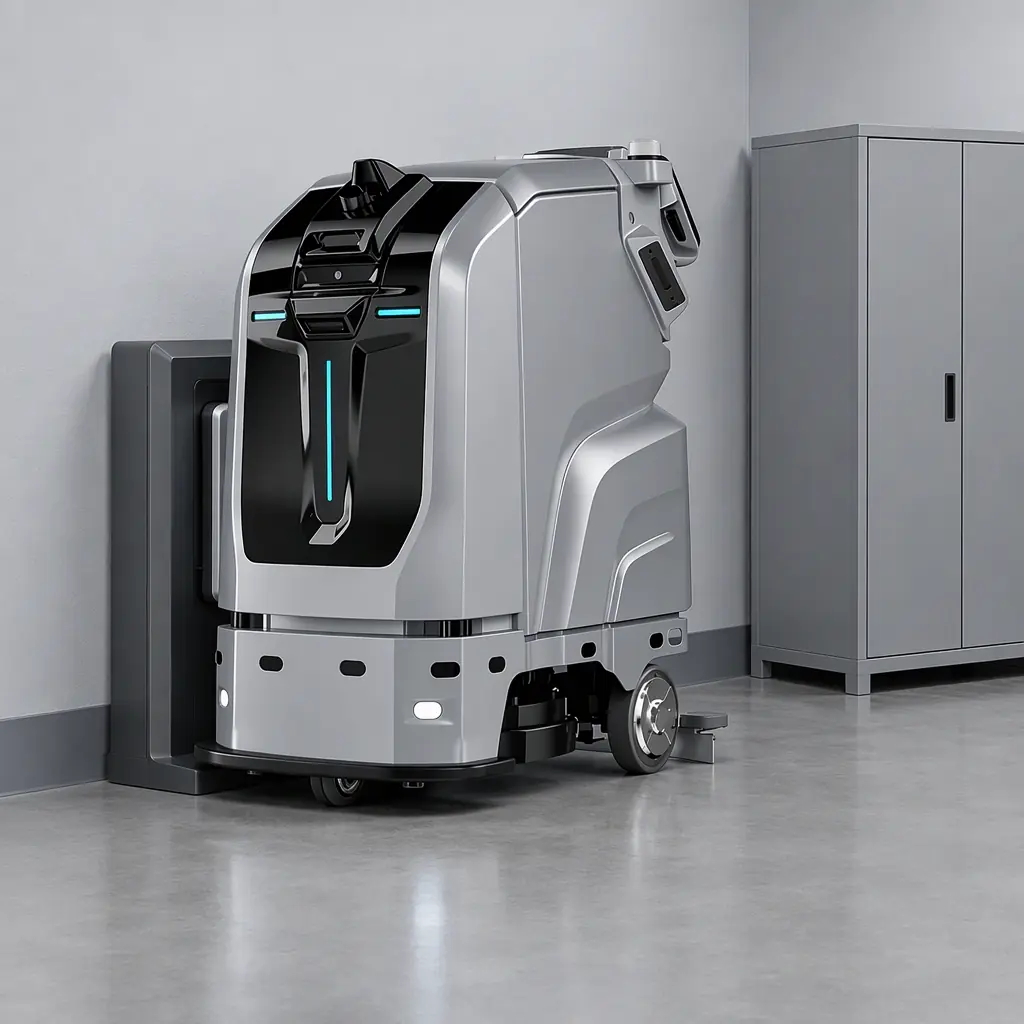
A robot in a cleaning contract is a multi-year asset inside a three-to-five-year term, so the bid must carry it as an annual charge with its own replacement and maintenance profile, not as a one-off capital item the buyer amortises mentally. Three ways to present it, each fitting a different contract type.
- Capital purchase, amortised in the bid. The contractor buys the robot and recovers it through an annual equipment charge across the term. The bid shows the purchase price, the maintenance and battery reserve, and the amortised annual figure. This suits contracts long enough to outlive the payback and buyers who want to see ownership.
- Lease, priced through as an operating cost. The robot is leased and the lease payment appears as a direct equipment cost in the rate build-up. Nothing is amortised because nothing is owned. This suits shorter terms and buyers who will not accept a capital recovery line.
- Subcontracted service, excluded from the rate. A specialist provider delivers the robot service at a fixed monthly charge, and the contractor shows it as a bought-in service. This suits contracts where the contractor wants no hardware risk at all, though it usually costs more per year than either alternative. The mechanics of the three structures, from the buyer's side, are set out in lease versus buy for service robots.
Whichever is used, the battery reserve must be visible. A robot on a two-pass daily schedule will need a pack replacement inside a five-year term, and a bid that omits the reserve is a bid that will come back to the contractor as an unbudgeted cost in year three. Reviewing a robot's whole-of-life cost before committing a bid figure is the same exercise as the fleet maintenance and total cost of ownership model.

Risk Margin, Transition and the Presentation
Three items separate a bid that holds from a bid that bleeds, and all three are routinely underestimated in a first robot tender.
The first is transition. A robot deployment in a live building does not deliver its steady-state saving on day one. The first weeks carry mapping, route tuning, staff adjustment and a period where the robot and the manual team overlap while the rota is reworked. A bid that assumes full saving from month one will show a loss in the first quarter. Build a transition cost, typically two to four weeks of partial overlap per site, into the mobilisation line rather than the steady-state rate.
The second is the specification risk. If the tender's output specification is written in a way the robot cannot evidence, the contractor carries the compliance risk. Before bidding, check that the cleaning specification defines outcomes the robot can demonstrate, and that any auditing or verification requirement, such as an audit trail of cleaned areas, is one the robot's own telemetry can satisfy rather than a manual inspection the robot displaces nothing from. Robot verification and audit trails are their own compliance topic, covered in cleaning robot verification and audit trails.
The third is the presentation. A public-sector evaluation typically rewards demonstrable sustainability and innovation alongside price. A robot bid that shows reduced water and chemical consumption, a measured productivity figure and a documented transition plan scores on the qualitative weightings as well as the price. A bid that presents the robot as an unexplained extra line scores on neither.
The Takeaway
A robot-inclusive cleaning tender is won or lost in the labour build-up, not in the robot line. Rebuild the rate so direct labour and on-costs fall by the hours the robot actually displaces, apply an honest productivity loading of 60 to 80 percent of rated output, keep the residual detail load in the manning schedule, and carry the robot as an amortised annual charge with a visible battery reserve and a transition cost. Present the loading factors and the residual load when the buyer asks, because that is the question every evaluation panel asks of a reduced price. Done this way the robot is a productivity line the buyer can audit, which is precisely why the bid wins.
If you are pricing a tender and need the robot cost architecture and productivity figures for your building types, send us the specification and the manning schedule. Contact us.
Continue Reading
Get a Quote
Tell us about your space and workload, we reply within 24 hours.