
Service Robot Electricity Cost, What a Fleet Actually Draws, and How to Size the Supply
At a glance: Electricity is the cost line almost every robot business case omits, and it is the one most likely to surprise a facilities team in month two. Here is the real draw, the losses between the wall and the wheel, and the worked annual number for a ten-robot fleet.
The Cost Line That Appears in Month Two
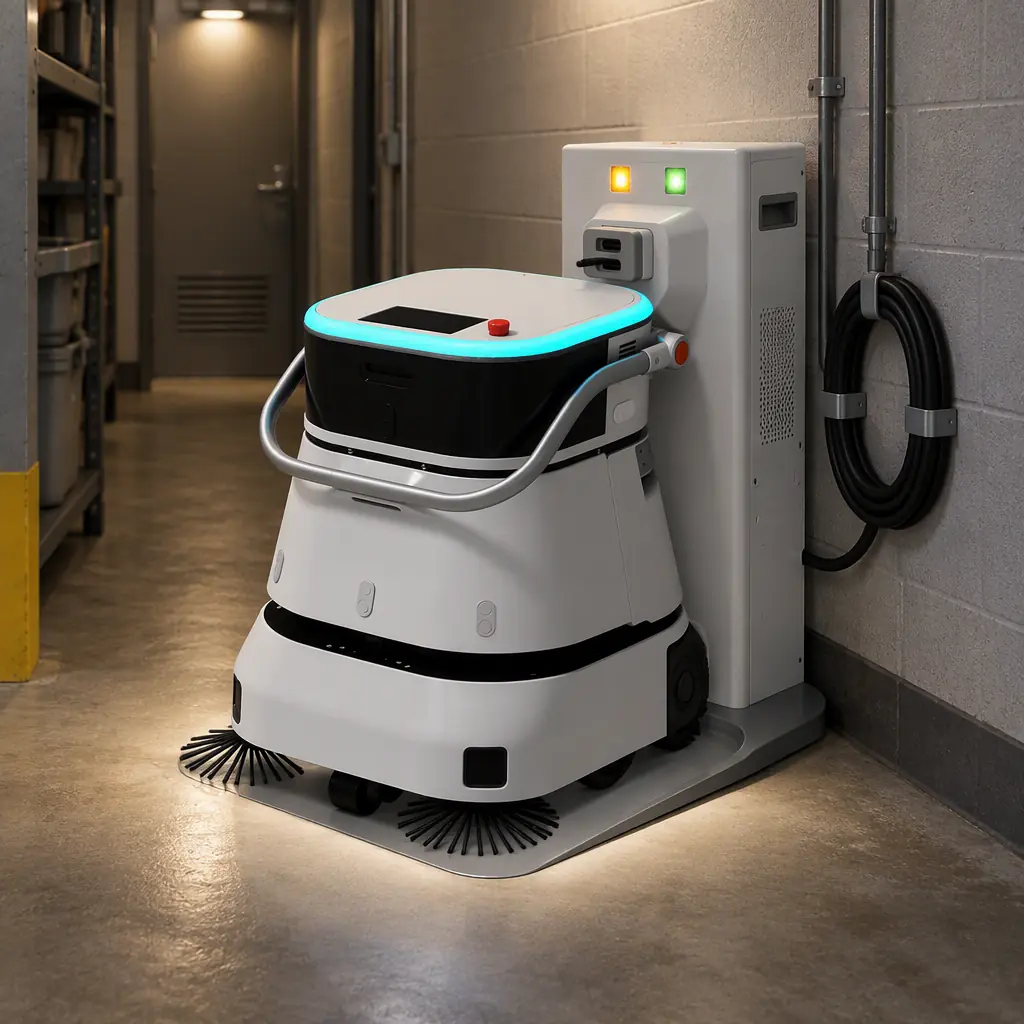
A service robot business case typically itemises capital, consumables, maintenance and supervision. Electricity is either omitted or dismissed as negligible. It is not negligible, and the reason it catches facilities teams out is not the total kilowatt-hours, it is the shape of the load. A robot fleet charges in concentrated windows, and a fleet charging simultaneously can move a building into a higher demand band, which re-rates the whole month's supply charge.
The arithmetic below uses figures that a buyer can verify against a site's own electricity tariff. The method matters more than the specific rate, because rates vary by region by a factor of three or more.
From Wall Socket to Wheel: Where the Energy Goes
The rated battery capacity on a specification sheet is not what the site pays for. Four losses sit between the meter and useful work.
Charger conversion. A switch-mode charger converts alternating current to the direct current the battery needs, at 88–93% efficiency. The remainder leaves as heat.
Battery charge acceptance. Lithium iron phosphate and lithium nickel manganese cobalt packs both accept charge at high efficiency but not perfectly. Round-trip energy efficiency for a well-managed commercial pack sits at 90–95%, with the top of the range achievable only when the pack is charged in its mid state-of-charge band rather than repeatedly to 100%.
Depth of discharge. This is the largest practical variable. A robot that runs its pack down to 20% before returning captures more useful work per cycle than one that opportunistically tops up to full, but the last portion of a charge is the slowest and the least efficient. Fleets configured for opportunity charging typically waste less energy per useful hour than fleets configured for full-cycle charging.
Hotel load. Sensors, compute, connectivity and status displays draw continuously, whether the robot is working or docked. On a compact cleaning robot this is 20–60 watts; on a larger machine with a full sensor suite it can exceed 100 watts.
Multiplying these factors gives a practical rule: expect the site to pay for roughly 1.25 to 1.4 times the nominal battery energy delivered to the machine. Plan with 1.35 as a working multiplier.

Worked Example: a Ten-Robot Cleaning Fleet
Assume ten compact cleaning robots, each with a 1.6 kWh usable pack, working two 4-hour shifts with a mid-shift recharge, six days a week. Each robot completes roughly 1.8 full pack cycles per working day including opportunity top-ups, delivering 1.5 kWh of usable energy per cycle.
Energy delivered to the battery per robot per day: 1.8 × 1.5 = 2.7 kWh. Applying the 1.35 wall-to-wheel multiplier gives a metered draw of about 3.6 kWh per robot per day, or 36 kWh for the fleet. Over 312 working days that is roughly 11,300 kWh per year.
Now apply a tariff. At a commercial rate equivalent to US$0.15 per kWh, the annual energy cost is about US$1,700 for ten robots, under US$175 per robot per year. At a high-tariff location of US$0.30 per kWh the figure doubles to roughly US$3,400 for the fleet.
That number is real but small. If the analysis stopped here, electricity would indeed be negligible. It does not stop here, because the energy charge is not the only charge on the bill.
The Demand Charge Is the Actual Risk
Most commercial electricity tariffs bill two things: energy consumed, and maximum demand, the highest rate of draw in a billing period, typically measured over rolling 15 or 30-minute windows. Demand is billed in kilowatts or kilovolt-amperes, and it frequently carries a larger effective cost than the energy itself for a site with a spiky load profile.
A robot fleet is a spiky load. If all ten robots dock and begin charging within the same twenty-minute window, which is exactly what happens when a night shift ends and the fleet returns together, the instantaneous draw stacks. Ten chargers at 1.2 kW each is 12 kW of added demand appearing at once, on top of whatever the building was already drawing.
If that 12 kW lifts the site's billing demand into the next band, the cost is charged against the entire month, not just the twenty minutes. On a tariff where demand is billed at a meaningful rate, this can dwarf the energy cost and it is entirely avoidable.
The remedy is staggered charging: sequencing dock activation across the return window so that no more than three or four chargers pull full rate at once. Most fleet management software supports this directly. The scheduling and queueing behaviour to look for is described in fleet software integration, and if you are still specifying the platform, in how to evaluate custodial robot management platforms.
Sizing the Supply Before the Fleet Arrives
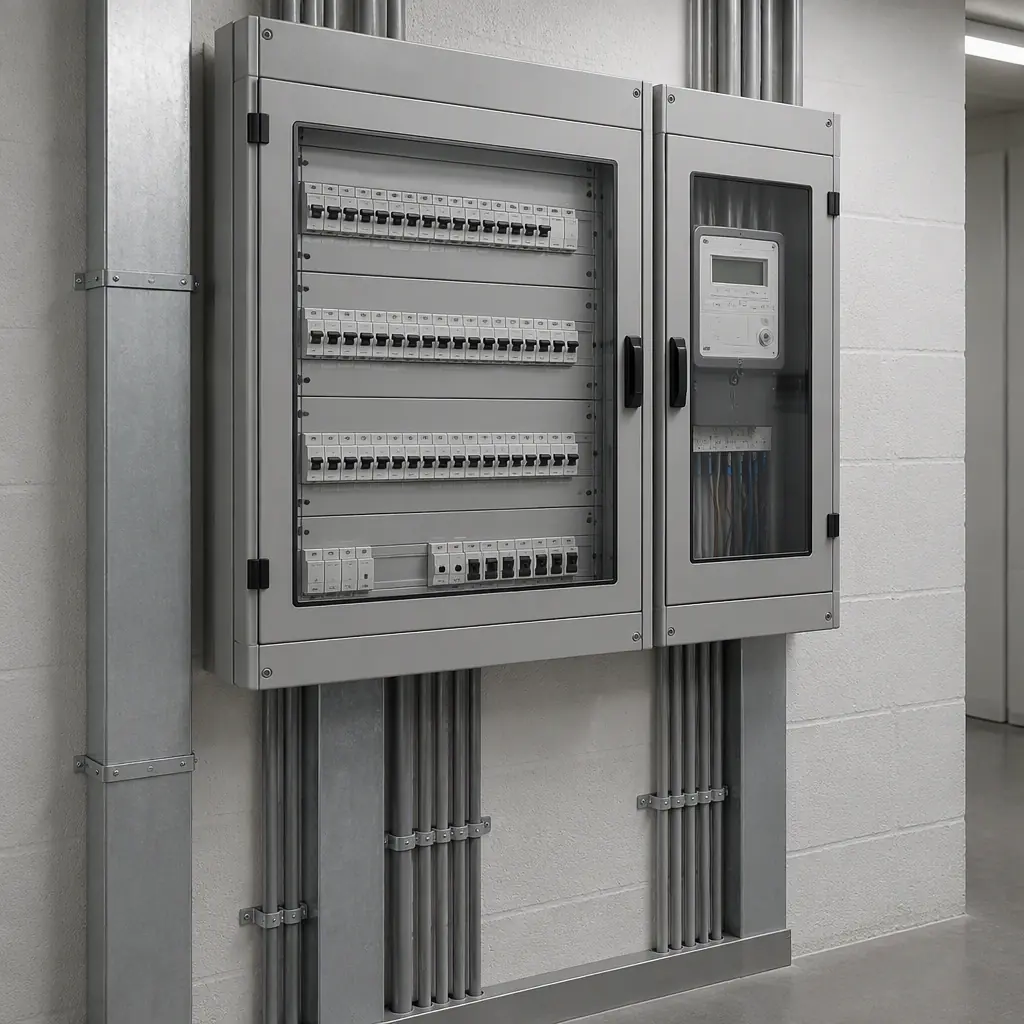
Site electrical readiness is a common cause of commissioning delay, and it is entirely predictable. Four numbers determine whether an existing circuit can carry the fleet.
Charger nameplate per unit. A compact cleaning robot typically draws 0.8–1.5 kW while charging; a larger machine with a bigger pack may draw 2–3 kW. Use nameplate, not average, for capacity planning.
Diversity factor. The proportion of chargers expected to pull full rate simultaneously. Without staggered charging, assume 1.0. With a well-configured queue, 0.3–0.4 is realistic.
Circuit headroom. The spare capacity on the circuit you intend to use, which is frequently much smaller than the panel's total rating suggests. Have an electrician measure it rather than infer it from the panel schedule.
Standby draw. Docked robots continue to draw hotel load to keep batteries conditioned and connectivity alive. Ten robots at 40 watts is 400 watts continuous. Roughly 3,500 kWh per year if left energised around the clock, which is a meaningful share of the total. If the site has long closure periods, a scheduled deep-standby mode is worth specifying.
For a ten-robot fleet, a dedicated 16-amp three-phase circuit with staggered charging comfortably covers the load; without staggering, plan for a considerably larger supply. The cost of a new circuit is a one-time site expense that belongs in the deployment budget, the same budget that covers the site-readiness items described in lead times and rollout planning.
Where Electricity Sits in the Total Cost Picture
Placed against the other operating lines, electricity is modest: for a ten-robot cleaning fleet it is typically a low single-digit percentage of annual operating cost, well below consumables and far below supervision. It should still appear as a line, for three reasons.
First, a business case that omits a cost invites the finance team to distrust the whole model when they find it. Second, the demand-charge risk is real and can be eliminated cheaply by design rather than expensively after the first bill. Third, the sizing work above determines whether the site is electrically ready on day one, which is a schedule risk rather than a cost risk.
The full operating-cost framework, consumables, service contract, supervision and amortisation, is set out in the maintenance and total cost of ownership guide. Charging technology itself, including the difference between conductive and inductive docking, is covered in battery and charging technology for service robots.
AOMAN FUTURE publishes charger nameplate ratings and standby draw for the C1 and C2 Pro cleaning platforms on request, alongside a site electrical readiness checklist. Ask for the electrical specification before your facilities team schedules the circuit work, or review the platforms on the cleaning robots page.