Service Robot Depreciation and Residual Value, The 7-Year Schedule Nobody Shows You
At a glance: A service robot is a capital asset, and the second-largest number in its business case is what it is worth when you stop using it. Almost every vendor ROI model ignores that number. This guide gives you the depreciation schedule, the residual brackets the used market actually pays, and the tax classification question that decides both.
What Actually Depreciates on a Service Robot
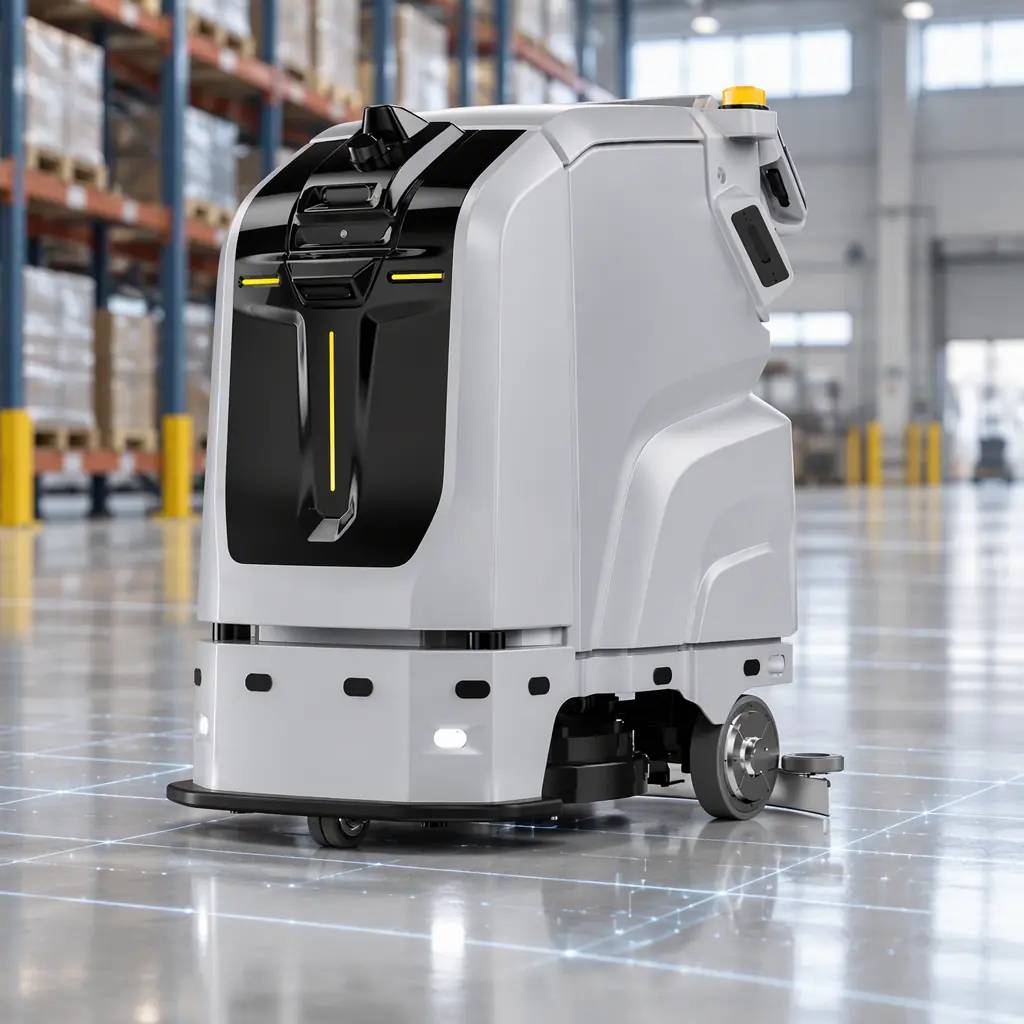
"The robot" is not one asset. A mobile service robot is a bundle of subsystems with service lives that differ by a factor of four, and the accounting treatment that matters is usually driven by the shortest-lived major component, not the chassis. Books that treat the whole unit as a single seven-year block tend to be optimistic.
The table below sets out the component breakdown we see in our own fleet data and in teardowns of third-party platforms. The five-year residual column is the share of original unit cost that component still contributes at year five, before refurbishment.
| Subsystem | Typical service life | Share of unit cost | Residual at year 5 |
|---|---|---|---|
| Lithium battery pack (LFP or NMC) | 1,500-3,000 cycles, roughly 3-5 years | 10-16% | 5-10% |
| Drive train, motors and gearboxes | 8,000-15,000 hours | 14-20% | 40-55% |
| Navigation sensors (LiDAR, depth cameras, IMU) | 5-8 years, calibration-sensitive | 12-18% | 35-50% |
| Compute and control electronics | 4-6 years before obsolescence | 8-12% | 15-30% |
| Chassis, housing, tanks, brushes | 8-12 years | 28-38% | 55-70% |
| Software and firmware licence | Not a depreciable fixed asset in most books | 0% (bundled) | 0% |
Two consequences follow. First, if your fleet does night shifts and covers 3,000 hours a year, the battery and drive train will be replaced inside the accounting life of the chassis, and those replacements are maintenance expense rather than capital. Second, a used robot's value is dominated by the chassis and drive train, which is exactly why the secondary market prices robots the way it does.
The Three Depreciation Methods and Which One Your Books Use
Most operators do not get to choose freely; the method is set by the asset class and by local tax rules. For a service robot the three possibilities are:
Straight-line spreads cost evenly over the useful life. A 28,000 dollar robot over seven years is 4,000 dollars a year, every year. This is the default for management accounts and the easiest to reason about when you are comparing two vendors.
Declining balance front-loads the expense, usually at double the straight-line rate. Year one on the same asset takes 8,000 dollars, year two roughly 5,714, and so on. This matches the economic reality that a robot loses more value in its first year than its fourth, and it is the method most commonly required for tax in jurisdictions that allow accelerated schedules.
Units of production ties depreciation to hours run or square metres cleaned. It is the most accurate for a robot, because a robot covering 4,000 hours a year genuinely wears faster than one covering 1,200. It is also the least used, because it requires that you meter hours reliably, which not every fleet management platform does out of the box.
For a quick sensitivity check: on our worked example below, switching from straight-line to a seven-year declining balance shifts roughly 7,400 dollars of expense from the back half of the life into the first three years. That changes the effective payback period a buyer reports, even though the total cost is identical.
A Worked 7-Year Schedule for a $28,000 Cleaning Robot
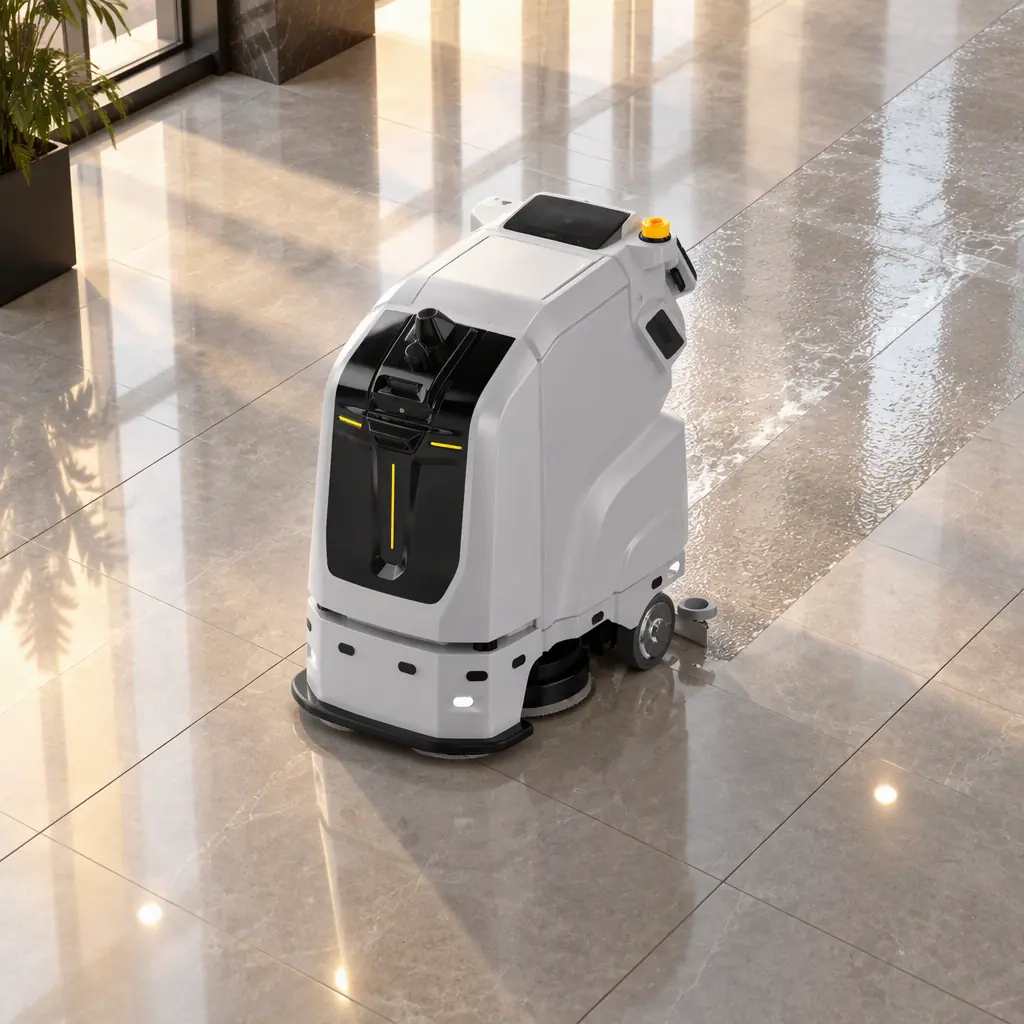
Take a large-format scrubber at 28,000 dollars delivered, four-hour battery, in a two-shift facility running 2,800 hours a year. Straight-line over seven years, with a 15% salvage estimate at the end. This is the ledger a finance controller should be able to reproduce:
| Year | Opening book value | Depreciation | Closing book value | Market estimate |
|---|---|---|---|---|
| 1 | $28,000 | $3,400 | $24,600 | $19,600 |
| 2 | $24,600 | $3,400 | $21,200 | $14,300 |
| 3 | $21,200 | $3,400 | $17,800 | $10,000 |
| 4 | $17,800 | $3,400 | $14,400 | $7,000 |
| 5 | $14,400 | $3,400 | $11,000 | $4,500 |
| 6 | $11,000 | $3,400 | $7,600 | $3,000 |
| 7 | $7,600 | $3,400 | $4,200 | $2,200 |
The gap between the book column and the market column is the whole point. Book value is an accounting convention that assumes a smooth 15% terminal salvage. The market column is what refurbishers and secondary buyers were actually paying at the time of writing. The two diverge from year two and never reconverge, which means an asset that looks healthy on the balance sheet can be functionally stranded if you try to sell it in year four.
Note the battery replacement. At year three this fleet needs new packs, roughly 3,600 dollars for the unit, which is maintenance expense and does not extend the depreciation schedule. Budget it as an operating cost, not a capital improvement.

What the Used Market Actually Pays
Two forces set used robot prices. The first is component condition: battery health above 80% capacity, drive train hours below 6,000 and no outstanding sensor calibration drift. The second is software: a robot whose fleet platform is no longer maintained is worth its parts value only, regardless of mechanical condition. That second force is why we published a separate guide on the refurbished service robot secondary market.
Observed residual brackets for mid-market cleaning and delivery platforms, as a share of original unit cost, clean and functioning:
| Age | Residual bracket | What drives the top of the range |
|---|---|---|
| 0-1 year | 65-72% | Warranty transferable, battery above 90% health |
| 2 years | 48-55% | Full service history, firmware still current |
| 3 years | 33-40% | Battery already replaced once, or above 80% health |
| 4 years | 22-28% | Drive train hours below 6,000 |
| 5 years and over | 12-18% | Vendor still sells parts for the model |
These are ranges, not guarantees, and they move with the model's installed base. A model that sold 200 units has a liquid parts market and holds value; a model that sold 12 units is a disposal problem. Before you sign, ask the vendor for installed-unit counts by model and region. It is the single best predictor of your exit value and almost no procurement template asks for it.
Depreciation vs Lease vs RaaS, Where the Tax Shield Sits
The depreciation schedule above is the ownership case. The alternative structures move the tax shield to a different party, and that is their main financial effect, not the headline monthly price.
Purchase and capitalise. You own the depreciation. If your jurisdiction allows accelerated treatment on robotics, the shield is largest in years one to three, when your cash outflow is also largest. The residual value belongs to you, so you capture the secondary market price on exit, which is the reason ownership wins on a five-year horizon in most of the models we run. Our full cost method is set out in the cleaning robot total cost of ownership ledger, and the cash-flow method in service robot budget planning.
Lease. You pay for use and show no asset. The lessor owns the depreciation and prices it into the payment, so your effective cost includes their cost of capital and their residual risk premium. Lease wins when capital is rationed, when the asset is genuinely experimental, or when the accounting treatment of an operating lease matters to your balance sheet ratios. Our detailed comparison is in service robot lease vs buy.
RaaS. You buy an outcome per square metre or per delivery, and the provider owns the whole lifecycle including depreciation, battery replacements and end-of-life. The trade is that you also give up the residual value and the flexibility to modify the fleet. RaaS is the right shape when your demand is uncertain or the contract is shorter than the asset life. See RaaS financing models.
The three structures are frequently mixed. A common and defensible pattern is to buy the robots, capitalise them over five years to match the fleet's realistic economic life rather than a nominal seven, and reserve RaaS for peak-season overflow capacity.
Five Questions to Ask Before You Capitalise
Before a service robot goes on your fixed-asset register, five questions decide whether the numbers in the vendor's ROI model survive contact with your accountant. Ask them in this order and get the answers in writing: what useful life applies to this asset class in your jurisdiction, which major components will need replacement inside that life, what installed base the model has for parts and resale, what the vendor's residual or buy-back position is, and whether the software licence transfers on sale. That last one determines whether a used buyer can actually operate the robot without the original account.
- Useful life and method. Confirm the classification with your accountant before signing, not after. Mobile service robots are often treated as five-year property and sometimes as seven-year, and the difference is material.
- In-life replacements. Get the battery and drive-train replacement intervals and prices in the contract. These are operating costs that most ROI models omit entirely.
- Installed base. Ask for unit counts by model and region. Low-volume models have poor parts availability and poor resale.
- Residual commitment. Some vendors offer a guaranteed buy-back at a stated percentage. Treat it as a ceiling, not a floor, and check the conditions that void it.
- Software transfer. Confirm whether the platform licence and any subscription can be transferred to a second-hand buyer. If not, your resale market is limited to buyers who will run the robot offline. The end-of-life mechanics of that software licence are covered in replacement and lifecycle planning, and the update channels themselves in firmware and OTA lifecycle.
If you want these numbers for a specific site rather than in the abstract, send us the floor plan and workload. We return a lifecycle cost sheet that includes the battery and drive-train replacements, the residual assumptions, and the five-year ledger, so your finance team can re-run it with their own depreciation policy.