
Robot Fleet Dock Scheduling: Slots, Dwell and Charge Windows
At a glance: A fleet of twelve robots with four charging plates is not a charging problem, it is a queueing problem. The arithmetic of dock dwell time, the rule for how many plates a shift actually needs, and the slot policy that stops a robot waiting 40 minutes for a plate it did not need.
Most fleet sizing arguments happen at the robot end. Buy fewer robots, the reasoning goes, and the charging problem goes away. It does not. It moves. A fleet where every machine is allowed to dock whenever its state of charge crosses a threshold will produce a predictable evening pile-up, because machines dispatched at the same time on the same shift wear down at the same rate and reach that threshold within the same half hour. The dock is a fixed resource with a fixed service rate, and it needs a schedule in exactly the way a loading bay or a till rota does. This article sets out the arithmetic that tells you how many plates you actually need, the slot policy that keeps them from queueing, and the failure modes that a schedule will not fix.
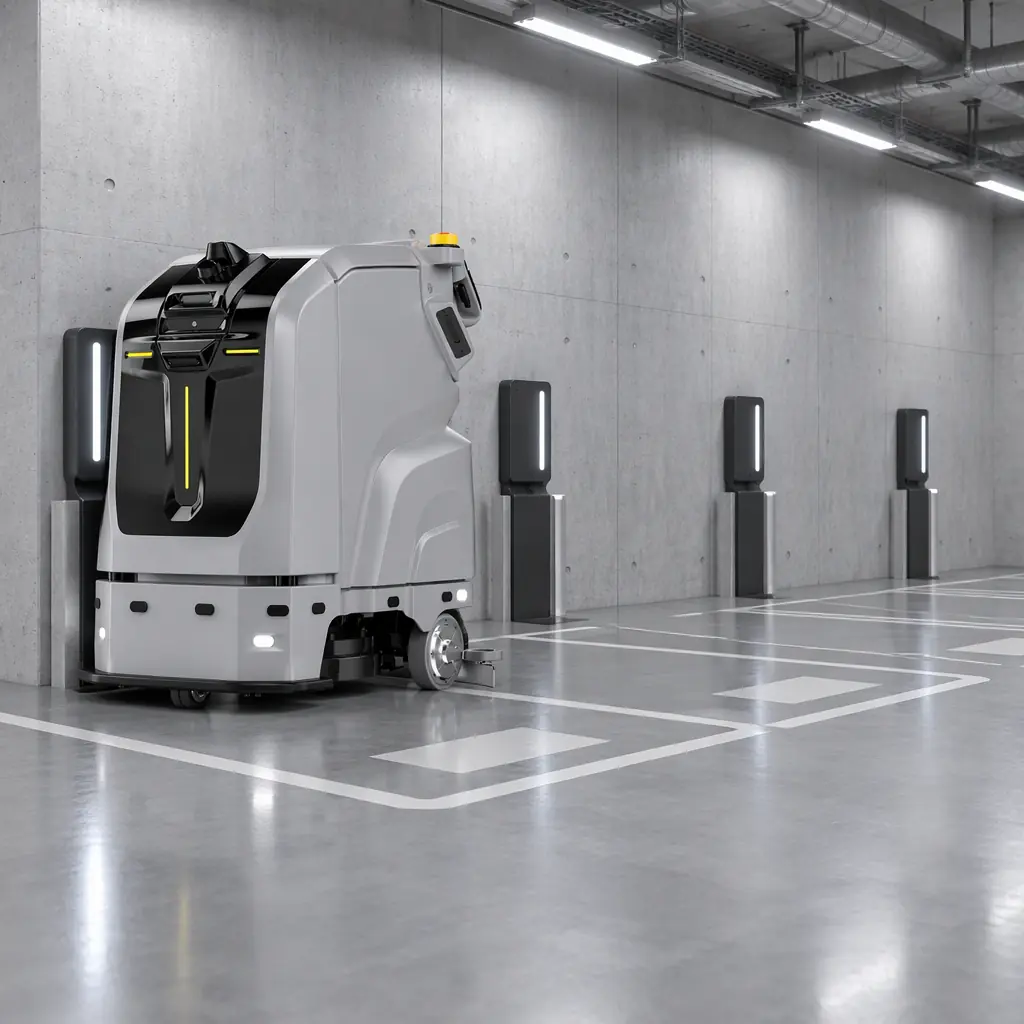
Why Opportunistic Docking Fails at Scale
The default behaviour on most fleets is opportunistic: a robot returns to a dock when its charge falls below a threshold, and takes the nearest free plate. This works with two robots and one plate. It degrades in four specific ways as the fleet grows, and each of the four is arithmetic rather than bad luck.
Charge thresholds synchronise. A fleet running the same duty cycle on the same shift reaches the same threshold at nearly the same time. If all twelve machines start a night shift at 96% and consume 8% an hour, all twelve cross 30% within a twenty-minute window around the fifth hour. The plate count did not change, but the instantaneous demand did.
Dwell time is longer than the charge time. The time a robot occupies a plate is charging time plus the time it takes to get there, seat the contacts, and get dispatched again. Operators who size plates on charge time alone under-provision by the docking overhead, which on a badly aligned plate is the larger of the two numbers.
Nearest-free is not the same as least-wait. Two robots heading for the same nearest plate is a resolved conflict one of them loses. Five robots over four plates means someone waits for a full cycle, not for a gap.
A queued robot is an idle robot with a full crew standing around it. The cost of a dock queue is not electricity, it is the machine-hours removed from the shift and the human time spent waiting for a machine that was supposed to be autonomous.

The Dock Arithmetic: Plates, Dwell and Utilisation
Three numbers decide whether a fleet has enough plates, and all three can be measured rather than guessed.
Dwell time per dock visit. Measure it as the interval between a robot entering the docking approach and the moment it is available for dispatch again. On a fleet where docking is clean this is charge-to-target time plus a couple of minutes. Where alignment is marginal it includes retries, and retries are the single largest source of dwell inflation.
Demand rate. Count how many dock visits the fleet makes per hour at the busiest hour of the busiest shift. Not the daily average, which is almost always flattering.
Plate utilisation. Demand rate multiplied by dwell time, divided by plate count. Above roughly 70% the queue becomes unstable: small variations in arrival timing stop being absorbed and start compounding. A bay running at 85% utilisation does not feel 15% short, it feels like it fails every evening, because it does.
| Measured value | How to get it | What it drives | Typical consequence if ignored |
|---|---|---|---|
| Dwell per visit | Timestamp from approach start to dispatch-available, from fleet logs, median across 20 visits | Plate count, and the size of the charge window | Plates undersized by the docking overhead alone |
| Peak demand rate | Dock visits in the busiest clock hour, from logs, not from the daily mean | Queue length at peak | Bay sized for an average day fails every Friday |
| Plate utilisation | Demand rate x dwell / plate count | Whether the queue is stable at all | A 70%+ bay queues in a pattern that looks random but is not |
| Arrival dispersion | Standard deviation of dock arrival times within a shift | Whether a schedule can help at all | Perfectly synchronised arrivals: scheduling is essential, not optional |
| Failed first-attempt rate | Retries per 100 dock visits | Effective dwell, and the real plate count | One in ten retries can add a whole plate to the requirement |
The failed-attempt rate is the row most often left blank and the one with the largest effect. A fleet with a 10% first-attempt failure rate does not have a 10% efficiency loss, it has a dwell distribution with a long tail, and the tail is what fills the bay at 22:00. If you measure only one thing on this table, measure retries.
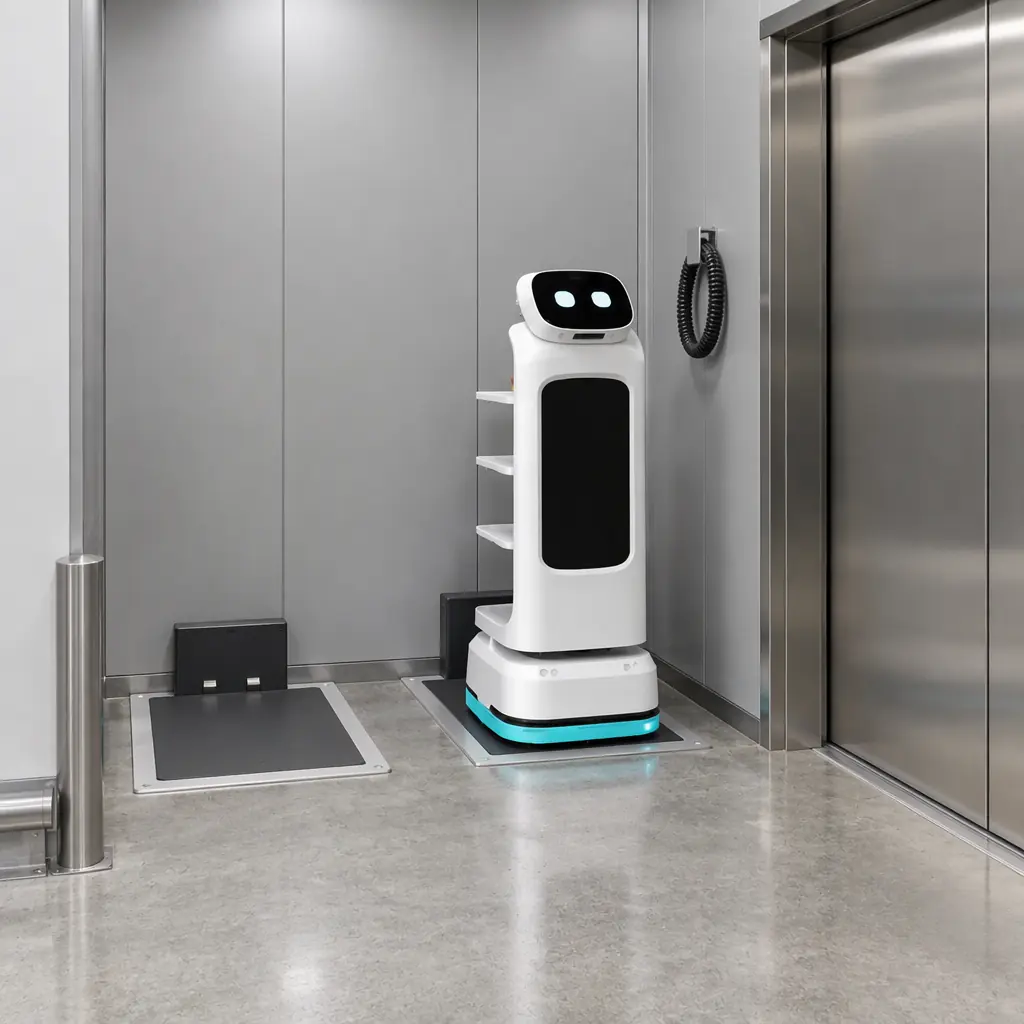
Slot Policy: Three Rules That Remove the Queue
Scheduling a dock is not a hard optimisation problem if you accept three rules. The rules cost nothing to implement and remove the majority of waiting.
- Stagger the threshold by machine, not by fleet. Give each robot a slightly different charge threshold, spread across a band of several percentage points. This de-synchronises arrivals without changing the average state of charge. A fleet that all docks at 30% is a fleet that all docks at once; a fleet that docks between 26% and 34% spreads the same demand across the hour.
- Reserve slots for the machines that cannot wait. Some robots have hard constraints: a delivery unit that must be available at service time, a cleaner that must be on a floor before opening. Give those machines an assigned plate and assigned window, and let the flexible machines fill around them. The reservation is not a reservation of time, it is a reservation of the right to displace a queued flexible machine.
- Assign plate by proximity of route, not by proximity in metres. The plate nearest a robot at 30% charge may be across a building it will have to traverse twice. Ranking plates by the extra route distance caused by the detour, rather than by straight-line distance, reduces the fraction of the shift burned in transit between work and charge.
The fourth rule, if you want one, is to schedule the low-priority top-up charges into the quiet hours rather than letting them happen when they happen. A machine sitting at 65% that docks for a top-up at 19:00 is using a plate a machine at 25% will need at 22:00. If the fleet has a quiet window, that is when the top-ups belong.

What a Schedule Cannot Fix
Three problems look like scheduling problems and are not. Adding slots to any of them makes the symptoms worse by hiding the cause for a few more weeks.
Marginal alignment. If first-attempt failure is above a few percent, the plate is out of tolerance or the floor under it has moved. A scheduler will route around a bad plate by avoiding it, which silently reduces the plate count and pushes the queue somewhere else. Fix the plate, then schedule. The alignment, flatness and contact tolerances to measure are set out in the dock and charger commissioning guide.
Undersized power. If the bay trips or throttles when several chargers energise together, the dwell time in the logs will be long and irregular and no slot policy will shorten it. The bay's electrical budget, including simultaneous start and summer ambient temperature, is in fleet charging infrastructure and power planning.
Fleet too small for the duty cycle. A fleet whose total available runtime per shift is below the work requirement cannot be scheduled out of the deficit. Scheduling recovers the time lost to queues and transit; it does not create runtime. If the shortfall is in the pack or the chemistry rather than the roster, the comparison in battery chemistry and duty cycle selection is the place to start.
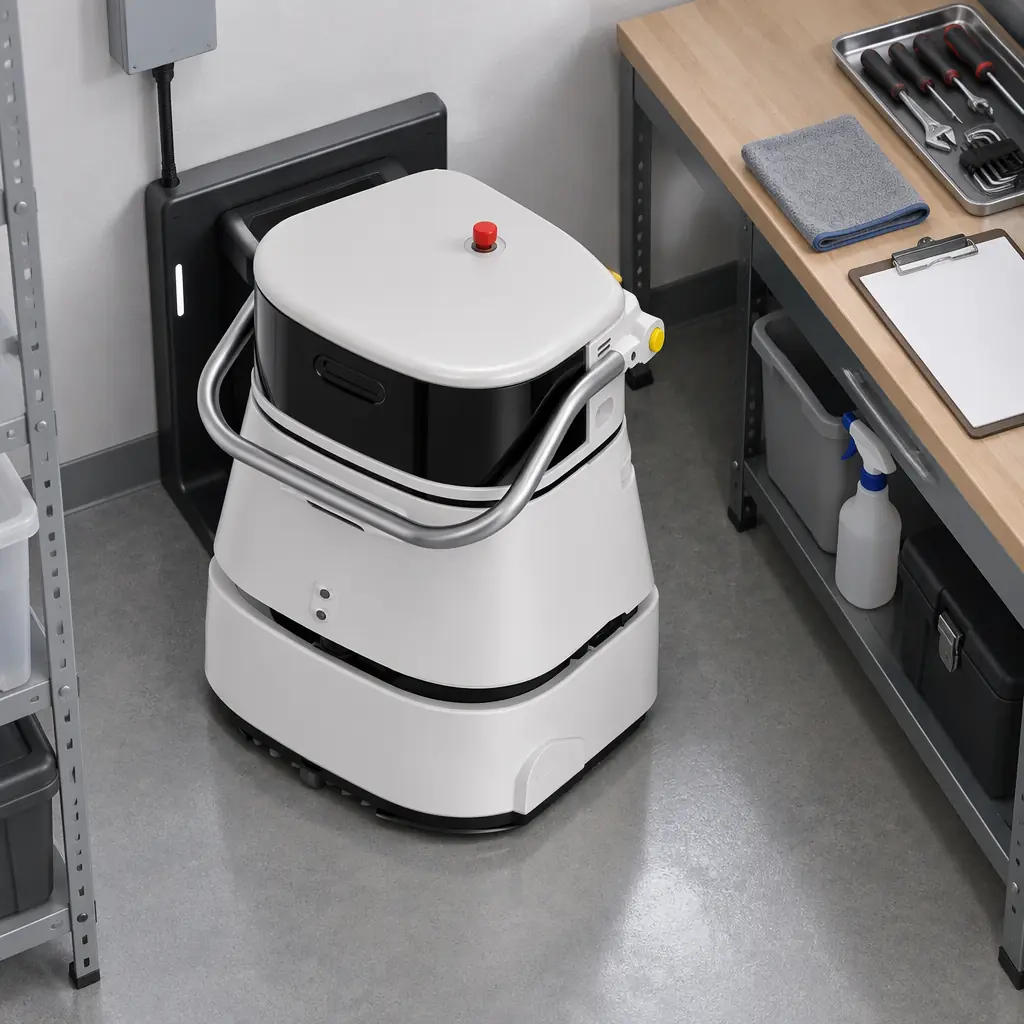
A One-Page Dock Schedule for a Twelve-Robot Site
The worked example below is a real pattern for a mid-size commercial site: twelve machines, three shift patterns, mixed cleaning and delivery duties. It is not a template to copy, it is a shape to adapt.
| Element | Setting | Reason |
|---|---|---|
| Plate count | Five for twelve machines, at peak utilisation near 65% | Four plates measured at 81% utilisation queued every evening; the fifth removed the queue without changing the duty cycle |
| Threshold band | 26% to 34%, assigned per machine and fixed | De-synchronises arrivals across roughly 40 minutes at this fleet's consumption rate |
| Reserved plates | One, assigned to the two delivery units in rotation | Delivery units have hard service commitments; cleaners can absorb a short wait |
| Top-up window | 13:00 to 15:00 only, flexible machines only | Moves low-priority charging out of the evening peak entirely |
| Retry alarm | Any plate over 5% first-attempt failure in a week is scheduled for re-measurement | Catches tolerance drift before it becomes a plate utilisation problem |
| Review interval | Monthly, and after any route or floor change | Route changes alter transit time and therefore effective dwell |
The fifth plate in that example was not a purchase decision made on intuition. It was the result of measuring utilisation at the peak hour and finding 81% against a target below 70%. That is the entire discipline: measure dwell, measure peak demand, compute utilisation, and fix the number that is wrong. The schedule then exists to keep the utilisation where the arithmetic says it should be, rather than drifting upward as routes change and fleets grow.
What AOMAN Provides and What It Does Not
AOMAN supplies the dock's mechanical and electrical specification, the charge profile of each model, the alignment window each chassis can tolerate, and the fleet-side interfaces needed to read dock state, queue state and per-visit dwell from the fleet logs. Where a site is deciding how many plates to install, our engineering team will review the measured dwell and peak demand figures before the bay is built rather than after.
What we do not do is design your shift rota or certify your electrical installation. The choice of how many machines run on which pattern, and the sign-off on the circuit feeding the bay, belong to the operator. What we ask in return is that dwell and retries are recorded per plate, because a bay that misbehaves in month nine is almost always a bay whose month-one numbers were never written down.
The short version: measure dwell including retries, size plates on peak-hour demand not the daily average, keep utilisation below 70%, stagger the charge thresholds across a band, and reserve a plate for the machines with hard commitments. Everything else is refinement.

Get a Quote
Tell us about your space and workload, we reply within 24 hours.