
Battery Swap Station Design and Rotation Sizing
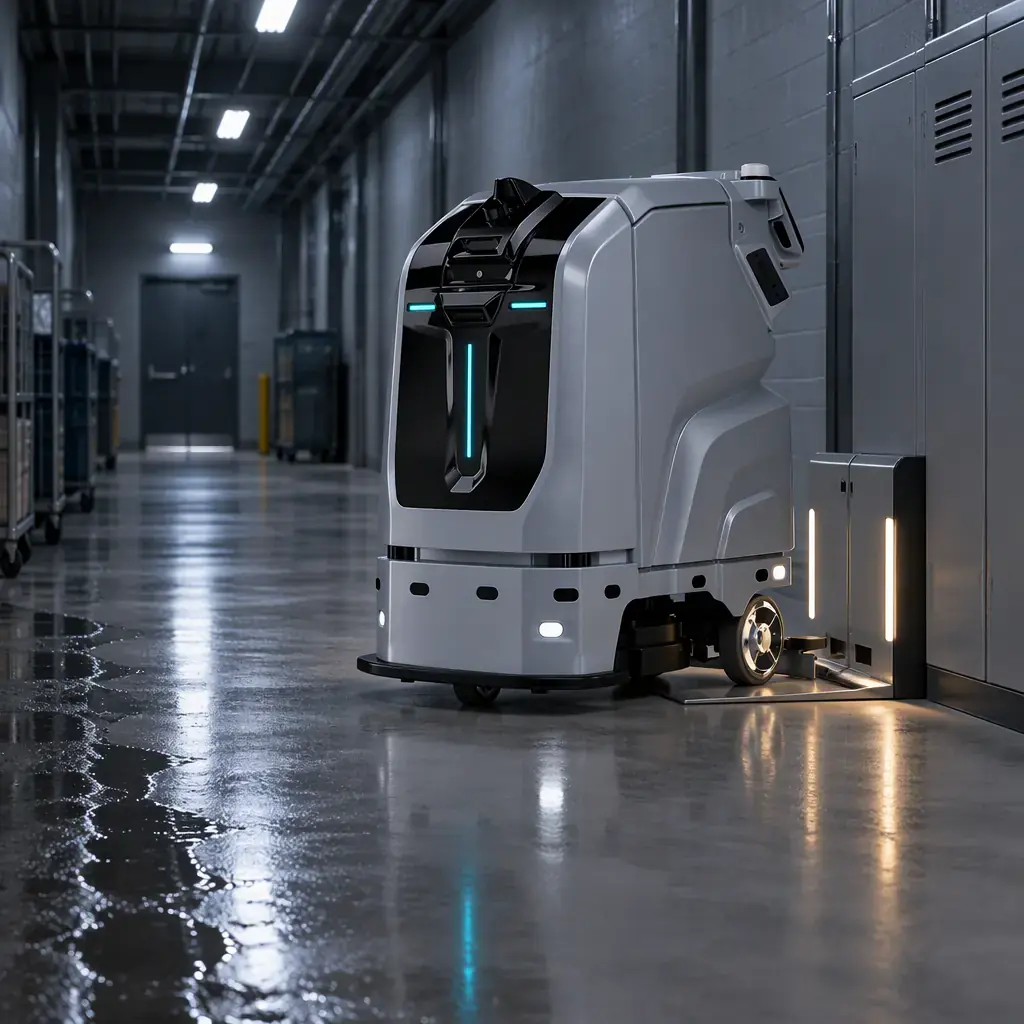
When Swapping Beats Charging
Most fleet plans assume the robot charges where it parks. That assumption silently caps the fleet: a unit that spends three hours a day on a dock is not a machine that works three shifts, it is a machine that works two. Swapping attacks the same constraint from a different angle. Instead of waiting for energy to move into a fixed pack, the operator moves the pack.
The economics are decided by one ratio. Take the work a single unit must deliver per day and divide it by the hours one pack can supply. If a scrubber needs 19 productive hours out of a 24-hour operating window and its pack gives 8, a dock-based plan needs three machines to cover the same floor that swapping covers with two. At roughly 20,000 to 30,000 currency units per large-format scrubber, that is not a charging decision, it is a capital decision, and the swap station usually costs less than the third machine.
The trade is real and worth stating plainly. Swapping buys utilisation and costs packs, floor space, and a new failure surface: the exchange itself. A station that jams at 02:00 has taken a robot out of service just as effectively as a flat battery, and the two common designs fail in different ways. Design the station before ordering the third pack, not after.
Three Station Architectures and What Each Costs
Swap stations divide by how the pack leaves the robot. Each design implies a different charger count, a different pack count, and a different staffing pattern.
| Architecture | Exchange time | Packs per robot | Chargers behind the station | Best fit |
|---|---|---|---|---|
| Manual bay, operator-assisted | 2 to 4 minutes | 1.2 extra | One charger per two bays | Day-shift operations with a technician already on site |
| Semi-automatic rack, tool-free tray | 60 to 90 seconds | 1.5 extra | One charger per bay, staged | Two-shift cleaning with a small fleet of 4 to 12 units |
| Automatic multi-bay station | 30 to 60 seconds, unattended | 1.8 to 2.0 extra | One charger per bay plus conditioning electronics | Near-continuous operation, 24-hour logistics or 3-shift industrial |
The automatic column is the one vendors quote first, and it is rarely the right first purchase. Automation removes the operator from the exchange but adds a control system, interlocks, and a maintenance discipline for the mechanism itself. For a fleet of six units running two shifts, a semi-automatic rack with tool-free trays delivers most of the utilisation benefit for a fraction of the station cost, and a technician is on site anyway for the other equipment.
One specification detail decides whether the whole scheme works: the pack must be a tool-free, field-replaceable module with a documented form factor, not a sealed assembly behind four bolts. If the pack cannot be exchanged by one person in under two minutes without tools, the station is decoration. That is a purchasing requirement, not an engineering preference, and it belongs in the battery specification discussed in battery pack specification and sourcing.
Sizing the Rotation: How Many Packs the Station Needs
A swap station is a queue, and sizing it is queue arithmetic rather than guesswork. Four numbers decide the pack count: pack runtime in productive hours, exchange time, charge time from exchange threshold to full, and the operating window the site actually runs.
Work an example for a three-shift industrial site running eight large-format scrubbers. Each pack delivers 7.5 productive hours. Exchange takes 75 seconds. A pack arrives at the station at about 20 percent state of charge and reaches 95 percent in 2.5 hours on a 24 V, 120 Ah-class pack charged at roughly 0.25C. The site runs 22 productive hours a day with two one-hour shutdowns.
| Quantity | Arithmetic | Result |
|---|---|---|
| Packs consumed per robot per day | 22 productive hours / 7.5 hours per pack | 2.9, round to 3 |
| Peak simultaneous charge demand | 3 exchanges per robot per day across a staggered 8-unit schedule | About 4 to 5 bays in use at any moment |
| Packs in circulation | 8 robots x 1 in the machine + 8 x 1 in the rack at any time | 16 to 17 |
| Spare for pack failure | 5 to 10 percent of the pack population | 1 additional pack |
| Bays needed | Peak charge demand plus one, so a jam does not cascade | 6 bays |
Three conclusions follow from that table, and all three are routinely missed. First, the pack ratio is close to two to one, not the 1.2 that manual-bay vendors quote, because a pack in the rack is still a pack you paid for. Second, bays must exceed peak demand by at least one, or a single blocked bay pushes a robot into waiting, which is downtime with extra steps. Third, the exchange schedule should be staggered by robot rather than triggered by low charge, because eight robots arriving at the same threshold create a spike the station was never sized for.
Staggering is also a power decision. Spreading exchanges across the shift flattens the station's load profile and keeps the site below its demand charge threshold, the same arithmetic that governs charging generally and is set out in fleet demand charges and peak load.
Site Requirements: Power, Floor and Clearance
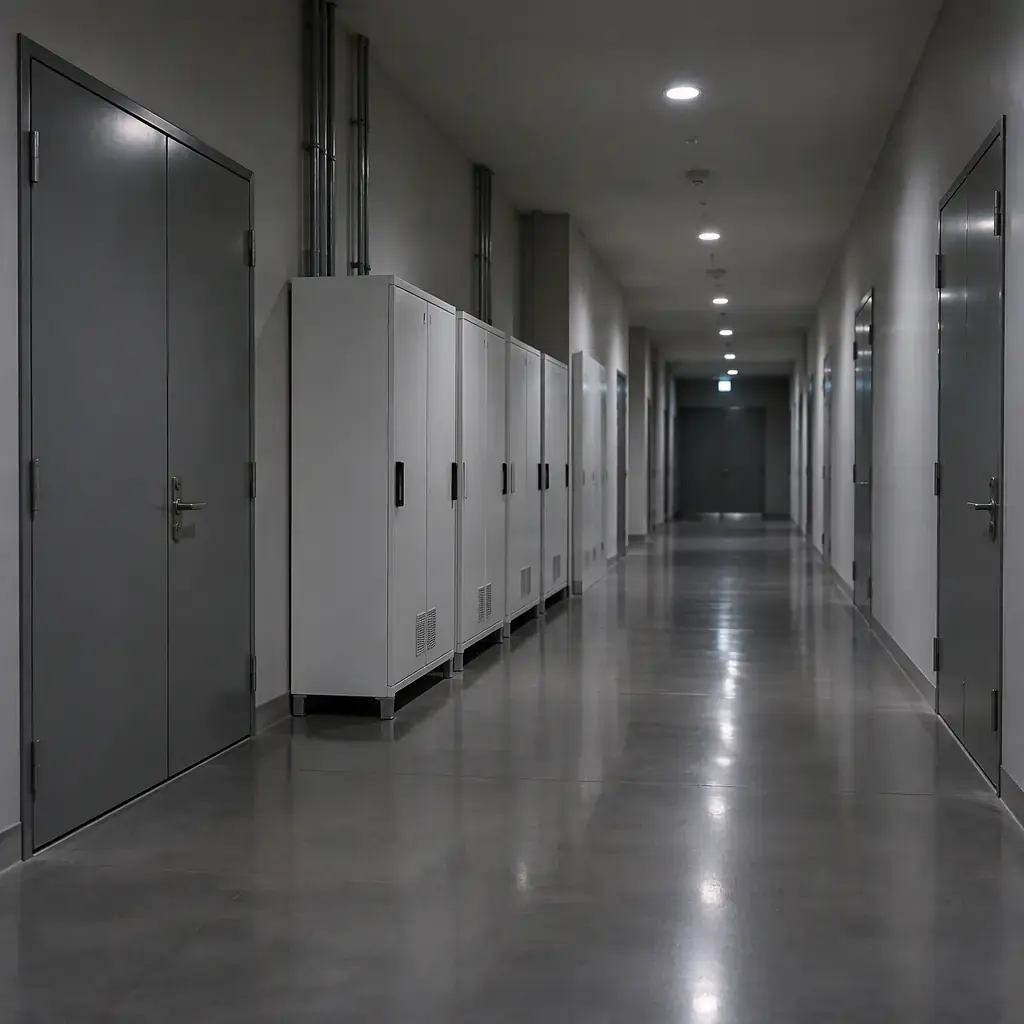
The station is a piece of plant, and it needs a plant-room level of specification, even when it stands in a corridor.
- Power. Budget roughly 1.5 to 2.5 kW of charger draw per bay for large-format packs, and check the site's existing spare capacity before choosing bay count. A six-bay station is a 9 to 15 kW load, which is a dedicated circuit and often a sub-distribution board.
- Floor and level. Exchange trays need level floor, typically within a few millimetres across the tray footprint, and a hard surface. Tolerances drift over time, so the station should be re-checked after the first month of service.
- Clearance. Allow the robot's turning clearance in front of each bay, which for a large-format scrubber is about 2 metres, and keep the approach path off the main pedestrian route so an exchange never blocks a fire exit or an aisle.
- Thermal environment. Lithium packs charge more slowly when cold and age faster when hot. A station in an unheated loading bay will need heating in winter or a charge-current derating strategy, and one beside a boiler room needs ventilation rather than insulation.
- Fire separation. The station concentrates charging in one place, so the fire strategy must be designed for that concentration rather than inherited from a dock-based plan. The requirements and the room-level controls are covered in battery fire safety and charging room design.
Floor space is usually the constraint that decides between architectures. A six-bay rack with exchange clearance occupies roughly 8 to 12 square metres, which in a shopping centre back-of-house is valuable. Siting the station in a service corridor near the cleaning store, rather than in a remote plant room, cuts the travel time that eats into the utilisation the station was bought to create.
The Exchange Protocol That Prevents Damage
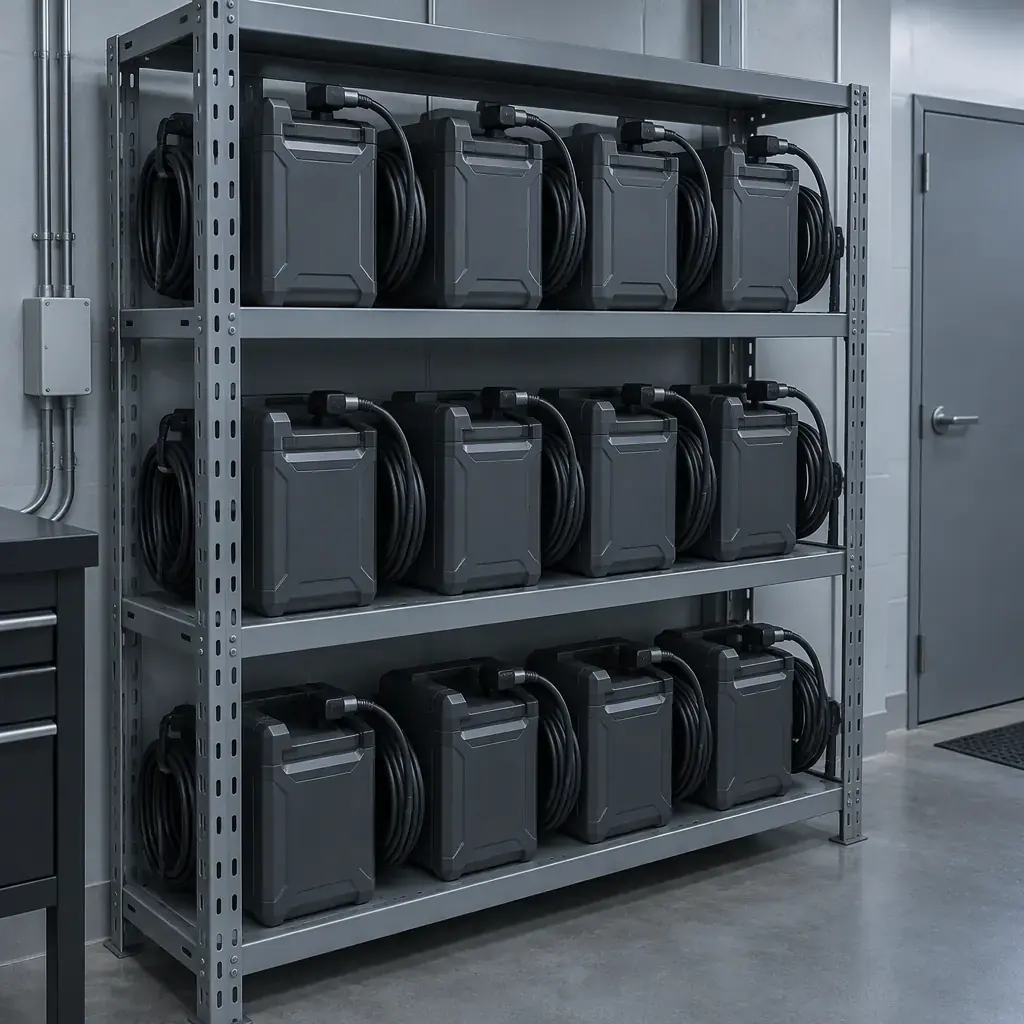
Most swap-related failures are handling failures, not electrical ones. A protocol written down and trained on prevents the expensive ones.
- Disconnect before release. The robot must confirm contactor open and pack isolated before the tray unlocks. An interlock is better than a procedure, but a procedure is better than nothing.
- Inspect the connector on every exchange. A two-second visual check for bent pins, arcing marks, or debris catches the failure that would otherwise surface as a thermal event three weeks later.
- Log pack identity against robot identity. Every exchange writes pack serial to unit serial with a timestamp. Without it, state-of-health history fragments and warranty claims become unprovable, as set out in the battery telemetry data contract.
- Quarantine, do not reissue. A pack with a hot connector, a swollen case, or an unusual voltage spread goes to a quarantine slot and stays there until inspected. Reissuing it to keep the rotation turning is how one bad pack becomes a fleet incident.
- Condition periodically. Racks that only ever do partial top-ups leave packs unbalanced. A scheduled full charge and cell balance every few weeks keeps the population healthy, and the interval arithmetic belongs in the battery health and replacement plan.
What Swapping Changes in the Contract
A swap-based fleet moves risk around, and the purchase contract should follow it. Five clauses matter more than usual.
| Clause | What to require | Why it matters in a swap fleet |
|---|---|---|
| Pack as field-replaceable module | Tool-free exchange in under two minutes by one person, with the procedure documented | Without this the station cannot function and the retrofit cost lands on the buyer |
| Pack availability commitment | Guaranteed supply of identical packs for the fleet's service life, with a stated lead time | A rotation depends on a homogeneous pack population; a discontinued pack strands the station |
| Cycle-life warranty per pack | Capacity retention floor, term in cycles, and a test protocol | Swapping consumes cycles faster, so the warranty is more valuable than in a dock-based plan |
| Station interface specification | Electrical, mechanical and communication interface documented and versioned | Lets the buyer source a second station or a second pack vendor at renewal |
| Exchange telemetry | Every exchange logged with pack and robot identity, exportable in bulk | The only evidence that a degradation claim or an incident investigation can rest on |
The commercial framing of these terms, including how they sit against a lease or a service agreement, is covered in contract renewal, escalation and exit terms and in lease versus buy for service robots.
The Decision in One Paragraph
Swap if the site runs longer than two pack-runtimes a day, if utilisation is the binding constraint on how much floor gets covered, and if the packs are genuinely field-replaceable modules. Do not swap if the site runs eight hours, if the packs are sealed assemblies, or if there is no technician within an hour of the station. In practice the crossover sits around 16 productive hours a day: below it a dock-based plan with a bigger fleet is simpler and cheaper, above it the third machine you avoid more than pays for the racks. For fleets running near-continuous operation, the AOMAN C1 large-format scrubber and the compact AOMAN C2 Pro are both specified with modular, tool-free tanks and packs, and our team can review a rotation plan against your operating window before you commit to a bay count.
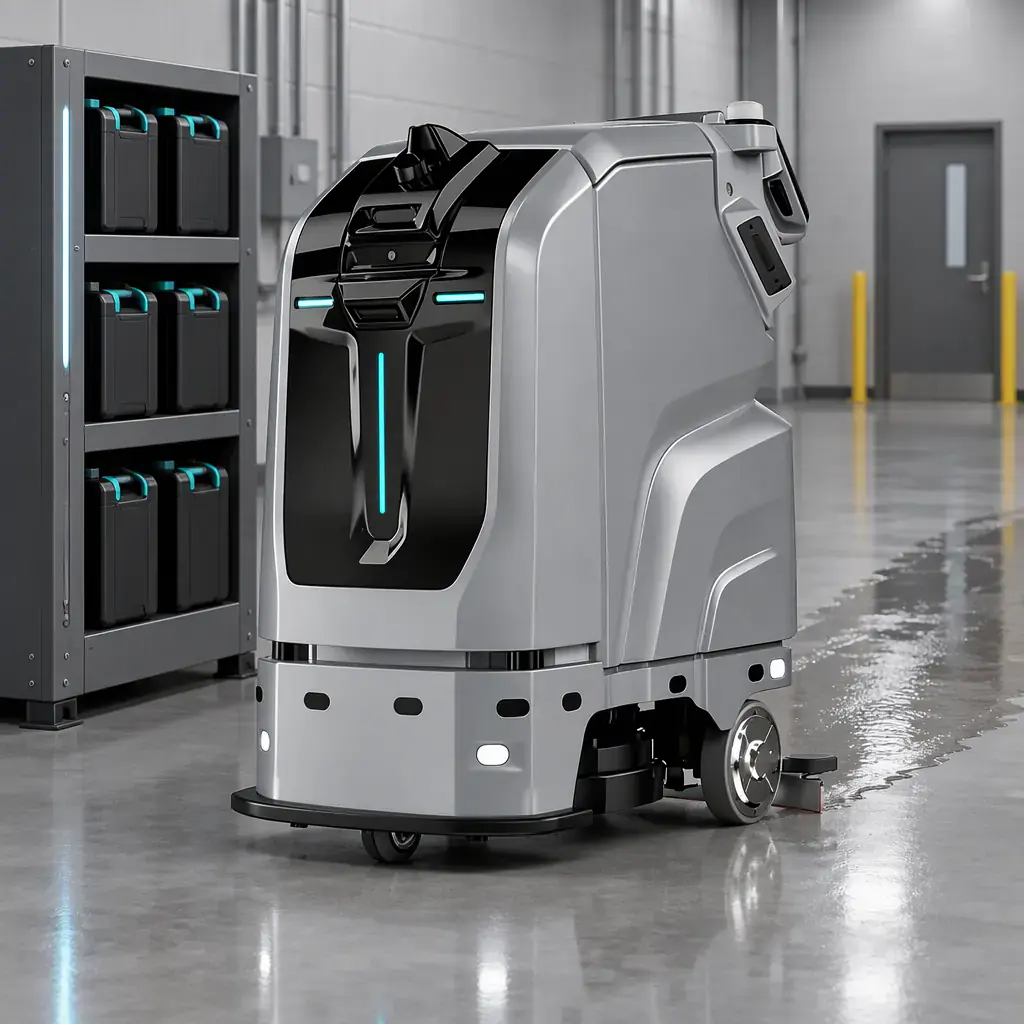
The Arithmetic Before the Architecture
Two sites with identical floors can need opposite answers. A shopping centre that cleans from 22:00 to 06:00 has eight hours of cleaning in a twenty-four hour day, so charging time hides in the closed hours and a dock is sufficient. A food distribution warehouse that runs three shifts wants its floors done continuously, and there the pack is the constraint on how many square metres a day the fleet can cover. The number to compute is required productive hours per day, not fleet size.
Required productive hours come from area and work rate. A 38,000 square metre distribution centre cleaned daily at 1,800 square metres per hour of effective coverage needs 21 productive hours across the fleet. The same figure, calculated from area rather than from a vendor's unit count, is what makes the pack count auditable. Work-rate arithmetic, including the dock overhead that most quotes leave out, is set out in robot throughput per hour and fleet sizing.

Operating the Rotation Day to Day
Once the station is built, three routines keep it earning. Assign exchanges to a schedule per robot rather than to a charge threshold, so demand is spread. Check tray alignment weekly, because a millimetre of drift becomes a connector that does not seat. Review the exchange log monthly for packs whose charge time is lengthening, which is the earliest visible sign of internal resistance climbing, months before a dashboard shows a capacity loss.
A swap fleet also needs a written answer to the obvious question: what does the site do when the station is out of service? The answer is usually a single manual bay with a standard charger, kept as a fallback. It costs a few hundred currency units and it converts a station failure from a fleet outage into a slower day.
Where Swapping Is the Wrong Answer
Swapping has a fixed overhead that small fleets cannot absorb. Below about four robots, the station cost per unit is higher than the marginal machine it displaces. In retail front-of-house, where the robot shares aisles with shoppers, an exchange in public view is a customer experience problem, and the station belongs back of house or not at all. And in buildings where packs are not designed for field exchange, retrofitting a swap capability means re-engineering the machine, which no fleet operator should accept on a new purchase.
The honest summary is that swapping is an engineering decision with a capital consequence, and it should be made on the operating window rather than on a preference for the more automated option. Sites that clear 16 productive hours a day usually find the racks pay for themselves inside two years; sites that clear eight rarely do.