
Robot Loading Dock Safety: Ramp and Leveller Limits
At a glance: The dock is the one place in a warehouse where the floor stops being a floor: a ramp, a leveller plate with a gap at each end, then a trailer bed on suspension. The gradient arithmetic, the gap and level-difference tolerances, the wheel-load check nobody performs, and the interlock that stops a unit driving out of an open door.
The Dock Is Where the Specification Breaks
An autonomous pallet truck that navigates a distribution centre flawlessly will still fail at the dock edge, because the dock is the one part of the building where the floor stops being a floor. It becomes a ramp, then a leveller plate with a gap at each end, then a trailer bed on suspension that moves as the load shifts. Four surfaces with four different gradients, joined by two gaps, inside a space 2.4 metres wide with a drop on one side.
Most vendor datasheets describe ramp capability as a single figure, typically 5 percent, with a footnote about dry floors. What the truck actually has is a set of interacting limits: gradient, gap crossing width, level difference at the lip, trailer floor capacity and an interlock that must stop the unit before the edge. This guide takes each limit apart with the arithmetic a buyer needs to check a dock against a candidate machine, and ends with the four sentences that belong in the specification.
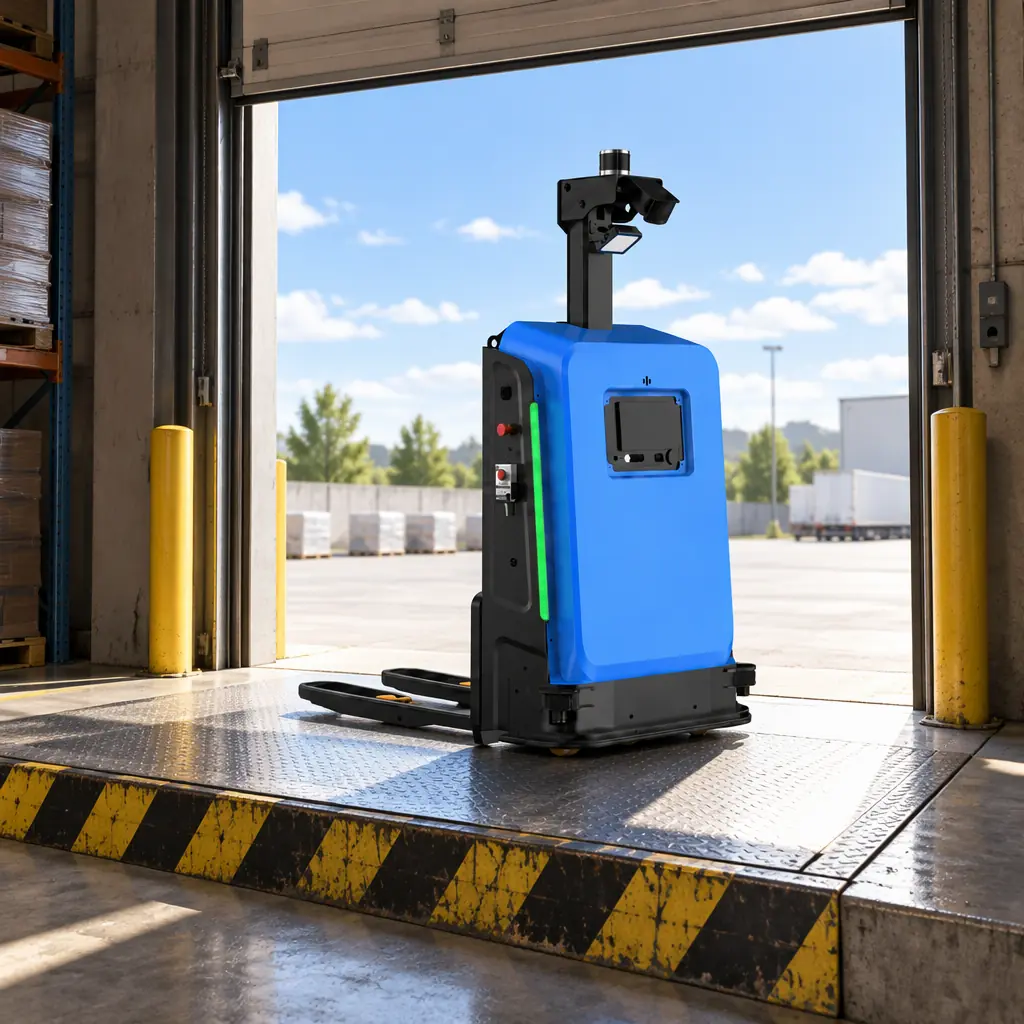
Ramp Gradient: Turning Percent Into a Traction Problem
Gradient is quoted as a percentage, which hides what actually changes. A 5 percent ramp rises 5 centimetres per metre. Over a 1.5 metre ramp that is 7.5 centimetres of lift, which sounds trivial and is not: the truck's drive wheels now carry a load vector that has a component pointing down the slope, and the traction available to hold position comes from the normal force on those wheels.
On a level floor a loaded pallet truck uses a large fraction of its motor torque to accelerate the load. On a ramp it uses torque to hold the load still. Calculated at the wheel, holding a 1,000 kilogram gross mass on a 5 percent grade requires roughly 490 newtons of tractive force, before any acceleration is included. That force has to come from friction between the drive wheel and the ramp surface. On dry sealed concrete the friction coefficient is comfortable. On a wet, dusty or oil-contaminated dock apron it is not, and the failure mode is a slow slide rather than a stop.
| Grade | Rise over 1.5 m ramp | Holding force at 1,000 kg gross | Where you meet it | Planning consequence |
|---|---|---|---|---|
| 2 percent | 3 cm | ~196 N | Mild dock apron camber | Normally within spec without derating |
| 5 percent | 7.5 cm | ~490 N | Typical dock leveller at mid-height | Specify wet-surface traction and a gradient derate for payload |
| 8 percent | 12 cm | ~785 N | Steep leveller at low trailer beds | Derate payload, check brake holding test, expect reduced speed |
| 10 percent | 15 cm | ~981 N | Fixed concrete ramps to a raised dock | Usually outside spec for a counterbalance pallet truck; use a different route |
The derate matters more than the headline. A machine rated for 1,500 kilograms on the level is commonly derated by 10 to 20 percent for continuous operation on a 5 percent grade, because the drive motor and brake are working against gravity in one direction continuously. Ask for the derate curve as a function of gradient, not a single number, and check it against your actual leveller angle rather than the datasheet's maximum.
Dock Levellers: Gap Width and the Lip Transition
A dock leveller is a hinged plate bridging the building floor and the trailer bed. Where it meets the building it is a hinge; where it meets the trailer it is a lip resting on the trailer's floor edge. Both ends are transitions, and both produce the two geometric problems that stop autonomous trucks: gap width and level difference.
The lip gap
At the trailer end the lip sits on the trailer bed, and the geometry of that contact changes with trailer type. A trailer with a worn bed edge, or a liftgate-equipped trailer whose bed sits lower than expected, leaves a step. Typical small-wheel pallet trucks tolerate gaps up to about 30 millimetres and level differences up to about 20 millimetres. Beyond that, the drive wheel drops into the gap, the unit loses its reference to the floor, and the safety scanners see a discontinuity they may interpret as an obstacle or as nothing at all depending on mounting height.
The hinge transition
At the building end the plate meets the floor at an angle that is largest when the trailer is high and smallest when it is low. A leveller operating at its upper travel limit produces an approach angle the truck must climb onto, and if the plate is not seated flat the truck climbs a short lip with no run-up. The angle at the hinge is not the gradient of the ramp; it is a step of two to four centimetres presented almost vertically.
| Tolerance | Typical limit | What it protects against | How to measure it on site |
|---|---|---|---|
| Maximum gap crossing | ~30 mm for small-wheel trucks | Drive wheel dropping into the lip gap and losing odometry | Feeler gauge or tape at the trailer end with the trailer at rest and loaded |
| Level difference at lip | ~20 mm | Wheel impact, load shock, false scanner trip | Straight edge across the lip with the trailer at both empty and loaded suspension height |
| Lateral tilt | ~2 degrees | Uneven wheel loading and one-sided slippage | Inclinometer across the plate width at both ends |
| Ramp gradient | Vendor derate curve | Loss of traction when holding a load | Inclinometer along the plate at mid-travel |
| Plate seating | Fully flat at both ends | Climbing an unseated lip with no run-up | Visual and feeler check at the hinge with the plate loaded |
The lip gap is also the tolerance most likely to change without anyone noticing, because it depends on the trailer rather than on the building. A fleet of twenty trailers includes at least one with a worn bed edge. The parcel locker handoff integration guide applies the same tolerance discipline to a different handoff surface, and the fire alarm and evacuation integration guide covers the case where a dock-adjacent route must clear on an alarm.
Measure these with the trailer at both empty and loaded suspension height. A trailer that sits correctly when empty can drop several centimetres when loaded, and the leveller follows it. The gap you measured before loading is not the gap the truck will cross.
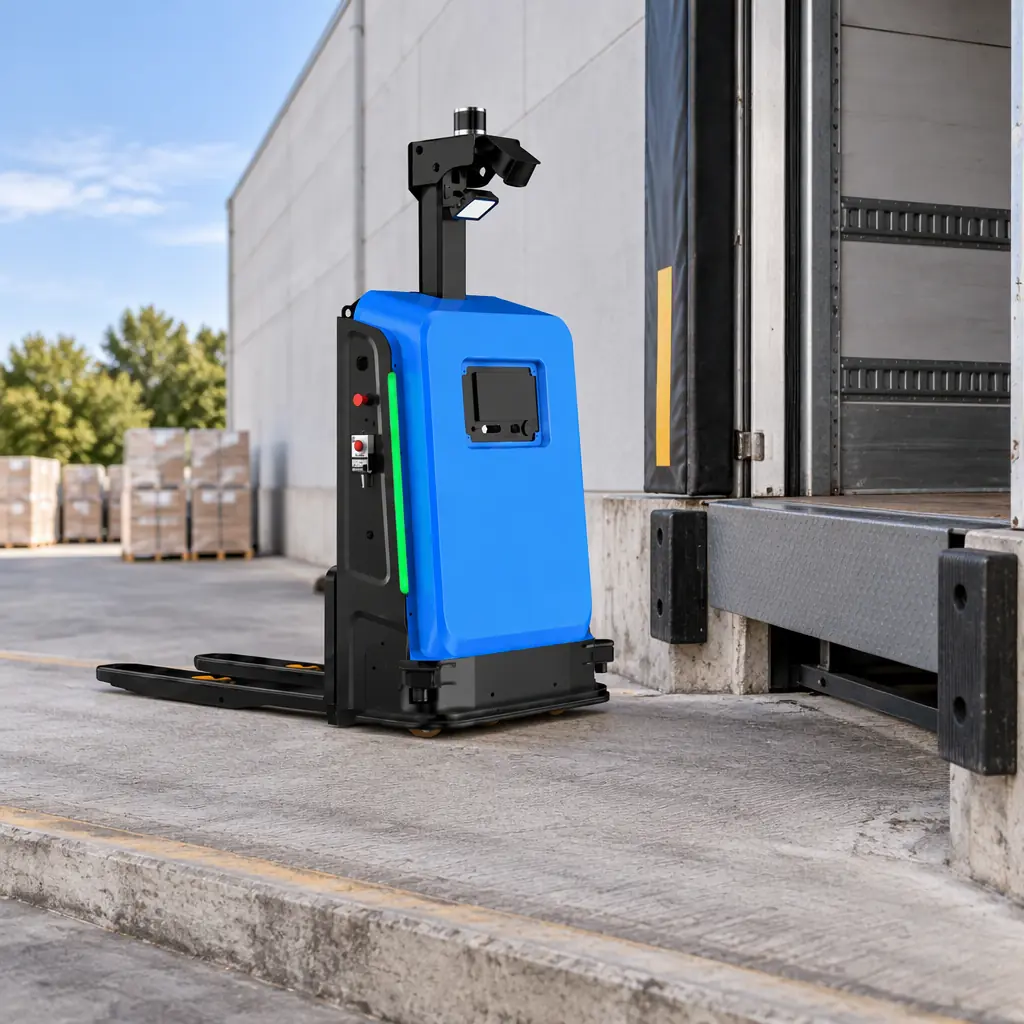
Trailer Floor Capacity: The Limit Nobody Checks
A loaded pallet truck is a concentrated point load. Its gross mass, up to 1,500 kilograms or more with a load, passes through small wheels onto a trailer floor built to carry freight distributed across its length and width. Trailer floors are engineered for a forklift, but the forklift is not the same machine: it has larger wheels, a different load distribution, and an operator who can see the bed condition.
What the truck needs is the wheel load, not the gross mass. A four-wheel pallet truck with a 1,200 kilogram gross mass distributes roughly 300 kilograms onto each wheel, but the peak at the drive wheel during acceleration can be substantially higher as load transfers rearward. Ask the vendor for the maximum wheel load and the contact patch size, then check those against the trailer floor's rated concentrated load. For standard dry-van trailers this is usually compliant. For older trailers, for refrigerated trailers with insulated floors, and for any trailer with visible deck damage, it is worth an explicit check.
Two conditions change the answer. A wet or contaminated deck reduces friction on the very surface the drive wheel depends on. And a trailer on suspension moves as the load enters: a loaded truck driving onto a lightly-laden trailer compresses the suspension, tilting the bed toward the dock. That tilt is added to the leveller gradient, and it is the reason the gradient at one moment is not the gradient a minute later.
The Interlock: What Must Stop the Truck Before the Edge
Every dock has an edge, and safety-field scanning is not sufficient on its own because the field is horizontal and the edge is a drop. A safety scanner mounted at 15 centimetres looks for obstacles at that height. It does not see the absence of floor. Three mechanisms together provide the protection, and a specification that names only one is incomplete.
Dock restraint and vehicle detection
The trailer must be mechanically restrained, not merely chocked, and the truck's operation must depend on that restraint's status. A wheel-engaged restraint with a status signal the truck can read is the arrangement to specify: if the signal is absent or the restraint is not engaged, the unit does not approach the door. This is also the mechanism that stops a truck driving into a trailer that has pulled away.
Door and leveller state
The unit should only cross when the door is fully open and the leveller is deployed and seated. Both states are available from the dock control system. Integrating them is a controls project, not a robot project, and it is the item most often deferred and then discovered to be the reason the safety case cannot be signed.
Floor-level edge detection
A floor scanner or a downward-facing sensor at the front of the forks, whose safety field extends past the fork tips, catches the case the horizontal field misses: the unit approaching an open door with no trailer present. Combined with a physical barrier that only opens under restraint, this closes the residual risk that a mis-set route sends a unit out of the door.
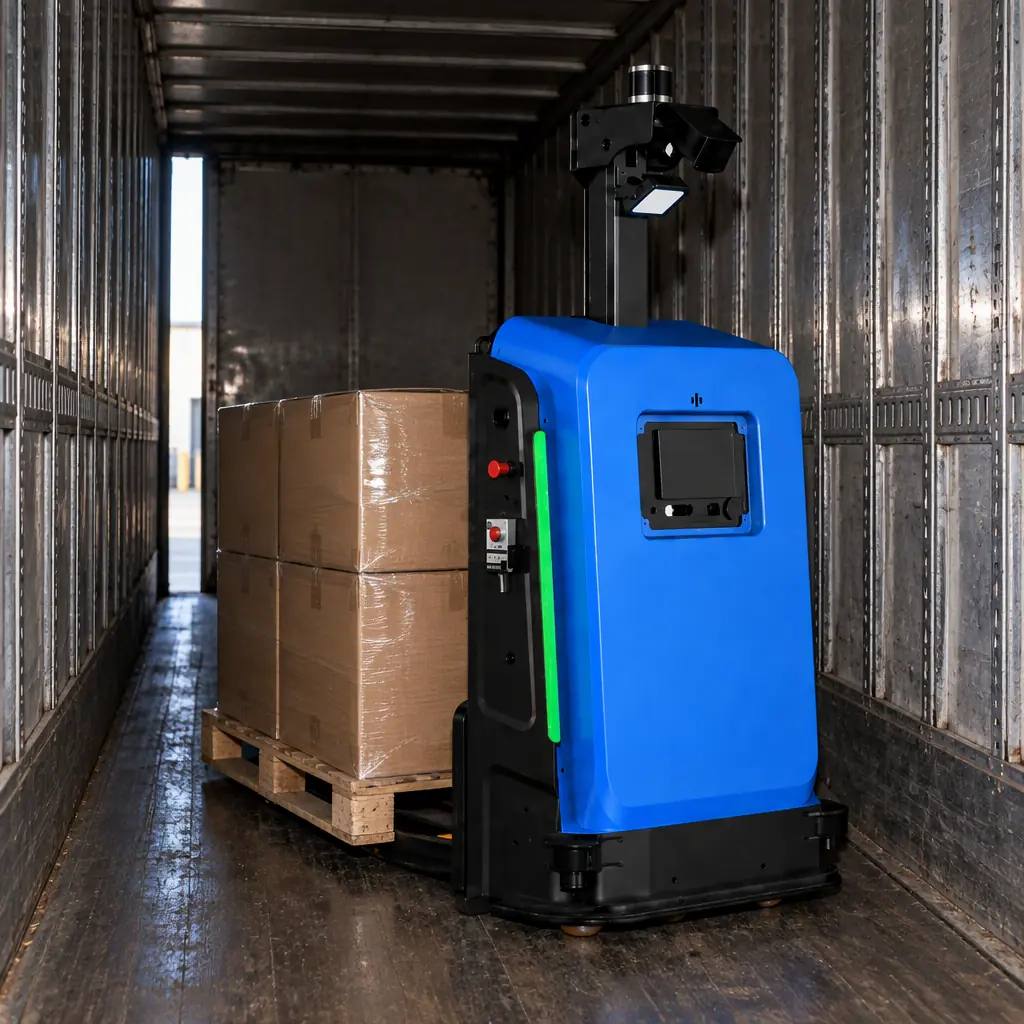

What Actually Fails In Service
Dock-related incidents cluster into four patterns, and all four are traceable to a specification that named a gradient but nothing else.
- Wheel in the lip gap. The drive wheel drops into a gap that widened as the trailer settled. The unit loses odometry and reports a localisation fault, or worse, keeps driving on a wrong pose. Detection: measure gap at loaded suspension height, specify a gap limit.
- Loss of traction on a wet apron. The gradient is within spec but the surface is not dry. The unit slips while holding a load and the position controller faults out. Detection: specify wet-surface traction and test it on a wet day, not a dry one.
- Driving off an open door. A route was taught or restored when a trailer was present. Detection: restraint status interlock and an edge safety field. This is the failure that produces a fall, and it is the one to design against first.
- Trailer floor damage. Peak wheel load exceeds a concentrated-load rating on an older deck. Detection: wheel load against deck rating, plus an inspection rule that the driver or the fleet supervisor checks the deck before entry.
Each pattern has a measurable specification line, and each line is cheap to write. The speed profile and deceleration guide covers how the approach speed on the ramp should be configured, and the dock and charger commissioning tolerances guide covers the same geometric discipline applied to the charging bay, which has a surprisingly similar set of tolerances.
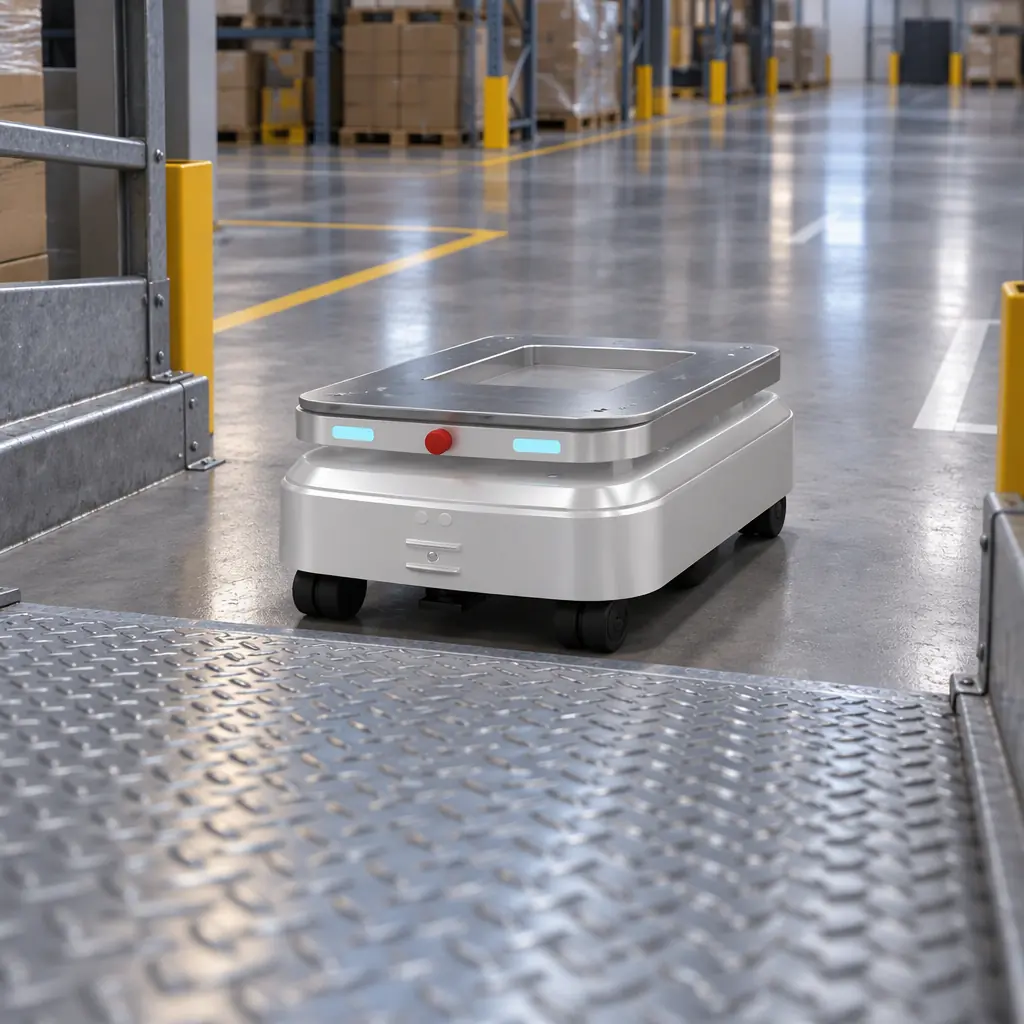
The Four Sentences for the Specification
Most dock failures are specified away at the procurement stage by four sentences. They belong in the technical annexe, not the marketing summary.
| Requirement line | Test method to name | Acceptance |
|---|---|---|
| Maximum negotiable ramp gradient at rated payload, with a stated derate curve above 3 percent | Loaded traverse up and down the customer's actual leveller at mid-travel, repeated with a wet plate | No traction fault, no position fault, stop and hold verified on the grade |
| Maximum gap crossing and level difference, wheels small-type, measured at loaded suspension height | Physical measurement at the trailer lip with the trailer loaded and empty | Gap and step within the stated limits; unit traverses without odometry loss |
| Peak wheel load and contact patch size | Vendor calculation plus weighbridge confirmation of gross mass | Peak wheel load below the trailer deck's concentrated-load rating |
| Dock interlock: restraint status, door state and leveller state as preconditions to approach; edge safety field active at all times | Functional test: remove each precondition in turn with the unit loaded and confirm the stop | Unit does not approach the door with any precondition absent; documented stop distance for each case |
Two of those four lines are about geometry and two are about controls. The geometry lines are cheap to verify on a site visit and they catch most of the risk. The controls lines require the dock equipment vendor to be in the conversation, which is the step that usually gets skipped until commissioning reveals the truck cannot read the restraint status. Put both equipment vendors in the same specification review, and the integration problem stops being a surprise.
For facilities where the dock is one part of a larger warehouse automation project, the industrial AMR selection planner covers the aisle and fleet arithmetic that sits upstream of this, and the safety standards and compliance guide covers the EN ISO 3691-4 obligations that the interlock design has to satisfy. AOMAN's FT2000 autonomous pallet truck is specified with the gradient derate curve and wheel-load figures as standard annexe documents, and the full product range shares the same dock integration interface across the AMR family.

Get a Quote
Tell us about your space and workload, we reply within 24 hours.