Indoor Air Quality Monitoring on Service Robots, Sensor Specs That Hold Up
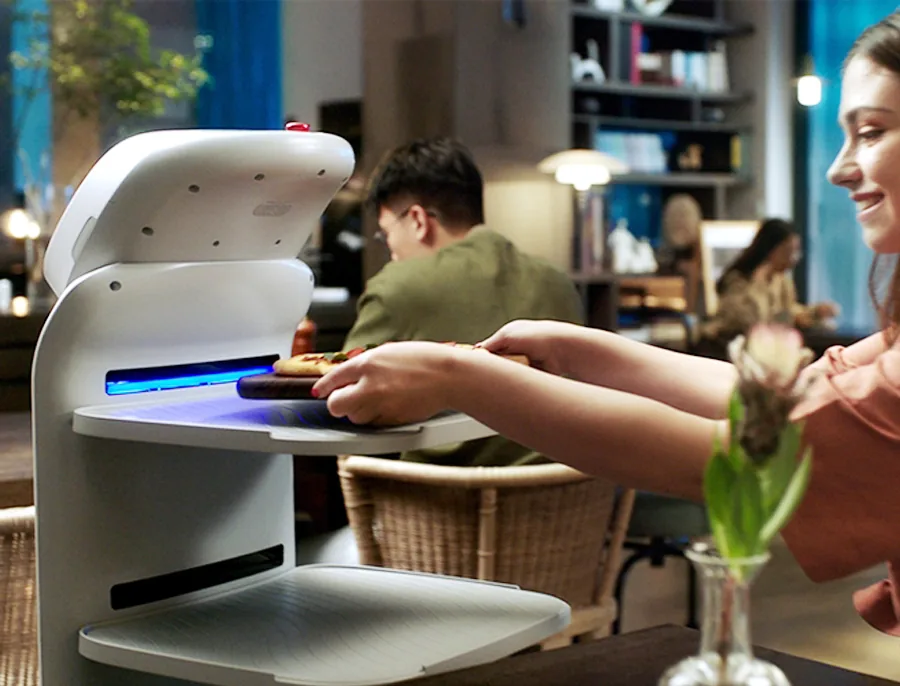
At a glance: A service robot already moves through every part of a building on a fixed schedule, which makes it an attractive host for indoor air quality sensors. The hardware is cheap; the data is only defensible if the sensor class, mounting height, calibration interval and sampling logic are specified before purchase. This guide covers each.

Why a Moving Sensor Beats a Fixed One in Some Buildings
Fixed IAQ sensors are installed where there is power and a network drop, which is rarely where people actually sit. A building with 40 sensors on walls may have none in the two rooms that generate the most complaints. A robot that already traverses the floor plate on a route can carry the same sensors anywhere on that route, and because it moves, it produces something a fixed grid cannot: a spatial map of how air quality varies across the floor at the same moment.
That capability only holds if the sensors are specified honestly. A robot moving at walking speed with a consumer-grade particle sensor produces numbers that look precise and are not. The sections below set out what to require.
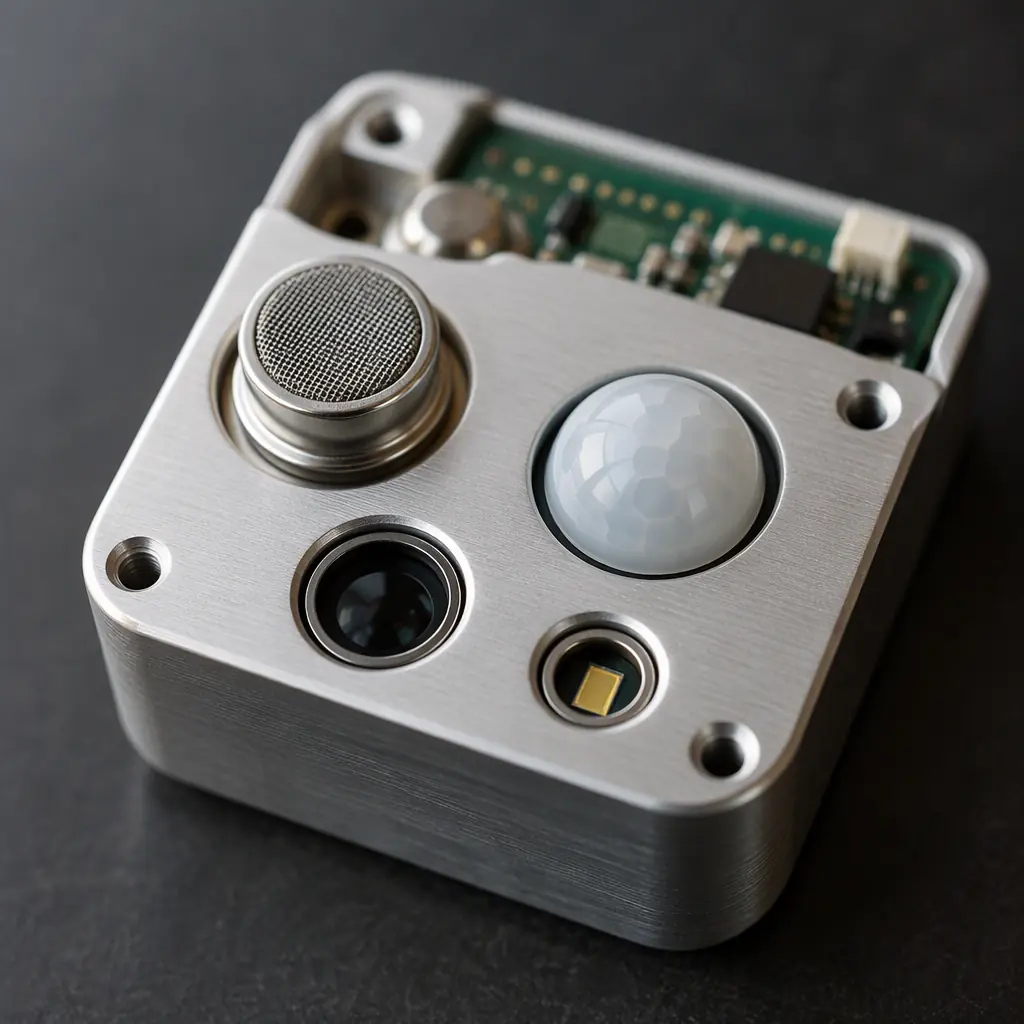
Sensor Class, PM, CO2 and VOC
Three measurement families matter most in commercial indoor air quality, and each has a specific technology split that determines whether the data is defensible.
| Parameter | Technology that holds up | Cheap substitute to avoid |
|---|---|---|
| PM2.5 and PM10 | Optical laser scattering with a fan-assisted flow path | Unaspirated sensors that rely on ambient air movement |
| CO2 | NDIR, non-dispersive infrared, true CO2 measurement | eCO2 estimated from VOC sensors, reported as if it were CO2 |
| VOC | MOX metal-oxide sensor reported as a relative index, not a concentration | Values quoted as parts per billion from an uncalibrated MOX element |
| Temperature and RH | Independent digital sensor, not derived from the VOC element | Humidity inferred from the gas sensor, drifts badly |
The single most common specification error is accepting eCO2 as CO2. eCO2 is a modelled value derived from total VOC response and it does not track CO2 concentration reliably in a room with occupants and no combustion source. If the purpose of the deployment is ventilation assessment, the specification must say NDIR and the vendor must name the sensor part.
Mounting Height and The Breathing Zone
Air quality is not uniform with height. CO2 accumulates where people breathe, and particulate settles. A sensor mounted in the base of a robot, 200 to 300 mm above the floor, samples a boundary layer that is not representative of the breathing zone at 1,100 to 1,700 mm, and it samples the dustiest few centimetres of the room.
The practical requirement is a sensor head at or near seated breathing height, with the intake not obstructed by the robot body and not placed directly above the drive wheels or the cleaning head. On a platform that also cleans, the sensors must be sited so that dust raised by the machine itself does not pass through the intake. This is a real effect: a robot scrubber working dry edges can raise a measurable local PM spike from its own operation, which will appear in the data as if the room were contaminated.
The specification should state the sensor intake height in millimetres and require the vendor to demonstrate the machine's own contribution to PM readings in a clean room, as a baseline offset.
Calibration, Drift and The Maintenance Interval
Optical particle sensors drift as the optical chamber accumulates dust, and cheap MOX VOC sensors drift with age and humidity. Neither failure is visible in the data stream, because a drifting sensor reports a plausible number. This is what separates a monitoring installation from a measurement installation.
Requirements that keep the data usable over a multi-year deployment:
- Stated calibration interval per sensor class, typically 12 months for optical particle counters in indoor use, and a published field-calibration procedure rather than a factory-only return.
- Reference comparison at commissioning. At least one co-located reference-grade instrument or a calibrated handheld, with the offset recorded, so the robot sensor can be corrected to it.
- Raw and corrected values both logged. A system that only reports a post-calibration number cannot be audited.
- A drift alarm. The platform should flag when a sensor's output diverges from its co-sensors beyond a threshold, so a failed unit is detected between calibration visits.
A sensor that is never calibrated is still useful for relative trends across a single deployment, and useless for any statement about absolute air quality or compliance.

Sampling Logic, Speed and Averaging
A robot does not sample a point, it samples a path. Two design choices determine data quality.
First, motion. An aspirated particle sensor needs a stable flow across its optical chamber, and the flow can be disturbed if the robot is accelerating hard or if the intake is in a turbulent wake. The platform should pause or slow at defined measurement stations rather than reporting instantaneous values while travelling. A defensible pattern is a dwell of 30 to 60 seconds at each station, on a route that revisits the same stations on a fixed cycle so readings are comparable over time.
Second, averaging window. Report a one-minute average rather than a spot reading, and publish the raw sample rate alongside it. A single instantaneous PM2.5 value from a moving sensor is noise; a one-minute average at a fixed station, repeated daily at the same station, is a trend you can act on.
What the Data Is Actually For
It is worth being clear about the purpose before buying hardware, because the sensor specification depends on it.
- Complaint resolution. Correlating a reported discomfort with a location and a time. Requires good spatial coverage and moderate absolute accuracy. A consumer-grade aspirated sensor is often adequate.
- Ventilation assessment. Deciding whether a space is under-ventilated. Requires true NDIR CO2 and a defined occupancy reference. Cheap sensors will not do.
- Compliance or certification reporting. Any external claim. Requires reference-grade instruments, formal calibration traceability and a documented method. A robot sensor can contribute coverage but rarely can be the sole instrument.
Most commercial deployments start at the first purpose and grow into the second. Specifying for the second from the start costs little more and avoids replacing the fleet a year in.
The Takeaway
A service robot is a good host for indoor air quality sensors because it already moves. The value comes entirely from the specification: true NDIR for CO2, aspirated optical sensors for particulate, a sensor head at breathing height, a stated calibration interval with a commissioning reference, and sampling at fixed stations rather than continuously in motion. Get those five right and a cleaning or delivery fleet becomes a genuine air quality record for the building. Skip them and the platform produces a confident stream of numbers nobody should rely on.