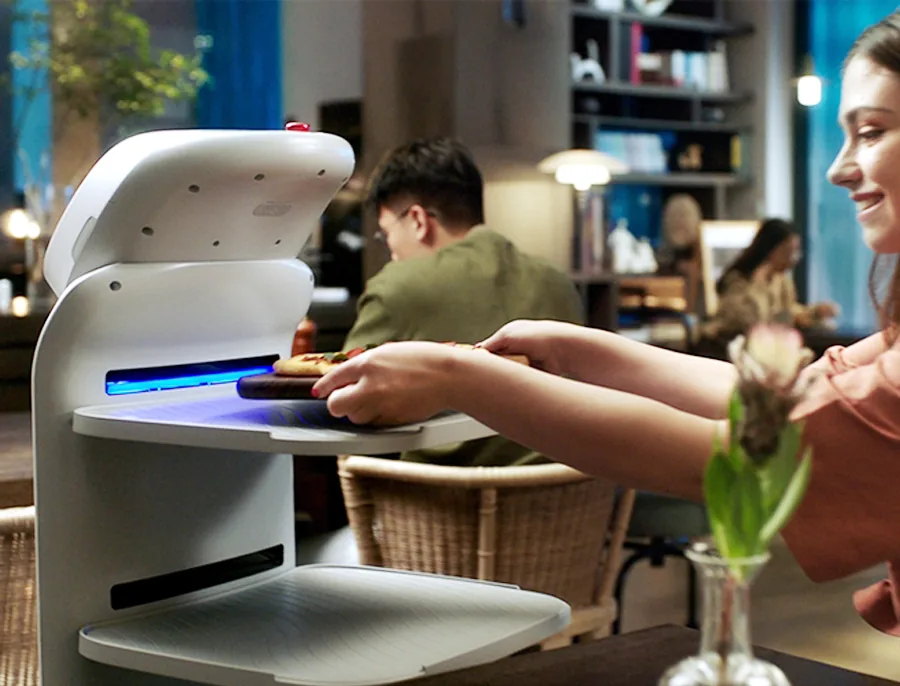
Hotel Minibar Restock Robots: A Consumption-Rate Model
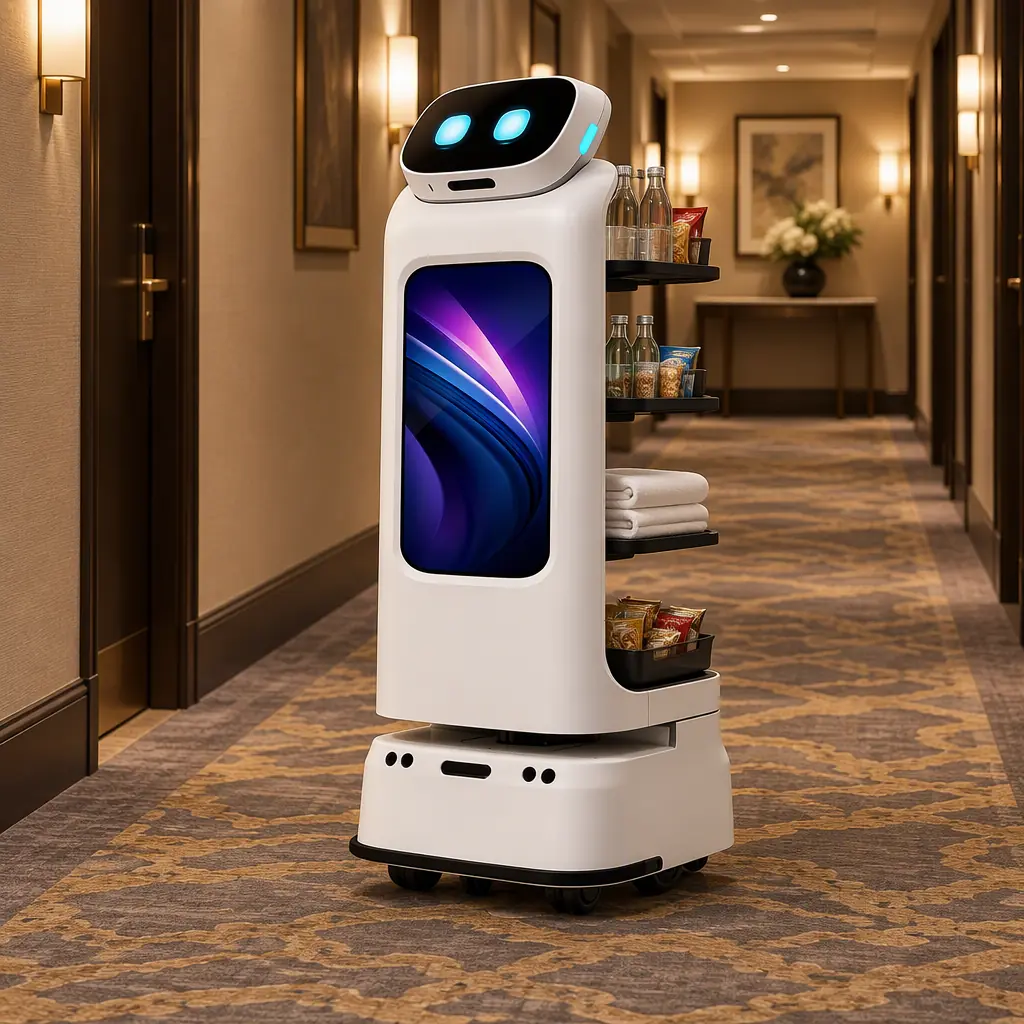
The Minibar Is a Revenue Line That Behaves Like a Stock Problem
Ask a hotel operations director about minibars and you will hear about labour. Ask the finance director and you will hear about margin. Both are describing the same thing from different ends: a minibar is a small retail operation with a very high cost per transaction, and the reason it costs so much per transaction is that replenishment is scheduled by habit rather than by consumption.
The habit is daily round. A housekeeper opens every minibar on every departure, notes what is missing, and reports it, and the bar is restocked whether it sold two items or nothing. In a 200-room hotel at 75 percent occupancy that is 150 room inspections a day to recover a handful of items. The labour is real but the labour is not the problem. The problem is that the schedule carries no information about the rate at which the stock actually leaves the building, so it can neither be compressed on quiet nights nor extended on busy ones.
Once you reframe minibar restock as a consumption-rate model, two things happen. The trip schedule becomes a function of occupancy and price rather than a rota convention, and the machine requirement becomes a small, defensible number rather than a headcount assumption. This article builds that model with real hotel arithmetic, and it deliberately includes the parts where the numbers do not work, because a minibar business case that only lists the wins is a business case that gets rejected in the second meeting.
Revenue per Occupied Room-Night Sets the Whole Model
Start with what a minibar actually earns, because that figure caps everything downstream. Minibar capture rates vary enormously by property type, and the difference between a resort and a business hotel is bigger than the difference between two suppliers of the same robot.
| Property type | Typical minibar penetration | Average items per participating room-night | Revenue per occupied room-night |
|---|---|---|---|
| City business hotel, 4-star | 12 to 18 percent | 1.4 | 0.45 to 0.95 |
| Airport hotel, single-night stays | 20 to 28 percent | 1.2 | 0.55 to 1.05 |
| Resort, 5-star | 35 to 50 percent | 2.1 | 2.20 to 4.40 |
| Extended-stay serviced apartment | 45 to 60 percent | 2.6 | 1.60 to 2.90 |
The figures assume an average item price between 3.50 and 6.00 in the local currency unit, which is where most hotel minibars sit outside luxury. Read the second column carefully: at a city business hotel, four out of five room-nights consume nothing from the minibar. That single fact is what makes daily inspection wasteful, and it is also what makes consumption-rate scheduling worth building.
Take a 200-room property at 75 percent occupancy, so 150 occupied room-nights a day. At a 15 percent penetration and 1.4 items per participating room-night, that is 21 participating room-nights and roughly 31 items a day. Thirty-one items, spread across 150 rooms, over 200 rooms of stock to check. The restock task is therefore overwhelmingly about visiting rooms, not about carrying goods.
Why the Labour Cost per Item Is Absurd Before Any Robot Arrives
Put a number on the current process. A minibar check on a departure room takes 90 seconds including the walk from the corridor, the inspection, the note and the door close. A check on an occupied room that must not be disturbed takes longer, because the housekeeper has to coordinate with the room status board and often wait.
At 150 room inspections a day and 90 seconds each, that is 225 minutes, or 3.75 hours of housekeeping time per day. Against 31 items sold, the labour content is 7.3 minutes per item sold. At a loaded housekeeping cost of 18 per hour, the labour cost per item is about 2.20, against an average item price of 4.50. The minibar is operating on roughly a 49 percent gross margin before the cost of the goods, the stock write-off, and the energy of the fridge.
Now the important part. No robot fixes that arithmetic by driving faster. The arithmetic improves when inspections stop being daily and start being triggered by evidence of consumption. That evidence already exists in most properties and is simply not used: the minibar fridge sensor, the door-open event on a smart lock, the point-of-sale record if the bar is self-service, or the housekeeping app entry. A property that can trigger a restock visit on evidence rather than on habit has already removed the majority of the wasted visits before any machine is involved.
Which raises the question this article has to answer honestly: if sensor-triggered inspection removes most of the labour, what is the robot for?
What the Robot Actually Does: Three Distinct Jobs
Delivery robots enter the minibar process in three places, and they are worth separating because each has a different payback logic.
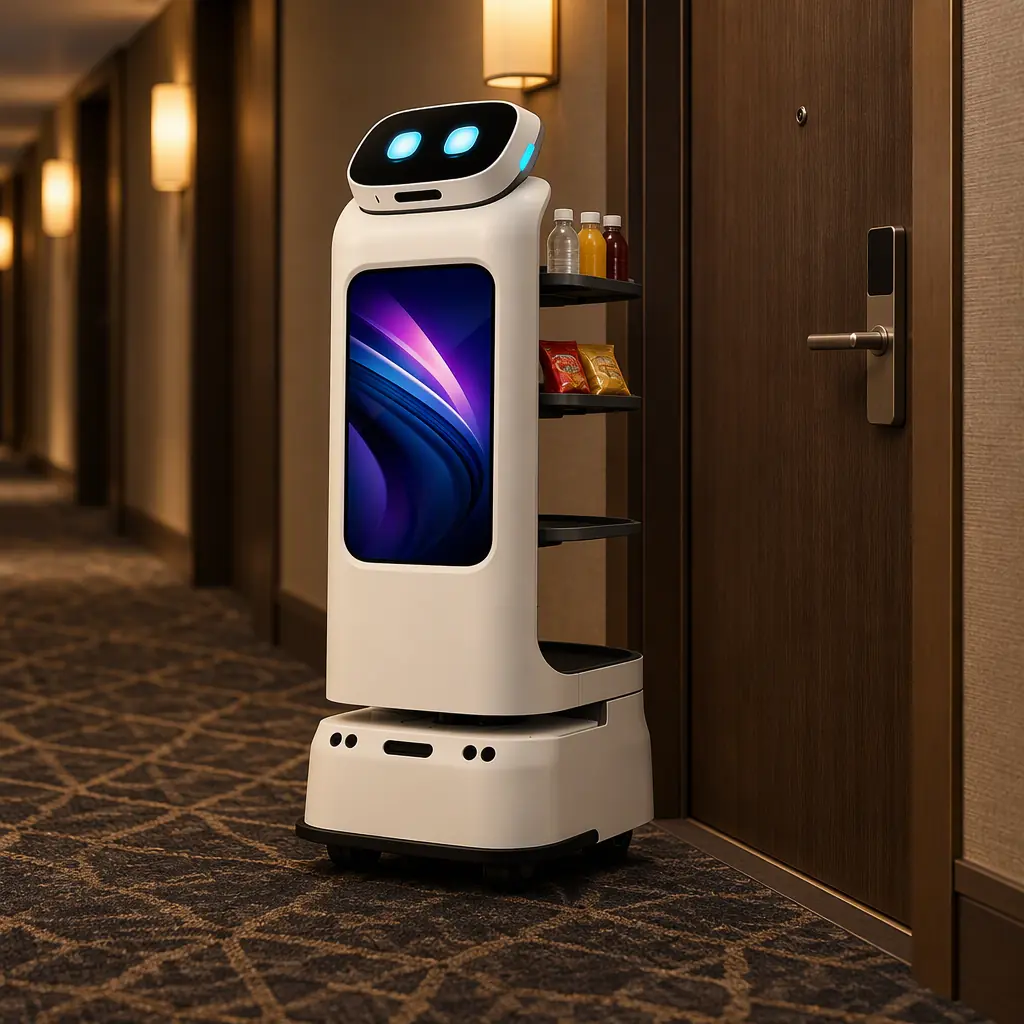
Job one: the stock run. Moving replacement items from the store to the floor rather than having a housekeeper carry a trolley. A housekeeper trolley loaded with minibar stock is heavy, and the 40 kg class of machine can replace the carrying but not the placing. The recovery is measured in the minutes a housekeeper no longer spends pushing a cart through service corridors, typically 25 to 45 minutes per floor per shift.
Job two: the guest-facing replenishment. In properties where a guest can request items through the room tablet or the app, the machine delivers to the door and the guest collects. This removes a room-entry visit entirely and is the only variant with a guest-experience benefit rather than a labour benefit, because it can run outside housekeeping hours. The door handoff problem it creates is the subject of guest room delivery and the door handoff.
Job three: the audit run. A machine carrying a scanner rather than stock, moving floor by floor to capture fridge status, and returning with a consolidated restock list. This is the variant that actually attacks the 225 minutes, because it separates the inspection from the restock. It requires the machine to be fitted with the sensor payload rather than trays, and it requires the property to accept that a machine is looking at fridges rather than a person.
Most properties that succeed start with job one, because it is the lowest-risk change and it produces a measurable time saving inside two weeks. Job three is where the real arithmetic lives, and job two is a marketing decision that happens to be delivered with hardware.
The Trip Schedule by Occupancy Band
Once the visits are triggered rather than scheduled, the dispatch volume becomes a function of occupancy and penetration, and it varies through the week in a way a fixed rota cannot follow.
| Occupancy band | Occupied room-nights (200 rooms) | Items sold per day at 1.4 per participating night | Restock visits per day | Machine trips if 8 items per trip |
|---|---|---|---|---|
| 45 percent, quiet Sunday | 90 | 19 | 12 | 2 |
| 65 percent, midweek | 130 | 27 | 17 | 4 |
| 78 percent, standard weekday | 156 | 33 | 20 | 5 |
| 95 percent, sold out with a conference | 190 | 40 | 24 | 6 |
The visit column assumes a 50 percent trigger efficiency, meaning that when a room reports a consumption event the property restocks that room and clusters it with neighbours on the same corridor. Clustering is what makes the trip count small: a single visit that services four adjacent rooms converts four trips into one, and the machine cost per item collapses accordingly.
The trip spread from two to six a day is the reason a shared machine makes sense rather than a dedicated one. A dedicated minibar machine would idle through most of a Sunday and queue on a sold-out Tuesday. A machine that also carries linen, amenities and guest requests absorbs the variance, and the minibar share of its duty cycle is what you should quote in the business case rather than a full-time equivalent.
For the wider question of what a flexible delivery chassis does in a hotel beyond minibars, the operational pattern in hotel housekeeping and the room-credit model is the companion piece, since both routes draw on the same corridor time.
The 40 kg Trolley Problem and Where the Payload Ceiling Bites
Here is the first place the numbers turn against the machine, and it is worth stating plainly. A loaded minibar restock trolley is heavy. A standard housekeeping trolley carrying linen, amenities and 40 to 60 minibar units across bottles, snacks and canned drinks typically weighs between 37 and 45 kg, and the minibar share alone is often 18 to 26 kg. A delivery unit rated at 40 kg across four tray positions will carry the minibar component comfortably and the full combined trolley not at all.
That is not a reason to reject the machine. It is a reason to split the job, and the trip arithmetic that shows why the split is cheaper than a bigger chassis is in delivery robot payload capacity and fleet sizing. The correct configuration for minibar restock is a dedicated tray load of stock only, with linen and amenities continuing on the housekeeping cart. Attempting to replicate the whole trolley on a delivery chassis produces a machine loaded to its limit, which then cannot climb the 5 degree ramp at the service end of the floor, and the operators quietly stop using it. The payload arithmetic for this split is set out in payload capacity and fleet sizing.
There is a second ceiling that surprises properties: tray geometry. Minibar stock is a mix of long bottles, flat snack packs and boxed items, and a 484 by 551 mm body with four standard trays will not accommodate a 750 ml bottle standing upright in every position. Measure the actual SKU list, including the longest and tallest item, before configuring trays. A property that buys the standard four-tray configuration and then discovers it cannot carry its own wine list has bought the wrong thing for a reason that had nothing to do with payload.
Cold Chain, Expiry and the Shrinkage Nobody Measures
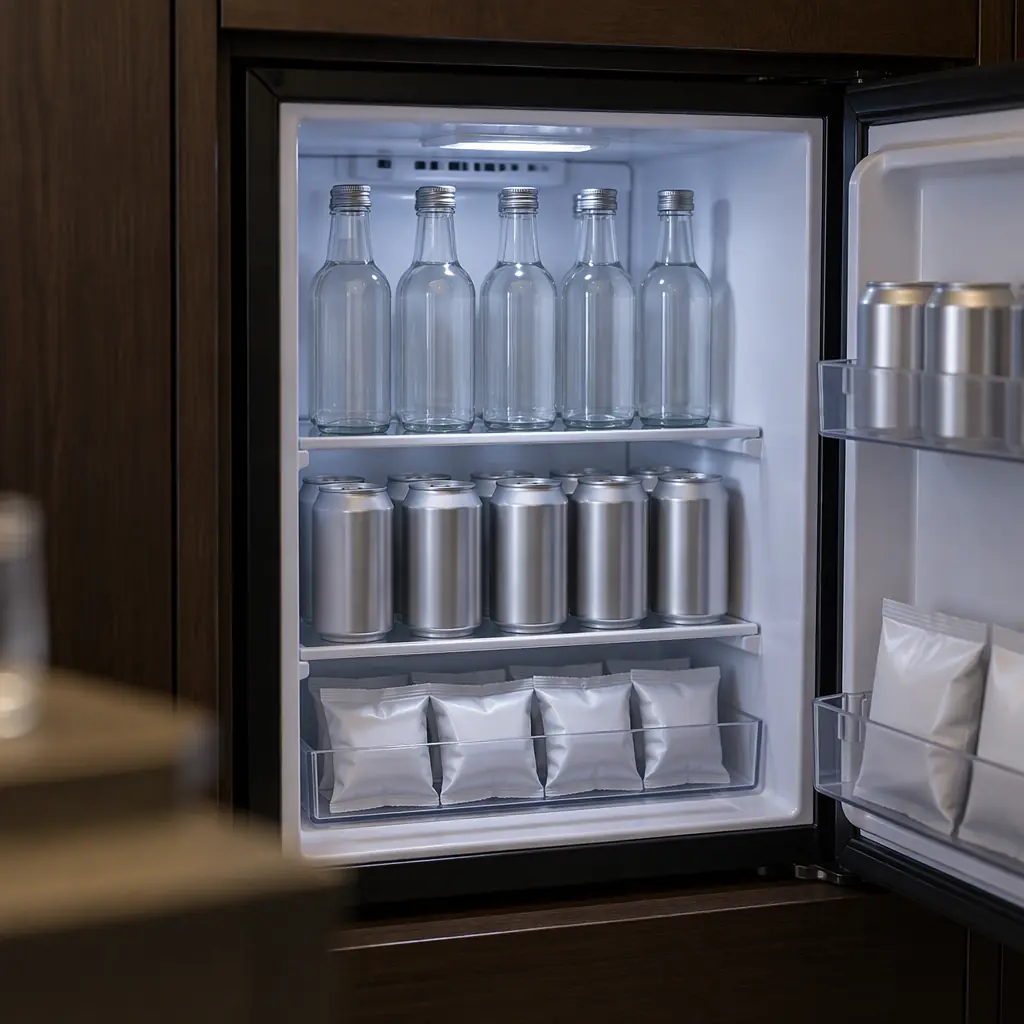
Minibar stock is partly perishable, and that changes both the economics and the compliance requirements. Chilled items have a defined temperature window, and the delivery leg between the store and the room is a gap in the documented chain unless the machine's cabin is capable of holding temperature.
Three requirements matter in practice:
- The holding window. Chilled stock typically needs to stay at or below 5 degrees from store to placement, and the time budget for the trip has to fit inside that holding capability. If a machine's cabin is uninsulated, the chilled component must be the last item collected and the first placed, which constrains the route order rather than the payload.
- The temperature record. Properties with a food safety management system are expected to demonstrate cold chain control, and a machine that cannot log its cabin temperature during a trip creates a documentation gap that most auditors will raise. Ask whether the unit can record and export cabin temperatures, and if not, keep chilled items out of the machine.
- Expiry and write-off. Minibar stock is stocked to a par level per room, and par levels set against a weekly delivery cycle overstock slow-moving rooms badly. Consumed-item data is what allows per-room par levels to drop, and reducing a par level from three units to two across 200 rooms at an average cost of 1.90 per unit releases 380 of working capital with no operational change at all.
The write-off figure is the one hotels least often measure. A minibar item that expires in the room is a total loss plus the labour of the inspection that found it, and in properties without consumption data the write-off rate typically runs between 4 and 9 percent of stock value. Tracking consumption by room and by SKU is what brings it down, and the machine's delivery log is a usable source of that data if the property is willing to read it.
A Worked Case: 200 Rooms, Mixed-Use, One Shared Machine
Bring the model together on a mid-market city property with a conference floor.
| Input | Value | Source |
|---|---|---|
| Rooms / floors | 200 across 7 guest floors plus conference level | Property schedule |
| Occupancy, annual average | 76 percent | PMS history |
| Minibar penetration | 16 percent of occupied room-nights | POS and housekeeping reports |
| Average minibar revenue per occupied room-night | 0.72 | Annual minibar revenue divided by occupied room-nights |
| Current inspection labour | 3.6 hours per day | Time study on two floors |
| Trigger data available | Smart lock door events plus housekeeping app | Existing systems |
| Minibar share of a shared machine duty cycle | 22 percent | Modelled against total delivery demand |
The revenue line is 200 rooms at 0.76 occupancy, so 152 occupied room-nights at 0.72 each, which is about 109 of minibar revenue a day, or roughly 40,000 a year. Against that, the property currently spends 3.6 hours a day on inspection, which at 18 per loaded hour is about 65 a day, or 23,600 a year. The inspection labour is more than half the revenue, and that is before the goods cost. This is the number that makes minibar restock worth redesigning.
Switching to triggered visits on door-event data plus clustered corridor runs removes an estimated 55 to 65 percent of inspections, which recovers 2.0 to 2.3 hours a day. That saving alone, at 18 per hour, is 13,000 to 15,000 a year. It does not require a robot. It requires the data feed, which is why the first recommendation to this property is not a machine at all.
The machine's contribution is different and smaller. Using 22 percent of a shared unit's duty cycle for minibar stock runs, and occupying perhaps 90 minutes of corridor time a day, it converts a housekeeper trolley run into a scheduled trip and reduces the number of times a loaded cart is pushed through a floor. The defensible saving is in the region of 35 to 50 minutes of housekeeping time per day, plus the guest-facing replenishment option after 22:00 which is genuinely new capability. Valued at 18 per hour that is 4,300 to 6,100 a year, against a shared share of the unit's five-year cost.
That is the honest shape of the case: the process redesign carries most of the saving, and the machine carries a smaller but real increment plus a service improvement. A property that presents the two together gets a decision. A property that presents the machine alone as a labour replacement gets a rejection, because the arithmetic does not support it.
What to Specify Before You Buy
- Which job is the machine doing? Stock runs, guest-facing replenishment and audit scans need different payloads, and a property that buys for stock runs and expects audit capability will be disappointed. State the job in the specification.
- How does the machine reach the floor? Guest floors require a lift, and a guest lift used by a stock machine outside housekeeping hours is a guest-experience problem. The interface requirements are in elevator integration for multi-floor deployments.
- Can it hold and log temperature? If chilled minibar items are in scope, the answer has to be yes to both, and the log has to be exportable for the food safety file. The compliance background is in HACCP and food safety compliance.
- What is the tray wash cycle? Minibar stock leaves sticky residue and trays are cleaned daily. Two tray sets per machine is the working minimum, and the wash time determines the spare count.
- Who reconciles consumption to billing? A machine delivery log is only useful if it posts to the guest folio. Ask how the delivery event reaches the PMS, because a log that has to be transcribed by hand will not be transcribed.
- What happens when a guest is in the room? A door handoff at 14:00 is an intrusion and at 23:00 is a service. Time-of-day rules belong in the configuration, not in staff memory. Failure and retry behaviour generally is in service robot failure modes.
Minibar restock is one of the few hospitality robot applications where the honest advice is to fix the data before buying hardware. Do that first, then size the machine against the residual work, and the case will hold up in year three rather than only in the pilot report.