A 35,000-case Napa Valley estate winery operates three parallel businesses under one P&L: a production facility running 14-hour crush shifts during harvest, a barrel room housing 2,800 barrels across 22,000 square feet of climate-controlled space, and a tasting room that serves 280 visitors per day at $45-125 per experience. The winery's operations director identified a structural tension in the labor model: production requires staff who can operate a bladder press and monitor fermentation kinetics; hospitality requires staff who can discuss terroir, vintage variation, and food pairings with a sommelier's vocabulary. These are different people, different wage scales, and different peak-demand patterns — harvest peaks in September-October when tasting room traffic is 40% below summer highs.
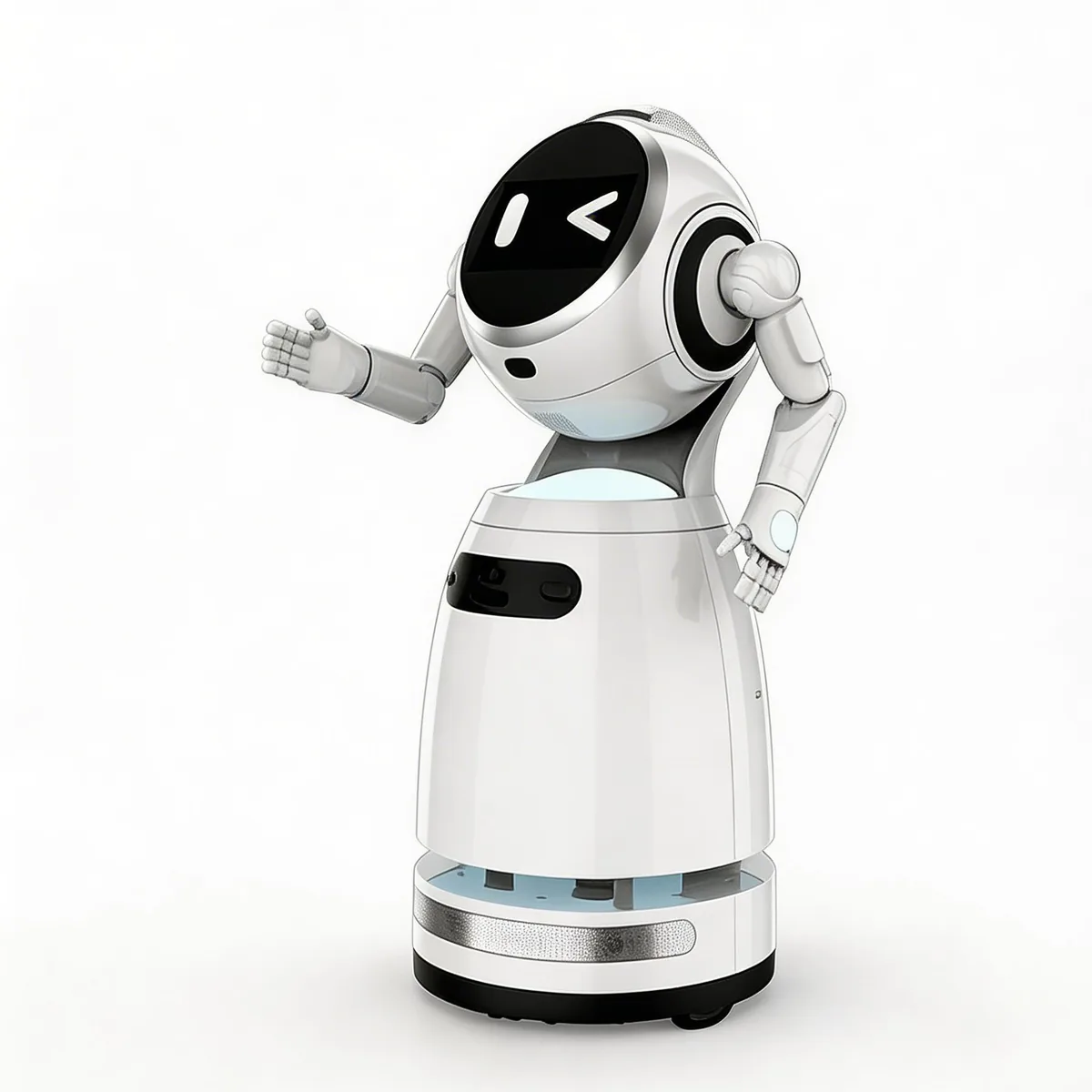
In Q1 2026, the winery deployed CRUZR humanoid reception robots in the tasting room entrance and CLEINBOT C2 Pro autonomous floor scrubbers across the production facility. The CRUZR unit handles visitor check-in, provides a 3-minute pre-tour orientation covering the estate's history and winemaking philosophy, and routes guests to the appropriate experience tier (standard tasting, reserve tasting, or private library tasting). The CLEINBOT units maintain production-floor sanitation on a 90-minute cycle — critical during crush when grape must, yeast nutrients, and potassium metabisulfite create slippery, sticky residues that accumulate faster than a nightly sanitation crew can address.
The Tasting Room Economics: Why a 12-Minute Wait Costs $18,000 Per Month in Lost Tasting Fees
Napa Valley tasting room data from the 2025 Wine Business Monthly Direct-to-Consumer Survey reveals a pattern familiar to any hospitality operator: the conversion rate from walk-in to paid tasting drops by 3.2 percentage points for every 5 minutes of lobby wait time beyond the 2-minute threshold. A tasting room averaging 280 daily visitors with a $65 average tasting fee loses approximately $580 per day — $17,400 per month — to walk-aways caused by lobby congestion during the 11 AM-2 PM peak window, when 60% of daily visitors arrive within a 3-hour span.
CRUZR addresses the bottleneck with parallel processing. When three parties arrive simultaneously — a common occurrence at 11:05 AM on a Saturday — a single human host can engage one party while CRUZR engages the other two simultaneously: greeting, qualifying ("Have you visited us before? Are you interested in a standard or reserve tasting?"), and beginning the pre-tour orientation. The human host transitions from "greet everyone sequentially" to "handle the one party that needs human judgment" (the couple celebrating an anniversary who want to discuss a library vertical) while CRUZR manages the routine throughput. This is the same parallel-processing dynamic that transformed check-in efficiency in hotel and resort deployments, where robot concierges reduce peak-hour lobby congestion by handling the 80% of guests with standard check-in needs.
The tasting room economics extend beyond conversion rates. A CRUZR unit programmed with the estate's full wine library — 14 current releases, 8 library wines, 4 large-format offerings — acts as a 24/7 product specialist that never forgets a vintage detail. When a guest asks "What's the difference between the 2019 and 2020 estate Cabernet?" the robot retrieves the exact growing degree days, harvest dates, oak program (75% new French vs. 60%), and bottle-aging duration for each vintage — information that even experienced tasting room staff may need to look up. The effect on average order value is measurable: at wineries using knowledge-augmented service tools, per-visitor wine sales average 22% higher than at wineries relying on staff memory alone, according to industry sales data from Commerce7's 2025 benchmarking report.
For organizations evaluating the financial case across multiple deployment scenarios — from single-estate wineries to multi-brand beverage groups — the RaaS financing models guide and the budget planning framework provide cost-modeling structures that accommodate seasonal revenue patterns common in beverage production.
Production Floor Sanitation: When Your Tank Room Has Higher Hygiene Standards Than a Hospital
Beverage alcohol production operates under a regulatory framework that most manufacturing sectors do not face: the Alcohol and Tobacco Tax and Trade Bureau (TTB) in the United States, the Food Standards Agency in the UK, and equivalent bodies globally impose sanitation requirements that are closer to pharmaceutical GMP standards than to general industrial cleaning. A fermentation tank that develops a Brettanomyces infection can contaminate an entire vintage — a six-figure loss at the estate-winery level and a brand-reputation event that takes years to recover from.
The sanitation challenge is temporal, not procedural. A winery production crew knows exactly how to clean and sanitize a 5,000-gallon stainless steel tank: triple-rinse, caustic cycle, acid passivation, hot water sanitization, ATP swab verification. The problem is that this process takes 45 minutes per tank, and during harvest, a winery may need to turn tanks in 12-hour cycles to receive the next day's fruit delivery. When the cleaning crew is simultaneously managing press cleanup, sorting-line sanitation, and must-pump maintenance, the tank cycle stretches to 90 minutes — and the fruit sits in a refrigerated truck accumulating enzymatic browning while the tank is unavailable.
CLEINBOT C2 Pro does not clean tanks — that requires specialized CIP (clean-in-place) equipment. What CLEINBOT does is eliminate the floor sanitation burden from the production crew's task stack, freeing 12-15 labor-hours per week during harvest that can be redirected to tank turnaround. The robot handles barrel-room floors (sugar-rich wine seepage that attracts fruit flies and promotes mold), fermentation-hall floors (potassium bitartrate crystals, yeast slurry, water from glycol-line condensation), and crush-pad surfaces (grape skins, stems, seeds, and juice tracked across 4,000-8,000 square feet of concrete by forklifts and bin dumpers).
The regulatory dimension is equally important. TTB inspections and third-party audits (ISO 22000, BRCGS for food safety) evaluate floor sanitation as a vector for cross-contamination between production zones. A CLEINBOT operating on a validated 90-minute cycle with logged cleaning events creates an auditable sanitation record that satisfies the documentation requirements that increasingly accompany food-safety certifications. This is the same compliance logic driving adoption in pharmaceutical GMP manufacturing facilities and laboratory and cleanroom environments, where autonomous cleaning with digital logs replaces manual cleaning with paper checklists that are notoriously vulnerable to "pencil-whipping" — signing off on cleaning tasks that were not actually performed.

The Distillery Barrel Warehouse: A 50,000-Square-Foot Labor Desert
Distilleries present a spatial challenge that wineries and breweries generally do not: the barrel warehouse. A mid-size craft distillery producing 5,000-15,000 proof gallons annually may operate a rickhouse containing 3,000-8,000 barrels stacked 6-9 high across 30,000-60,000 square feet. These environments are dark (UV degrades aging spirits), poorly ventilated (airflow is controlled to manage the angel's share evaporation rate), and arranged in narrow aisles (36-48 inches) between barrel racks that forklifts cannot navigate.
The distillery's operational pain point is barrel sampling for quality control. Every barrel must be sampled at 3-6 month intervals to track proof, color extraction, and flavor development. A human QC technician with a whiskey thief, graduated cylinder, and hydrometer can sample approximately 40-60 barrels per 8-hour shift in a rickhouse environment — meaning a full barrel audit of 5,000 barrels requires 83-125 person-shifts, or roughly one full-time equivalent for an entire quarter, just for the sampling task.
AOMAN's CADEBOT L100 delivery robot, repurposed as a barrel-sampling transport platform, changes the economics. The robot carries the sampling equipment, sample bottles, and a tablet with barrel-location mapping. The QC technician walks the rickhouse with the robot following autonomously — the technician focuses on the sampling procedure (thief insertion, measurement, sample labeling) while the robot handles equipment transport, reduces the physical burden of carrying 15-20 pounds of sampling gear through a 90°F rickhouse in August, and serves as a mobile data-entry terminal for logging proof and tasting notes directly into the distillery's barrel-management database.
The same CADEBOT unit, programmed with a different payload configuration, handles the most physically demanding task in any distillery: moving full barrels. A standard 53-gallon whiskey barrel weighs 480-550 pounds when full. While barrel movement between rickhouse and bottling line is handled by forklift, the short-distance repositioning within the rickhouse — shifting barrels to access interior rows for sampling, or reorganizing by age statement as barrels graduate from "new make" to "2-year" to "4-year" status — is manual labor performed by two-person teams using barrel dollies in 90-100°F heat. CADEBOT configured with a barrel-handling attachment reduces this to a one-person operation, with the robot providing the motive force while the human operator guides positioning. At distilleries that have tested this configuration, the injury rate for barrel-house workers — among the highest in beverage production due to the combination of heat, heavy loads, and confined spaces — dropped 38% in the first six months.
For organizations managing physical safety and liability across industrial environments, the insurance and liability considerations guide provides the risk-assessment framework, and the safety standards compliance reference covers the ISO 3691-4 and ANSI/RIA R15.08 standards applicable to autonomous mobile robots in mixed human-robot workspaces.
The Brewery Taproom: Hospitality Automation Without Losing the Craft Vibe
Craft breweries with taproom operations face a unique version of the hospitality-automation tension: the "craft" identity is built on authenticity, human connection, and the brewer's personal story. Introducing a robot into the taproom risks undermining the very brand narrative that drives $8-12 pint prices. The 2025 Brewers Association Taproom Benchmarking Study found that 67% of taproom customers cite "interaction with brewery staff" as a top-3 reason for visiting — a higher percentage than "beer quality" (61%) or "atmosphere" (58%).
The successful deployment model for brewery taprooms is augmentation, not replacement. CRUZR handles the tasks that no customer came to the taproom for: waitlist management during peak hours, merchandise inventory queries ("Do you have the hazy IPA hoodie in size large?"), and the single most common taproom staff complaint — repeatedly answering "What's on tap today?" when the taplist is displayed on a chalkboard 8 feet away and on every table's QR-code menu. Staff time studies at breweries that deployed CRUZR show that front-of-house staff spend 31% of their shift hours on these three categories of low-value interaction — time that, when redeployed to genuine guest engagement, directly improves the experience that customers actually came for.
The cleaning application is less controversial. Brewery production floors accumulate malt dust (respirable particulate that settles on every horizontal surface), spent grain residue from the mash tun (organic material that begins decomposing within hours), and the ever-present beer spillage from kegging, canning-line overflows, and taproom draft-system maintenance. CLEINBOT units running on 60-90 minute cycles in production areas eliminate the characteristic brewery smell — the slightly sour, damp-grain odor that is not part of the craft-brewery brand experience — by removing the organic residue before it begins decomposing. This is the same hygiene-through-frequency principle demonstrated in food service and restaurant deployments, where autonomous cleaning between peak meal periods maintains a standard that nightly deep-cleaning alone cannot achieve.

The Multi-Facility Beverage Group: Centralized Robot Fleet Management
Beverage conglomerates operating multiple production facilities, tasting rooms, and distribution centers face a coordination challenge that single-estate producers do not: maintaining consistent operational standards across sites with different management teams, different local labor markets, and different physical layouts. A group with 3 wineries, 2 distilleries, and 1 brewery across three states has six different floor-sanitation protocols, six different visitor-experience standards, and six different equipment-maintenance schedules — unless the group imposes centralized standardization.
The fleet management systems overview describes how a centralized robot operations platform enables a single facilities director to monitor cleaning-cycle completion, visitor-interaction metrics, and equipment health across all six sites from one dashboard. When the Oregon distillery's CLEINBOT completes 22% fewer cleaning cycles than the Kentucky distillery's unit — a variance that might indicate a coverage-pattern problem, an understaffed shift that is manually pausing the robot, or a physical obstruction that the local team has not reported — the discrepancy is flagged automatically rather than discovered during a quarterly site visit.
For organizations planning multi-site rollouts, the multi-site deployment strategy guide provides the phased approach — pilot site, standardization, parallel rollout — that minimizes the operational disruption of deploying new equipment across geographically distributed facilities.
The beverage industry's adoption trajectory mirrors the pattern seen in senior living facilities and hospitality deployments: early adopters deploy point solutions (a cleaning robot in one production area, a concierge robot in one tasting room), measure results for 6-12 months, then expand to fleet-wide deployment across all facilities. The difference in beverage production is that the regulatory compliance dimension — TTB sanitation standards, FDA food-safety requirements, OSHA workplace-safety rules for barrel handling — adds a documentation and audit-trail requirement that makes autonomous systems with digital logging inherently more valuable than manual processes with paper records that cannot prove compliance during an inspection.