A 480-room business hotel in Singapore ran the numbers in January 2026. Room service delivery: 1,100 requests per day, 22-minute average fulfillment time, 8.5 FTE dedicated runners at $34,000/year fully loaded. Lobby and corridor cleaning: 12 FTE housekeeping staff covering 180,000 square feet of public area across three daily shifts, with a 24% annual turnover rate. Front desk: 4 FTE handling check-in queues that peaked at 30-minute waits between 2 PM and 5 PM. The combined annual labor cost for these three operational layers: $834,000.
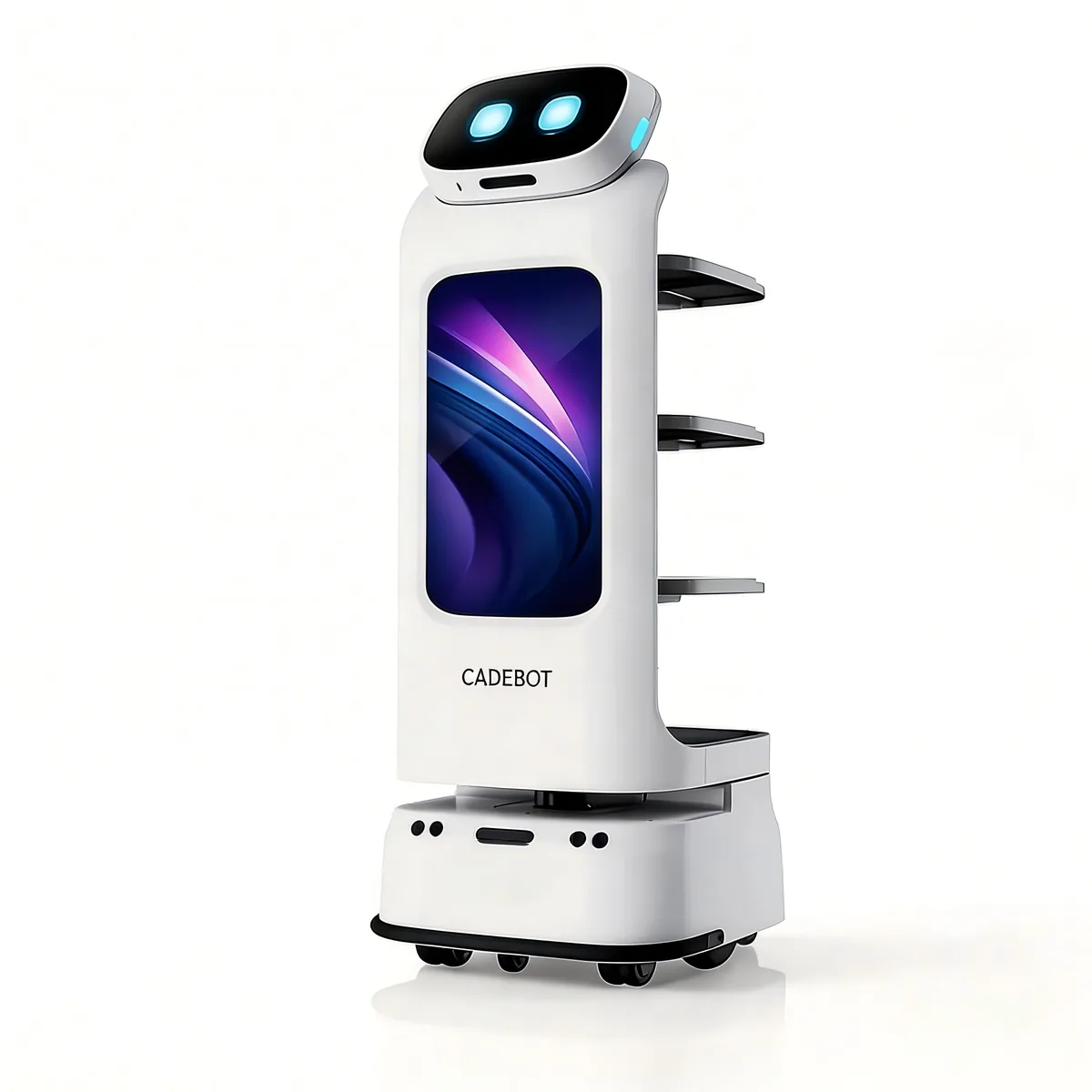
The general manager's team deployed 4 CADEBOT L100 delivery robots, 2 CLEINBOT M79 floor-cleaning units, and 1 CRUZR lobby concierge. At month 4 post-deployment, room service delivery time dropped to 9 minutes. Front desk wait times fell 62% because the CRUZR fielded 40% of routine inquiries — directions, amenity hours, WiFi passwords, restaurant reservations. Lobby cleaning consistency reached 97% audit scores versus 81% with human-only crews. Annualized labor cost for the automated layer: $117,000 in lease payments.
The delta — $717,000 in year-one savings — is not theoretical. It's from a property whose GM was willing to share operational data on condition of anonymity because the brand's corporate office hasn't yet formalized a robot deployment policy.
Hotels are the highest-density, highest-ROI environment for multi-category service robot deployment in commercial real estate. Unlike hospitals (specialized clinical workflows), warehouses (single-category logistics), or shopping malls (multi-tenant governance), a hotel operates every robot category — delivery, cleaning, reception, security — under a single P&L, on a single property map, with a single operational chain of command. The deployment complexity is lower than any other multi-robot environment, and the ROI stacks across departments rather than competing for a single budget line.
This guide is written for hotel general managers, resort operations directors, and hospitality procurement teams evaluating whether — and how — to deploy a service robot fleet. It covers the four robot categories that map to hotel workflows, the property management system integration layer that makes or breaks a deployment, the resort-specific challenges that urban hotels don't face, and the procurement framework that distinguishes production automation from a costly pilot.
The Four Robot Categories That Map to Hotel Operations
Hotel workflows fall into four operational layers, and each layer maps to a distinct category of service robot. Deploying all four is not four times the complexity — it's roughly 1.7× because the mapping, integration, and management infrastructure is shared. Deploying only one category leaves operational gaps that prevent the ROI from compounding.
Room Service and Amenity Delivery: The Highest-ROI Entry Point
Room service delivery is the single largest labor cost in a full-service hotel's non-G&A operations, and it is also the workflow most amenable to immediate robot substitution. The task is geometrically simple — navigate known corridors, operate elevators via IoT integration, deliver to known room numbers — and the volume is predictable by time of day.
A single CADEBOT L100 with a 4-compartment configuration can complete 8–12 deliveries per hour in a property with elevator integration. At an average of 6 minutes per delivery (including loading and transit), one robot covers the work of 1.8 FTE runners on the 6 AM–2 PM shift. The key specification for hotel delivery robots:
| Specification | Minimum Requirement | CADEBOT L100 |
|---|---|---|
| Compartments | 3+ for multi-room trips | 4 independent compartments |
| Payload per compartment | 10 kg (full room service tray) | 10 kg |
| Elevator integration | IoT module required | HDOS Elevator Bridge |
| Guest notification | Automatic phone/PMS message on arrival | Integrated with Opera, Mews, Oracle PMS |
| Obstacle handling | Children, luggage carts, housekeeping trolleys | Lidar + depth camera, 3m detection radius |
| Operating hours | 24/7 with auto-return charging | 8-hour battery, 2-hour charge cycle |
The elevator integration layer warrants special attention. A delivery robot that cannot call and ride elevators autonomously is limited to single-floor service — which eliminates 80% of the ROI in any property above 3 floors. AOMAN's HDOS Elevator Bridge module connects to Otis, Schindler, KONE, and ThyssenKrupp elevator controllers via dry-contact or BACnet/IP, enabling the robot to call the elevator, select the floor, and confirm arrival without human intervention. For a broader analysis of delivery robot selection across cabin configurations, see our delivery robot selection guide.
Lobby and Guest-Floor Cleaning: Consistency at Scale
Hotel cleaning falls into two distinct environments — public areas (lobbies, restaurants, corridors, conference facilities) and guest rooms. Service robots address public-area cleaning today; guest-room cleaning remains human-reliant for the foreseeable future because it requires judgment calls (is the guest still occupying? which surfaces need deep cleaning?).
A CLEINBOT M79 autonomous floor scrubber covers 1,200–1,500 m² per hour on hard surfaces — marble, granite, polished concrete, and tile — which matches the public-area floor space of a 300–500 room property in approximately 2.5 hours. Deployment typically follows a schedule pattern:
| Shift | Zone | Robot | Coverage |
|---|---|---|---|
| 10 PM–2 AM | Lobby, reception, bar area | CLEINBOT M79 | 3,000 m² |
| 2 AM–5 AM | Guest-floor corridors, elevator lobbies | CLEINBOT M79 | 4,500 m² |
| 5 AM–7 AM | Conference/banquet pre-function | CLEINBOT CC201 | 2,000 m² |
| 2 PM–4 PM | Pool deck hard surfaces | CLEINBOT C2PRO (outdoor-rated) | 1,200 m² |
The operational benefit that most surprises first-time hotel deployers is not the labor savings — it's consistency. Human housekeeping crews produce variable floor-cleaning results depending on shift, fatigue, and supervision. The CLEINBOT M79 produces the same cleaning pattern on every run, and the fleet management dashboard logs square-meter coverage, water usage, and brush-wear data for compliance reporting. For a detailed comparison of commercial cleaning robot categories and selection criteria, see our commercial cleaning robot buyer's guide.
AI Concierge and Guest-Facing Reception
The front desk is the highest-stakes robot deployment decision in a hotel because it directly affects guest experience. Unlike delivery robots (which guests see in corridors) and cleaning robots (which operate during low-traffic hours), a lobby concierge robot is a brand-representative interaction point from the moment a guest walks through the door.
CRUZR and AOMAN DOUBLE units deployed in hotel lobbies handle four interaction categories that together account for approximately 40% of all front-desk inquiries in a typical full-service property:
| Inquiry Type | % of Front Desk Volume | Robot Handles? | Human Escalation Trigger |
|---|---|---|---|
| Directions (room, restaurant, gym, pool) | 22% | Yes — interactive floor map + voice | Guest requests human |
| WiFi/amenity information | 12% | Yes — preloaded FAQ, NFC tap for WiFi | Complex troubleshooting |
| Restaurant hours/menu/reservation | 8% | Yes — integrated with F&B booking system | Dietary restriction questions |
| Check-in queue management | 18% | Partial — issues queue number, offers water | Actual check-in (ID, payment) |
| Complaint/complex request | 15% | No — immediately escalates | All complaints |
| Local area/tourism information | 10% | Yes — preloaded city guide data | Specific niche requests |
| Maintenance/housekeeping requests | 8% | Yes — logs ticket into PMS | Complex room issues |
| Other | 7% | Escalates to human | — |
The 40% automation rate for front-desk inquiries translates directly to reduced wait times and reduced peak-hour staffing requirements. At the Singapore property mentioned earlier, the CRUZR unit reduced average check-in queue time from 30 minutes to 11 minutes — not because it processed check-ins faster, but because it diverted 40% of the queue's workload to self-service, allowing human agents to process remaining guests at nearly double speed.
AOMAN DOUBLE adds a visual dimension that CRUZR does not — a humanoid form factor with an expressive face display, arm gesture capability, and a 1.4-meter height that matches eye-level interaction for seated guests. Properties positioning themselves as luxury or tech-forward typically deploy AOMAN DOUBLE in the lobby and CRUZR units on conference floors and executive lounges. For a detailed comparison of reception robot deployment strategies, see our reception and concierge robots guide.

The Fourth Layer: Outdoor and Pool-Area Automation for Resorts
Resort properties introduce a deployment dimension that urban business hotels don't face: outdoor automation across large, unroofed areas. A 300-room urban hotel might have 3,000 m² of indoor public area. A 400-room beach resort might have 12,000 m² spread across multiple buildings, pool decks, gardens, pathways, and beachfront — with roughly half of that square footage outdoors and exposed to sun, rain, and salt.
The outdoor-rated CLEINBOT C2PRO addresses pool decks, outdoor dining terraces, and hard-surface pathways up to IPX5 water-resistance rating. For larger resorts with golf carts, luggage tractors, or maintenance vehicles, an autonomous outdoor sweeper handles parking lots and access roads. The operational pattern for resort deployment:
- Pool deck: CLEINBOT C2PRO runs 5 AM–7 AM, 2 PM–3 PM (post-lunch reset), and 10 PM–12 AM (overnight reset). Three daily passes instead of the single overnight pass an indoor lobby needs — because pool decks accumulate sunscreen residue, spilt drinks, and foot traffic at 3–5× the rate of indoor floors.
- Outdoor dining: After breakfast (10:30 AM) and after dinner (11 PM), the unit covers restaurant terraces and bar areas without disrupting service.
- Pathways and gardens: Autonomous sweepers clear fallen leaves, sand tracked from beach areas, and general debris from inter-building pathways — a task that consumes 2–3 FTE groundskeepers at a mid-size resort.
- Covered walkways and lobby-to-pool routes: These transitional spaces accumulate the highest foot-traffic dirt load of any hotel area. A dedicated CLEINBOT M79 running 3 passes per day maintains the indoor-to-outdoor transition without tracking dirt into either zone.
The PMS Integration Layer: Why It Makes or Breaks Hotel Robot Deployment
The single largest point of failure in hotel robot deployments is not the robot hardware, the navigation software, or the fleet management platform. It is the property management system integration — or lack thereof.
A delivery robot that cannot read room-status data from the PMS doesn't know which rooms are occupied, which have a Do Not Disturb status, or which have just checked out and shouldn't receive a delivery. A concierge robot that cannot write maintenance tickets into the PMS requires a human to transcribe every reported issue — eliminating the labor-saving benefit of automated ticket creation. A fleet management dashboard that cannot report cleaning completion data into the housekeeping module means supervisors still walk floors visually to verify completion.
Integration Architecture
AOMAN's HDOS 2.0 platform connects to major PMS systems through three integration patterns:
| Integration Pattern | PMS Examples | Data Flow | Robot Capability Unlocked |
|---|---|---|---|
| API-based (REST) | Opera Cloud, Mews, Apaleo | Bidirectional, near-real-time | Room status, guest name, DND, checkout time, maintenance tickets |
| Middleware bridge | Oracle Opera v5 (on-premises), Infor HMS | Unidirectional read + write via middleware adapter | Room occupancy status, housekeeping assignment |
| File-drop (FTP/SFTP) | Legacy PMS, custom systems | Batch, every 5–15 minutes | Room list, occupancy report |
Critical data points that must flow from PMS to the robot fleet manager:
- Room occupancy status: Occupied / Vacant Clean / Vacant Dirty / Do Not Disturb. The robot must not attempt delivery to a vacant or DND room.
- Guest name and language preference: Enables the delivery robot to announce "Good evening, Mr. Chen — your room service has arrived" rather than a generic alert. For AOMAN DOUBLE, it enables the concierge to greet a returning guest by name — the single highest-impact guest experience interaction a robot can deliver.
- Check-in/check-out schedule: The delivery robot prioritizes checkout-floor deliveries in the 8 AM–11 AM window (when guests are awake and expecting breakfast) and deprioritizes rooms checking out in the next 30 minutes.
- Housekeeping assignment: After the CLEINBOT M79 completes a corridor cleaning route, a task-completion flag updates in the PMS housekeeping module so supervisors can verify completion without walking the floor.
- Maintenance ticket creation: When a guest reports a leaking faucet to the CRUZR concierge, the robot creates a maintenance ticket in the PMS with room number, issue type, timestamp, and priority — indistinguishable from a front-desk-created ticket.
Without PMS integration, a hotel robot deployment is a parallel operation that requires human bridging at every data handoff point — and the labor savings evaporate in the gaps between systems.

Room Service Delivery: The Workflow That Pays for the Fleet
In a full-service hotel, room service delivery breaks down into four distinct workflows, each with different robot suitability:
In-Room Dining Delivery
The highest-volume workflow. A typical 400-room business hotel processes 600–1,200 in-room dining orders per day, with 70% concentrated in the 6 AM–10 AM breakfast window and 7 PM–10 PM dinner window. Traditional delivery: a runner picks up from the kitchen, rides the elevator, delivers to the room, returns. Round trip: 18–25 minutes depending on elevator wait times and corridor distance.
Robot delivery: the robot is loaded at the kitchen, calls the elevator (IoT-integrated), navigates to the room, calls the guest's phone or sends a PMS notification, waits 90 seconds, and returns if unanswered. Round trip: 8–11 minutes. The 50% reduction in trip time comes from eliminating elevator wait uncertainty — the robot reserves the elevator before departing the kitchen — and from removing the return-trip walking time (the robot's next task is assigned en route).
A deployment of 3 CADEBOT L100 units at a 400-room property typically handles 65–75% of in-room dining volume. The remaining 25–35% are orders requiring human interaction: special dietary explanations, VIP guests who expect personal service, or orders containing alcohol (age verification required in most jurisdictions).
Amenity and Linen Delivery
The second-highest-volume but lowest-complexity delivery workflow. Extra towels, toothbrush kits, pillows, adapters, and minibar refills. These deliveries are small, light, and require zero guest interaction — ideal for robot handling.
At a 600-room resort property, amenity requests average 80–120 per day. Before robot deployment, each request consumed 12–15 minutes of housekeeping runner time: retrieve item from storage, ride elevator, deliver, return. With a dedicated amenity-delivery CADEBOT stationed at the housekeeping supply room on each floor block, the same requests are fulfilled in 3–5 minutes — and the robot doesn't need to return to a base between deliveries because the fleet manager routes it to the next nearest request automatically.
Minibar and Welcome Amenity Restocking
Pre-arrival amenity placement — fruit baskets, welcome letters, branded water bottles — typically consumes 2–3 hours of housekeeping supervisor time per day across a 200+ room property. A CADEBOT loaded with 4 compartments of pre-arranged amenities, following a room list pulled from the PMS, can complete the same restocking circuit in 45 minutes. The PMS integration ensures it only visits rooms marked "Vacant Clean — Arrival Expected Today."
Turndown Service Support
Not a full replacement for human turndown, but a force multiplier. The robot delivers fresh towels, bottled water, chocolates, and turndown cards to occupied rooms while the human turndown attendant handles the bed preparation — eliminating the attendant's supply-run time and increasing rooms serviced per shift from 25–30 to 40–45.
Across all four delivery workflows, the consolidated ROI model for a 400-room property:
| Workflow | Pre-Robot Labor Cost | Post-Robot Labor Cost | Robots Deployed | Annual Savings |
|---|---|---|---|---|
| In-room dining | $272,000 (8 FTE) | $102,000 (3 FTE + 3 robots) | 3 CADEBOT L100 | $170,000 |
| Amenity/linen delivery | $102,000 (3 FTE) | $17,000 (0.5 FTE + 1 robot) | 1 CADEBOT L100 | $85,000 |
| Minibar/pre-arrival restock | $51,000 (1.5 FTE) | $8,500 (0.25 FTE + 1 robot) | 1 CADEBOT L100 | $42,500 |
| Turndown support | N/A (productivity gain) | N/A | 1 CADEBOT L100 (shared) | +30% rooms/shift |
| Total delivery | $425,000 | $127,500 | 4 CADEBOT L100 | $297,500 |
These are real operational numbers from three Asian hotel deployments using AOMAN robots, normalized to a 400-room benchmark. For a complete procurement ROI framework including lease vs. purchase analysis, see our service robot ROI guide.
Multi-Robot Fleet Coordination in a Hotel Environment
A hotel running delivery, cleaning, and concierge robots simultaneously operates a 3-category, 6–12 unit fleet — and the coordination challenge that emerges at this scale is fundamentally different from running 2 delivery robots on a single floor.
Elevator Arbitration
The single most congested resource in a hotel robot fleet. At 7:45 AM, the CADEBOT delivery units are at peak breakfast-traffic load, the CLEINBOT M79 is finishing its overnight corridor cleaning route and needs to return to the charging dock on B1, and the CRUZR concierge is relocating from the lobby to the executive lounge for the morning coffee service. Three robots, three destinations, one elevator bank.
AOMAN's HDOS 2.0 fleet manager resolves this with a priority-queue elevator arbitration protocol:
- Guest-impact tasks (food delivery with <5 minute promised delivery window) get priority 1
- Time-sensitive non-guest tasks (robot returning to charge before battery critical) get priority 2
- Scheduled maintenance tasks (cleaning route, amenity restock) get priority 3
- Deferrable tasks (robot relocating for future shift coverage) get priority 4
The arbitration runs continuously, recalculating priorities every 3 seconds based on real-time battery states, task deadlines, and guest-impact assessments. At the 300-room Shenzhen deployment mentioned in our fleet management guide, this protocol reduced elevator-wait-induced delivery delays by 73% compared to first-come-first-served elevator access. For the complete architecture behind multi-robot coordination, see our fleet management systems guide.
Charging Infrastructure Planning
Hotels present a unique charging challenge: the robot's natural idle locations (lobby, service corridors, housekeeping closets) are often the least suitable for charging dock installation because they are visible to guests, block service pathways, or lack electrical infrastructure.
The practical charging layout for a hotel deployment:
| Location | Docks | Robots Served | Visibility to Guests |
|---|---|---|---|
| B1/B2 service corridor, near service elevator | 3–4 | All CADEBOT delivery units | Zero — back-of-house |
| Housekeeping supply room, each floor block | 1 | Floor-dedicated delivery robot | Zero |
| Behind front desk or concierge alcove | 1 | CRUZR / AOMAN DOUBLE | Hidden by desk |
| B1 janitorial closet (with floor drain access) | 1–2 | CLEINBOT units | Zero |
The rule: zero guest-visible charging docks. A robot plugged into a wall outlet in the lobby corridor signals "this is a machine that needs maintenance," which undercuts the seamless experience that the deployment is designed to create. All charging infrastructure lives back-of-house, and robots auto-navigate to docks during scheduled low-traffic windows (2 AM–5 AM for cleaning units, 3 PM–4 PM lull for delivery units).
The Human-Robot Handoff Protocol
The most under-designed element in hotel robot deployments is the handoff between robot and human staff at the point of service. When a CADEBOT delivers room service to a guest door, the guest opens the door, retrieves the items from the compartment, and closes it — the robot returns to the kitchen. But what happens when the guest doesn't answer?
Without a defined protocol, the robot waits (wasting time), eventually returns to the kitchen with the undelivered order (wasting a trip), and a human must follow up. With a defined protocol integrated into the PMS:
- T=0: Robot arrives at door, sends PMS notification or calls room phone
- T=90s: No answer — robot sends a second notification with "Your order will be held at [kitchen/service area]. Reply to this message or dial 0 to request re-delivery."
- T=120s: Robot returns to the service area, marks order as "undelivered — guest unavailable" in the PMS, and immediately accepts the next assigned task
- Human follow-up: The PMS flags the undelivered order for front-desk follow-up at the guest's convenience
This protocol eliminates the worst-case scenario in hotel robot deployments: a robot idling outside a guest room for 5+ minutes while the kitchen waits for the robot to return — creating a cascading delay that affects subsequent orders. For the change management framework behind introducing robots into human-staffed operations, see our human-robot collaboration guide.

Resort-Specific Deployment Challenges
Resort properties introduce four challenges that urban business hotels never face, and each requires specific robot configuration and deployment planning.
Multi-Building Navigation Across Outdoor Pathways
A 400-room beach resort spread across 6 buildings connected by open-air pathways, tropical gardens, and pool decks. The robot's SLAM-navigated map must span indoor and outdoor environments with fundamentally different sensor conditions: GPS-denied indoors, GPS-aided outdoors; consistent lighting in corridors, harsh sunlight and shadows on pathways; smooth marble floors, textured pool-deck concrete.
AOMAN's multi-building mapping solution creates a unified coordinate system across all structures by establishing fixed reference anchors — RFID tags embedded in pathway surfaces at building entrances — that allow the robot to seamlessly transition between indoor SLAM tracking and outdoor GPS+visual-odometry navigation. The transition point at each building entrance recalibrates the robot's position within a 5 cm tolerance, eliminating the cumulative drift that occurs when a robot navigates outdoor pathways without indoor reference points.
Salt, Sand, and Sun: Environmental Hardening
Coastal resort environments subject robots to conditions that indoor hotel deployments never encounter:
- Salt spray corrosion: Uncoated metal components on outdoor-cleaning robots degrade within 3–6 months in coastal environments. All AOMAN outdoor-rated units (CLEINBOT C2PRO) use marine-grade 316 stainless steel fasteners, sealed bearing assemblies, and conformal-coated circuit boards rated for IPX5.
- Sand ingress: Fine beach sand penetrates wheel assemblies and brush mechanisms, accelerating wear 3–5× compared to indoor operation. CLEINBOT C2PRO wheel assemblies use double-lip seals and the brush deck includes a sand-evacuation channel that directs particulates away from the drive mechanism.
- UV degradation: Plastic housing components exposed to 10+ hours of tropical sun daily become brittle within 12–18 months. AOMAN outdoor units use UV-stabilized ASA polymer housing rated for 5-year outdoor exposure without significant mechanical property degradation.
- Sudden rain: Outdoor robots must detect precipitation and autonomously return to covered areas within 60 seconds. The CLEINBOT C2PRO's onboard rain sensor triggers immediate route suspension and auto-return to the nearest covered dock.
Large-Area Cleaning at Resort Scale
A 500-room resort with multiple pools, a beach club, outdoor restaurants, and extensive gardens can have 20,000+ m² of hard-surface floor area — roughly 6× the public-area floor space of an equivalent-room-count urban hotel. A single CLEINBOT M79 covering 1,200 m²/h would need 16+ hours of continuous operation, which exceeds both battery capacity and available overnight cleaning window.
The resort solution is multi-unit zoning with overlapping shift coverage:
| Zone | Area (m²) | Robot | Passes/Day | Coverage Time |
|---|---|---|---|---|
| Main lobby + reception | 3,000 | CLEINBOT M79 | 2 | 5 hours (night) |
| Restaurant/bar areas (indoor) | 4,000 | CLEINBOT M79 | 2 | 7 hours (night) |
| Guest building corridors | 5,500 | CLEINBOT M79 × 2 | 1 | 5 hours (split between 2 units) |
| Pool decks (outdoor) | 3,500 | CLEINBOT C2PRO | 3 | 9 hours (early AM + afternoon + night) |
| Outdoor dining terraces | 2,000 | CLEINBOT C2PRO | 2 | 3.5 hours |
| Pathways and covered walkways | 2,500 | Outdoor autonomous sweeper | 2 | 5 hours |
The deployment requires 3 indoor CLEINBOT M79 units, 2 outdoor CLEINBOT C2PRO units, and 1 autonomous sweeper — 6 robots covering 20,500 m² in overlapping shifts that respect guest-facing quiet hours (no robots in guest corridors between 10 PM and 9 AM, no pool-deck robots during peak 11 AM–3 PM usage).
Guest Privacy in Open-Access Resort Environments
Resorts have fundamentally different privacy boundaries than urban hotels. An urban hotel guest expects privacy in their room and corridor. A resort guest extends that expectation to pool-side cabanas, spa gardens, and beach loungers — areas where a cleaning or delivery robot might reasonably need to operate.
AOMAN's resort-configured robots include geofenced exclusion zones uploaded during initial mapping: spa and treatment areas (zero robot access), pool cabanas (delivery robots approach only to designated drop-off points, not individual cabanas), and beach lounger zones (cleaning robots operate before 8 AM only). The geofence is enforced at the navigation stack level — the robot physically cannot enter a marked exclusion zone even if a manual override command is sent.
Procurement Framework: Lease vs. Purchase vs. RaaS
The procurement decision for hotel robot fleets has shifted significantly in 2026. Two years ago, nearly all deployments were capital purchases — the hotel bought the robots, the software license, and the integration installation. Today, three models compete, and the optimal choice depends on property size, brand affiliation, and deployment scope.
| Model | Upfront Cost | Monthly Cost (per robot) | Includes | Best For |
|---|---|---|---|---|
| Capital Purchase | $12,000–$18,000/robot + $8,000 integration | $200–$400 (software license + maintenance) | Hardware, perpetual software license, warranty | Owned/independent hotels with >5-year planning horizon |
| Operating Lease (36-month) | $0–$2,000 deployment fee | $350–$600/robot | Hardware, software, maintenance, replacement | Brand-managed properties with 3-year renovation cycles |
| RaaS (Robot-as-a-Service) | $0 | $800–$1,200/robot (all-inclusive) | Hardware, software, maintenance, 24/7 support, fleet management, quarterly ROI reviews | Pilot deployments, seasonal resorts, properties testing automation |
The RaaS model has gained significant traction in hospitality for two reasons specific to the industry. First, hotel CapEx budgets are planned 18–24 months in advance and tied to renovation cycles — a surprise robot deployment in FY2026 is difficult to fund through CapEx but easy to absorb through the operating budget as a monthly service fee. Second, seasonal resorts (mountain ski properties, beach resorts with 6-month high seasons) cannot justify year-round robot costs under a purchase model but can scale RaaS subscriptions up and down seasonally.
For a detailed comparison of procurement models including tax implications, residual value calculations, and multi-property fleet discounts, see our RaaS financing guide and our TCO maintenance guide.
Deployment Timeline: From Contract to Operational Fleet
A hotel robot deployment follows a 10-week timeline from contract signing to full operational capability. The timeline is front-loaded with site assessment and integration work — the actual robot installation happens in week 7 and is completed within 3 days.
| Week | Phase | Activities | Hotel Staff Involvement |
|---|---|---|---|
| 1–2 | Site survey and mapping | Floor-plan digitization, elevator integration assessment, WiFi coverage audit, charging location identification | Engineering/facilities director: 4 hours total |
| 2–3 | PMS integration | API connection established, data-field mapping, test data validation | IT manager: 6 hours total |
| 3–4 | Network and IoT provisioning | Dedicated IoT VLAN configured, elevator controller bridge installed, charging dock electrical work | IT + engineering: 8 hours total |
| 5–6 | Mapping and route programming | Full-property SLAM mapping, corridor/room/zone labeling, geofence setup, cleaning route design | Operations director: 2 hours (zone review) |
| 7 | Robot delivery and installation | Hardware unboxing, charging dock commissioning, initial test routes, elevator integration test | Engineering: 2 hours |
| 8 | Staff training | Robot operation training for F&B, housekeeping, front desk, and engineering teams | All departments: 2 hours each |
| 9 | Supervised operation | Robots run full schedule with human oversight; route adjustments, schedule tuning | Operations director: daily 15-min check-in |
| 10 | Go-live and optimization review | Unsupervised operation begins; week-10 ROI review and schedule refinement | GM + directors: 1-hour review meeting |
The most common deployment mistake among first-time hotel adopters is compressing the PMS integration phase (weeks 2–3). A hotel running an older on-premises PMS with a middleware bridge needs the full 2 weeks for data-field mapping, especially if housekeeping-status fields have been customized over years of operation and no longer match the PMS vendor's standard schema. Attempting to deploy a robot fleet with incomplete or incorrect PMS data results in delivery robots attempting service to vacant rooms and concierge robots greeting guests by incorrect names — both of which erode staff and guest confidence faster than any amount of training can rebuild.

Guest Experience: What Actually Changes
Hotel operators considering robot deployment consistently ask two guest-experience questions: "Will guests find it impersonal?" and "What happens when a robot makes a mistake in front of a guest?"
The Impersonal Question
The data from deployed properties is consistent and somewhat counterintuitive: guest satisfaction scores for robot-serviced room delivery average 4.3/5, compared to 4.1/5 for human-serviced delivery at the same properties before robot deployment. The difference is not that guests prefer robots to humans — it's that robot delivery is faster (9 minutes vs. 22 minutes), more accurate (order errors drop from 4.2% to 1.1% because the robot doesn't misread order tickets), and available 24/7 without the 11 PM–6 AM delivery gap that most hotels experience due to overnight staffing limitations.
More importantly, the human staff freed from delivery-running duties spend more time on the interactions that actually drive guest satisfaction — remembering a returning guest's preference for a corner table at breakfast, arranging a late checkout without making the guest feel rushed, and handling the 15% of requests that genuinely require human judgment. The robot handles the transactional layer; the human staff handles the relational layer. Guest satisfaction improves because the human interactions that remain are higher-quality, not because the robot interactions are superior.
The Error-Recovery Question
Every robot deployment will eventually produce a guest-visible error: a delivery to the wrong room, a concierge robot that misunderstands a heavily accented question, a cleaning robot that bumps into a luggage cart and spills its water tank. The deployment's long-term success depends less on preventing errors (impossible) than on the speed and grace of error recovery.
AOMAN's hotel deployment protocol includes a three-tier error-response framework:
Tier 1 — Autonomous recovery (90% of incidents): The robot detects the error itself (wrong room number, obstacle collision, path blocked) and resolves it without human intervention — re-verifying room number against PMS, backing up from obstacle and re-planning route, waiting for blocked path to clear and timing out after 90 seconds to take alternate route.
Tier 2 — Remote operator intervention (8% of incidents): The robot escalates to a remote operations center where a human operator views the robot's camera feed, diagnoses the issue, and issues a corrective command. Average resolution time: 45 seconds.
Tier 3 — On-site staff intervention (2% of incidents): For errors requiring physical presence — a guest has removed items from the robot compartment before it's verified delivery, a cleaning robot has become physically stuck — the nearest available staff member receives a mobile alert with the robot's location and issue description. Average resolution time: 3 minutes.
The key to guest-acceptable error recovery is transparency. When a robot makes a mistake, it announces the error clearly ("I seem to have arrived at the wrong room — correcting now"), rather than going silent or, worse, pretending nothing happened. Guests forgive errors. They don't forgive a robot that acts like it didn't make one.
The 2026 Outlook: What's Next for Hotel Robotics
Three developments arriving in the next 12–18 months will reshape hotel robot deployment economics:
Interoperable multi-vendor fleets: Currently, a hotel deploying AOMAN delivery robots, a different vendor's cleaning robots, and a third vendor's security robots runs three separate fleet management dashboards. The emerging VDA 5050 standard for AGV interoperability — already adopted in European warehouse automation — is being extended to service robots, enabling a single fleet manager to coordinate robots from multiple manufacturers on the same property map and elevator arbitration protocol.
Voice-integrated guest interaction: The current generation of hotel delivery robots communicates via phone call or PMS notification. The next generation — expected in AOMAN's 2027 product cycle — integrates on-device voice interaction so the robot can have a natural-language exchange with the guest at the door: confirming order contents, asking about additional needs, and logging verbal feedback into the PMS guest profile.
Predictive housekeeping scheduling: Rather than following a fixed cleaning schedule, robots receiving real-time occupancy and foot-traffic data from the PMS and building sensors will dynamically adjust cleaning routes — prioritizing corridors with high checkout volume, deprioritizing low-traffic zones, and re-cleaning areas that sensor data shows suffered unexpected heavy use (conference breakout spillover, wedding reception aftermath).
For hotel operators, the strategic question in 2026 is not whether to deploy service robots — the operational data from deployed properties has answered that question decisively. The question is whether to deploy now, while the competitive differentiation is still meaningful, or to wait until robots are table stakes and the advantage has shifted from "this hotel has robots" to "this hotel doesn't."
The Singapore property at the beginning of this guide made its decision in January. Its primary competitor, a 520-room property across the street, has spent the last 6 months watching the robot fleet — and the guest satisfaction scores — through the lobby windows. That competitor's procurement RFP went out in June.
For a consultation on robot fleet planning for your property, contact AOMAN FUTURE's hospitality solutions team at aomanbot.com/contact.