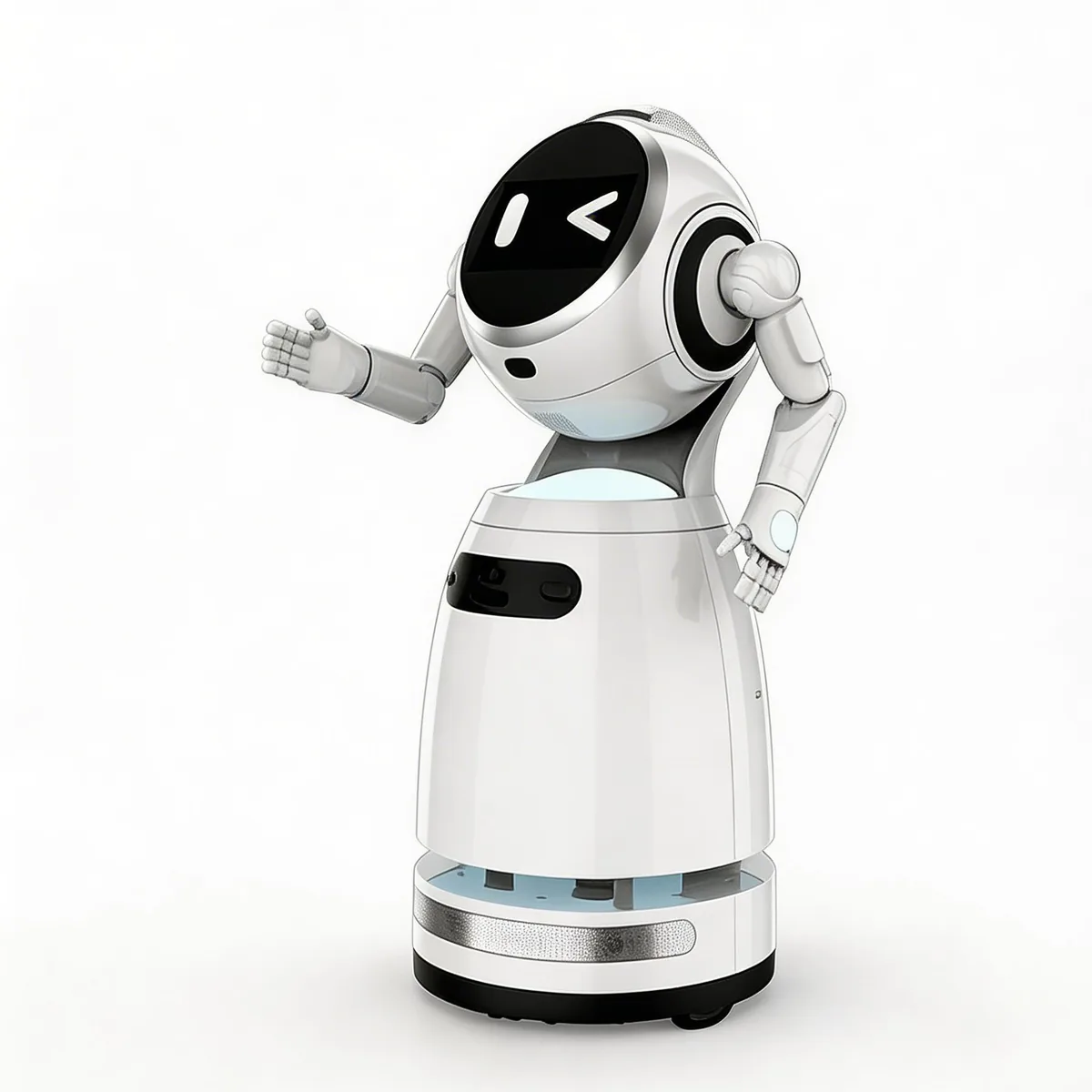
A facility manager at a 600-room convention hotel watches a delivery robot navigate a crowded corridor. A guest steps backward into its path. The robot's LiDAR detects the obstacle and stops 12 centimeters short. No contact. No injury. The facility manager exhales.
Three months later, a different robot at the same property clips a service cart — no sensors failed, no software error, just a 4-centimeter gap the path planner judged acceptable. The cart topples. A banquet server whose foot was under the cart sustains a crush fracture. Medical costs: $47,000. Lost wages claim: $22,000. The insurance adjuster's first question: "Does your commercial general liability policy contain a robotics exclusion?"
Most facility managers deploying service robots in 2026 have thought about floor surfaces, Wi-Fi coverage, and battery charging — the safety standards and maintenance schedules that dominate procurement conversations. Almost none have verified that their insurance actually covers autonomous equipment operating in shared human spaces. That gap is the single largest unmanaged risk in service robot deployment today.

The Insurance Coverage Gap: Why Your Current Policy Probably Doesn't Cover Robots
Commercial general liability (CGL) policies were written for static equipment, human workers, and conventional premises risk. A cleaning robot navigating autonomously through a hotel lobby at 2 AM does not fit neatly into any of those categories. Three specific gaps create exposure:
The "mobile equipment" exclusion. Most CGL policies exclude "mobile equipment" — a category originally designed for bulldozers and forklifts but increasingly applied to autonomous mobile robots (AMRs). Zurich Insurance Group's 2025 commercial lines bulletin explicitly classified AMRs as mobile equipment requiring a separate robotics endorsement. Facilities without that endorsement are effectively uninsured for robot-related third-party injury claims.
The "your product" exclusion. If a robot malfunctions and damages guest property — a delivery robot spills beverages on a $4,000 designer suitcase, or a cleaning robot's leaking solution damages hardwood flooring — the CGL policy's "your product" and "your work" exclusions may apply. Product liability coverage, typically carried by the manufacturer, becomes the relevant policy — but facility managers who own the robots outright (CapEx purchase) may find themselves in a coverage gap between their CGL and the manufacturer's product liability policy, neither of which fully covers operational incidents.
The cyber liability gap. A cloud-connected robot is an IoT endpoint. If an attacker compromises a delivery robot's firmware and uses it to access the hotel's guest Wi-Fi network — exfiltrating 8,000 guest records in the process — the resulting breach falls under cyber liability, not general liability. A 2026 IBM/Ponemon Institute report pegged the average cost of an IoT-originated data breach at $4.85 million. Facilities that have not extended their cyber coverage to include autonomous equipment endpoints are carrying that exposure uninsured.
Insurance carriers are responding. As of Q2 2026, at least four major US commercial carriers — Liberty Mutual, Chubb, Travelers, and Hartford — have introduced robotics-specific endorsements or questionnaires. The trend line is clear: autonomous equipment is moving from "covered by default unless excluded" to "excluded by default unless specifically endorsed."
Coverage Types: What a Service Robot Insurance Program Actually Requires
A comprehensive insurance program for a service robot deployment spans five coverage lines. The table below maps each to the risk scenario it addresses and the party typically responsible.
| Coverage Type | Risk Scenario | Typical Annual Cost per $1M Coverage | Purchased By |
|---|---|---|---|
| Commercial General Liability (CGL) with robotics endorsement | Third-party bodily injury or property damage caused by robot operation | $2,800–$6,500 | Facility operator |
| Product Liability | Injury or damage caused by robot design defect, manufacturing flaw, or software bug | Included in manufacturer's policy; $1,200–$3,000 if facility carries own | Manufacturer (primary); facility may need contingent |
| Cyber Liability | Data breach via robot network connection, ransomware on fleet management system, guest/staff PII exfiltration | $1,800–$4,200 for $1M limit with IoT extension | Facility operator |
| Workers' Compensation | Staff injury during robot interaction, maintenance, or manual override | Standard workers' comp rates apply; robotics classification may adjust premium by 5–12% | Employer |
| Equipment / Inland Marine | Physical damage to robot from fire, water, collision, theft, or vandalism | 1.5–3% of robot's replacement value annually | Owner (purchaser or lessor depending on contract) |
Commercial General Liability with Robotics Endorsement
This is the foundation. Without the endorsement, a CGL policy's standard definitions leave autonomous mobile equipment in a gray area that adjusters resolve against the policyholder. Key terms to negotiate:
- Coverage trigger: "Occurrence" vs. "claims-made." For robot incidents — where a navigation error in March may not manifest as a discovered injury until June — occurrence-based coverage is strongly preferred.
- Aggregate limit: A single robot incident at a convention hotel involving multiple injured guests could generate claims from 8–15 plaintiffs. A $2M aggregate may be insufficient. Facilities deploying 5+ robots in high-traffic environments should evaluate $5M+ aggregate limits.
- Defense cost treatment: Does defense cost erode the liability limit ("inside limits") or sit outside it? For robotics claims, which often involve technical expert testimony and accident reconstruction costing $50,000–$150,000, outside-limits defense is worth the premium increment.
Product Liability
Under a CapEx purchase, the manufacturer's product liability policy is the primary coverage for design-defect claims. Under RaaS or operating lease arrangements, the vendor retains ownership and typically carries product liability — but the facility's operational negligence (improper charging-station placement, failure to maintain clear corridors) may shift liability back to the facility. The contract must explicitly state which party's insurance is primary and which is excess for each claim type.
Cyber Liability
A 2026 survey by Coalition, a cyber insurance provider, found that 23% of cyber claims in the hospitality and healthcare sectors now involve IoT or connected equipment as the initial attack vector. A fleet of 10 cloud-connected robots represents 10 additional network endpoints — each with an operating system, a Wi-Fi stack, and a telemetry uplink to a vendor's cloud platform. Standard cyber policies may exclude "operational technology" — negotiate an IoT/OT endorsement that explicitly covers autonomous mobile equipment.
Real Claims Scenarios: What Actually Happens When Robots Cause Damage
Abstract risk is hard to budget for. Specific scenarios, with real dollar figures, make the exposure tangible.
Scenario 1: The Obstacle-Avoidance Edge Case
A cleaning robot in a hospital corridor detects a visitor's rolling suitcase and stops. It does not detect the visitor's ankle, which is 8 cm behind the suitcase and outside the LiDAR's near-field blind spot. The robot's next path-planning cycle initiates a 20-degree turn to navigate around the suitcase — and its drive wheel rolls over the visitor's foot. Fractured metatarsal. ER visit, surgery, physical therapy. Total claim: $68,000. The hospital's CGL covered the medical costs, but the carrier added a $5,000 robotics sublimit for future incidents and required semiannual safety audits.
Scenario 2: The Software-Update Cascade
A hotel chain operating 18 delivery robots across 6 properties receives an over-the-air firmware update from the vendor. The update introduces a regression in the elevator-interface module. On three robots, the elevator-door timing logic fails — the robot enters the elevator while the door is closing, damaging the door mechanism and the robot's top-mounted sensor array. Repair costs: $14,000 per damaged elevator door ($42,000 total) + $3,800 per robot sensor array ($11,400 total). The vendor's product liability policy covered the robot damage. The hotel's property policy covered the elevator repairs — minus a $25,000 deductible. The hotel absorbed $25,000 because its property policy had a standard equipment-damage deductible, not a robotics-specific rider that would have lowered it.
Scenario 3: The Untrained Staff Member
A night-shift janitor at a retail complex sees a delivery robot stopped in a corridor, assumes it's malfunctioning, and attempts to push it to a charging station. The robot's stabilizers are engaged — pushing it causes it to tip, pinning the janitor's hand against a wall. Worker injury: crushed fingers requiring surgery, 6 weeks of lost work. Workers' comp claim: $41,000. The OSHA investigation found that the facility had not provided formal robot-interaction training to night-shift staff — only to day-shift supervisors. The change management strategy had a shift-coverage gap that became a liability.
Scenario 4: The Water Damage Chain
A floor-scrubbing robot in a corporate office operates on a cleaning schedule that runs after hours. A software bug causes it to dispense cleaning solution continuously rather than in measured pulses across a 2,400 sq ft hardwood-floor executive suite. By morning, the solution has seeped through floor joints, damaging the subfloor and the ceiling of the conference room below. Property damage: $87,000. The facility's CGL denied the claim under the "your work" exclusion. The robot vendor's product liability policy covered the robot defect but not the consequential property damage — a gap that cost the facility $87,000 out of pocket because no party's policy explicitly covered autonomous-equipment operational water damage.
These scenarios share a pattern: the damage is real, the dollar amounts are material, and the coverage gap is always in the fine print that nobody read before deployment.

Who Pays? Insurance Responsibility Under Purchase vs. Lease vs. RaaS
The acquisition model directly determines who bears insurance responsibility — and facility managers often assume the wrong answer. Here is the allocation by model:
Capital Purchase (CapEx)
The facility owns the robot. The facility carries all five coverage lines: CGL with robotics endorsement, equipment coverage, cyber, workers' comp, and contingent product liability (in case the manufacturer's policy has exclusions or limits that leave the facility exposed). Annual insurance cost for a 5-robot fleet under CapEx: $8,000–$18,000, depending on facility type, claims history, and coverage limits. The ROI calculation must include this line item — most procurement spreadsheets omit it entirely.
Operating Lease
The lessor (typically a leasing company or the vendor's financing arm) carries equipment coverage. The facility carries CGL, cyber, and workers' comp. Product liability is typically the manufacturer's, but the lease agreement should explicitly confirm this. The key risk: lease agreements often require the lessee to name the lessor as an additional insured on the CGL policy, which can increase premiums by 8–15%.
Robot-as-a-Service (RaaS)
The vendor owns the robot and typically carries equipment and product liability coverage. The facility carries CGL, cyber, and workers' comp — but the RaaS contract should explicitly indemnify the facility for claims arising from vendor-side defects. The most dangerous RaaS contracts are silent on indemnification; the facility signs, assumes it's covered, and discovers the gap when a claim lands. Before signing any RaaS agreement, facilities should require a certificate of insurance from the vendor naming the facility as an additional insured, with minimum coverage limits of $2M general liability, $2M product liability, and $1M cyber liability.
Insurance Requirements in RFPs: The Questions Most RFPs Don't Ask
A well-structured RFP specifies door widths, Wi-Fi signal strength, and elevator integration protocols. It rarely specifies insurance requirements. That omission creates exposure that no amount of operational planning can close. Every service robot RFP should include the following insurance section:
| RFP Requirement | What to Ask | Red Flag If |
|---|---|---|
| Vendor insurance certificate | Require COI naming buyer as additional insured with 30-day cancellation notice | Vendor cannot produce COI within 5 business days |
| Product liability minimum | $2M per occurrence, $4M aggregate | Vendor offers less or claims product liability is "not applicable" to their product |
| Cyber liability minimum | $1M with IoT/OT endorsement | Vendor's fleet management platform is cloud-connected but vendor carries no cyber coverage |
| Indemnification clause | Mutual indemnification with carve-out for vendor's sole negligence | Vendor proposes unilateral indemnification in their favor |
| Subrogation waiver | Mutual waiver of subrogation for property damage | Vendor refuses — this means their insurer can sue your facility after paying a vendor claim |
| Contractual liability | Vendor's policy must include contractual liability coverage broad enough to cover indemnity obligations | Vendor's COI lists "no contractual liability" or limits it to "insured contract" only |
A vendor evaluation framework should weight insurance and indemnification at a minimum of 8% of the total vendor score. A vendor with superior navigation but no cyber insurance is a higher total-cost-of-ownership risk than a vendor with adequate navigation and full coverage.
Risk Assessment Framework: What Carriers Want Before They Quote
Insurance carriers are not waiting for claims to arrive. They are proactively requiring risk assessments before quoting coverage for autonomous equipment. Facilities that can present a structured assessment receive standard rates; facilities that cannot face surcharges or declination. A Liberty Mutual internal underwriting memo obtained by Business Insurance in Q1 2026 listed five factors that determine whether a service robot deployment qualifies for standard commercial rates:
- Safety certification documentation. ISO 13482 or UL 3300 certification for each robot model deployed. Our safety standards guide covers the certification landscape in detail.
- Formal staff training program. Documented training for all staff who interact with robots — not just operators. Training records must show completion dates and refresher schedules.
- Incident reporting protocol. A written procedure for documenting robot incidents (near-misses and actual), with root-cause analysis and corrective action. Carriers want to see that the facility treats robot incidents with the same rigor as workplace safety incidents.
- Environmental risk assessment. A documented survey of the deployment environment identifying high-risk zones (narrow corridors, blind corners, floor-surface transitions, high-traffic intersections) with mitigation measures for each.
- Fleet management and remote monitoring. Evidence that the facility uses a fleet management system with real-time monitoring, remote-stop capability, and audit-log retention of at least 90 days.
Facilities that meet all five criteria typically receive standard rates with no robotics exclusion. Facilities that meet fewer than three face premium surcharges of 25–40% or outright declination from admitted carriers — pushing them into the surplus-lines market where premiums can be 2–3× standard rates.
Insurance Cost Ranges by Fleet Size
Insurance costs scale non-linearly with fleet size. A 2-robot deployment may add $4,000–$7,000 to annual premiums. A 20-robot deployment across multiple sites adds $25,000–$55,000 — but the per-robot cost drops as the fleet grows, because the largest premium component (the CGL aggregate limit) does not scale linearly.
| Fleet Size | Annual Insurance Cost (Approx.) | Per-Robot Cost | Key Cost Driver |
|---|---|---|---|
| 1–2 robots | $4,000–$8,000 | $2,000–$4,000 | Minimum premium thresholds for robotics endorsement |
| 3–5 robots | $8,000–$18,000 | $2,000–$3,600 | CGL aggregate limit increase; cyber IoT/OT endorsement |
| 6–10 robots | $15,000–$30,000 | $1,500–$3,000 | Multi-site exposure adds complexity premium |
| 11–20 robots | $25,000–$55,000 | $1,250–$2,750 | Cyber coverage scaling; equipment schedule premium |
| 20+ robots (multi-site) | $45,000–$100,000+ | Varies by risk profile | Requires standalone robotics program; surplus-lines may be needed |
For multi-site deployments, insurance costs should be modeled per site, not per robot. A 6-site deployment with 3 robots each will cost more to insure than a single-site deployment with 18 robots, because each site introduces unique environmental risk factors that carriers price independently.

Practical Mitigation: Actions to Take Before the Robots Arrive
Insurance is the backstop. Mitigation is what prevents claims from reaching the backstop. The following actions, implemented before deployment, reduce both incident frequency and insurance premiums:
1. Request the vendor's risk assessment documentation. ISO 13482 requires manufacturers to produce a risk assessment identifying every reasonably foreseeable hazard. Ask for it. If the vendor cannot produce it, their product has not undergone a structured safety evaluation — and your insurance carrier will price accordingly.
2. Conduct an environmental walkthrough with your insurance broker. Before deployment, walk the facility with the broker who will place the coverage. Identify the 5 highest-risk zones and document the mitigation for each. This demonstration of proactive risk management frequently results in better underwriting terms.
3. Require a contractual incident-response SLA. The RaaS or purchase agreement should specify vendor response time for post-incident data extraction: 24 hours for telemetry and video data, 48 hours for a written incident analysis. When a claim lands, the first 72 hours of evidence collection determine the trajectory of the entire claim.
4. Train every shift, not just supervisors. The claims data shows that untrained staff interacting with robots generate a disproportionate share of incidents. Night-shift and weekend staff must receive the same robot-interaction training as day-shift supervisors. Document the training and maintain attendance records — carriers will ask for them after an incident.
5. Add robotics to your annual insurance renewal questionnaire proactively. Do not wait for the carrier to ask. Disclosing a robot deployment mid-policy term can trigger a coverage review; disclosing it at renewal allows the broker to negotiate terms from a position of transparency rather than remediation.
6. Verify the vendor's insurance annually. A vendor who carried $2M in product liability coverage at contract signing may have reduced limits at renewal. Require an annual COI refresh as a condition of continued operation.
Service robot insurance is not a compliance checkbox. It is the difference between a $12,000 claim that is processed in 30 days and an $87,000 uninsured loss that comes out of the facility's operating budget. The time to close the gap is before the robots arrive — not when the adjuster calls.