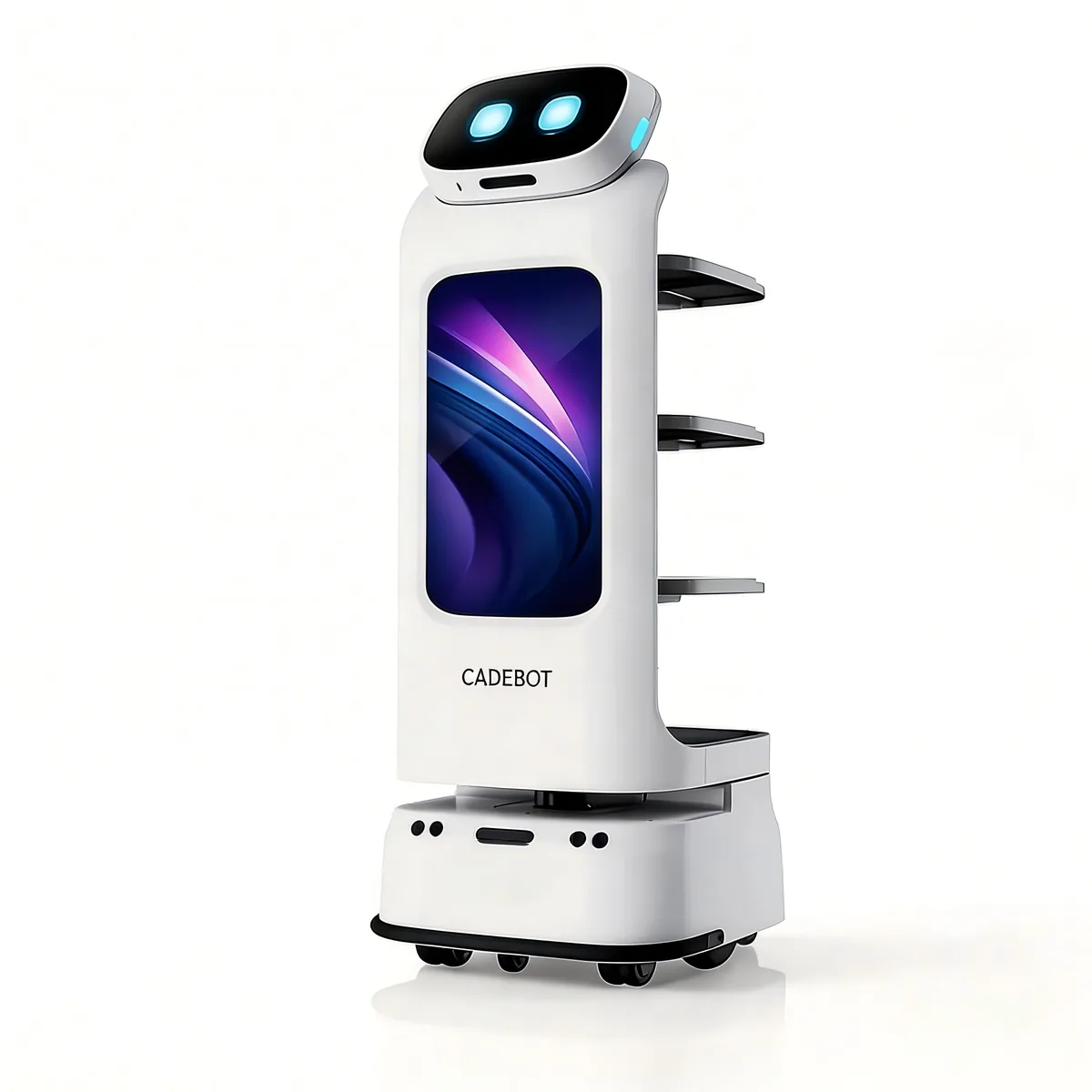
A mid-size restaurant chain in Dallas replaced 4 food runners with 3 delivery robots in Q3 2025. By month 6, labor costs for those positions dropped from $168,000/year to $28,000/year in robot lease payments — an 83% reduction. Table turnover improved by 12% because food arrived 90 seconds faster on average. The robots didn't call in sick during flu season and didn't quit for a competitor offering $2/hour more.
Restaurant operators in 2026 face a three-way squeeze: labor costs rising at 4-6% annually, employee turnover hovering near 70% industry-wide, and consumer expectations for speed that no amount of "we're short-staffed" placards can excuse. Service robots — once a novelty act at a handful of theme restaurants in Tokyo — are now a financially defensible operational decision for restaurants serving 200+ covers per day.
This guide evaluates the categories of restaurant service robots available today, maps them to specific front-of-house workflows, and provides the ROI framework you need to run the numbers for your own operation.

The Three Categories of Restaurant Service Robots
Not every robot on the market belongs in a dining room. Understanding the distinction between categories prevents the most expensive mistake a restaurant operator can make: buying a warehouse AMR and expecting it to navigate between tables of startled diners.
Delivery Robots: Food Runners That Never Drop a Plate
Delivery robots handle the highest-volume, lowest-complexity task in restaurant operations: moving items from point A to point B. In a restaurant context, this means:
| Task | Traditional Labor | Robot Alternative | Time Saved / Shift |
|---|---|---|---|
| Kitchen-to-table food delivery | 1-2 dedicated runners | 1 robot per 15-20 tables | 3-4 labor hours |
| Table bussing / dish return | 1 busser per section | 1 robot covering 2-3 sections | 2-3 labor hours |
| Drink/condiment refill runs | Ad-hoc by waitstaff | On-demand robot dispatch | 1-2 labor hours |
A delivery robot with a 30-50kg payload — such as the CADEBOT L100 — can carry 4-6 plated dishes per trip across a 300-seat restaurant floor. For larger venues or banquet operations, a high-capacity dual-cabin unit like the AOMAN DOUBLE handles 70L of payload, enough for a full table's worth of dinner service in a single run.
The key specification for restaurant delivery robots is tray configuration, not top speed. A robot that carries 4 plates in 90 seconds does more for table turnover than one that carries 2 plates in 60 seconds — because kitchen-to-table transit time is only ~25% of the total food delivery cycle. The other 75% is kitchen pickup coordination and table-side handoff.
Reception & Greeting Robots: The Host Stand That Never Gets Overwhelmed
A reception robot stationed at the entrance handles greeting, waitlist management, and wayfinding — the tasks that occupy a host for 70% of their shift. During peak hours (Friday 7-9 PM, Saturday brunch), a host managing a 45-minute waitlist has zero bandwidth for welcoming walk-ins. A reception robot absorbs that overflow.
The CRUZR humanoid service robot provides voice-guided greeting, QR-code-based waitlist signup, and automated table escort — essentially functioning as a self-service host stand with personality. Restaurants that deploy reception robots report an average 40% reduction in "walk-away" customers during peak wait times, because guests who interact with the robot feel acknowledged even when a human host is occupied.
This category overlaps with what we cover in our reception and concierge robot guide — the hardware is similar, but the restaurant use case adds table management integration and menu knowledge that a corporate lobby deployment doesn't require.
Hybrid / Multi-Function Platforms
Some restaurant operators prefer a single robot type that handles delivery and greeting — switching roles based on time of day (greeter during lunch rush, food runner during dinner service). This approach simplifies fleet management but sacrifices task optimization: a robot built primarily for delivery has limited interactive display capability, and a humanoid built for greeting has limited payload. We discussed this platform specialization trade-off in the delivery robot selection guide.

The ROI Case: Running the Numbers for Your Restaurant
The restaurant industry operates on margins of 3-6%. A capital investment in robotics only makes sense when the payback period is under 18 months — and ideally under 12. Here's the math for a representative 250-seat full-service restaurant deploying 3 delivery robots:
Labor Savings
| Position | Robots Replacing | Annual Fully-Loaded Cost | Robot Annual Cost (Lease) | Net Savings |
|---|---|---|---|---|
| Food runner (×2) | 2 delivery robots | $84,000 | $18,000 | $66,000 |
| Busser (×1) | 1 delivery robot | $42,000 | $9,000 | $33,000 |
| Total | 3 robots | $126,000 | $27,000 | $99,000/year |
At this rate, the robot lease investment pays back in 3.3 months. Even in a purchase model (approximately $45,000 for three mid-range delivery robots), the payback period is 13.6 months — within the 18-month threshold.
Revenue Uplift
Labor savings are the obvious half of the ROI equation. The less obvious half is revenue uplift from improved operations:
- Table turnover: Faster food delivery + faster bussing = 8-15% more seatings per shift. For a restaurant doing $2.5M annual revenue, a 10% turnover improvement adds $250,000 in top-line revenue.
- Order accuracy: Robots don't mis-hear "medium rare" as "medium well." Error reduction of 80% on robot-delivered orders eliminates comp costs (typically 1-2% of food revenue).
- Consistent guest experience: A robot delivers the same service quality at 9 PM on a Saturday as it does at 2 PM on a Tuesday. No fatigue, no attitude, no "sorry, we're slammed."
We covered the broader ROI framework — including TCO analysis for service robot fleets — in the service robot ROI guide and the TCO and maintenance guide.

Integration: Making the Robot Part of Your Restaurant, Not a Visitor in It
The most common failure mode in restaurant robot deployments is not a technical malfunction — it's an operational one. The robot arrives, gets programmed with a floor map, and then... sits unused because nobody redesigned the workflows around it.
Kitchen-Robot Handoff
The kitchen pass — where plated dishes are staged for pickup — needs a designated robot zone. This requires:
- A dedicated pickup station: A counter-height shelf or cart where kitchen staff place completed dishes. The robot docks here automatically between delivery runs.
- Order-to-robot mapping: The POS system or kitchen display must indicate which robot is assigned to which table's order. This prevents the "two robots, one table" confusion where both arrive with half the order.
- Hot-hold capability: Food that waits 60 seconds for robot pickup needs to stay at temperature. Induction-heated tray modules on the robot itself solve this — specify this in your RFP.
POS Integration
The robot needs to know where table 14 is, not just the coordinates of a point on the map. This requires:
- Table mapping: A one-time configuration that assigns table numbers to map coordinates. Robots with SLAM navigation (see our navigation technology guide) handle this natively.
- POS trigger: When the kitchen marks an order "ready," the POS sends a dispatch command to the robot. This can be a direct API integration or a middleware layer.
- Completion confirmation: The robot signals "delivery complete" back to the POS, closing the order loop in the kitchen display system.
Staff Workflow Redesign
The human staff role shifts from transporting to interfacing:
| Before Robots | After Robots |
|---|---|
| Server walks to kitchen, picks up food, walks to table, serves | Server stays in section, greets tables, takes orders; robot delivers food |
| Busser clears tables between seatings | Robot pre-busses dishes; staff handles final wipe-down and reset |
| Host manages waitlist + greets + seats | Robot greets and manages waitlist; host handles VIPs and exceptions |
This workflow redesign is the difference between "the robot is in the way" and "the robot handles 60% of the grunt work so my staff can focus on hospitality."
Safety and Compliance in Food Environments
Restaurant floors are wet, greasy, and crowded — the worst-case environment for autonomous navigation. A robot that works flawlessly in a warehouse can become a liability in a dining room if it lacks:
- IP54+ rating: Protection against water spray and grease exposure. Non-negotiable for kitchen-adjacent operation.
- Dynamic obstacle avoidance: Not just static map navigation, but real-time reaction to children running, chairs being pushed back, and servers carrying trays at eye level.
- Food-safe materials: Robot surfaces that contact serving trays must be NSF-certified or equivalent food-grade material.
These requirements align with the broader safety standards and compliance framework we detailed for all service robot deployments — but the restaurant environment adds specific food-safety and slip-hazard concerns that an office or hospital deployment doesn't face.

Restaurant Formats: Where Robots Make Sense (and Where They Don't)
Not every restaurant benefits from service robots. The break-even point depends on volume, layout, and service style.
High-ROI formats
| Format | Why Robots Work | Recommended Robot Type | Payback Estimate |
|---|---|---|---|
| High-volume casual dining (200+ seats) | High table turnover, standardized menu, predictable routes | 2-3 delivery robots | 3-6 months |
| Hotel F&B / banquet | Large floor plans, high labor cost, repetitive service | Delivery + reception | 4-8 months |
| Food courts / cafeteria | Long walking distances, self-service model | Delivery (kitchen-to-counter) | 6-10 months |
| Quick-service chains (QSR) | Standardized operations, high volume, labor shortage acute | Delivery (counter-to-table) | 8-12 months |
Low-ROI formats
- Fine dining (under 80 seats): The human touch is the product. A robot delivering a $200 tasting menu plate contradicts the value proposition.
- Pop-ups and seasonal operations: Deployment time (2-4 weeks for mapping and training) exceeds the operating window.
- Restaurants with split-level or stair-heavy layouts: Unless the robot can use a service elevator, stairs break the autonomous workflow.
The 2026 Restaurant Robot Buyer's Checklist
When evaluating vendors, request answers to these 7 questions before signing:
- What is the hot-hold capability of the tray module? If food loses 8°F between kitchen pickup and table arrival, you're sending lukewarm entrees to every table.
- Does the fleet management system integrate with our POS, or do we need middleware? Middleware adds $200-400/month and a point of failure.
- What is the robot's runtime on a single charge, and how long does a full charge take? A robot that runs 4 hours and charges for 2 hours covers one shift; one that runs 8 hours and charges for 1 hour covers two.
- How are software updates deployed — over-the-air or on-site? OTA updates mean no service interruption. On-site updates mean a technician visit at $150-300 per call.
- What is the warranty period on drive motors and battery? These are the two highest-cost replacement items. A 2-year warranty vs 1-year is worth roughly $1,200-3,000 per robot.
- Can the robot handle floor transitions (carpet-to-tile, threshold strips)? Test this in your actual space, not the vendor's showroom.
- What training and onboarding does the vendor provide for front-of-house staff? If the answer is "a 2-hour video," plan for 2 weeks of operational friction while your team figures it out themselves.
The Deployment Timeline: What to Expect
A realistic restaurant robot deployment follows this cadence:
| Week | Activity | Key Deliverable |
|---|---|---|
| 1 | Site survey + floor mapping | Complete SLAM map of service area |
| 2 | POS integration + table mapping | Robot receives live order dispatch |
| 3 | Staff training + dry runs | Staff comfortable with robot handoff |
| 4 | Soft launch (off-peak hours) | Real-world validation of routes and timing |
| 5-6 | Full deployment | Robot operating all service hours |
The single biggest variable in this timeline is POS integration. If your POS provider has an existing API module for robot dispatch, Week 2 takes 2 days. If they don't, it takes 2 weeks and a custom integration. Ask the robot vendor for their list of pre-integrated POS platforms before you buy.
Where Restaurant Robotics Is Heading
Three trends are accelerating restaurant robot adoption in 2026:
Lease-over-buy: 65% of restaurant robot deployments in 2026 use a monthly lease model ($300-500/robot/month) rather than an upfront purchase. This turns a $15,000 CapEx decision into a $300/month OpEx decision — one that a restaurant GM can approve without board-level sign-off.
Multi-vendor fleets: Restaurants are mixing delivery robots from one vendor with reception robots from another, managed through a unified fleet orchestration layer. Our fleet management guide covers the integration architecture for this approach.
Customer-facing interfaces: The next generation of restaurant robots will interact directly with diners — taking drink orders table-side, processing payments, and even upselling desserts based on order history. This blurs the line between service robot and self-service kiosk, creating a new category that combines the mobility of a delivery robot with the interactivity of a humanoid service robot.
The restaurant that deploys service robots in 2026 isn't making a technology decision — it's making a labor economics decision with a 12-month payback and a 5-year competitive advantage. The restaurant that waits until 2028 will pay the same price for the robots but miss three years of margin improvement that competitors already banked.