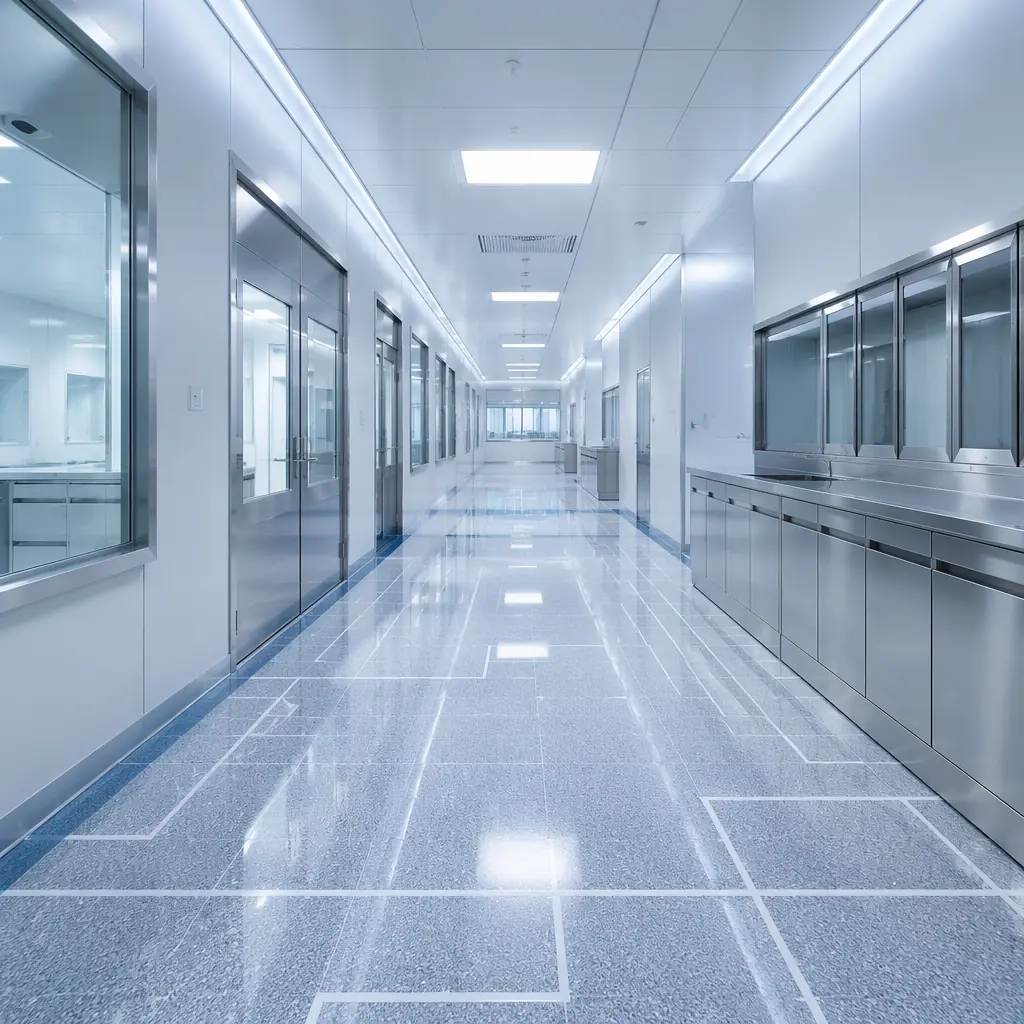
A pharmaceutical plant manager at a contract manufacturing organization stares at the quarterly deviation report: three batch record discrepancies traced to manual material movements between GMP zones, a cross-contamination investigation triggered by an operator entering Grade C with the wrong gowning protocol, and 47 hours of production downtime while QA reviewed paper batch records for a serialization audit. "We've automated the chemistry," she tells the site director. "The logistics between processes are still running on clipboards and human memory."
Pharmaceutical manufacturing operates under the most stringent regulatory framework in industrial production — 21 CFR Part 211 for finished pharmaceuticals, EU GMP Annex 1 for sterile manufacturing, and serialization mandates under DSCSA and the Falsified Medicines Directive. Yet between the automated reactors, isolators, and fill-finish lines, the movement of materials, samples, and documentation remains overwhelmingly manual. That gap — the 60% of GMP workflows that happen between validated process steps — is where service robots are entering pharmaceutical production in 2026.
Here's what plant managers, quality directors, and manufacturing operations leaders need to know about deploying autonomous service robots in regulated GMP production environments.

Why GMP Manufacturing Needs a Different Class of Automation
The cleanroom robotics conversation has focused heavily on research laboratories and biotech R&D — specimen transport, media preparation, sample logistics. Pharmaceutical production is a fundamentally different challenge. The stakes are higher, the regulations stricter, and the integration requirements deeper.
Laboratories vs. Production: The Three Differences That Matter
Validation burden. A lab robot handling specimen transport needs to demonstrate it doesn't contaminate samples. A production robot moving active pharmaceutical ingredients between GMP Grade C and Grade B zones needs validated cleaning procedures, documented changeover protocols between product campaigns, and environmental monitoring data proving it doesn't compromise the classified space — all maintained in an audit-ready state for FDA and EMA inspectors.
Batch record integration. In a research lab, a LIMS entry noting "sample delivered to Station 4 at 14:22" is sufficient. In GMP production, every material movement must be logged to a batch record with timestamp, operator identity (or robot ID), material lot number, origin, destination, and a verification that the transaction occurred within validated environmental conditions. Service robots deployed in production must integrate with the electronic batch record (EBR) system — not as an afterthought, but as a qualified component of the manufacturing execution system.
Multi-product changeover. Research labs typically process one project at a time per zone. Pharmaceutical plants produce multiple drug products on shared lines — beta-blockers on Monday, oncology APIs on Wednesday, antibiotics on Friday. Cross-contamination between product campaigns is not a quality deviation to investigate; it's a regulatory event that can shut down a facility. Robots moving between production suites must have validated cleaning SOPs, dedicated product-contact surfaces (or single-use covers), and documented changeover procedures that satisfy 21 CFR Part 211.67 (equipment cleaning and maintenance).
Organizations that already operate in GMP environments will recognize the regulatory framework from our safety standards and compliance guide. Production adds the additional layers of batch traceability and campaign changeover that don't apply in laboratory settings.
The Regulatory Stack: What Your Robot Vendor Must Support
| Regulation | Scope | Robot-Specific Requirement |
|---|---|---|
| 21 CFR Part 211.67 | Equipment cleaning & maintenance | Validated cleaning SOP, residue limits, changeover documentation |
| 21 CFR Part 211.68 | Automatic/electronic equipment | Source code review, audit trail, authority checks |
| 21 CFR Part 211.184 | Component/drug product records | Material movement logged to batch record with full traceability |
| EU GMP Annex 1 | Sterile manufacturing | Environmental monitoring data during robot operation in Grade A/B zones |
| EU GMP Annex 11 | Computerized systems | Data integrity, backup, disaster recovery for robot fleet management software |
| DSCSA (US) / FMD (EU) | Serialization | Robot-handled materials must not break serialization chain of custody |
The takeaway: a service robot vendor selling to pharmaceutical manufacturing must demonstrate more than hardware reliability. They must provide validation support packages — installation qualification (IQ), operational qualification (OQ), and the documentation framework for performance qualification (PQ) — that a site quality unit can review and approve. If a vendor's response to "can we review your source code for Part 211.68 compliance" is confusion, that vendor is not ready for GMP production.

Four High-Impact Robot Applications in GMP Production
1. Validated Material Transport Between GMP Zones
The highest-value — and highest-regulation — application for service robots in pharma manufacturing is moving materials between classified zones without breaking containment, chain of custody, or environmental control.
Consider a typical oral solid dosage facility: raw materials enter the warehouse, move to a dispensary (Grade D), then to granulation (Grade D), compression (Grade D), coating (Grade D), and finally packaging (controlled non-classified). Between each step, materials travel 50–200 meters through corridors that must maintain ISO 8 (Grade D) classification. Every manual transfer is a contamination risk and a batch record documentation event — typically consuming 8–12 minutes of operator time per transfer for gowning, movement, documentation, and de-gowning.
The CADEBOT L100 with a GMP production modification package — sealed brushless motors, HEPA-filtered exhaust (99.97% at 0.3µm), ESD-safe conductive wheels, and stainless steel exterior surfaces rated for standard pharmaceutical cleaning agents — handles inter-zone material transport in Grade C and D environments. Its 40 kg payload carries up to 8 standard 5 kg API drums or 4 intermediate bulk containers per trip.
Production deployment data from a European solid-dose CMO: 5 CADEBOT L100 units deployed across 3 production buildings connected by classified corridors. After 9 months of validated operation:
| Metric | Manual Baseline | With AMRs | Change |
|---|---|---|---|
| Material transfer time (dispensary → compression) | 11 min | 3 min | −73% |
| Batch record documentation errors per campaign | 8 | 0.5 | −94% |
| Operator hours/day on material movement | 64 | 12 | −81% |
| Cross-contamination investigations triggered | 3/quarter | 0/quarter | −100% |
The critical detail for quality assurance: each CADEBOT logs every material pickup and delivery to the site's EBR system via REST API integration — capturing robot ID, timestamp, origin zone, destination zone, material lot number (scanned via onboard barcode reader), and environmental conditions (temperature, humidity, particulate count) during transit. When an FDA inspector asks "how do you know this lot of API wasn't exposed to conditions outside validated parameters during transport?", the answer is a query to the fleet management database, not a search through paper logs.
For multi-product facilities, the AOMAN DOUBLE with its 70L dual-cabin configuration enables segregated transport — Product A materials in Cabin 1, Product B samples in Cabin 2, each with independent temperature control and validated cleaning between campaigns per SOP. This architecture reduces changeover time by routing multiple material streams through a single robot while maintaining physical separation.
2. Automated Environmental Monitoring and Quality Surveillance
GMP facilities spend approximately 8% of total operating cost on environmental monitoring — viable and non-viable particulate counting, surface sampling, temperature and humidity logging, and differential pressure verification across classified zones. The majority of this cost is labor: technicians walking predetermined routes, holding particle counters at specified locations for prescribed durations, and manually transcribing readings.
The CRUZR humanoid robot configured for pharmaceutical environmental monitoring automates the data collection component of this workflow. Mounted with an integrated particle counter (0.5µm and 5.0µm channels), temperature/humidity probe, and differential pressure sensor, CRUZR patrols pre-programmed routes through Grade C and D production corridors, stopping at each monitoring location per the site's environmental monitoring SOP. Readings are timestamped, geo-tagged to the monitoring location ID, and uploaded directly to the site's environmental monitoring database — no manual transcription, no transcription errors, no missing data points because the night-shift technician skipped a location.
Real-world deployment data: A sterile injectables manufacturer with 12,000 m² of classified production space deployed 3 CRUZR units for Grade C/D environmental monitoring across 168 monitoring locations per shift. Results after 6 months of validated parallel operation (robot + human technician running the same route, comparing readings):
| Metric | Manual | Robot | Impact |
|---|---|---|---|
| Monitoring locations completed per shift | 168 | 168 | Equivalent |
| Data transcription errors per 1,000 readings | 23 | 0 | −100% |
| Technician hours/day on monitoring rounds | 36 | 8 | −78% |
| Excursion detection-to-alert time | 4.2 hours | 12 seconds | −99.9% |
| Missing data points per month | 47 | 0 | −100% |
The most significant finding from the parallel validation was the excursion detection time: manual monitoring generated data that was reviewed by a supervisor at end-of-shift, meaning an actionable particulate excursion at 09:00 wasn't investigated until 14:00 — 5 hours of potentially compromised production. The robot's real-time data upload triggered an alert to the quality unit 12 seconds after the excursion was detected, enabling immediate investigation and batch quarantine.
3. Serialization-Ready Material Tracking
Serialization — the requirement to track individual saleable units from manufacturing through distribution to dispensation — has transformed pharmaceutical logistics. Under the Drug Supply Chain Security Act (DSCSA), every package of prescription drug product in the US supply chain must carry a unique product identifier with a 2D data matrix barcode containing NDC, serial number, lot number, and expiration date.
The serialization challenge extends backward into manufacturing. When a production robot moves a container of coated tablets from the coating suite to the packaging line, it must not break the chain of custody that connects those tablets to their specific batch record, and ultimately to their serialized finished goods. If a tablet container sits unattended in a corridor for 17 minutes because a manual handoff was missed, the quality unit must investigate whether the material could have been tampered with — and potentially quarantine the entire batch.
CADEBOT and AOMAN DOUBLE robots maintain continuous chain of custody: material is loaded by an authorized operator (badge scan + biometric confirmation), the robot's cabin locks electronically, and the cabin only unlocks at the validated destination when the receiving operator authenticates. The entire journey is logged — departure time, arrival time, route taken, environmental conditions throughout — and fed into the batch record. For contrast with how robot asset rotation works across distributed operations, our fleet management guide covers multi-site coordination for organizations deploying robots across multiple manufacturing facilities.
4. Validated Cleaning and Changeover Automation
Manual cleaning of production equipment between product campaigns is the single most common source of cross-contamination deviations in multi-product pharmaceutical facilities. Cleaning validation — proving that the cleaning procedure reduces residues of the previous product below acceptable limits — is labor-intensive, time-consuming, and prone to operator variability.
The CLEINBOT M79 with a pharmaceutical cleaning configuration (HEPA-filtered exhaust, pharmaceutical-grade cleaning agent compatibility, stainless steel housing) addresses the floor and surface cleaning component of campaign changeover. In Grade C and D production areas where floors and non-product-contact surfaces must be cleaned between campaigns per validated SOPs, CLEINBOT M79 executes the cleaning cycle consistently — same route, same cleaning agent concentration, same contact time, same scrubbing pressure — every campaign, every time.
GMP deployment data: An OSD facility producing 14 different drug products on shared equipment deployed 4 CLEINBOT M79 units for inter-campaign floor cleaning in Grade D production corridors and equipment rooms. Results after validation:
| Metric | Manual Cleaning | Robot | Change |
|---|---|---|---|
| Cleaning cycle time (2,000 m²) | 6.5 hours | 3.2 hours | −51% |
| ATP swab pass rate (post-cleaning) | 87% | 99.4% | +12.4pp |
| Cleaning SOP deviations per quarter | 6 | 0 | −100% |
| Operator exposure to cleaning agents | 180 hrs/quarter | 0 hrs/quarter | −100% |
The robot doesn't eliminate cleaning validation — the site still performs recovery studies, rinse sampling, and swab testing per its validated cleaning validation master plan. What the robot eliminates is variability — the primary cause of cleaning failures and the primary headache during regulatory inspections.

The GMP Qualification Pathway: What Your Quality Unit Will Require
Bridging the gap between a robot vendor's commercial claims and a site quality unit's acceptance requires a structured qualification pathway. Based on deployments at FDA-registered and EMA-inspected facilities, here is the framework that quality directors consistently require:
Installation Qualification (IQ)
The IQ protocol verifies that the robot is installed correctly in its intended GMP environment. Key checkpoints:
- Environmental compatibility: verify the robot's particulate emission profile at rest and in operation meets the classified zone's ISO limits — tested with a calibrated particle counter at 0.5µm and 5.0µm at 1 meter distance, in all operating modes
- Material of construction documentation: all surfaces exposed to the GMP environment must be documented (stainless steel 316L, medical-grade PTFE seals, low-outgassing polymers) with certificates of conformance
- Cleaning agent compatibility: verify the robot's exterior materials withstand the site's qualified cleaning agents (typically 70% IPA, quaternary ammonium compounds, or sporicidal agents like hydrogen peroxide/peracetic acid) without degradation
- Network qualification: verify the robot's wireless connectivity meets the site's cybersecurity requirements for GMP networks (21 CFR Part 11 / EU GMP Annex 11 compliance for data integrity)
Operational Qualification (OQ)
OQ demonstrates that the robot performs its intended functions within specified limits:
- Navigation accuracy in classified corridors: robot must navigate pre-defined routes with positioning accuracy of ±50 mm, demonstrated over 50 consecutive cycles
- Payload handling within specified limits: verify material transfer completes without spillage, tipping, or environmental excursion at minimum and maximum payload weights
- Alarm and alert functionality: simulate material compartment temperature excursion, route obstruction, low battery — verify that alerts reach the designated operator within 30 seconds
- EBR integration verification: test that each material transfer transaction is correctly logged to the electronic batch record system with all required data fields populated
Performance Qualification (PQ)
PQ — typically conducted over 2–4 weeks of parallel operation alongside existing manual processes — demonstrates consistent performance in actual production conditions:
- Run the robot on live production material movements (initially non-critical materials) for a minimum of 100 cycles
- Compare environmental monitoring data from robot-operated corridors against baseline data from manually-operated periods
- Conduct at least one mock regulatory audit using exclusively robot-generated batch record entries — verify that an auditor can reconstruct material movement history from robot logs alone
The organizations that move fastest through qualification are those that treat it as a collaborative process between the vendor and the site quality unit — not as a checklist to be satisfied, but as a framework for building the evidence package that will be presented to regulators. For broader context on evaluating and selecting automation vendors, our vendor evaluation framework covers the 12-point assessment criteria that apply across all service robot procurement decisions.
The Business Case: Why GMP Robot Deployment Pays Back in 14–18 Months
Pharmaceutical manufacturing operates on thin margins for generics (15–25% gross) and higher margins for branded/patented products (70–85% gross). For generic manufacturers — who represent the largest addressable market for production automation — every percentage point of operating cost reduction translates directly to competitiveness.
A mid-size solid-dose facility producing 2 billion tablets annually with 250 production staff can build the following business case for a 10-robot fleet (6 CADEBOT L100 for material transport, 3 CLEINBOT M79 for inter-campaign cleaning, 1 CRUZR for environmental monitoring):
| Cost Category | Annual Manual Cost | Annual Robot Cost | Net Savings |
|---|---|---|---|
| Labor (material handling operators, loaded) | $720,000 | $0 | +$720,000 |
| Robot lease/service (annual, 10 units) | $0 | $320,000 | −$320,000 |
| Validation & qualification (one-time, amortized over 3 years) | $0 | $85,000/year | −$85,000 |
| Batch record error investigations | $140,000 | $20,000 | +$120,000 |
| Cross-contamination deviation investigations | $95,000 | $15,000 | +$80,000 |
| Cleaning agent & PPE consumables | $45,000 | $10,000 | +$35,000 |
| Net annual impact | $1,000,000 | $450,000 | +$550,000 |
The 14-month payback period assumes a conservative deployment model: one production building qualified per quarter, with full fleet operational by month 9. Facilities that have already deployed robots successfully in adjacent environments — such as cleanroom laboratories or general manufacturing settings — can compress this timeline by carrying forward qualification documentation and operational learnings.
For organizations exploring financing structures beyond outright purchase, the RaaS and financing models guide covers lease-to-own, per-hour subscription, and performance-based contracting options that convert capital expenditure to operating expense.

Implementation Roadmap: 120 Days to Validated GMP Robot Operations
For the plant manager ready to move forward, here is a phased implementation plan developed from deployments at three FDA-registered pharmaceutical facilities:
Days 1–30 — Site Assessment and Vendor Selection
- Map all inter-zone material movement routes; quantify transfer frequency, distance, and current documentation burden
- Identify the single highest-volume route as the pilot target — typically dispensary-to-granulation or granulation-to-compression
- Issue an RFQ to shortlisted vendors requiring GMP validation support packages (IQ/OQ/PQ documentation templates, material of construction certificates, cleaning agent compatibility data)
- Select vendor based on regulatory readiness, not just hardware specifications
Days 31–60 — Qualification Documentation and Quality Unit Review
- Vendor delivers IQ/OQ protocol templates; site quality unit reviews and adapts to site-specific SOPs
- Conduct installation qualification on 1–2 pilot robots in a non-production area — verify particulate emissions, cleaning compatibility, network connectivity
- Quality unit approves the IQ report before proceeding to OQ — this is the regulatory gate
- Train production operators and quality assurance staff on robot operation and documentation procedures
Days 61–90 — Parallel Operation and Performance Qualification
- Run pilot robots on live (non-critical) material movements in parallel with manual processes
- Execute OQ protocol: navigation accuracy, payload handling, alarm response, EBR integration
- Begin PQ: 100+ cycles of material transport with concurrent environmental monitoring
- Compare robot-generated batch record entries against manually-generated entries — verify completeness and accuracy
Days 91–120 — Production Go-Live and Fleet Expansion
- Quality unit reviews and approves IQ/OQ/PQ package
- Pilot robots transition to full production operation on the qualified route
- Submit change control for fleet expansion to additional production zones
- Begin decommissioning manual material handling procedures on robot-serviced routes
- Schedule the first GMP regulatory inspection readiness walkthrough with robot-generated batch records
The common thread across successful deployments: quality unit engagement from Day 1. When QA is brought in after procurement, the robot sits in a holding area for months while documentation catches up. When QA helps write the qualification protocols, they own the acceptance criteria — and the deployment moves at production speed rather than regulatory speed.
Pharmaceutical GMP manufacturing has automated the chemistry, the filling, the inspection, and the packaging. The material logistics between these steps — representing roughly 25% of production labor hours — have been waiting for an automation solution that satisfies regulators as thoroughly as it satisfies operations. Service robots with GMP validation packages, EBR integration, and documented cleaning protocols are that solution. The facilities that qualify them first will gain a compliance and cost advantage that competitors cannot replicate with process chemistry improvements alone — because the next frontier of pharma manufacturing efficiency isn't in the reactor. It's in the corridor.