A regional wastewater plant serving 210,000 people ran a 2025 operations audit and found its housekeeping problem hiding in the walk-time ledger: the plant covers 18 hectares of clarifiers, aeration basins, pump buildings and laboratory blocks, and the four-person day crew logged 1,900 hours a year just walking parts, tools and samples between buildings — 25 minutes per one-way trip from the maintenance shop to the farthest pump building, repeated 6–8 times a day. The second finding was the grit trail: chemically dosed grit tracked from the tank-farm walkways into the control room entrance, where it abraded the epoxy floor and showed up in the housekeeping inspection as a repeat finding three quarters in a row. The third was the sample-run pattern: the lab's 2 a.m. sample pickup required a licensed operator to leave the control room for 40 minutes, four times a night.
Treatment plants are process facilities with a housekeeping and logistics layer, and the renewable energy facilities guide documents the adjacent utility-infrastructure pattern; this guide covers the water-specific version, where grit control, controlled-access floor care and parts delivery are the three highest-value robot roles — the yards and tank-farm walkways outside, the control rooms and labs inside, and the delivery loop that keeps licensed operators at the process.
The Yard & Tank-Farm Perimeter: Grit Is a Process By-Product
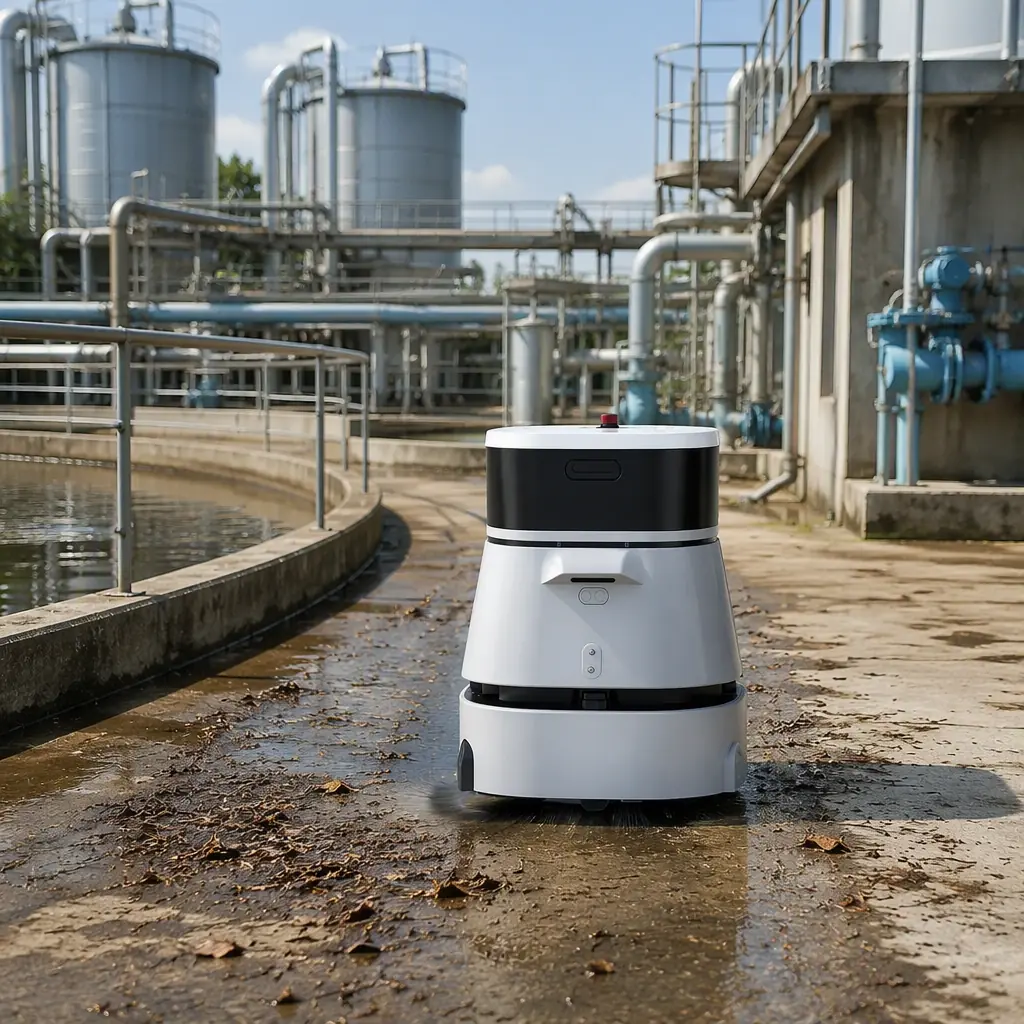
Treatment plant yards accumulate a specific debris profile: grit from the screening and grit-removal stages, polymer and lime dust from the chemical dosing area, leaves and windblown litter on the perimeter, and the sand that trucks track from the dewatering pad. The CLEINBOT CC201 outdoor sweeper holds the yard loop: a 1,020 mm sweeping width at 3,000 m²/h, a 130L dust container that auto-empties into an 800L docking station, IP67 sealing with a rain sensor for the wet-process environment — the design rule that matters most at a plant, where walkways are wet by design and a sweeper that stops for rain would stop daily — and GPS + LiDAR + IMU navigation that follows the approved plant loop between tank-farm zones. Its 10-hour battery runs the off-peak program against the night shift's demand window, and its -10°C to 50°C range covers exposed northern plants and desert facilities alike.
The grit-tracking design rule is the one plant superintendents ask about first: the CC201's route is sequenced to clean the tank-farm walkways first and the control-room approach last, so the grit trail is picked up before it reaches the building threshold — the same "clean the contamination source before the sensitive zone" logic the chemical plants guide documents for hazardous-area facilities, applied to the tracking problem instead of the hazard problem.
Control Rooms, Labs & Admin: Dust-Free Is a Data-Quality Issue
The control room and laboratory are where plant housekeeping becomes process quality: grit and dust on instrument-room floors get walked into analyzer cabinets, and sample-integrity protocols assume clean surfaces around the lab benches. The CLEINBOT M79 scrubber covers the interior loop: single-pass scrub, vacuum and mop at up to 2,000 m²/h — a 400 m² control room and lab block in under 15 minutes — with adjustable water output for the transition from epoxy-sealed control-room floors to tiled lab corridors, and a 45L tank with auto-return docking that lets it run between shifts without a dedicated operator. The specification framework in the commercial cleaning robot buyers guide applies; the plant-specific rule is to schedule the interior loop against the shift-change window so the instrument rooms are never cleaned during live sampling — a scheduling pattern the data centers guide documents for 24/7 infrastructure, where maintenance windows are the scarcest resource.
The Parts & Sample Run: Licensed Operators Stay at the Process
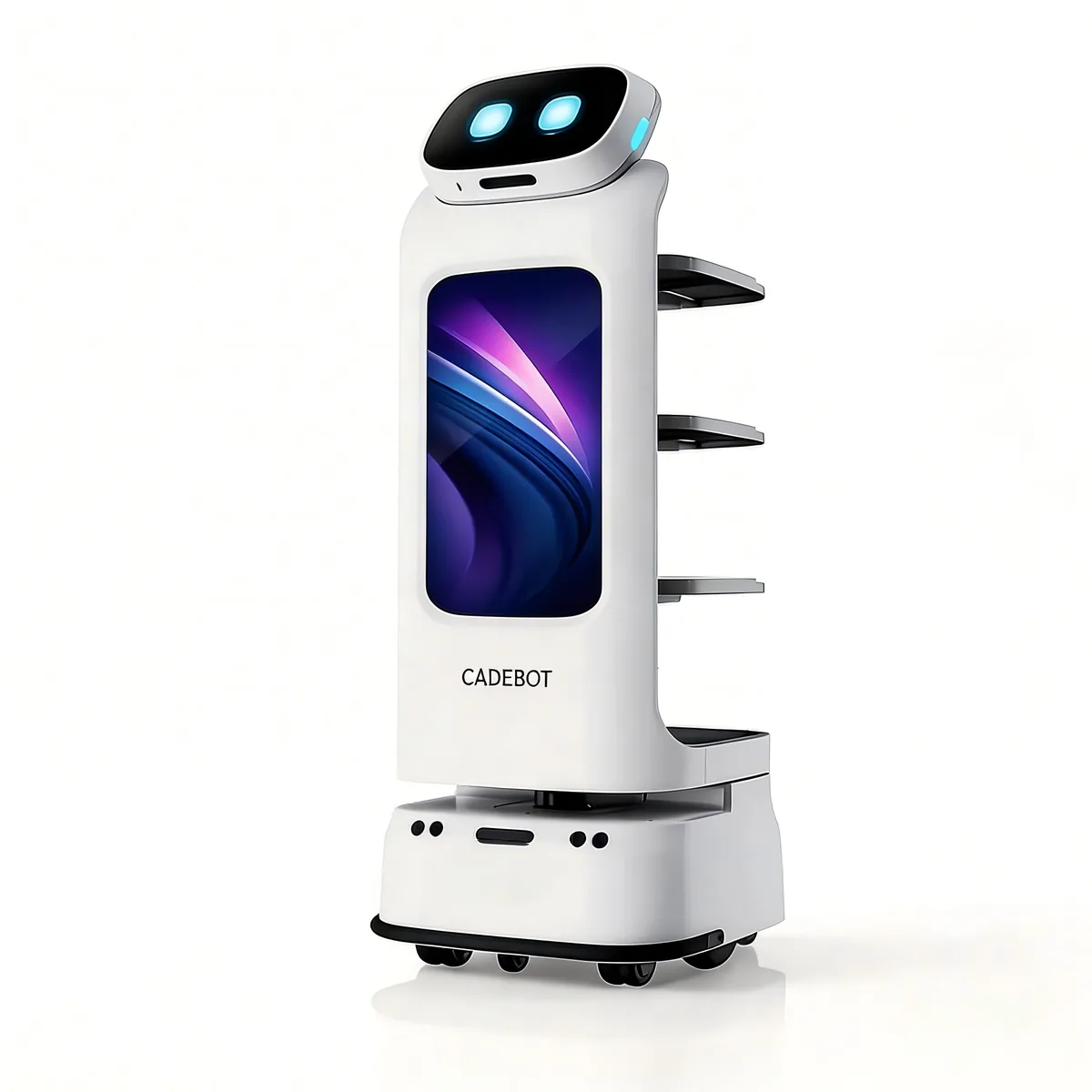
The most expensive walking in a treatment plant is done by the people who should not be walking: licensed operators walking parts to a pump building, and lab staff walking samples from the sampling points to the lab. The CADEBOT L100 covers the delivery loop: a 400 mm-wide platform that clears standard plant doorways and lift gates, four independent trays rated for 15 kg each, and a 40 kg total payload that carries a full parts-and-consumables run in one trip — 6–8 deliveries per hour across the plant, including the 2 a.m. sample run that used to cost an operator 40 minutes per pickup. The same pattern the aerospace manufacturing guide documents for tool-crib logistics on a factory floor applies to the plant: the robot runs the route, the operator stays at the process, and the sample chain-of-custody is logged by the fleet dashboard at every handoff.
Multi-Plant Districts: One Dashboard, Every Facility
Municipal utility districts run multiple plants with the same process standard and the same inspection regime — surface water plants, regional wastewater facilities and remote pumping stations — and the multi-site deployment guide documents the fleet pattern: every CC201, M79 and L100 reports to one cloud dashboard, routes and schedules are configured remotely by the district's facilities office, and a district with six plants runs the same grit-control sequence and the same cleaning log everywhere — with the fleet management guide covering the operational layer. The maintenance & TCO guide covers the lifecycle cost structure, and the safety standards & compliance guide documents the audit trail that the timestamped cleaning and delivery logs feed directly into — the same logs OSHA and state environmental inspectors ask for when housekeeping is a permit condition. The RaaS financing guide covers the subscription structure that fits utility procurement: most plants start with one CC201 on the yard and one L100 on the delivery loop, measure the walk-time and inspection-finding delta across one quarter, and add the M79 when the control-room floor record becomes the audit focus.
Deployment Table for Plant Types
| Plant type | Outdoor fleet | Interior fleet | Monthly cost (RaaS) | Operator hours returned |
|---|---|---|---|---|
| Surface water plant (single site) | 1 × CC201 (yard + tank-farm walkways) | 1 × M79 (control room + lab) | $1,800–2,700 | 400–700/year |
| Regional wastewater facility | 1–2 × CC201 + 1 × L100 | 1 × M79 | $3,200–5,000 | 1,200–2,000/year |
| Multi-plant utility district (5+ sites) | 1–2 × CC201 per site + 1 × L100 per site | 1 × M79 per site | $12,000–22,000 | 5,000–9,000/year |
A treatment plant's housekeeping is measured in inspection findings and operator hours, not mop buckets. The CC201 picks the grit trail up before it reaches the control-room threshold, the M79 keeps instrument and lab floors audit-clean on a documented schedule, and the L100 returns the 2 a.m. sample run to the process — all on logs that become part of the plant's compliance file. That is the automation pattern that fits a utility budget, and it starts with the same step every successful deployment starts with: a walk-around audit of where the grit, the walking and the inspection findings actually are.